I’ve never been much into hell. I mean, I don’t believe in Hell, not that I’ve never been there, mostly of my own making. Though I think of Hell as a symbol of alienation and estrangement, it feels more real every day in America. The search for faith and hope that Love has the final word led back to this sermon from a decade ago. I am less the preacher than a listener now, in need of reassurance that cruelty and criminal insanity will not prevail.
Christus Victor: the Harrowing of Hell
Thanks for coming by Views from the Edge. Grace and peace,
Gordon
Gordon C. Stewart, PC(USA) minister (HR), public theologian and social critic; host of Views from the Edge: To See More Clearly; author of Be Still! Departure from Collective Madness (2017, Wipf and Stock), 49 brief meditations on faith and the news; Brooklyn Park, MN, January 25, 2025.
“God Made Trump” is a masterpiece of cunning. Borrowing creation images from the Book of Genesis 1-3 and the Good Shepherd of fPsalm 23, Ezekiel 34:2-34, John 10:1-2), the three-minute video posted on Donald Trump’s social media platform Truth Social, goes like this:
“And on June 14th, 1946, God looked down on his planned paradise and said, 'I need a caretaker,' so God gave us Trump," the narrator says in the same style that the Book of Genesis in the Bible is written, while a video of Earth from space flashes to a photo of a young Trump.

"God said, 'I need somebody willing to get up before dawn, fix this country, work all day, fight the Marxists, eat supper, then go to the Oval Office, and stay past midnight at a meeting of the state, so God made Trump," the narrator says.

Trump is shown interacting with world leaders, signing executive orders, posing for photos with his supporters, hugging the American flag, and walking onto Air Force One, with former First Lady Melania Trump as the narrator describes God's "need" for the former president.

"God said, 'I need somebody who will be strong and courageous. Who will not be afraid or terrified of the wolves when they attack," says the narrator, while the viewer sees a wolf baring its teeth and Rep. Alexandria Ocasio-Cortez (D-N.Y.), "a man who cares for the flock. A shepherd to mankind who won't ever leave or forsake them."
Personal Reflection: ‘God’ and ‘the gods’
The Reform tradition of Christianity in which I stand views the Bible as a pair of spectacles through which to see God, the world, and oneself more clearly. Looking more clearly at “God Made Trump,” you will see something missing — the letter ‘s’, as in, “You shall have no other gods before Me.” We live among the gods that become God for us. A fitting title would be “The gods Made Trump.”
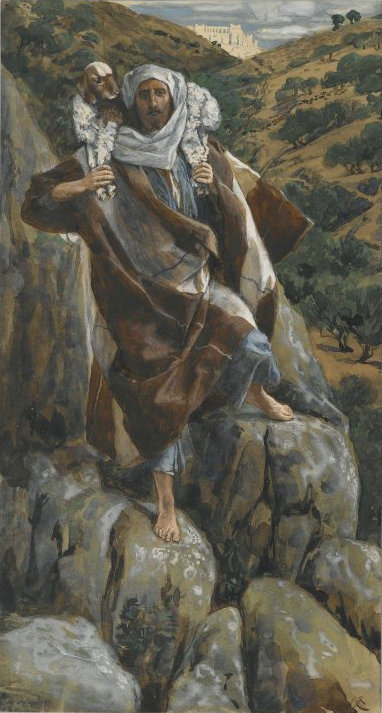
James Tissot, “The Good Shepherd.”
Mr. Magoo
“God Made Trump” is a rip off that takes off our glasses and turns it viewers into Mr. Magoo. It takes advantage of impaired eyesight. It blurs the ability to differentiate between hype and reality, fraud and truth, pretence and piety, subterfuge and honesty. We are all easily confused. “A little learning,” wrote Alexander Pope, “is a dangerous thing; Drink deep, or taste not the Pierian spring: There shallow draughts intoxicate the brain, and drinking largely sobers us again.”
Impostors of God
A cursory reading of the biblical creation and Good Shepherd stories is a shallow draught. A deeper drink guides the reader into what Karl Barth called “the strange new world of the Bible,” in which we see more clearly. Though monotheists, atheists, and agnostics are of diverse opinions about the one God, they agree that there is not more than one, i.e., the gods do not exist. Those who claim the Bible as their source of truth and life should know better.
Constitutional lawyer, lay theologian William Stringfellow describes the gods as “imposters of God,” which the great theologian and philosopher of culture Paul Tillich saw as substitutes for the “God above god” (life’s Ultimate Concern) and the gods of real but penultimate concern among which all of us live in daily life, e.g. religion, work, money, family, status, sex, patriotism, which, although part of the fabric of human life, become substitutes for that which concerns us ultimately. Living anxiously among the gods leaves us restless – “Our hearts are restless,” said St. Augustine, “until they find their rest in Thee.”
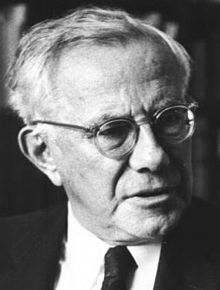
Jacket of An Ethic for Christians and Other Aliens in a Strange LandPaul Johannes Tillich (1886-1965)
Serious study of the Bible leads a reader to notice something missing in “God Made Trump.” The gods of the First Commandment have been deleted – “I am the LORD your God. You shall have no other gods before Me. No longer are their other gods before God. Cut in half, the First Commandment is castrated, but, in reality, only the gods remain.
Seen through the eyes of the First Commandment, Stringfellow, and Tillich, the real question is not whether God made Trump; the question is two-fold: “Which gods made Trump?” and “Which gods are making us in their images?
The Incarnation of the gods
On June 14th, 1946, the gods look looked up and said, “Let us make a creature in our images who will incarnate all of us,” and, so they did. For six days the gods who aspired to be God laid aside their competitive urges to work together as a consortium. They would be godlier than “the God above god” (Paul Tillich), Maker of heaven and earth, whose fatal flaw was to grant the gods freedom to do their mischief.

So, the gods of Pride, Greed, Wrath, Envy, Lust, Gluttony, and Sloth laid aside their several powers for the sake of greater effectiveness. They put their heads together to craft an Immaculate Conception suited to their purposes.

Their creation would be the Incarnation of themselves and would embody all that the less-blessed creatures wanted for themselves: freedom from anxiety, absolute certainty, security, safety, and wealth. So, the gods found a virgin in Queens, and Mary Anne gave birth to her fourth-born child and named him Donald. The things the lesser creatures envied and desired for themselves – his unshakeable self-confidence, freedom to have any woman he wanted, his mastery of the arts of entertainment, prevarication, hypocrisy and greed, exemption from legal restraint and pangs of conscience, fearlessness in the valley of the shadow of death and prosecution, and palaces of silver and gold – would be theirs, just like him.
“God Made Trump” is an adaptation of “God Made a Farmer,” Paul Harvey’s speech to the 1978 Future Farmers of America convention that paid tribute to the American farmer’s dedication to caring for the land, plowing the fields, caring for animals. “God Made a Farmer” honored the farmer without idolizing him. It did not make wrongful use of the Name of God.
Gordon C. Stewart, public theologian and social critic, author of “Be Still! Departure from Collective Madness” (2017 Wipf and Stock), 49 short commentaries on faith and life. Writing from Brooklyn Park, MN, Feb. 7, 2024.
As far back as I can remember, I’ve said that if, God forbid, what happened in Germany would ever happen in America, I would stand up and speak out. It’s always been part of who I am. I made that commitment early on as a fledgling Christian who saw the flag and cross as the warp and woof of the same cloth. To be a disciple of Jesus was to be an American patriot, to take up my cross on behalf of democracy and freedom. As I saw it then, there was little, if any, distinction between standing for the Hallelujah Chorus on Easter and standing for the national anthem on the Fourth of July. Every school day began standing with hands over our hearts to face the flag and say the Pledge of Allegiance. When we finished the pledge, we took our seats for the Bible reading and a prayer. Once a week we ducked under our desks in fear the Russians would hit Marple Elementary School with a nuclear strike.
American Civil Religion
That was a long time ago, but not so long ago to have forgotten. Flawed though it was, there an unspoken code which Robert Bellah later called the “American civil religion,” a societal consensus that knit us together in one commonwealth, an aspirational commitment to goodness, however strong the forces that threatened to shred it.
Humility was a virtue; arrogance was not. Pride goeth before the fall — don’t get too big for your britches — the foolish man built his house upon the sand, and the rains came down and the floods came up….When you are invited by someone to a wedding banquet, do not sit down in the place of honor . . . For all who exalt themselves will be humbled, and those who humble themselves will be exalted. Honesty was a virtue; lying was not. Revenge was not a virtue. Blessed are the merciful . . . . You have heard that it was said, an eye for an eye, and a tooth for a tooth, but I say to you . . . . Glamour, greed, and wealth were not virtues. Blessed are the meek . . . .Your rich men are full of violence; your inhabitants speak lies, and their tongue is deceitful.Blessed are the poor. The rich man went away sorrowfully. The parable of the rich man and Lazarus. It is easier for a camel to go through the eye of a needle than for a rich person to enter the kingdom of heaven. Blessed are the poor…. Do not store up for yourselves treasures on earth where moth and rust consume, and thieves break in and steal… For where your treasure is, there will your heart be also; you cannot serve both God and wealth.
The Golden Mean between Extremes
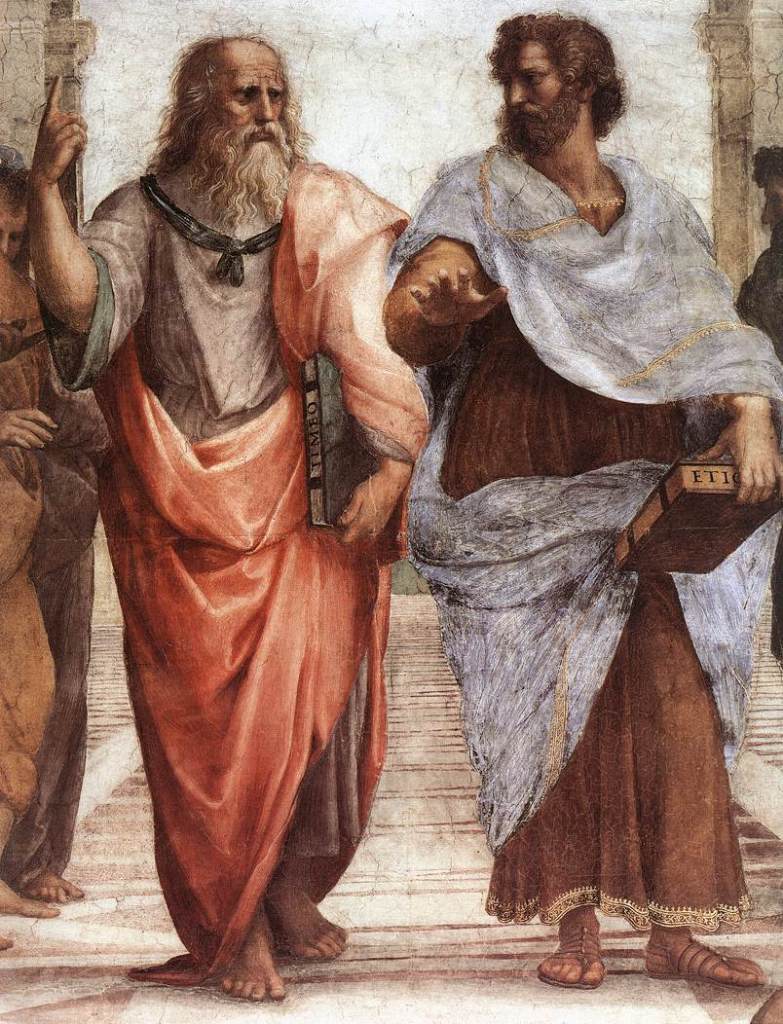
Robert Fulgrum’s Everything I Learned in Kindergarten gives insight into a social ethic akin to Aristotle’s Nicomachean Ethics, by which, in the pursuit of happiness (eudaimonia), one navigates the “golden mean” between the opposites. The virtue of courage, for example, is the middle way between cowardice and recklessness. Generosity is the golden mean between the extremes of stinginess and profligacy. Confidence avoids the opposing extremes of arrogance and self-loathing.
Robert Fulgrum’s Everything I Learned in Kindergarten offers practical insight into a social ethic like Aristotle’s Nicomachean Ethics, by which, in the pursuit of happiness (eudaimonia), one navigates the “golden mean” between the opposites. The virtue of courage, for example, is the middle way between cowardice and recklessness. Generosity is the golden mean between the extremes of stinginess and profligacy. Confidence avoids the opposing extremes of self-loathing and arrogance.
A Social Consensus
This moral consensus is rooted in classical Greek and Roman philosophy and culture every bit as much as it is in the Judeo-Christian tradition and scripture. A Thesaurus lists the following adjectives to describe the most egregious extremes of unacceptable behavior and character to be avoided:
big-headed
boastful
braggin
cocky
conceited
condescending
egomaniacal
haughty
high and mighty
hoity-toity
nose in the air
ostentatious
patronizing
pretentious
self-admiring
self-centered
snippy
snooty
snotty
stuck-up
superior
uppity
vain.
The social code at Marple Elementary
At Marple Elementary we feared bullies, but we did not respect them. Though we were often rude, crude, cruel, and mean, we knew better. We were taught that all of us are responsible to each other. We were accountable for our behavior. We were taught to be good sports. We didn’t like sore losers. Getting revenge was not a virtue.
“I am your revenge”
What is happening to us? “I am your revenge.” When did vengeance become a virtue, while truth-telling, honesty, and personal accountability went out of style? How did it become acceptable to insult another person with belittling nicknames? How did attacks on courts, judges, prosecutors, and grand juries (ordinary people exercising their civic duty without favor or prejudice) become accepted practice in American daily life? How did it happen that the party of Abraham Lincoln has become the party of Marjorie Taylor Greene, Matt Goetz, and a Freedom Caucus cowering in fear of the bully? How did criminal indictment become a Medal of Honor?
Legitimacy and a Mist that Vanishes
“I’m a legitimate person. I’ve done nothing wrong. It’s all a hoax.” Legitimacy is the question now. Can it honestly be said that a former president and the Grand Old Party are still legitimate players in a constitutional republic? I’m old now, but not too old to forget the promise I made as a child.
“What is your life?” asked the writer of the Epistle of James. “You are a mist that appears for a little while and then vanishes…. As it is, you boast in your arrogance; all such boasting is evil. Anyone, then, who knows the right thing to do and fails to do it, commits sin.” (from the Letter of James 3:13-17 NRSV.)
Marple Elementary School vanished. The wrecking ball of time demolished it, but some of its old students are still here to fulfill the promise we made to our young selves. If ever there was a time to stand up and speak out, that moment is now.
Gordon C. Stewart, Presbyterian Minister (HR), author of Be Still! Departure from Collective Madness (49 two-four page meditations of faith and public events), host of Views from the Edge: To See More Clearly (gordoncstewart.com); Brooklyn Park, MN, September 13, 2023.
Getting up at the break of day is not unusual. I get dressed and take the steps down from the loft to make the coffee. But this daybreak was different. Through the window of the A-frame cabin loft, I catch sight of the tops of two long white necks. I rush to the window to see a Trumpeter Swan pen and cob…and six cygnets parading across the yard. The next day they were nowhere to be found.
Below the Window
morning with the swans, GCS, May 24, 2023
slender snow-white necks
pass below the window of
the a-frame next to the
wetland pond where the
trumpeter swans build their
borning home each year
while the red-wing blackbirds
feast on cotton-candy puffs
the cat’n-nine-tails serve
for breakfast each spring
and the loons dive and
rise to feed their young by
the land we think we own.

no “no trespassing” signs
mark the land where the two-
leggeds come when the
Illusion of meta-verses
where wetlands never shrink
or die leave us yearning for
this wondrous place where a
trumpeter swan pen and cob
proudly march their young
across the dmz between reality
and madness craning their
necks to guard their cygnets
from the two-leggeds looking
through the lofty windows.
Puff
the day after, GCS, March 25, 2023
there was no parade today
below the windows — no cob
or pen, no line of six cygnet
trumpeter swans — on our
side of the dmz, not a feather
left behind. An early morning
mournful loon cry warbles
across the pond a psalmic
lament for the soul-mates who
return each year to build a nest
to hatch and train the next
newborn from primordial depths.

far from the wrecks of time where
drones with artificial intelligence
bulls-eyes drive the world insane —
perhaps somewhere in moscow
or miami a strong-man thirsts for
a place like this where cygnets,
cobs and pens play by the wetland
no one owns where instead of
drones with eyes that cannot not see --
no bully or bomb breaks the hush
when the red-wing blackbirds
swoop and sing an ode to joy.
This podcast is the second in a series of autobiographical reflection on life as a theological pilgrimage.
Gordon C. Stewart, public theologian, author of Be Still! Departure from Collective Madness (2017 Wipf and Stock), 49 brief (two to four page) essays on faith and life; host of Views from the Edge; Brooklyn Park, MN.
Third of the four-part series Blind Biases” by Harry L. Strong
“People can’t see what they can’t see.”
— Brian McLaren
Catching Up to Lean Forward
Today we turn to the final four (4) of thirteen (13) biases identified by author, activist, and public theologian, Brian D. McLaren, which, McLaren believes, contribute significantly to the hatred, hostility, and polarization that pervades so much of our nation and world today. Previously, we have noted nine (9) additional biases that McLaren suspects explain partially why we see things so differently from one another. These include Confirmation Bias; Complexity Bias; Community Bias; Complementarity Bias; Competency Bias; Consciousness Bias; Comfort or Complacency Bias; Conservative/Liberal Bias; and Confidence Bias. To glean a more thorough understanding of what these biases entail and how they create stumbling blocks to healthy communication and understanding among people with conflicting opinions, the reference appears below to Brian McLaren’s e-book, Why Don’t They Get It? Overcoming Bias in Others(and Yourself). So, what are four other biases that can dramatically impact our views of life and the world? McLaren cites these:
Catastrophe or Normalcy Bias: I remember dramatic catastrophes but don’t notice gradual decline (or improvement).
Contact Bias: When I don’t have intense and sustained personal contact with “the other,” my prejudices and false assumptions go unchallenged.
Ca$h Bia$: It’s hard for me to see something when my way of making a living requires me not to see it.
Conspiracy Bias: Under stress or shame, our brains are attracted to stories that relieve us, exonerate us, or portray us as innocent victims of malicious conspirators. [1]
A Window and a Mirror
Did any one of these prompt you to think to yourself: “Oops! ‘Never thought about that before, but that sounds like ME!” If you identified one (or more) of those biases in yourself, good for you! Give yourself a pat on the back for your openness and your vulnerability! That’s one of the reasons McLaren published his e-book in the first place – so readers like us (you and I) would see our reflection in a mirror and ask: “OK, so now what? Now that I’ve acknowledged this blind spot, how can I do something about it? What can I do to change my perspective?” The other reason McLaren believed his literary venture had some merit was so he could inspire folks like us to recognize biases in others who may not view the world the same way we do AND to motivate us to take the courageous step of looking out our window and reaching out to our sisters and brothers in pursuit of understanding and healing.
Contact Bias: Guilty as Charged
If you zeroed in on “Contact Bias” the way I did, perhaps that’s already occurred to you. When I was serving as a pastor in a university community like Ames, Iowa, or State College, Pennsylvania, or in an urban setting like Trenton, New Jersey, or Memphis, Tennessee, daily I found myself encountering people who were not like me in appearance, heritage, values, economic status, lifestyle, faith perspective, and a myriad other ways. Now, living in a golf course community in a town of 20,000 on the western slope of Colorado, hard as it is to hear: “When I don’t have intense and sustained personal contact with ‘the other,’ my prejudices and false assumptions go unchallenged.” Contact bias: guilty as charged.
So, if like me, you’ve identified Contact Bias as one likely impediment to your ability to understand and appreciate why other people may see things differently than you do, what can we (you and I) do about it? Fortunately, our instructor/mentor, Brian McLaren, can help. His e-book is not just an academic analysis of our polarization plight. Brian offers us some very practical bridge-building guidelines, at least one for each of the thirteen (13) biases he identifies. What does he suggest related to Contact Bias?
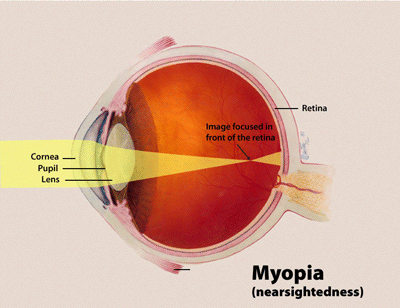
Beyond Myopia (Nearsightedness)
McLaren points us to Jesus and his intentional, unique way of reaching out to the other, including the other at the table, and putting the other in the spotlight by giving the other a voice.
We may protest: “But how does that help us when there are so few “others” in our geographical area?”
I think McLaren might say something like this: “Maybe you need to reassess your definition of “others.” The conflicts that plague our nation are not all related to racial ethnic, socio-economic, or religious differences. No matter how homogeneous you may think your community is, topics like vaccinations, masking, gun control, individual rights vs. the common good, states’ rights vs. federal mandates are just a few of the issues that are traumatizing and polarizing our nation these days. No matter how isolated and insulated you think you are where you live, what if you were to broaden your horizons a bit by exploring books, magazines, websites, blogs, news channels, and other venues that are outside your community?
Remember that Community Bias? “It’s almost impossible to see what our community doesn’t, can’t, or won’t see.” “Community” can refer to like-minded folks as well as to geography. Nobody said it was going to be easy, but, one-on-one or in small groups, you can humanize the other by giving people with diverse opinions a spotlight and a voice. Be intentional about trying to facilitate understanding and deeper relationships. Again, like Jesus, engage people in storytelling and active, conscious listening.”
Sneak Peak
Wouldn’t it be great if we could conclude our consideration of Blind Biases by identifying Five Ways We Can Help Others to See What They Can’t See? Guess what? Brian McLaren can make that happen! I look forward to getting together with you one more time for Blind Biases 4. Meanwhile, let’s reflect on these wise words from Stephen Covey (which McLaren quotes in his chapter on Contact Bias): “When you show deep empathy toward others, their defensive energy goes down, and positive energy replaces it. That’s when you can get more creative in solving problems.” Harry
)[1] Brian McLaren, Why Don’t They Get It? Overcoming Bias in Others (and Yourself), Self-published: 2019), e-book.
Elijah was Spider-Man this Halloween. No one was fooled. Everyone knows Spider-Man isn’t a four years-old and that Spider-Man exists only in the comics. As It turned out, Elijah’s head was too big for the mask! Elijah’s not the only one whose head is too big for its mask. Facebook is trick-or-treating with a new mask, hoping we won’t see or remember what’s under it.
Rebranding
Re-branding has a history. Not every company is as lucky as Apple. Who doesn’t like apples? Facebook’s new name — Meta — doesn’t change what’s under the mask any more than Xe Services changed Blackwater U.S.A two years after Blackwater “security” guards killed 17 un-armed Iraqi civilians and injured 20 more in Baghdad in 2007. When Blackwater changed its name to Xe in 2009, Views from the Edge highlighted the danger of a privately-owned standing army for-hire on American soil. Click herefor the article re-published by Minnpost.com.
From Blackwater to Academi
Changing a name doesn’t change a thing. In 2011, Xe Services was rebranded “Academi”– a training center for military and police special operations. In 2014, Academi merged with Triple Canopy, a rival security company owned by the Constellis Group. But it was and still is a “private security company” of well-trained Army Special Operations personnel, Green Berets, Rangers, SEALs, MARSOC Critical Skills Operators, and other retired armed forces personnel, operating away from public scrutiny in the black waters of its 6,000-acre training ground in North Carolina.
From Facebook to Meta
The same is true of Facebook. Rebranded last week after a whistleblower exposed Facebook and the founder with an ego is too big to hide behind a mask, Facebook is still what it was before it re-presented itself as “Meta”. The rebranding doesn’t remove the spider or erase the algorithm spiderweb in which Facebook users are forever trapped. You can put a mask on a spider but it’s still a spider. In fact, it makes it worse. It “creates” a “metaverse” of “avatars,” and “afterparties” that bring users closer than we dared imagine. “Horrison” is the name of the new “Meta” platform.
Time will tell
If rebranding Blackwater as Academi and Facebook as Meta succeeds in fooling us, it will be because they know better than we how short the American memory is. The companies founded by Erik Prince and Mark Zuckerberg have placed their bets that the American public won’t remember what’s behind the masks. They believe we’re stupid. Only time will tell.
Gordon C. Stewart, public theologian, author of Be Still! Departure from Collective Madness (2017 Wipf and Stock), November 2, 2020.





 Views from the Edge