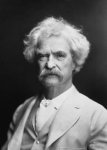
News that the Ten Commandments will be posted in all schools and public places in Louisiana and Oklahoma took me back to Mark Twain’s encounter with a sanctimonious businessman notorious for his unscrupulous business practices.
“Before I die,” said the shyster, “I want to take a pilgrimage to the Holy Land. I’ll climb Mount Sinai and read the Ten Commandments aloud from the top.”
“’I have a better idea,’” said Twain. “’You could stay home in Boston and keep them.'”
What difference do the 10 Commandments make if one shouts them from the top of Mount Sinai . . . or insists they be posted in every school and public space . . . but ignores them and does not practice them?
You shall not take the name of the Lord your God in vain, for the Lord will not hold him guiltless who takes His name in vain.
Not taking the Lord’s Name in vain is hard. It would be easy to keep If the commandment tells us, as children often are taught, not to say “G-d damn.” But, if it prohibits the wrongful use of the Divine Name, any person, official, or group (church, synagogue, political party) that uses the 10 Commandments for selfish ends and purposes makes a wrongful use of the Name of God.
You shall not commit adultery.
Anyone who sweeps aside a jury’s conviction on 34 counts for cooking the books to hide from his third wife and from the press his tryst with a porn star from his third wife and out of the news on the cusp of an election violates the commandment
You shall not steal.
You shall not steal an election which every court decides is legitimate. You shall not make a wrongful use of your constitutional oath of office by refusing to concede the victory of your opponent preventing the peaceful transfer, invite your followers to the Capitol to stop the steal of power, telling them to go to the Capitol to prevent Congress from its Constitutionally required certification of election results on January 6, and continue to promote the lie that the election you are seek to steal has been stolen. You shall not steal.
You shall not bear false witness
Tell the truth! Do not make up stories that will hurt someone else. Do not call them names that have no foundation in reality. Do not malign judges, Jurys, court personnel, and potential witnesses, a jury of your peers. Do not insult your adversaries. Do not shift the blame to those who testify against you. You shall not make a wrongful use of your First Amendment right of free speech, promoting what you know is false, and claiming that your country’s judicial system has been rigged by the person who wrongfully occupies the Oval Office.
You shall not covet your neighbor’s house; you shall not covet your neighbor’s wife, nor his male servant, nor his female servant, nor his ox, nor his donkey, nor anything that is your neighbor’s
Earth and the fulness thereof belong to the Lord, not to you! Be careful that your prayers do not become a form of preying. Stem the tide that confuses wants with needs. America has devolved from any sense of responsibility and moral character into the quicksand of late consumer capitalism. Citizens of Aboriginal communities likely experienced covetousness. A member of the tribe may have wanted to be the chief or fantasized about another’s attractive spouse, or being jealous of larger huts or more hides to warm themselves in the cold. Covetousness is human, and, as such, it needs to stay within the guard rails that limit its search for dominion.
Gordon C. Stewart, Brooklyn Park, MN, June 30, 2024.
A personal reflection on God’s word to Sennacherib
I know your sitting down and your going out and coming in, and your raging against Me
Isaiah 37:28
19th-century wood engraving by Gustave Doré depicting the destroying of Sennacherib’s army outside Jerusalem.
You cannot hide. You plot and scheme as though unseen, not noticed, secure in the dark places of public life. You rise. You sit. You go out among the shadows, declaring innocence and impunity. You mislead. You cheat. You lie. You bear false witness and concoct stories to assail your neighbors. You connive, conspire, and assassinate. You poison your opponents and flood the public with fear and hate. You threaten your critics, and pay, or refuse to pay, legal fees for sycophants who have placed their trust in you. You rant and rage and rouse the people with a voice that feigns righteous indignation.
Because you have raged against Me and your insolence has come to My ears, I will put My hook in your nose and My bit in your mouth; I will turn you back on the way by which you came.
Isaiah 37:29
Uncivil, insolent, resistant, unhinged, kicking up dust on everyone around you, you mock whatever would restrict you, restrain you, expose you to the light of day, but darkness is not dark to Me. I hear you snorting, braying and bellowing. I see you bucking against all attempts to rein in your whims and schemes, your defamations and slander, your arrogance and threats, your schemes of terror, your treasonous justifications of insurrection, invasion, and assassination.
Gordon C. Stewart, public theologian, author of Be Still!: Departure from Collective Madness (2017, Wipf and Stock), 49 brief (two to four page) reflections on faith and public life; Brooklyn Park. MN, Feb. 22, 2024.
Pull down thy vanity, it is not man Made courage, or made order, or made grace Pull down thy vanity, I say pull down. Learn of the green world that can be thy place .
Ezra Pound, Canto LXXLI
They’re not after me. They’re after you. I’m just standing in the way.
There’s been a mistake
There’s been a mistake. I don’t know you; you don’t know me. No one is coming after me. I’m not that important. Neither are you. No one with their wits about them could believe you are the only one who keeps “them” from getting to me. But the pitch has a familiar ring.
The old, old story?
It sounds like “the old, old story of Jesus and his glory, of Jesus and his love,” but this story is a far cry from the one in the New Testament. The Biblical story includes a warning, attributed to Jesus: “Many will come in my name, saying, ‘I am the Messiah,’ and they will lead many astray.”
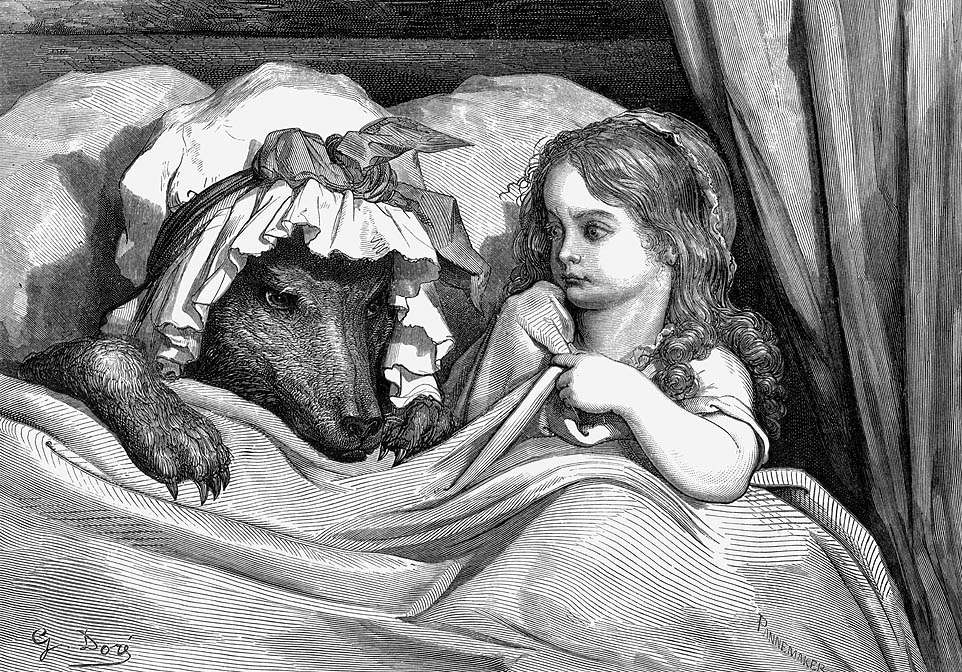
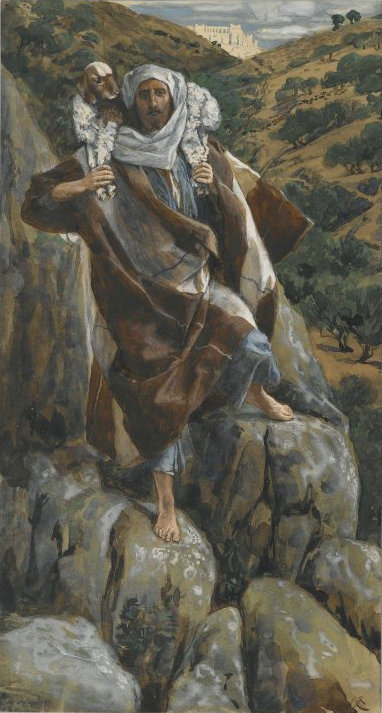
It’s a biblical way of saying, “Don’t mistake a wolf disguised as Little Red Riding Hood’s Grandma for the Good Shepherd who lays down his life for the sheep.
Life with Buddy
Even a parrot can quote scripture. But there’s a difference: the parrot has no idea what it’s saying. Human beings do. Take Buddy, for example. Shortly after arriving for a visit with old friends, the phone rang. Harry stayed put. Knowing that any call to Harry could be an emergency, we encouraged Harry or Anna to feel free to take the call.
Harry raised his finger to his lips. Anna smiled and whispered, “Shhhh!
The phone continued to ring. When it stopped, a voice from an adjacent room yelled, “Harry! It’s for you! Harry. . . it’s for you!”
If imitation is the highest form of flattery, an African Grey Parrot doesn’t know it. After Buddy had fooled us with his imitation of the phone ringing, with precise intervals between the rings, and calling Harry to the phone, Buddy went on to recite the 23rd Psalm. “The Lord is my shepherd; I shall not want…” before imitating the sounds of Anna he’d heard every morning: brushing her teeth, gargling, and other sounds not fit to print.
Shakespeare: “O, what a goodly outside falsehood hath!”
“The devil can cite Scripture for his purpose,” wrote Shakespeare in The Merchant of Venice. “An evil soul producing holy witness Is like a villain with a smiling cheek, a goodly apple rotten at the heart. O, what a goodly outside falsehood hath!”
Gordon C. Stewart, public theologian, host of Views from the Edge: To See More Clearly, and author of Be Still! Departure from Collective Madness (2017 Wipf & Stock), Brooklyn Park, MN.
In the eyes of QAnon and Christian fundamentalism, I’m a heretic. I don’t believe in Satan. Not that Satan, the devilish opponent of God. But trying to make some sense of life these days has led me to take another look at Satan.
The biblical Satan is the personification of trickery and the reptilian impulses that lie in wait in every mortal psyche. Satan is a con artist. “You will not die,” whispers the serpent to the mortals in the Genesis story of humanity’s fall from paradisaical innocence. Likewise, in the wilderness temptations of Matthew and Luke, it is Satan who lures “the man for others” (Dietrich Bonhoeffer’s description of Christ) to being a man who cares only for himself. Satin is the personification of the lies that flips reality on its head. Satan is a Con Artist.
Con artistry is never far away. Sometimes we come face-to-face with it. I see it inside the courtroom in New York City where a jury wrestles to disentangling truth from falsehood, evidence from sham, honesty from fraudulence, in full view national figures, members of the U.S. House of Representatives take their seats in room as visiting dignitaries who are surely recognizable to at least one member of the jury. Their physical presence is intimidating; it strikes me as its own kind of witness and jury tampering, a violation of the defendant’s gag order.
Outside the courtroom, I see these same Members of the United States House of Representatives, each of whom has sworn the Constitutional oath of office, line up take their turns behind the microphone and media cameras to denounce the judicial system, malign court personnel, the judge, prosecutors and their families, and read aloud. Up is down and down is up; right is wrong and wrong is right; truth-telling is out; conning is in. I hear Pinocchio’s surrogates betray their oaths of office in hopes of becoming Pinocchio’s right hand. Jiminy Cricket is a distant memory. Conscience is nowhere to be found.
Yesterday confirmed what I know of the biblical Satan who never was but always is wherever there’s an Achilles’ Heel – the vulnerability of mortals to the Con that I and we can do no wrong.
Gordon C. Stewart, public theologian, host of Views from the Edge, author of Be Still! Departure from Collective Madness (2017 Wipf and Stock), Brooklyn Park, MN, May15, 2024.
Who but a sociopath on his way to trial on charges of buying a porn star’s silence would think the American people would fall for a stunt like this? It’s a short step from selling gold sneakers for $399/ pair to selling another first of its kind, the “God Bless the USA Bible,” complete with a copy of the U.S. Constitution.
Happy Holy Week! Let’s Make America Pray Again. As we lead into Good Friday and Easter, I encourage you to get a copy of the God Bless The USA Bible….
All Americans need a Bible in their home, and I have many. It’s my favorite book,” Trump said in his video posted on Truth Social. “I’m proud to endorse and encourage you to get this Bible. We must make America pray again.”
Donald J. Trump,
Those who practice their Christian faith know that “Happy Holy Week!” is a sign of the greeter’s unfamiliarity with the faith. We don’t wish each other a “Happy Holy Week.” Tears of joy (not happiness) well up only after tears of our own participation in the horror and sadness of Maundy Thursday, Good Friday, and in the haunting silence of god-forsakenness on Holy Saturday.
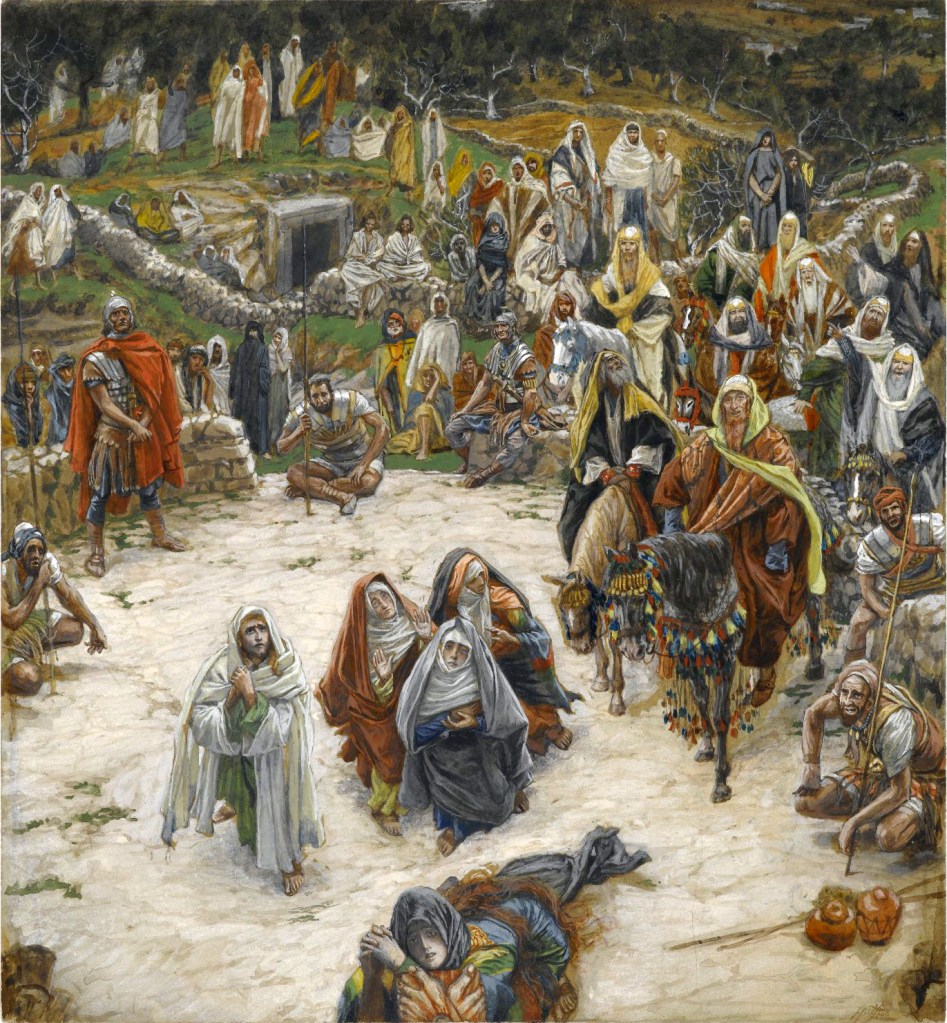
What Jesus Saw from the Cross by James Tissot
“Then said Jesus, ‘Father, forgive them; for they know not what they do.’ And they parted his raiment, and cast lots.”
Gospel of Luke 23:34 NRSV
Rev. Gordon C. Stewart, Presbyterian pastor (H.R.), public theologian, author of Be Still! Departure from Collective Madness (2017 Wipf and Stock Publishers), Brooklyn Park, MN, March 27, 2024, Wednesday of Holy Week.
“God Made Trump” is a masterpiece of cunning. Borrowing creation images from the Book of Genesis 1-3 and the Good Shepherd of fPsalm 23, Ezekiel 34:2-34, John 10:1-2), the three-minute video posted on Donald Trump’s social media platform Truth Social, goes like this:
“And on June 14th, 1946, God looked down on his planned paradise and said, 'I need a caretaker,' so God gave us Trump," the narrator says in the same style that the Book of Genesis in the Bible is written, while a video of Earth from space flashes to a photo of a young Trump.

"God said, 'I need somebody willing to get up before dawn, fix this country, work all day, fight the Marxists, eat supper, then go to the Oval Office, and stay past midnight at a meeting of the state, so God made Trump," the narrator says.

Trump is shown interacting with world leaders, signing executive orders, posing for photos with his supporters, hugging the American flag, and walking onto Air Force One, with former First Lady Melania Trump as the narrator describes God's "need" for the former president.

"God said, 'I need somebody who will be strong and courageous. Who will not be afraid or terrified of the wolves when they attack," says the narrator, while the viewer sees a wolf baring its teeth and Rep. Alexandria Ocasio-Cortez (D-N.Y.), "a man who cares for the flock. A shepherd to mankind who won't ever leave or forsake them."
Personal Reflection: ‘God’ and ‘the gods’
The Reform tradition of Christianity in which I stand views the Bible as a pair of spectacles through which to see God, the world, and oneself more clearly. Looking more clearly at “God Made Trump,” you will see something missing — the letter ‘s’, as in, “You shall have no other gods before Me.” We live among the gods that become God for us. A fitting title would be “The gods Made Trump.”
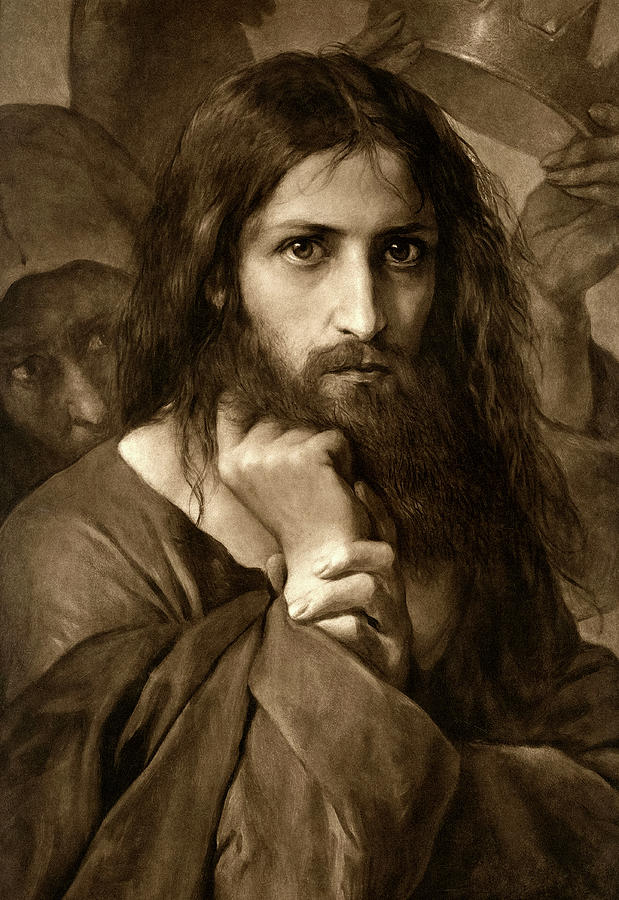
James Tissot, “The Good Shepherd.”
Mr. Magoo
“God Made Trump” is a rip off that takes off our glasses and turns it viewers into Mr. Magoo. It takes advantage of impaired eyesight. It blurs the ability to differentiate between hype and reality, fraud and truth, pretence and piety, subterfuge and honesty. We are all easily confused. “A little learning,” wrote Alexander Pope, “is a dangerous thing; Drink deep, or taste not the Pierian spring: There shallow draughts intoxicate the brain, and drinking largely sobers us again.”
Impostors of God
A cursory reading of the biblical creation and Good Shepherd stories is a shallow draught. A deeper drink guides the reader into what Karl Barth called “the strange new world of the Bible,” in which we see more clearly. Though monotheists, atheists, and agnostics are of diverse opinions about the one God, they agree that there is not more than one, i.e., the gods do not exist. Those who claim the Bible as their source of truth and life should know better.
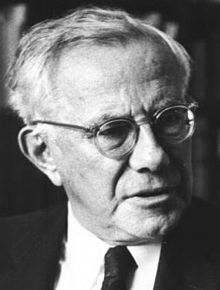
Constitutional lawyer, lay theologian William Stringfellow describes the gods as “imposters of God,” which the great theologian and philosopher of culture Paul Tillich saw as substitutes for the “God above god” (life’s Ultimate Concern) and the gods of real but penultimate concern among which all of us live in daily life, e.g. religion, work, money, family, status, sex, patriotism, which, although part of the fabric of human life, become substitutes for that which concerns us ultimately. Living anxiously among the gods leaves us restless – “Our hearts are restless,” said St. Augustine, “until they find their rest in Thee.”
Jacket of An Ethic for Christians and Other Aliens in a Strange LandPaul Johannes Tillich (1886-1965)
Serious study of the Bible leads a reader to notice something missing in “God Made Trump.” The gods of the First Commandment have been deleted – “I am the LORD your God. You shall have no other gods before Me. No longer are their other gods before God. Cut in half, the First Commandment is castrated, but, in reality, only the gods remain.
Seen through the eyes of the First Commandment, Stringfellow, and Tillich, the real question is not whether God made Trump; the question is two-fold: “Which gods made Trump?” and “Which gods are making us in their images?
The Incarnation of the gods
On June 14th, 1946, the gods look looked up and said, “Let us make a creature in our images who will incarnate all of us,” and, so they did. For six days the gods who aspired to be God laid aside their competitive urges to work together as a consortium. They would be godlier than “the God above god” (Paul Tillich), Maker of heaven and earth, whose fatal flaw was to grant the gods freedom to do their mischief.

So, the gods of Pride, Greed, Wrath, Envy, Lust, Gluttony, and Sloth laid aside their several powers for the sake of greater effectiveness. They put their heads together to craft an Immaculate Conception suited to their purposes.

Their creation would be the Incarnation of themselves and would embody all that the less-blessed creatures wanted for themselves: freedom from anxiety, absolute certainty, security, safety, and wealth. So, the gods found a virgin in Queens, and Mary Anne gave birth to her fourth-born child and named him Donald. The things the lesser creatures envied and desired for themselves – his unshakeable self-confidence, freedom to have any woman he wanted, his mastery of the arts of entertainment, prevarication, hypocrisy and greed, exemption from legal restraint and pangs of conscience, fearlessness in the valley of the shadow of death and prosecution, and palaces of silver and gold – would be theirs, just like him.
“God Made Trump” is an adaptation of “God Made a Farmer,” Paul Harvey’s speech to the 1978 Future Farmers of America convention that paid tribute to the American farmer’s dedication to caring for the land, plowing the fields, caring for animals. “God Made a Farmer” honored the farmer without idolizing him. It did not make wrongful use of the Name of God.
Gordon C. Stewart, public theologian and social critic, author of “Be Still! Departure from Collective Madness” (2017 Wipf and Stock), 49 short commentaries on faith and life. Writing from Brooklyn Park, MN, Feb. 7, 2024.
The beginning of this commentary will sound familiar to those who have read “The Counterfeit Gospel” (Jan. 29, 2022). The beginning through “The Gospel of Jesus the Loser” is edited and amplified. Everything from the rubric “From Prosperity to QAnon” is original to this post.
A Question of Glory
Donald Trump and I each claim a footing in the Presbyterian Church and its Reformed theological tradition. It’s hard to remember much of what happened in Confirmation Class. But it’s hard to forget the first article of the Shorter Catechism. The way to a meaningful life is “to glorify God, and enjoy Him forever.” None of us understood it, of course. But one thing was clear: We are not to glorify ourselves.
The Workshop for Cranking Out Idols
The Reformed faith tradition focuses on the majesty of God and our propensity to bow before an infinite variety of substitutes for the Infinite. The issue for faith is not belief or unbelief. The issue is idolatry. Earth is the theatre of God’s glory. Yet human nature is a perpetual factory of idols. –Jean Calvin, Institutes of the Christian Religion,1556.
Author theologian William Stringfellow described idols as “imposters of God,” — the finite, manageable works we crank out that take the place of the Ineffable and Infinite.
There are gods and there is God. There is the finite and there is the Infinite. The gods are nearer-to-hand stand-ins, substitutes that promise what they cannot deliver. The world is beautiful and filled with goodness, yet the underlying goodness is twisted against itself. The idols are endless and varied. Nation, work, money, status, race, religion, political party, ideology take center stage in “the theater of God’s glory.”
The Gospel of Jesus the Loser
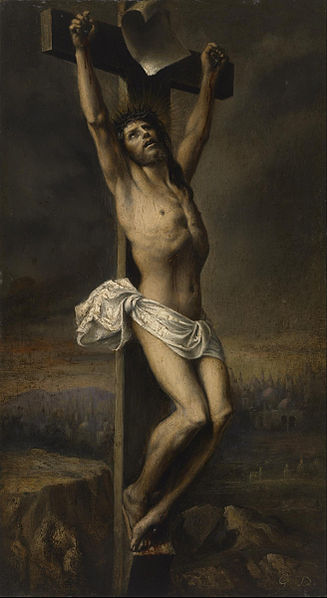
By the standards of the Prosperity Gospel, Jesus of Nazareth was a loser. Yet the loser will not go away. The loser executed on a Roman cross was raised as the archetype of authentic humanity. Unless the church gets that straight, everything it gains is loss. In spite of all attempts to circumvent, delete, or deny it, the cross remains the primary symbol for those who seek to follow Jesus. Whoever spends time looking at Gustav Doré’s painting of the crucifixion cannot dismiss the horror of it, the cruelty of it, the god-forsakenness of it.
From Prosperity to QAnon
It’s a short distance from the Prosperity Gospel to QAnon. Neither pays attention to Matthew or Luke’s vivid narratives of Jesus in the wilderness. Is Satan real? Yes and no. Satan is not someone’s name. It’s a title — the Shatan, the Diabolos — for the diabolical. It has no other home than our hearts and minds, the blacksmith shop that never ceases. The factory that cranks out idols. Satan is the Adversary of the Divine. QAnon says little about God but sees Satan everywhere. QAnon is the latest metastasis of a simplistic theology that divides the world between God and Satan, good and evil, saved and damned, elect and non-elect, heaven and hell, soldiers and cowards. If those characteristics sound familiar, it’s because they are.
“You people seem normal”
Thanksgiving is a day of mostly cheerful moments, but some Thanksgivings are also epiphanies. My younger son’s college friend opened a window to his experience of Christian faith and practice. During a light-hearted conversation around the Thanksgiving table, the student guest took what seems like a risk, but it landed on ears that understood how he felt. “I don’t know quite how to say this,” he said with eyebrows rising, “but you people seem normal.” The conversation the followed focused on his view of Christians as whackos. The whackos held the worldview described in the previous paragraph. Why did he think so? While changing channels he had stopped in on Jimmy and Tammie Baker, Jimmy Swaggert, and other televangelists who had not seemed normal. They were abnormal by almost any standards mental health, reason and sanity.
The Lure of Prosperity
The Prosperity Gospel preachers proclaim it can all be yours, if… If you accept Jesus Christ as your Savior, if you stop thinking negatively, it can all be yours. It can all be yours in a secure gated community. It can be yours if you climb to the top. It can all be yours if you just close your eyes to the homeless who disturb an otherwise beautiful day. It can all be yours, if you stop thinking of yourself as a school drop-out ditch digger and think of yourself as (fill in the blank).
Flights from Ambigiuity
What is missing in the Prosperity Gospel and QAnon are the biblical stories of Jesus in the wilderness with Satan. Any study of the Gospel of Matthew’s or Gospel of Luke’s narratives lead to a conclusion that life is more ambiguous than we would like it to be. It is good that our material needs are met. It’s not good when we turn needs into greed. In the same way, religion can go either way. It is good to praise God and practice a tradition’s wisdom, but religion can become, and often is, a form of idolatry that substitutes itself for the Eternal and Ineffable it claims to worship. But the third scene in the wilderness narratives that leaps from the page in America today, is the one about power and authority described below.
Satan
You may or may not hear much about Satan from Prosperity Gospel preachers or, for that matter, from the pulpits of traditional churches. It’s either because it’s not popular. It won’t attract new adherents. Or it’s an embarrassment. Or the biblical texts that speak of Satan or the Devil require an inordinately long explanation than a sermon allows. Not so for QAnon where the talk is all about Satan.
What has been lost is a literary and emotional understanding of the complex and confounding character of the biblical Satan. Satan is the personification of the diabolical. The Trickster, the Deceiver, the Twister, the Half-Truth Teller, the Liar. Beauty, truth, and goodness are given lip service, but beneath the talk of beauty lies ugliness, beneath the tributes to truth lies deceit, beneath the salute to goodness lies a tornado twisting goodness into its opposite.
The most poignant of the three wilderness scenes
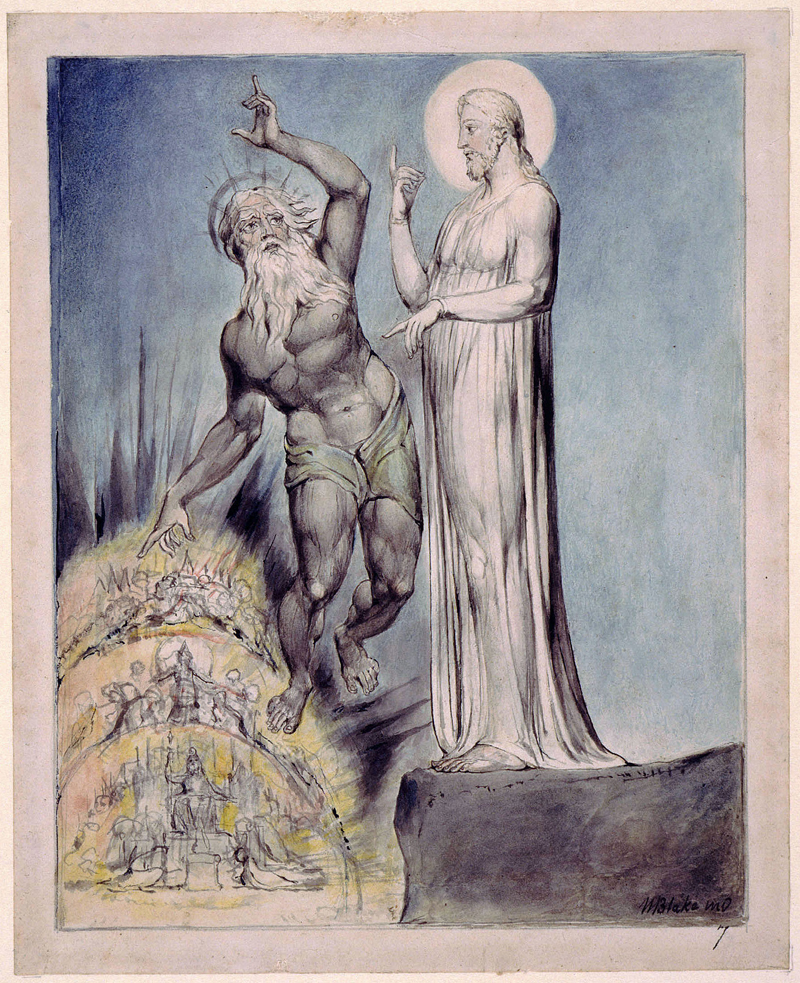
William Blake paints the most poignant of the three episodes of Jesus’s 40 days with the Diabolos in the wilderness. The scene is a mountaintop where Satan and Jesus the Christ have in view all the nations and kingdoms of the word. Blake’s painting gives visual expression to the narcissistic lure of political power and authority. “Then the devil took him to a very high mountain and showed him all the kingdoms of the world and their glory. ‘All this I will give you,’ he says, ‘if you will bow down and worship me.’ Jesus says to him, ‘Begone, Satan, for it is written ‘you shall worship the Lord your God, and serve him only.'” (Matthew 4:10 NIV and NRSV combined)
Blake – Kingdoms
Where was God?
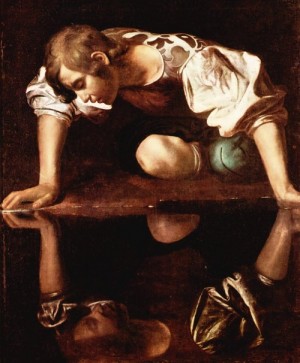
Those who see the countenance of God in the face of Jesus the Loser face a challenge that won’t go away. Where was God when America’s First People were being stripped of their homeland, slaughtered, stripped of their religion and culture, and consigned to reservations and Christian boarding schools? Where was God when White hoods with torches burned their crosses and formed a congregation gathered around the lynching tree? Where was God at the whipping post? Where was God during the Holocaust, the “Final Solution”? Where was God at the gun massacres at Columbine, Sandy Hook, and Parkland? Where was God when Narcissus was dying of dehydration at the edge of the pond?
You will find God there
Jesus the Loser tells us where. God was among those who were robbed of their homeland. God was shuttled off to the reservations. God was hanging from the lynching tree. God was whipped at the whipping post. God was on the trains to Auschwitz; God was among the children, teachers, and parents at Sandy Hook. God was among the Losers — the tortured, the poor, the starving, the dying and the dead. God was in the pond inviting Narcissus to drink. We will find God there.
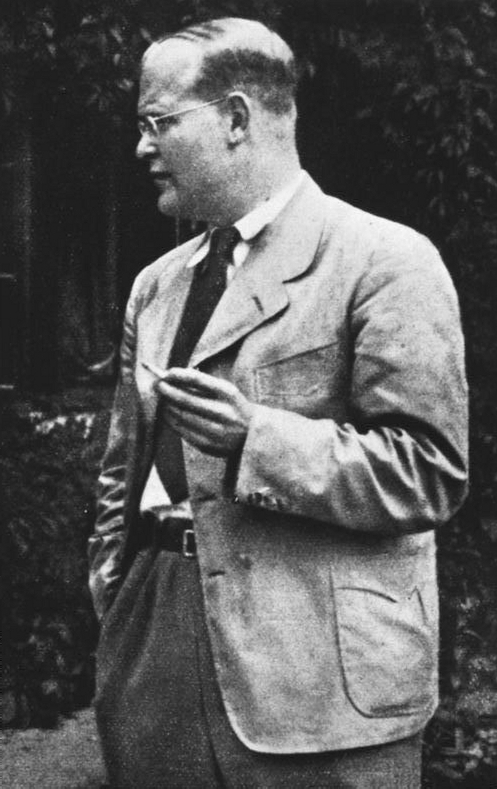
Letters and Papers from Prison preserves a poem from the cell of a pastor, theologian, professor, and resistor of the German Third Reich. Dietrich Bonhoeffer was hanged at Flossenburg Concentration Camp April 9, 1945 as the Nazi regime was collapsing.
CHRISTIANS AND UNBELIEVERS
Dietrich Bonhoeffer, July, 1944
Men go to God when they are sore bestead, Pray to him for succour, for his peace, for bread, For mercy for them sick, sinning or dead: All men do so, Christian and unbelieving.
Men go to God when he is sore bestead, Find him poor and scorned, without shelter or bread, Whelmed under weight of the wicked, the weak, the dead: Christians stand by God in his hour of grieving.
God goeth to every man when sore bestead, Feedeth body and spirit with his bread, For Christians, heathens alike he hangeth dead: And both alike forgiving.
Gordon C. Stewart, Presbyterian minister (H.R.) and public theologian, Brooklyn Park, MN, author of Be Still! Departure from Collective Madness (2017, Wipf and Stock), available in kindle and paperback.
I love olives. I love the Psalms. Well . . . some of them . . . some times. Partly. Like the Psalm that greeted me this morning at the cabin far from the news.
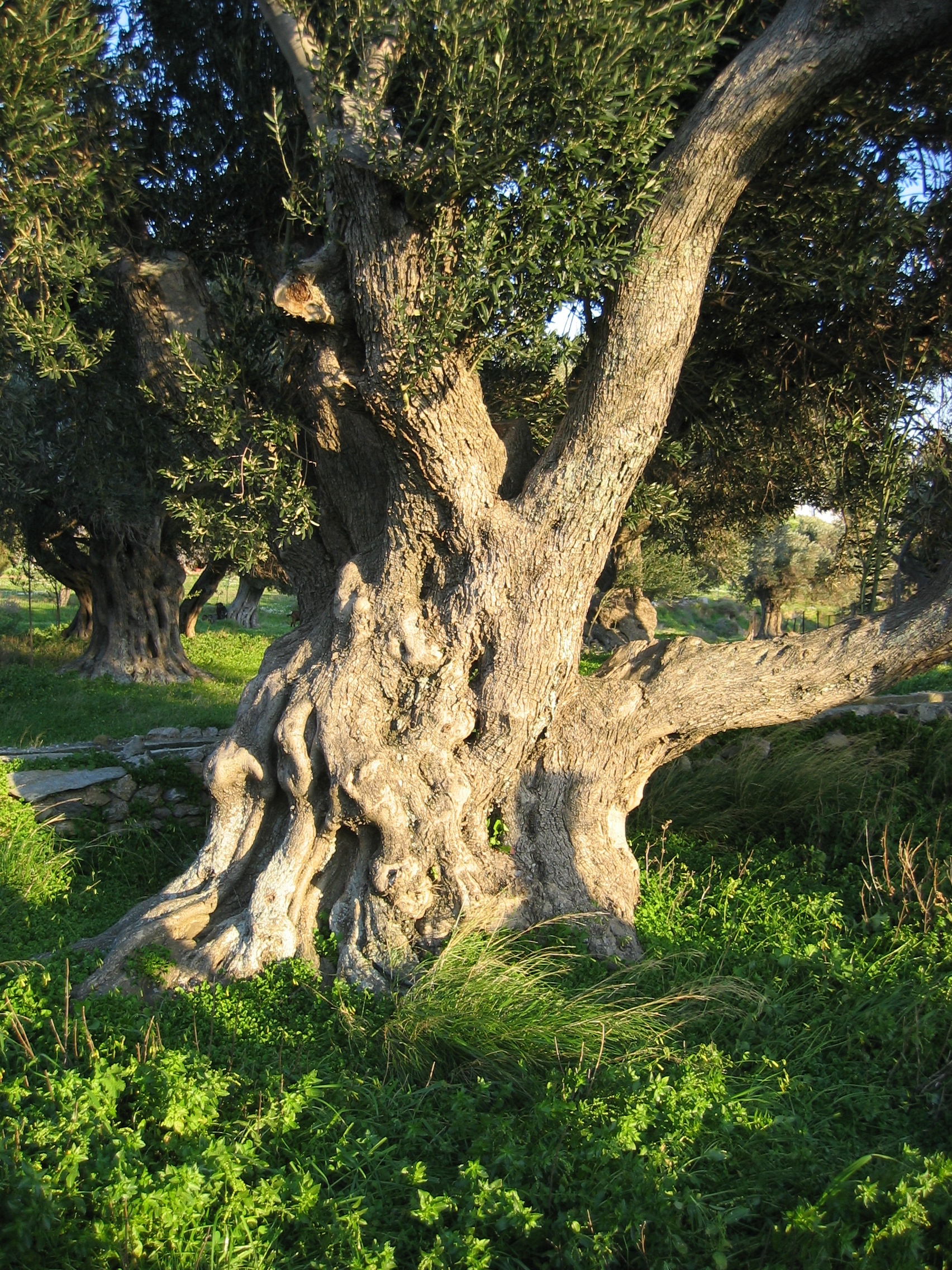
Old olive tree in Karystos, Euboia, Greece
Maybe you’ll like it too.
Why do you boast of evil, you mighty man?
Why do you boast all day long,
you who are a disgrace in the eyes of God?
Your tongue plots destruction;
it is like a sharpened razor,
you who practice deceit.
You love evil rather than good,
falsehood rather than speaking the truth;
You love every harmful word,
O you deceitful tongue!
Surely God will bring you
down to everlasting ruin:
He will snatch you up and
tear you from your tent:
He will uproot you from
the land of the living.
The righteous will see and fear;
they will laugh at him, saying
“Here now is the man
who did not make God his stronghold
but trusted in his wealth
and grew strong by
destroying others!”
But I am like an olive tree
flourishing in the house of God . . . .
(Psalm 52:1-8a, NIV)
I am not righteous. But I do fear.
I just want to be an olive tree. Like the olive tree that produced the twig the dove brought back to the ark signaling to Noah that the flood was over.
Gordon C. Stewart, truck stop near cabin in northern MN, November 3, 2017.
Writing Be Still! Departure from Collective Madness (scheduled for release by Wipf and Stock Publishers in January), I had a growing sense of its prescience. The subtitle “departure from collective madness” is anchored in the works of Elie Wiesel and Old Testament scholar Walter Brueggemann, and the Gospel of Matthew’s story of the Wise Men (sic) who “departed” for their own country by another way.
As the date for final submission of the Be Still! manuscript drew near, I saw a madman running for the highest office of the land but underestimated the extent of the collective madness that would be drawn like iron to a magnet. The billionaire television personality who puts his name on everything his hands have touched, gave voice to people who have felt groped by the system.
Michael Moore, a champion of America’s forgotten working class, saw this coming. He was in touch with the many sources of anger that found a voice in Donald Trump, and he warned the Democratic Party to get in touch with it before it was too late.
Now it is history. I felt sick Wednesday morning. By yesterday evening, I was able to calm down. Today’s sense of nausea is worse than yesterday’s after reading “Meet Trump’s Cabinet-in-Waiting” – a cabinet which will put the country back into the hands Wall Street, big oil, climate change-deniers, and the likes of Chris Christie, Jeff Sessions (R-AL), Rudy Gulliani (Attorney General candidate), loose-talking groper Newt Gingrich (Secretary of State candidate), and CEOs.
President Obama and Secretary Clinton have called for the country to unite for an orderly transition. I believe in orderly transitions. I applaud them. A democratic republic depends upon such transitions. I support that. But I will not be united behind a madman or absorbed into a collective madness that bodes evil. I will not turn over cars. I will not stop traffic. I will not burn things. I will write. And write. And write knowing, as this election has reaffirmed, that words DO matter.
I will do my best to be still. I will follow the example the biblical Wise Men (sic) who “being warned of God in a dream that they should not return to Herod, . . . departed into their own country another way”[Matthew 2:12 KJV]. Herod was a strongman in whom there was no refuge. There was and is another way.
God is our refuge and strength,
a very present help in trouble.
Therefore we will not fear, though the earth should change,
though the mountains shake in the heart of the sea;
though its waters roar and foam,
though the mountains tremble with its tumult.
There is a river whose streams make glad the city of God,
the holy habitation of the Most High.
God is in the midst of the city; it shall not be moved;
God will help it when the morning dawns.
The nations are in an uproar, the kingdoms totter;
he utters his voice, the earth melts.
The Lord of hosts is with us;
the God of Jacob is our refuge.
Come, behold the works of the Lord;
see what desolations he has brought on the earth.
He makes wars cease to the end of the earth;
he breaks the bow, and shatters the spear;
he burns the shields with fire.
“Be still, and know that I am God!
I am exalted among the nations,
I am exalted in the earth.”
The Lord of hosts is with us;
the God of Jacob is our refuge.
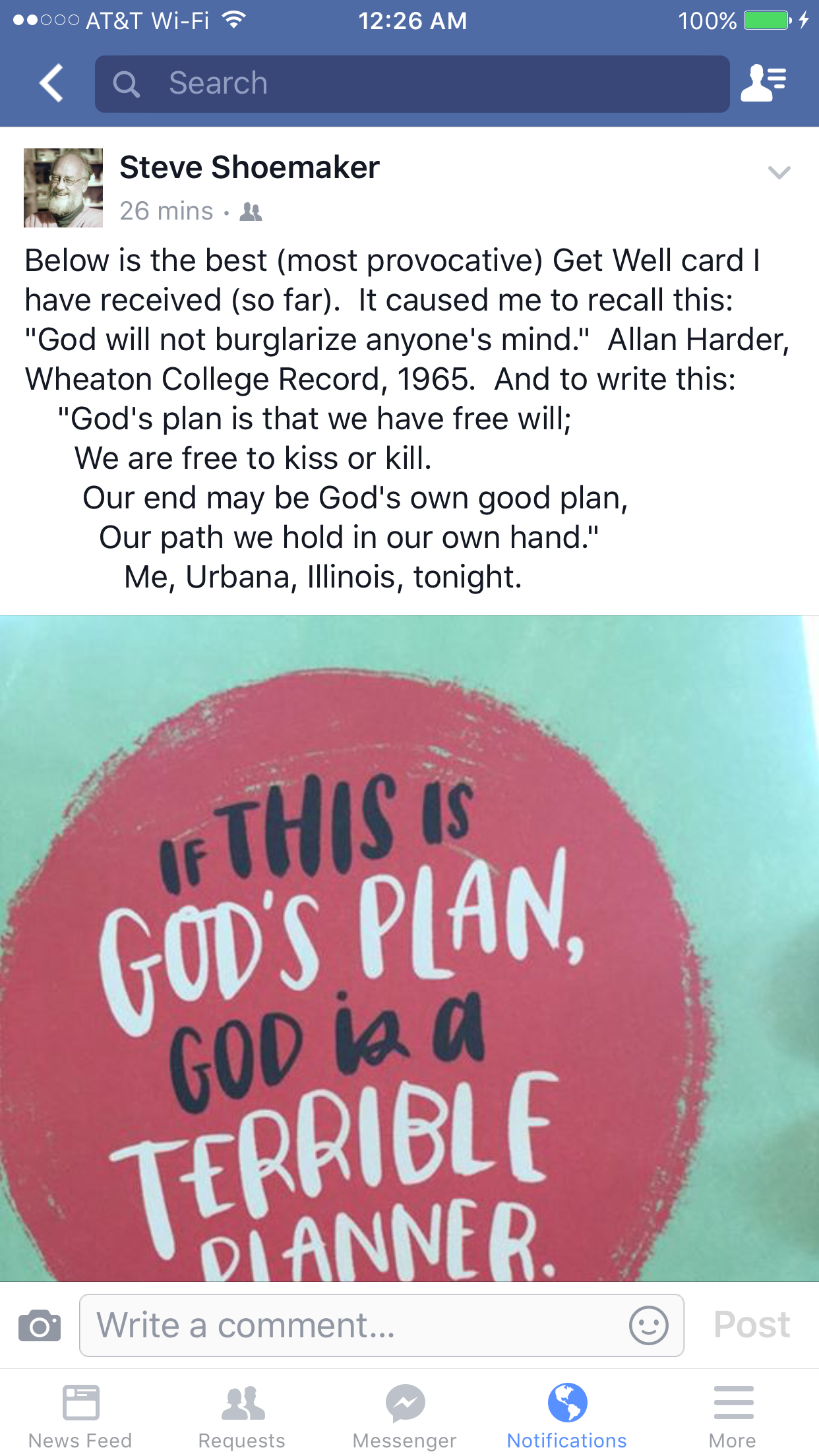
Steve sent this @12:26 a.m. today. Though fatigued, he had a “good day” with visits from his high school friend Gary, an 18 year-old he’s mentored since the fourth grade (clarification: since the young man, not since Steve, was in the fourth grade 😮), and a yoga instructor friend who helped him “straighten up in my wheelchair”:







 Views from the Edge