Blameless and Exasperating

“Blameless people are always the most exasperating.”– Mary Ann Evans [pen name, George Eliot], Middlemarch,  A Study of Provincial Life, 1871.

Blamelessness and exasperation have characterized both sides of a recent conversation on Views from the Edge. Not blamelessness exactly, but certainty, positions that seem to each party to be apparent and true beyond a doubt. Each of us has become exasperated with  the other.

Jesus’ word to the harsh critic of others – “You hypocrite, first take the log out of your own eye, and then you will see clearly to take the speck out of your brother’s eye”- is forgotten or ignored. Claims to righteousness and suspicion of the other replace self-criticism and magnanimity.

We live increasingly trapped in separate bubbles of survival in the war of ideas, convictions, platforms, moralities, religions, and ideologies in the search for security.

Instead of bubbles, Dennis Aubrey’s A Patron for Prisoners uses the metaphor of prison, quoting a sage from the 5th Century C.E., Saint Léonard of Noblat, the patron saint of prisoners, whose “Song” (based on Psalm 107) describes a hope for liberation from the prison cell whose doors we have locked from the inside.

“A Patron for Prisoners” opens with The Song of Saint Léonard of Noblat (5th Century):

He has liberated those sitting in darkness and shadow of death and chained in beggary and irons,
Then they cried to the Lord in their trouble, and he saved them out of their distresses,
He brought them out of the path of iniquity,
For he hath broken the gates of brass, and cut the bars of iron in sunder,
He hath liberated those in bindings and many nobles in iron manacles.

– Song of Saint Léonard, quoted by Aymeri Picaud, translated by Richard Hogarth

Saint Léonard’s Song ends with the release of the nobles, the only class of people named among the liberated throng.  It is no mistake that he includes them among those to be blessed by release from iron manacles. We are all bound in the prison cells of logs and specks, blameless and exasperated, fearful of our survival on the other side of the release.

  • Gordon C. Stewart, Chaska, MN, August 19, 2015.

The Punishment and Rescue of the Talkative

You’re reading a blog post. Blogging is talking. Sometimes it’s downright t-a-l-k-a-t-i-v-e. Chatty. Pointless. Silence is to be preferred to word pollution.

Two photographs in The Wood of Our Lady, Dennis Aubrey’s Via Lucis post, give reason to talk about talkativeness. Open the link and scroll down near the bottom to see two capitals: 1) two figures with their heads in their hands, weeping, and 2) what Dennis calls “The Punishment of the Talkative”.

The weeping figures of 12th century Église Notre-Dame-de-la-Nativité strike a chord of familiarity.  How many times a day does the news cause us to put our head in our hands in despair? But “the punishment of the talkative” capital evokes no such sympathy. It strikes us moderns as barbaric, the art of a Christian first-cousin of ISIL with grotesque figures excising the tongue of the talkative. Yet it served to remind the worshipers in the 12th century, as it still does in its startling way, that talkativeness is no virtue. Words are sacred. Dennis Aubrey puts it this way:

Perhaps the most famous capital represents the punishment of the talkative, presumably by excising the tongue with tongs. I don’t know if this condemns lying, calumny, or verbal abuse, or if it is a more generalized censure of chattiness or language in general. While this punishment somehow seems fitting for the slanderers who fill our public lives, I would prefer these thoughts of Voltaire, … les anges m’ont tué par leur silence. Le silence est le just chatiment des bavard. Je meurs, je suis mort. “The angels have killed me with their silence. Silence is the just punishment for the talkative. I’m dying. I’m dead.”

It was poet Kahlil Gibran, author of The Prophet, whose first published book (1918) was titled The Madman, who used words to say, “I have learned silence from the talkative, tolerative from the intolerant, and kindness from the unkind; yet strange, I am ungrateful to those teachers.”

Thank you, Dennis Aubrey and P.J. McKey for bringing the teachers to light.

– Gordon C. Stewart, Chaska, MN, April 20, 2015.

Our Lady of the Crusades Redux


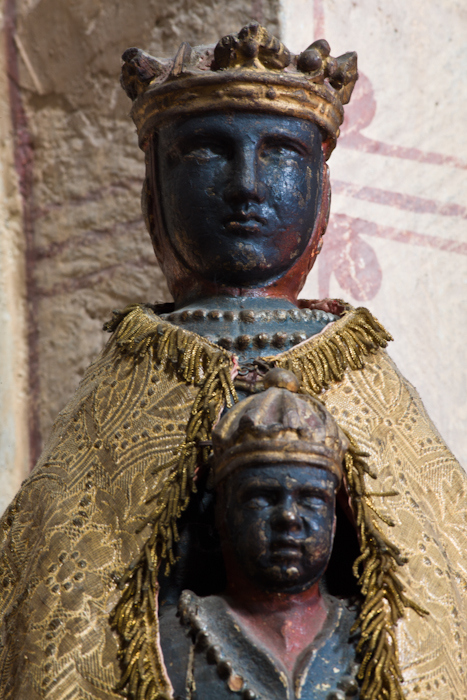
Crusader Madonna and Child courtesy of Via Lucis Photography (Dennis Aubrey and P.J. McKey)

Crusader Madonna and Child courtesy of Via Lucis Photography (Dennis Aubrey and P.J. McKey)How differently people of different times view life is masterfully illustrated by Dennis Aubrey’s post . .Dennis Aubrey’s post .

Dennis Aubrey’s post The Throne of Wisdom demonstrates how peoples’ views of life are shaped by their times in history.

During the Crusades, Mary and the Jesus of the Gospels become the authorization for killing Muslims. The executed Jesus of Nazareth becomes the Knight Templar, angrily taking up the sword against the unbelievers. Mary, the iconic “Mother of God” of Catholic and Orthodox Christian veneration, is turned into the Mother of Christian Jihad.

Pictured below is an altogether different Madonna  (12th Century from Notre Dame de Vauclair, Église de Molompize, Molompize [Cantal] Photo by Dennis Aubrey) who seems to be looking with horror at what is happening.

Notre Dame de Vauclair, Église de Molompize, Molompize (Cantal) Photo by Dennis Aubrey

Notre Dame de Vauclair, Église de Molompize, Molompize (Cantal) Photo by Dennis Aubrey

There is a great struggle today over which Madonna to enthrone.  Our Lady of the Crusades is back. For example, click HERE for Sen. Tom Cotton, author of the letter to Iran signed by 47 U.S. Senators, interviewed by CBS host Bob Schieffer on Face the Nation.

Thanks to Dennis and P.J. for prompting this post. When we look carefully at where we come from, we sometimes see the darkness today in the clearer light.


Their Blood Runs in Mine

Our friend Dennis Aubrey posted “The Destruction of History” today on Via Lucis, lamenting the latest in the sordid history of religion destroying history and art.

Dennis Aubrey and P.J. McKey love beauty, history, and the religious architecture of Gothic and Romanesque churches they photograph in Europe. Sometimes, like today, they express a profound despair over the destruction done in the name of religion.

“Now we have word that ISIS has defaced and destroyed artifacts in Mosul, including Assyrian statues of winged bulls from the Mesopotamian cities of Ninevah and Nimrud. Video released by the newest barbarians to assault the cultural history of humanity shows a man using a power drill to deface the works.

“As so often throughout history, the excuse was religion. ‘The Prophet ordered us to get rid of statues and relics, and his companions did the same when they conquered countries after him.’  How many times in our work at Via Lucis have we read variations of these words from Catholics, Huguenots, Calvinists, revolutionaries, counter-revolutionaries, and military leaders?”

Years ago during a sabbatical in St. Andrews, Scotland, the destruction wrought there by my Scottish reformation forebear John Knox and his followers chilled my soul. The people who bred and raised me – Presbyterians of Scottish descent and religious sentiment – did this. They took the commandment to have no other gods as license to destroy, maim, and burn church art and heretics. Their blood runs in mine. Their DNA is mine. And, if confession has any meaning or merit whatsoever, the children of such crimes must say we’re sorry. Really sorry. Repentant. No more destruction. No more following the orders of bully prophets, no matter whose name they claim to honor.

Thank you, Dennis, for your post. On behalf of my ancestors and in the spirit of spirituality of beauty, love, and peace on the other side of destruction, thank you for your artist’s eyes. Thank you for your courage. Thank you for the hope in something better in a barbaric time.

– Rev. Gordon C. Stewart, Presbyterian minister Honorably Retired, Chaska, MN, March 4, 2015.

Église Abbatiale Saint-Jouin-de-Marnes (Dennis Aubrey)

Via Lucis Photography of Religious Architecture is a Views from the Edge favorite because of its ability to synthesize art, history, theology, and social commentary centering on the deeper things of the human spirit and the awe of Gothic and Romanesque architecture. In the midst of this post, Dennis Aubrey draws attention to the lion which appears to be spewing foliage. I proposed to Dennis that perhaps the lion is “eating straw like the ox” in Isaiah 11 and 65, Isaiah’s vision of the peaceable kingdom, an interpretation that seems to go well with the church’s sculptural rendering Jesus’ Parable of the Last Judgment in Matthew 25.

Église Abbatiale Saint-Jouin-de-Marnes’s Last Judgment scene suggests an artistic interpretation that eliminates the divide between sheep (saved) and goats (damned), a pictorial witness to the final judgment as universal forgiveness and salvation. To enjoy the original, complete with photographs, scroll down and click on “View the Original”.

Dennis Aubrey's avatar

The church of Saint Jouin de Marnes is known as the Vézelay Poitevin, a tribute to its importance and beauty. It was named after a 4th century hermit named Jovinus from Mouterre-Silly near Loudun. Desiring a retired, contemplative life, he settled on a site of a Roman camp near the road from Poitiers to Angers, ten miles southwest of Mouterre-Silly. The site was called Ension and was in the swamps of the river Dives which flows two miles to the east. In 342 he founded an oratory church which attracted a modest religious community. By the time he died in 370, Jovinus had achieved a great reputation for sanctity and miracles. Over the years, his small community grew in importance, but eventually there was another decline.

In 843, however, the monks of Saint-Martin-de-Vertou in Brittany were forced to abandon their monastery by depredations of the Vikings. With the help…

View original post 968 more words

Privatization: the Death of Public Life

Dennis Aubrey, photographer of great religious architecture, brought to our attention this edgy view from The Guardian on the deleterious effects of privatization on the city of London.

Photo of Europe's tallest building, The Shard, Lorenzo Piano, architect

Photo of Europe’s tallest building, The Shard, Lorenzo Piano, architect

Click The city that privatized itself to death and ponder the meaning of “us” and the political economy of greed in the U.S.A.


The Distant Murmurs of Prayer

“In our imaginations, we listen for the distant murmurs of prayer,” wrote Dennis Aubrey in his post “In Seclusio at Thines” posted on Via Lucis Photography.

Listening for the distant murmurs immediately brought to mind a hymn composed by Anne Quigley in 1992. The tune is LONGING. The textual refrain is:

“There is a longing in our hearts, O Lord, for you to reveal yourself to us. There is a longing in our hearts for love we only find in you, O God.”

It was the recollection of the text that drew me to LONGING. I searched YouTube for possible videos for this post but found that the lightness of the tune, like so much contemporary Christian music, left me longing for “the distant murmur of prayers” that echo down the ages in the Gregorian Chants once sung in the now empty or mostly empty monasteries and churches that inspired Dennis to conclude “In Seclusio in Thines”:

“[PJ and I] … hear the echoes of sandaled footsteps in lonely churches long deprived of their monastic communities. And in our imaginations, we listen for the distant murmurs of prayer.”

I long for gravitas awakened by the beauty of silence.

Via Lucis (way of light)

Funny how things slip away. Not really funny. Just strange and sad.

Dennis Aubrey’s posts on Via Lucis Photography have been meaningful to me over the past few year. But because i’m technically challenged and just a bit lazy, Via Lucis has slipped out of site. Until tonight. Wondered why Via Lucis was not popping up on my email notifications. I went to see what Dennis Aubrey and P.J McKay were saying, and there it was. Another thoughtful post , on Weeping for Zion, about which Views from the Edge recently published,

If you haven’t yet noticed Via Lucis Photography, it’s worth your time. Few other authors offer such deep insights into the human condition.

Thank you, Dennis Aubrey and P.J. McKay.

Weeping for Zion (Dennis Aubrey)

This post by Dennis Aubrey on Via Lucis Photography is splendid.

Dennis Aubrey's avatar

By the rivers of Babylon, there we sat down, yea, we wept, when we remembered Zion. Psalm 137:1 (King James Bible)

Aleksandr Solzhenitsyn was quoted as saying, “Over a half century ago, while I was still a child, I recall hearing a number of old people offer the following explanation for the great disasters that had befallen Russia: ‘Men have forgotten God; that’s why all this has happened.’ Since then I have spent well-nigh 50 years working on the history of our revolution; in the process I have read hundreds of books, collected hundreds of personal testimonies, and have already contributed eight volumes of my own toward the effort of clearing away the rubble left by that upheaval. But if I were asked today to formulate as concisely as possible the main cause of the ruinous revolution that swallowed up some 60 million of our people, I could not put…

View original post 765 more words

Kim Jong Un and the Numinous

Rudolph Otto’s idea of the mysterium tremendum et fascinans, the source of holy dread and attraction that sends shudders down the human spine, rises to the fore as North Korea’s young leader Kim Jong Un plays with the possibility of nuclear holocaust.

It’s one thing to play with toys. It’s something else when the toys are nuclear bombs and missiles.

In The Idea of the Holy: An Inquiry into the Non-rational Factor in the Idea of the Divine and its Relation to the Rational, Rudolph Otto examines what he called the “numen,” the non-rational mystery that evokes feelings at once terrifying and sublime regarding our human condition.

“Otto on the Numinous” provides a concise introduction by an unidentified City University of New York English professor.

In The Idea of the Holy: An Inquiry into the Non-rational Factor in the Idea of the Divine and its Relation to the Rational, Rudolph Otto identifies and explores the non-rational mystery behind religion and the religious experience (“non-rational” should not be confused with “irrational”); he called this mystery, which is the basic element in all religions, the numinous. He uses the related word “numen” to refer to deity or God.

Forced, necessarily, to use familiar words, like “dread” and “majesty,” Otto insists that he is using them in a special sense; to emphasize this fact, he sometimes uses Latin or Greek words for key concepts. This fact is crucial to understanding Otto. Our feeling of the numinous and responses to the numinous are not ordinary ones intensified; they are unique (I use this word in its original meaning of “one of a kind, the only one”) or sui generis (meaning “in a class by itself”). For example, fear does not become dread in response to the numinous; rather, we cease to feel ordinary fear and move into an entirely different feeling, a dread that is aroused by intimations of the numinous or the actual experience of the numinous.

The word “absolute” is used in its metaphysical sense of “existing without relation to any other being; self-existent; self-sufficing” (OED); its adjectival form, “absolutely,” is used with the same meaning.”

The fact that North Korea’s young leader Kim Jong Un is threatening the world with nuclear holocaust does what World War I did to many theologians who had presumed that history is on a course of inevitable progress.

It is not.

The power of death is enticing, a sin to which Robert Oppenheimer, the father of the bomb, later confessed. The human will to power becomes evil when real soldiers, real nuclear bombs, and real missiles, and real threats of destruction are mistaken for childhood toys or computer games where human folly can be erased by hitting a delete button.

We are all children inside, for both good and ill.

Looking at the young North Korean leader, psychiatrists might see an Oedipus complex, the son outdoing the father at the game of nuclear threat, the boy who played with matches and determined that if his father was afraid to light the fuse, he would step out from his father’s shadow onto the stage of world power in a way the world would never forget.

But deeper and more encompassing than any Freudian analysis is Rudolph Otto’s mysterium tremendum et fascinans.

The philosophical-theological debates about Modernism and Post-Modernism are interesting. They deserve our attention. But neither Modernism’s rationalism nor Post-Modernism’s deconstructionism is equipped to address the most basic reality which encompassing the human condition: the mysterium tremendum et fascinans and the horror of its daemonic distortion in the shrinking of it by the human will to power.

Whenever we take the ultimate trembling and fascination of the self into our own hands, the world is put at risk. In the world of the ancients and the pre-historical world of our evolutionary ancestors the consequences were limited to a neighbor’s skull broken with a club. In the advanced species that has progressed from those primitive origins, we have fallen in love with our own toys of destruction, the technical achievements and manufactured mysteries that are deadly surrogates for the mysterium tremendum et fascinans that sends shudders down the spine in terror and in joy before what is Real.

Our time is perilously close to mass suicide. Unless and until we get it straight that I/we are not the Center of the universe, the likes of Kim Jong Un – and his mirror opposite but like-minded opponents on this side of the Pacific – will hold us hostage to the evil that lurks in human goodness.

Progress isn’t all it’s cracked up to be. The ancient shudder of the creature – the human cry for help in the face of chaos and the heart’s leap toward what is greater than the self or our social constructs – unmasks every illusion of grandeur in a world increasingly put at risk by little boys with toys.

P.S. Just as this piece was in final editing, Dennis Aubrey published “Mysterium Tremendum” on Via Lucis Photography.