Verses – Peter Michalove

Two Acrostics

Peter, like many Arts Ph. D.s,
Entered the work-force, but could not find
The right music composition place.
Earning money for his brand new bride
Required taking a job at the school.

Music would be heard for 30 years
Instead of written. But then a real
Creative time in retirement days.
He wrote music, heard it played, but when
Aggressive cancer hit him he had
Little strength left to compose. The pain
Overcame the music in his head.
Valiantly he taught others to hear,
Even laughing, having music near.

— — — —

Perhaps it was hallucination,
Even a vision, but a guy named
Tom showed up the last hours the patient
Endured the cancer. Ghostly Tom claimed
Right after death we all will get a preview

Making clear what the afterlife will be.
If people wish, they enter in–but few do
Choose that life, “Been there, done that!” they say.
How can more years, even if pain-free
Atone for dying young and leaving
Loved ones, music, teaching, history
Of stamps… The time would be spent grieving.
Very plain spoken always, he said:
Everlasting sleep I choose instead.

– Steve Shoemaker, Urbana, IL, December 12, 2013

Dr. Peter Michalove, who died last week, was a career Business Manager for several academic departments at the University of Illinois, where he had received his Doctorate of Musical Arts in composition.

In retirement, music he wrote was played and appreciated (see “Peter Michalove” on YouTube).

Chemotherapy fatigue eventually made writing music impossible, but Peter taught music classes to other retirees at the University, to enthusiastic applause. He has written about music and cancer: http://petermichalovecomposer.com

The Waiting Room

The voices of the visitors
would drop when they entered
the almost empty anteroom
and stood before the blond wood door
of her positive pressure room.

The air could exit but could not
bring more bad bugs into her lungs
immuno-compromised by stays
in this or other hospitals.

Her breathing stopped on the 4th night
as cancer squeezed another last
breath from exhausted failing lungs.
The empty room keeps breathing out.

[Abigail A. Salyers, 12/24/42–11/6/13, received a Ph. D. in nuclear physics from George Washington University, later did Post-Doctoral studies in Microbiology in Virginia & was the first female tenured Professor in the microbiology department at the Univ. of Illinois. She was elected President of the 40,000 member American Society for Microbiology for 2001-2. She was the author of several books & hundreds of professional articles in her field.]

– Steve Shoemaker, Urbana, IL, November 7, 2013

Verse – The Cancer Joke

She knew cancer
better than almost
anyone else
in the hospital.
Although not an MD,
she had taught
in the Med School
while doing research
and writing books
and using her Ph. D.
to produce others.

Cancer Society money
had come to her lab
of busy bees for years.
She sat on panels
of judges that chose
who would study which
type of the deadly C.

Now the crooked cells
that had begun in her throat
had caused spots, as they say,
on her lungs and heart
and in her bones.

As a pastor married to the lab
headed by this agnostic,
I knew how to visit
folks given the death sentence:
listen, touch an arm, a shoulder,
remember good times together.

She wanted to tell me a joke.
I leaned close to hear the raspy voice
above the hissing oxygen.
“A microbiologist’s joke
is only one millionth as funny
as a regular joke.”

She raised a needle-filled hand
to touch my worried brow
bowed over her dry grinning lips.

-Steve Shoemaker, Urbana, IL, November 5, 2013

Editor’s Note: Steve was “married to the lab” at the University of Illinois through one of its research scientists, his wife, Nadja.

The Other Side

The poem of one dying of cancer:

“NOTES FROM THE OTHER SIDE”

I divested myself of despair
and fear when I came here.

Now there is no more catching
one’s own eye in the mirror,

there are no bad books, no plastic,
no insurance premiums, and of course

no illness. Contrition
does not exist, nor gnashing

of teeth. No one howls as the first
clod of earth hits the casket.

The poor we no longer have with us.
Our calm hearts strike only the hour,

and God, as promised, proves
to be mercy clothed in light.

Jane Kenyon (1947-1995), New Hampshire Poet Laureate, written while dying of cancer.

✚ Lessons in Stone (Dennis Aubrey) ✚

✚ Lessons in Stone (Dennis Aubrey) ✚.

Dennis Aubrey’s “Lessons in Stone” took me back three years ago.

I’m sitting in a small room with a Benedictine monk at St. John’s Abbey in Collegeville, MN. It’s the first of six private meetings over a three day silent retreat.

“What brings you here?” asks the spiritual guide. “My step-daughter is dying of cancer.” “What is her name?” “Katherine.” How old is Katherine?” “Thirty-three. She was diagnosed four years ago with Leiomyosarcoma, a rare incurable sarcoma, and is now in her last months in hospice care.”

“So what troubles you? Are you afraid for the state of her soul?” “No,” I respond quickly. “Not at all. It’s not about that. God is Love. I don’t believe in hell.”

“Hmmm,” said the monk. “I see. Interesting. Our tradition says that there is a hell, but that the likelihood is that there’s nobody in it.”

The centerpiece of the tympanum that captured the attention of the little Danish boy in Dennis’ “Lessons in Stone” is the scene of God’s hand reaching to pull Saint Foy toward heaven.

You don’t have to believe in hell as an eternal state to cry out for release from its torments here and now, or to pray for a peace that passes all understanding.

Nature

The tick that carries spotted fever

malaria that mosquitos pass

on to mere kids, and then the cancer

that twists, subverts, deforms normal cells–

who can ever say this world is good?

The mind that in an empty room hears

loud voices saying run, hurt, be bad

not good, rape, kill, then die yourself.  Fears

are all around.  There is no hope left.

We can be as deformed as our world.

Can someone befriend us when bereft?

Join us with our demons in the cold?

Maybe not help us to understand

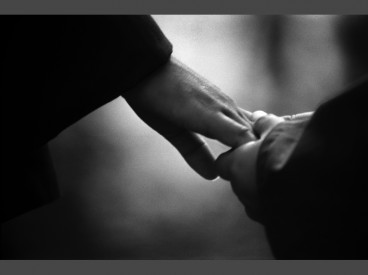
evil all around, but hold our hand?

– Steve Shoemaker, Urbana, IL, June 7, 2012

The Convoy and the Man on the Bridge

Cup of coffee in hand, I read this story on the front page of the morning newspaper (click on): Truckers lined up rigs to save suicidal man.

Seeing a man clinging to an overpass high above Interstate 94, Carl Hoffman, a quick-thinking state trooper, “found an ingenious way to save him. He summoned a convoy of 18-wheelers…positioning them one by one to break a potential plunge to the pavement about 25 feet below.”

Carl Hoffman deserves a medal. So do the truck drivers. But the truckers got back on the road before anyone took their names. “The drama over, ‘we told the truckers to take off,’ trooper Hoffman said, leaving the identities of the Good Samaritans a mystery to authorities.” One of the truckers told the trooper that he had done this once before in Florida.

Trucker are a different breed of cat.

Take Wes, for example. Wes logged over a million miles as an over-the-road long-distance hauler. He and his wife, Alice, are members of Shepherd of the Hill Presbterian Church, the wonderful small church I like to call a collection of characters with character.

Wes and Alice are retired in their 80s. Wes was recently diagnosed with cancer that leaves him in great pain and some confusion.

I walk into his hospital room. His eyes are closed. I speak his name. He opens his eyes. His face breaks into a smile. His eyes grow wide. He reaches out his hand. “Oh, my! Look at you. You came all this way just to see me? Oh, my!  Great to see you. You didn’t have to that. You didn’t have to come all that way…just to see me.”

“No problem,” said, “it only took me four hours.” We both laugh. It takes 25 minutes, and he knows it, although the cancer has taken its toll on his memory and cognitive skills. ‘Yeah, but you didn’t have to come.” He squeezes my hand and holds on.

Reading the paper this morning, I imagine Wes as one of those truckers lined up in the truck convoy under the bridge.

Like each of the those truckers, Wes has his own story. And he has lots of stories to tell.

Wes and Alice are the only people I know who have had a coyote for a pet. While Wes was was on the road with his rig, Alice was taking care of the farm with the coyote at her side for companionship and protection.

During one of those weeks, one of the calves was in trouble back on the farm. Alice called the veterinarian. When the vet arrived and reached to open the gate to the pasture, Alice stopped him.  “Don’t go in there. That bull’s mean. Stay right here. Watch this.” Alice opened the gate enough for the coyote to enter the pasture. The coyote ran directly to the bull, stared him down, grabbed hold of the chain from the bull’s nose, yanked the chain tight, and led the submissive bull into the barn. No bull!

So…who saved the calf’s life? Alice? The veterinarian? Or the coyote that got the bull into the barn?  Who rescued the despondent man on the I-94 overpass? The State Trooper? The firemen who cut through the fence and pulled the man to safety? The six truckers in the 18-wheeler convoy?

One of the long-distance haulers is coming down the home stretch asking why his pastor would “come all that way just to see me.” He and his fellow Good Samaritans know the answer better than the pastor.

Yours truly’s favorite form of adoration

Yours truly’s favorite form of adoration.

It’s Raining, It’s Pouring

Today, three years to the day after Katherine’s (“Katie’s”) death (May 9, 2010), we inter her cremains, an appropriate time to re-post the effect of Katie’s illness along the way. This is a re-posting of a piece written along the way of Katie’s illness.

I wrote this piece when we learned that my stepdaughter Katherine’s incurable Leiomyosarcoma had taken a turn for the worse. In memory of Katherine (“Katie”) Elizabeth Slaikeu Nolan.

Gordon C. Stewart   Feb. 11, 2009

It’s raining, it’s pouring
The old man is snoring
He went to bed and he bumped his head
And couldn’t get up in the morning

It’s a day like that.  I bumped my head on the illness of a 33 year-old loved one.  It’s raining sadness. I’m having trouble getting out of bed in the morning.

Terminal illness has a way of doing that unless you believe in miracles of divine intervention or you have extraordinary powers of denial.

My spirituality has become increasingly like that of Rebbe Barukh of Medzobaz, an old Hasidic master in Elie Wiesel’s tale of Four Hasidic Masters and Their Struggle Against Melancholy.  When he prayed the customary Jewish prayer, “Thank you, Master of the Universe, for your generous gifts – those we have received and those we are yet to receive” – he would startle others with his weeping.  ‘Why are you weeping?” one of them asked.  “I weep,” he said, “in thanksgiving for the gifts already received, and I weep now for the gifts I have yet to receive in case I should not be able to give thanks for them when they come.”

For my family at this critical time, the real miracle has already occurred – the shared gift of love – and it will come again in ways I cannot now anticipate when the last page of the final chapter of our loved one’s life is over.

The miracles are more natural, nearer to hand.  Although I don’t believe in selective divine intervention, I am on occasion a sucker for denial – except on days like this when it’s raining and gray and I’ve bumped my head on the hard fact that cancer is ransacking my loved one’s body.  A certain amount of denial, too, is a blessing in disguise, one of God’s generous gifts to keep us sane when the rain pours down and clouds are dark.

Faith comes hard sometimes.  In college mine was challenged and refined by Ernest Becker‘s insistence that the denial of death lies at the root of so many of our problems.  My faith has been refined along the way by the courage of Albert Camus and Jean-Paul Sartre to face the meaninglessness of the plague, the faith and courage of Dietrich Bonhoeffer and Paul Tillich who stuck their fingers in the gears of Nazism, and the humble witness of Mother Teresa working in the slums of Calcutta with more questions than answers and some anger at God.

The job of faith, as I see it, is to live as free as possible from illusion with a trust in the final goodness of Reality itself, despite all appearances to the contrary.  Faith is the courage and trust to look nothingness in the eye without blinking or breaking our belief in the goodness of mortal life.

When I look into my loved one’s eyes I see that courageous kind of faith that defies the cancer to define her, and a resilient spirit that makes me weep tears of joy over the gifts we’ve already received and the ones we have yet to come.

It’s still raining and it’s still pouring, but I refuse to snore my way through this.  I’ve bumped my head on the news of a loved one’s terminal illness, but I’m getting up in the morning.

POSTSCRIPT March 21, 2012

Conversation yesterday about “The List” posted on Bluebird Boulevard:

Karen:

My mother died of cancer eight years ago. Her loss is still visceral. She is in every bird I see.

Me:

The morning of Katherine’s memorial service Kay, Katherine’s mother, was standing by the large picture window gazing out at the pond in our back yard. Out of nowhere, it seemed, two Great Blue Herons flew directly toward the window and swooped upward just before they got to the house. “She’s here. That’s Katie,” said Kay without a second’s hesitation. On her last day of hospice care, Kay and I each remarked that her face looked like a baby bird. I’m a skeptic about such things. I’ve always been, and always will be, a  doubting Thomas. My assumptions and conclusions come the hard way. But on the day the herons flew directly at Kay from across the pond, I saw it with my own eyes…and HAD to wonder.

Within a minute a third Great Blue Heron perched on the log by the edge of the pond and stood alone for a LONG time.  It reminded me of a gathering on the steps of the State Capitol in Saint Paul following the tragic deaths of school children at Red Lake, MN. The crowd stopped listening to the speaker. They were looking up. “What’s going on?” I asked Richard, the Red Lake American Indian advocate and my co-worker at the Legal Rights Center.org. “Eagles,” he said. “Where?” “WAY up. They’re circling.”

I learned later that the eagles were also circling at that same moment over the grieving families gathered at Red Lake. I asked American Indian colleague what he took it to mean. “We don’t ask. That’s the white man’s question,” he said. “We just accept it. We live in the mystery.”

The List

“You have ca… You have can.. cancer. But we think it’s treatable.”

I read The List early this morning, the day after hearing a doctor tell a wonderful older couple the news. The full bone scan tells a different story. It can be treated with radiation, but at what price for an old man already writhing in unbearable pain? My friend has been on “the list” once before 20 years ago. Now he’s back on it, this time for good. He’s a strong man, but not that strong, not immortal, not invulnerable. The treatment will not stop it this time. Morphine and lots of love will see him through until he’s off the list for good.

My step-daughter, Katherine, was placed on “the list” at age 30. She was exited the list at 34. Her ashes are on the mantel now. Her courage, her buoyancy, her steadfast refusal to let being on “the list” define her, her compassion for the doctors and nurses who “treated” her with surgery, chemo, more surgery, radiation, lasers, and morphine, and for us, the members of the family to whom she brought so much delight, have left us with so much more than what’s left on the mantel.

I’ll post a piece written during the third year of Katherine being on “the list” later today. Look for “It’s raining; it’s pouring.”

For now, share your stories with a comment here, or go to Courteney Bluebird’s blog and comment there. All of her work is remarkable and worth the visit.