
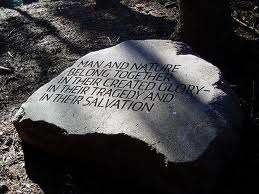
Paul Tillich quote in Tillich Park, New Harmony, IN: “Man and nature belong together in their created glory – in their tragedy and in their salvation.”
A spiritual reflection for the Second Sunday of Advent, December 7, 2014.
The beginning of the GOOD news is HARD news, according to John the Baptist, calling people out into the wilderness. “We must change,” he said. “Repent” by which the Judeo-Christian tradition means a 180 degree turn. “About face!” Only by turning will we be delivered from the consequences of the actions that have led us here.
For John the Baptist and the writer of the Gospel of Mark’s opening paragraph (Mark 1:1-8) the system at issue was Roman imperialism, an economic system centered in Rome, expanding out, and enforced by, military invasions, subjugation, religious tolerance (so long as the religious practice did not interfere with Roman prerogatives) and occupation.
One could repeat the sentence in 2014 with little change: “the system at issue [is [American] imperialism, an economic system centered in [Washington] expanding out, and enforced by, military invasions, subjugation, religious tolerance (so long as the local religious practice [does] not interfere with [American] prerogatives) and occupation.”
It is our spiritual, moral, economic, cultural and political captivity to a global system that cannot satisfy our real needs or the world’s that produces a longing in our hearts, a readiness to make the lonely trip to the wilderness.
We’re a weary people in 2014. Wearied and still disheartened 11 years after the “Shock and Awe” that took down Saddam Hussein on the pretense that he had weapons of mass destruction (WMDs) that threatened us, the Administration’s manufactured association of Saddam Hussein as the cause of 9/11. We’re wearied of lies and misrepresentations. Weary from budget fights that barely reference 10 years of un-budgeted military expenses, the loss of thousands of American soldiers’ lives and as many as 100,000 Iraqi civilians, a military venture undertaken on the assumption that the Iraqi people would welcome our presence as the beginning of democracy and a “free market” economy that would lift them all up.
That belief in the goodness of American intentions hit the rocks as quickly as Saddam’s statue hit the pavement in Baghdad. All the while we were wearied by the earlier invasion of Afghanistan, whose original justification was a quick elimination Osama bin Ladin and Al-Qaida untempered by realistic knowledge of the long history of the military interventions that mired the invaders in quagmires such as the Soviet Union found itself before leaving in defeat. To the Afghans it didn’t matter whether the troops were Soviet or American. They were the same. They were the occupation forces of an imperial power destined to fail.
In the midst of the weariness about what was happening abroad, the financial system at home took the American economy to the brink of disaster in 2008. Occupy Wall Street rose to the top of the news cycles. Although the movement fizzled over time, as such movements inevitably do, it caught the attention of television viewers, internet surfers, and newspaper and magazine readers. Occupy Wall Street and the spot light it placed on “crony capitalism” became a hot topic around water coolers at work and the table in the coffee shops.
For the first time in recent memory, capitalism was no longer sacred, no longer off limits. Time’s front cover asked the question whether Capitalism was dead. But, as with Occupy, public attention is short-lived. Amnesia sets in when people are weary. How soon we forget…until some new John the Baptist issues the cry for a 180 degree turn for the sake of something better.
Maybe Naomi Klein is edition of John the Baptist. This Changes Everything: Capitalism vs. the Climate, reviewed by the New York Times – places the over-riding systemic issue squarely before the general public again. Senator Bernie Sanders, America’s only socialist Senator who names climate action as among his four top priorities, is gaining attention as a possible presidential candidate. Elizabeth Warren, the Senate’s bulldog on holding Wall Street accountable is creating a wave of populist momentum. Put them with Bill McKibbon and 350.org and you begin to hear the echo of John’s all to the hard truth that is the beginning of the good news.
The hard truth that precedes good news is the discovery of the myth that has coupled democracy with capitalism in the American psyche, while demonizing socialism as democracy’s opposite. Ideological blinders are to nations and peoples what blinders are to horses on a race track: they limit vision to the straight-ahead narrow limits of the track. Ideological blinders prevent the owners’ horses from thoughts of anything but the track on which they’ve been placed to race each other.
But when the climate is changing our track in ways that compel our attention, and when we ask how we will make it through the changes together, the bigger question of the economic system – the race track itself – comes into view by virtue of necessity. It calls us off the track into the wilderness of Nature.
The words ‘economy’ and ‘economics’ derive from the Greek words for ‘house’ and ‘the management of the household’. Economics not about markets, free or otherwise, or about the technicians and pundits who monitor investments and predict quarterly outcomes. It is not an academic discipline, the exclusive province of experts on Wall Street or in university Economics departments who understand how the free market works.
Economics is a spiritual perspective like the one on Paul Tillich’s marker in Tillich Park in New Harmony, Indiana. “Man and nature,” he said, “belong together in their created glory – in their tragedy and in their salvation.” There is no humanity with nature; the human calling of our time is to reshape our lives for the wellbeing of the one house in which all life lives.
During this Advent season of longing expectation, John the Baptist with his axe aimed at the root of the tree reminds us that economics is the spiritual issue of the first order. The good news is what the Hebrew Bible calls “the Day of the Lord” and John the Baptist and Jesus of Nazareth called “The Kingdom [i.e. Society] of God”. The hard news is we’ve been running on the wrong track, or, you might say, barking up the wrong tree.
The planet – this home we call “nature”, without which no person, society or form of life exists – is an economy that requires different management. The economy for which our hearts long is the one house imagined by the psalmist and announced by John in the wilderness beyond the Pax Romana: the good news awaiting our longing hearts to embrace it, a planetary home where “righteousness and peace will kiss each other” (Psalm 85:10) and wars will be no more.
The beginning of the GOOD news is HARD news. “Repent, for the kingdom of heaven is at hand.”
– Gordon C. Stewart, Chaska, MN, December 7, 2014

 Views from the Edge