Acquittal of Jeronimo Yanez – a Response

The following letter from Presbyterian Church (USA) leaders in Minnesota arrived this morning in response to the acquittal of police officer Jeronimo Yanez in the shooting death of Philando Castile.

“Nearly a year ago, in a community overwhelmed with anger, grief, frustration, and despair at the shocking video images of the shooting death of Philando Castile, and then at the roiling protests that have followed, we—the Presbytery of the Twin Cities Area—joined our voices together with each other and with many others in a cry for comfort, for equality, for justice.

“We committed ourselves to prayer for the family of Philando Castile, that they would know our God’s deep and abiding presence, and for the many others so deeply grieved by these events. We prayed for our community,that amidst its deep divides and fractured relationships, amidst the fear and anger especially of our black community, we in the church might find words of comfort and challenge to speak into the yawning chasm of societal fractures and divides. We prayed for our police officers and all who daily place themselves in potential harm’s way in order to protect us. And we said, firmly and unequivocally, that Black Lives Matter, and we committed ourselves as a Presbytery to the work of understanding white privilege and to anti-racism.

“That work is not done. Today, we are compelled to revisit those prayers and commitments in the aftermath of the acquittal of police officer Jeronimo Yanez, a verdict that ripped open a family’s overwhelming grief and further caused our African-American brothers and sisters to fear anew that their lives indeed do not matter in this country.

“As followers of Jesus, our task is to listen, to hear, to act, in response to the call of God and the voices of the people. And so we again join our voices in prayer for the family of Mr. Castile. But we must not stop there. We must commit ourselves anew to work for end the perpetual sense of fear and suspicion under which our African American brothers and sisters constantly live. Whetherwe live in a community with very few people of color or with many, no one of us has the luxury of being detached and unaffected. Those of our society who feel suspect and vulnerable are our very sisters and brothers in Christ. As Christians, we must stand with them.

“We are challengedto look anew into the imperfect structures of our society; and to speak our belief that every person is created in the image of God, even as we confess our denial of that very belief in the sin of institutional racism. We must speak our belief that “Christ’s work of reconciliation is made manifest in the church,” knowing that, too often, we have allowed our ideological differences to fracture our unity in the One Body. We must challenge ourselves anew to proclaim Christ’s words, “that they may all be one,” knowing the essential need for all Christians of privilege to seek deeper understanding when so many of our brothers and sisters cry out for a justice they do not know.

“Our African American brothers and sisters have implored us to raise our voices on their behalf. Together, we in the Presbytery of the Twin Cities Area re-commit our voices and our actions to better seek justice and work for the good of all of our brothers and sisters in Christ.Give us the determination to build new or deeper relationships, as together we seek new ways to partner in work for a just society. Give us courage, in all that we do, to be not simply speakers of peace, but peacemakers.”

The Presbytery Leadership Team, Sue Rutford, chair
The Executive Presbyter, Jeffrey Japinga

The Shooter


the-latest-pence-speaks-with-victims-of-ballpark-shooting“Fools rush in where angels fear to tread.” Yet tread we must the day after the shooter aimed his rifle through the ballpark’s chain-linked fence at members of the U.S. Congress and their staff.

It’s a temptation to tread heavily, claiming only shock when, in fact, we all heard verbal shots before we heard the the gun shots from Alexandria, VA. Moral righteousness doesn’t help on a day like this because it is moral righteousness that pointed the rifle at the Congressional Representatives the shooter regarded as the unrighteous.

2631978_ThumbOne man decided to defend the American republic with a rifle, a horrendous offense that points the finger back at the rest of us who have tread heavily against the evils we deplore or who have tread less heavily in a seething wordless silence.

There is, of course, a huge difference between a rifle and a sentence. We have spoken out here about that difference. We proudly use words, not guns.

Yet, we must confess that, in the interest of defending the America we love, Views from the Edge has fired its own shots in the appalling era yesterday’s shooter sought to end with his rifle. As a follower of Christ immersed in scripture, we have known but have sometimes failed to heed the wise caution of the Letter of James (“How great a forest is set ablaze by a small fire! And “tongue is a fire” [Js. 3:5-6]) or the counsel of the Hebrew proverb (“The words of the reckless pierce like swords, but the tongue of the wise brings healing”[Proverbs 12:18]).

Moral righteousness wears a multiplicity of masks and uses many vocal disguises that hide its ugliness. Today we step back a few paces to ponder the question:

“How do we speak and act responsibly in ways that bear witness to what we believe in this time that puts our better angels to the test?”

We have no answers. Only a question.

Maybe today’s Congressional baseball game will speak louder than rifles or words.

Grace and Peace,

Gordon C. Stewart, Chaska, MN, June 15, 2017.


Jake’s bench visitor

The stranger sits alone on Jake’s’ bench under the elm tree in the grassy area behind the seasonal Mexican food truck parked at the edge of the Cooper’s Food parking lot.

It’s not everyone who comes to sit on Jake’s bench. I wonder whether he knows of Jake and whether he’s read the inscription etched into the marble:

“Now Jake is a man who wonders why the world is torn asunder. Better worlds he plans, where joy is at hand, and people can live in peace and plenty”.

Mexican food truck 55d36cc8485e9.imageHis back is turned to the picnic table where I eat my taco from the food truck. I only see him from the back, which, come to think of it, is how one sees Jake here – the way Elijah saw God from a cave while God passed by: from the back, the mystery of the Presence maintained against every mortal effort to control, define, or reduce a mystery to a thing.

A bedroll and a pair of well-worn shoes sit on the ground under the inscription. A pair of dirty, wet socks sits on the bench beside him. Clearly he’s been on the road. Is he a hiker on a long trek? A traveler passing through Chaska? Does he have a home somewhere else? Is he homeless and torn asunder in this world?  Or maybe he’s a rare fellow-traveler pausing in the company of Jake on Jake’s bench.

CoopersFoods1Jake’s bench is meant for the weary traveler.

Jake Cooper was an American socialist, the second generation of Cooper’s Foods.

Cooper’s still sits there today, hosting the Mexican food truck, a witness to an era when care for a stores’s customers were more important than updating its physical appearance and service to the community was as important as profits. Cooper’s is the most generous business in Chaska, the go-to supplier of food for community events and good causes. Coopers is a community institution. Its Deli offers complete meals for under $6.70 with portions large enough to provide dinner for two with some left over. Best little restaurant in Chaska! It’s not a money-maker, but it pretty much pays for itself, says Jake’s latest successor at Cooper’s – and it serves the people who can’t afford higher end restaurants or who just know good food at a great price. An example of the spirit of American democratic socialism to whose dream Jake’s bench still bears witness behind the Mexican food truck.

Whether the stranger sitting at Jake’s bench came by chance or came to pay his respect to Jake, he is like most of us in this day and time: a weary traveler who wonders why the world is so torn asunder, and hopes for a better world of peace and plenty.

  • Gordon C. Stewart, Chaska, MN, June 14, 2017.


Tapering off my MacBook Air

The word ‘taper’ is today’s Daily Post prompt, i.e. a topical challenge to writers.

43A1720B-BC80-0060-873FBDFD04548E20Since watching last Sunday’s “60 Minutes” episode on “Brain Hacking” — an essay on cell-phone addiction — I’ve been trying to taper off how often I turn to my MacBook Air. Okay, so it’s not a cell phone, but I’m as addicted to the MacBook Air as cell phone owners are to cell phones. Time away does weird things to the brain, like withdrawal from addiction to drugs or alcohol. Since Sunday night, I’ve been trying to taper off.

apple-laptop-notebook-notesBut I can’t. Writing is what I do. I can’t stop. The MacBook Air is my lifeline, my unfailing connection with my imaginary friend, the addict’s needle, always within arms reach. Besides, like Echo in the myth of Narcissus, the MacBook Air always tells me what I want to hear – my own voice . . . except when the beep beep of an uninvited text interrupts our conversations.

I’ve been trying to taper off on the emails and texts, as well as the writing. But I don’t taper off easily. It’s not in my DNA.

Speaking of DNA, learning last week that some relatives inherited a gene that has left them vulnerable to auto-immune diseases left me wondering about my PMR, an auto-immune thing, and the Prednisone I’ve been taking for three months. No other drug addresses the symptoms of PMR.  But it’s a short-term fix with its a long list of side-effects. There’s no assurance the PMR will be gone when I taper off the Prednisone.

91d40efa6017040fa5159b5e83aa94b7Thursday’s appointment with the rheumatologist will determine whether I taper off again from 10 mg to eight from the original 20. If so, I might take it as a sign to limit the MacBook Air time to eight hours per day, or to make Views from the Edge readers happy by posting no more than eight times a day . . .  until I leave you completely alone with your brain-hacking cell phone when I taper off completely . . . into complete withdrawal.

  • Gordon C. Stewart, Chaska, MN, June 13, 2017.

Elijah’s third birthday

Elijah IMG_0078

“Grandpa, I’ve already learned to swim, and pretty soon I get to go to kindergarten, right? Will my kindergarten teacher teach me everything I need to know, like Miss Britten and Robert Fulghum taught you before you got to be decrepit?

“Remember, Grandpa, what Rev. Fulghum said? ‘Don’t worry that children never listen to you; worry that they are always watching you.'”

When I’m old like you, will I still smile? Or will I be a frowning curmudgeon?

  • Gordon C. Stewart, Chaska, MN, June 13, 2017.


The Adult American Kindergarten

“All I really need to know . . . I learned in kindergarten,” wrote Robert Fulghum.

Way back in Miss Britten’s kindergarten class, we learned to play, learn, and grow together. We didn’t like:

  • playground bullies,
  • two-faced liars,
  • braggarts,
  • belittlers,
  • the selfish,
  • the greedy,
  • the mean,
  • the arrogant
  • big-shots,
  • the spoiled rich kid.

That was a long time ago.

All these years later, I wonder whether Miss Britten had it right that “It is still true, no matter how old you are, when you go out into the world, it is best to hold hands and stick together” – Robert Fulghum, All  I Need to Know I Learned in Kindergarten.

In today’s adult American kindergarten, I take comfort in holding hands and sticking together going back out into the world I barely recognize.


Gordon C. Stewart, Chaska, MN, June 12, 2017.


Ever wonder about your DNA?

How much of you is written already by the latest rendition of the old doctrine of predestination? Not so much by religious predestination as by your DNA? Or are predestination and DNA the same?

Reconnecting with the second cousin from the Andrews family raises the questions. I’d only met her once sixty years ago, yet, like twins separated by distance and circumstance, the parallels of perception, pencraft, and psyche are unmistakable.

Mr. Rogers assured the children that each of them was special. I like the sentiment but have preferred the word ‘unique’. None of us is nearly as ‘special’ as we’re prone to think we are, but, come to think of it, neither is any of us quite as unique as ego might lead us to think.

As Carl Sandburg reminded me, “O, I got a zoo, I got a menagerie inside my ribs!” Many of the creatures in my zoo were not of my choosing. They were, you might say, predestined. They predetermined me. Some of them date back to the Andrews family in Andrews Hollow, Maine, and as farther back into time than memory can follow.

  • Gordon C. Stewart, Chaska, MN, June 12, 2017


Who’s taking the pictures? Who’s singing?

Re-blogging Dennis Aubrey’s photographic essay today (see previous post) took me back to the sermon Dennis inspired years ago with his experience in the basilica dedicated to Mary Magdalene in Vizelay, France.

At the end of a week in Chaska when my cup has been overflowing with reasons to touch again the power of the non-rational that is deeper than what goes on in my spinning head, we republish “The Stones Are Singing” in thanksgiving for Dennis’s and PJ McKee’s influence on me and Dom Angelico’s influence on them.

Gordon C. Stewart, Chaska, MN, June 11, 2017.

The Monk in the Morvan Forest (Dennis Aubrey)

We post Dennis Aubrey’s latest epistle for a number of reasons. Readers of Views from the Edge may recall that the Via Lucis photographic essay on the stones singing at Vizelay inspired a sermon on the stones singing. Here the monk who wrote the history of these Romanesque churches comes out from the shadows in a lovely tribute by Dennis, complete with pictures of PC and Dom Angelico Surchamp.

Dennis Aubrey's avatar

We are finally home again after two months photographing in France, Spain, and even a little bit of Italy. We drove 6,960 kilometers during that time at an arrive speed of 51 kilometers an hour, which translates to 4,344 miles and a dazzling 32 miles per hour. This demonstrates the narrowness of the country roads where we drive and the amount of time we spent in the Pyrénées and Alps. Until we hit the highway returning to Paris, the average speed was 48 kilometers per hour!

The trip ended in Vézelay at the Crispol hotel, which is almost like home to us. The Schori family is always so welcoming and the addition of the two children Max and Clémence makes it even brighter. It is always bittersweet leaving France. We love it there but we are always anxious to return home, this time to our new house amidst the Amish

View original post 521 more words

Revelation at Andrews Hollow

After several days away from writing for Views from the Edge, today’s Daily Post invitation to write something about ‘revelation’ struck a familiar chord, so to speak.

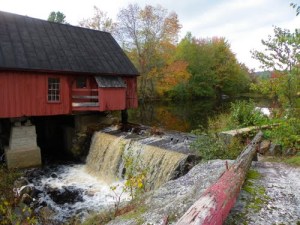
Andrews Casket Company mill in Woodstock, ME

Andrews Casket Company mill in Woodstock, ME

Earlier this week an email arrived from a complete stranger who believed we were family. In a google search she had come across Views from the Edge’s photograph of the Andrews’ family property.

What’s that have to do with ‘revelation’?

It revealed a blood relative I didn’t know existed and led to the correspondence with the second-cousin I’d only met once on the old Andrews’ homestead years ago but had never forgotten.

The emails we’ve exchanged have removed the cover (i.e., ‘revealed’) from family origins that had remained hidden for almost 75 years.

The reflections of the second-cousin who grew up on the ancestral property of the Andrews family help explain both the sense of homesickness and forlornness I felt while visiting “The Hollow” last month. The latest visit confirmed the feeling expressed in “The Forlorn Children of the Mayflower” in “Be Still!”

Until this week’s correspondence, I hadn’t know the property was “The Hollow” to the relatives who grew up there, or as “Andrews Hollow” to the those whose relatives’ funerals had been handled by the Andrews family. It all came as a revelation.

So, today I take time out to write this post in reply to The Daily Post’s invitation. Perhaps life itself is a life-long pilgrimage of revelation – the unveiling of the deeper chords and cords of the DNA that lives on in the tissues and bloodstreams of later generations.

  • Gordon C. Stewart, Chaska, MN, June 10, 2017.