John Buchanan provides in Hold to the Good what he did from the pulpit of Fourth Presbyterian Church in Chicago, and as publisher of The Christian Century: timely reflection on current events in light of biblical texts. His latest post, The Children, shines the light of an often ignored part of the Christmas story — Herod’s Slaughter of the Innocents — on the royal palace’s current cruelty toward children on America’s southern border.
Christmas is over but a singular Biblical incident is haunting me this year. The Christian story, from the beginning, is set in the context of political power, insecurity and cruelty. “In the time of King Herod” is the way Matthew begins. The Magi, mysterious seers from the east- modern Iran, Iraq and Saudi Arabia, following a star that announced the birth of a new king, stop at the royal palace in Jerusalem, the locus of imperial political power. They assume, reasonably, that if a new king has been born it must be in the palace of the current king, Herod. The story recounts how Herod, obviously distressed and frightened by what the Magi said, learns from his own experts that Hebrew scripture predicts “From Bethlehem shall come a ruler who is to shepherd my people, Israel.” When Herod later discovers that the Magi have deceived him, not returning with the…
There are for most of us those rare moments that give definition to one’s life. Such singular moments cast a wider light on all the other moments on calendars and clocks.
These are moments of the heart that touch us deeply — like Sunday’s return to Cincinnati to preach the sermon for the ordination of David Annett who was a boy when I served as his pastor at Knox Church 25 years ago, and the Monday and Tuesday times with my best friend Wayne as he nears the end of life in Indianapolis. Jean-Paul Sartre’s words from Nausea were never far away:
“One is still what one is going to cease to be, and already what one is going to become. One lives one’s death, one dies one’s life.”
The friendship with Wayne began at McCormick Theological Seminary in Chicago where the housing director had assigned us to room together in Room 311 of Alumni Hall. No friendship has been longer or deeper since that day in 1964. We have lived our deaths together over the years, and now one of us is in hospice care dying his life. The visits last Monday and Tuesday were what they have always been: moments described by the old hymn “Blest be the ties that bind Our hearts in Christian love.”
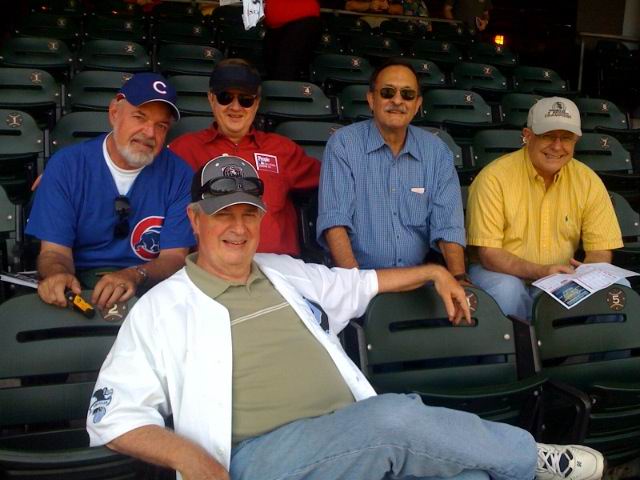
Front row: Don. Back row: Harry, Wayne, Bob, and Gordon at Wrigley Field
Sometimes a singular moment of time reveals one’s continuing character. I cannot yet find the moment that would open the window into who Wayne is or what our friendship has meant over the years since we met in Room 311. Memory will open it when the time is right, as it did when David invited me to preach his ordination sermon.
Our life stories rise out of the meeting points when our separate journeys converge as a dramatic moment that feels like fiction. As I spiraled back to the 11 years with David here at Knox, a singular moment in time seemed to put a frame around who you have ceased to be but still are, David, and who you will become after we have prayed over you with the laying on of hands.
The day I’m remembering happened years ago. You were eight years-old the day I’m remembering. Your grandmother was dying, You asked me to take you to see you grandmother one last time. We drove to Mercy Hospital and talked about what it’s like to visit a hospital, what he was likely to see in preparation for David’s visit with his Grandma.
At the hospital, David punched the elevator button for Grandma’s floor. When the doors opened, we exited the elevator, and walked side=by-side down the long hall toward her room. As I recall, I had to slow you down! You marched down that hall like a soldier, brave and true, a soldier of love for you grandma. You went directly to your grandmother’s hospital bed and stood there, refusing to submit our culture’s denial of death. You didn’t run. You put your hand on her arm and stayed awhile in the silence. And, when you’d taken in the sober reality of it, you spoke the words you had come to say, “I love you, Grandma.” We offered a brief prayer by her bedside and walked back down the hall in the kind of silence that comes over you when you’ve said good-bye to a loved one.
I was so proud of you that day! That moment will stay etched in my memory so long as my memory lasts. I feel that same pride now as you become the pastor who takes a walk down the hall with the other Davids of this world — the children here at Knox and at Cranston Memorial, and their parents; and the Syrian, Yemeni, and Guatemalan children and parents who have been left to fend for themselves. That brave, compassionate walk down the hall that is behind you is the ministry before you. As your train makes the curve around the bend to ordained Minister of Word and Sacrament, the connections slowly emerge, and the way you’ve come is the way ahead. Long before today, David, you were already what you would become.
Excerpt from Ordination sermon, Knox Church, Cincinnati, OH 1/13/19
The Monday following David’s ordination, I drove two hours to Indianapolis, knowing it likely would be the last time with Wayne. But funny things happen on a walk down the hall to the room that soon will be empty. To my surprise, the one dying his life was more cheerful than the one who expects to continue living his death. Sometimes, the one who’s dying becomes the pastor to the boy.
— Gordon C. Stewart, Chaska, MN, January 20, 2019.
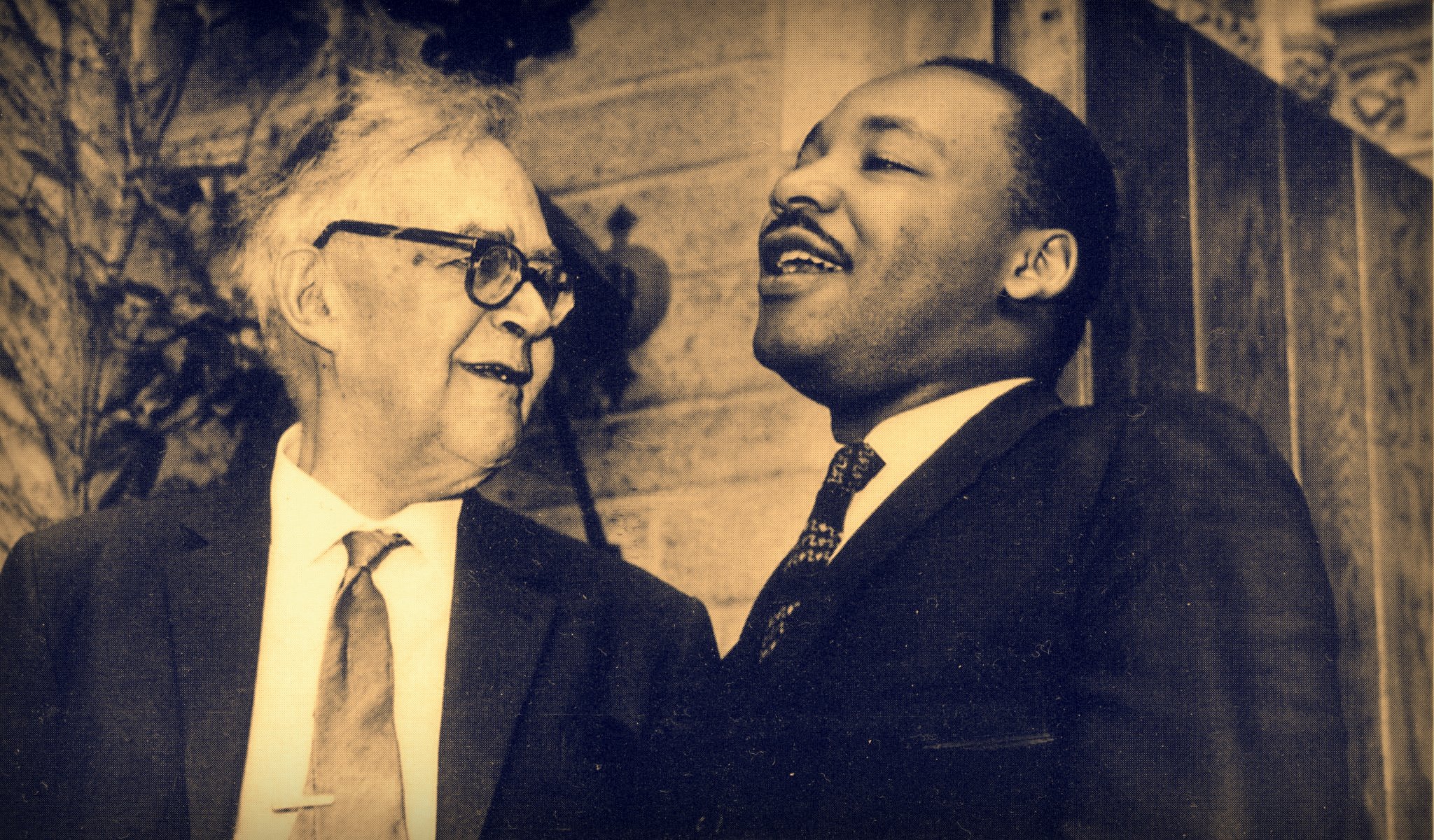
This year’s Martin Luther King, Jr. commemoration comes in the fifth week of the American federal government partial shut-down over a wall. In the name of the Beloved Community — the just and peaceable society — Dr. King and Dr. Barth had things to say about building walls.
Karl Barth and Martin Luther King, Jr. are formative influences on my life. I hadn’t realized until this morning how fully their theology and ethic were in the warp and woof of last Sunday’s sermon at Knox Church in Cincinnati. With apologies to these two great figures, we post an excerpt from a sermon of one of the many lesser lights who live in their long shadows.
Something there is in the Beloved that doesn’t love a wall. Something there is in Jesus that tears down the walls between neighbors and turns enemies into friends, brick by brick, stone by stone — between the Judeans and the Samaritans, and between the male apostles and the Canaanite woman; between the “righteous” who choose purity over compassion and the “good” Samaritan who binds up the wounds of the one in the ditch; between the publicly scorned blind beggar and the charitable nickel-and-dimers who passed by on their way to secure homes and lavish parties; the crowds on the street and the sinful Zacchaeus in the sycamore fig tree; between the Beloved Son and the hosts of sinners who flocked to him for acceptance, forgiveness, healing, hope, and compassion.
For Jesus, love was not a private thing. Love must be made public. As Cornel West puts it, “Justice is love made public.”
Going through airport security recently, I thanked the TSA employees for working. Other passengers did the same. It’s an odd thing to do. We expect employees to show up for work. We also expect their employers to pay them for their work. No one can expect employees to work without compensation.
New flag of the TSA unveiled at the TSA’s 2018 commemoration of the 9/11 attacks.
These TSA workers have families. Their needs are not shut down. Only the paychecks that pay the rent and utility bills, the public transportation to and from work, groceries, insurance, prescriptions, and day care for their families are shut down.
Denver Airport security
“Thank you for working,” said the passengers going through the security procedures put in place to prevent another high-jacking like those on 9/11. Their work is essential to national security. Looking back on it, I’m ashamed of myself. You don’t thank hostages for being hostages. You free them from their hostage-taker . . . without paying the $5.1 Billion ransom to make America safe again.
— Gordon C. Stewart, Chaska, Minnesota, January 20, 2019
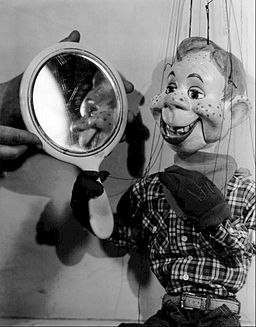
Readers who aren’t geezers didn’t watch the Howdy Doody Show Monday through Friday from their TV dinner trays.
I was never a big fan of Uncle Bob, the emcee, or the mindless Peanut Gallery that broke into frenzies of foolish applause, but I always chuckled when Mr. Bluster appeared.
In this episode Mr. Bluster insists on the impossible — a ROUND mailing envelope to contestants in the “Bluster Contest.”
All these years later, I wonder whether another Howdy Doody fan in Queens sat like the rest of my generation in front of his television, eating a Swanson’s TV dinner on a TV dinner tray.
“Invisibly, almost without notice, we are losing ourselves” (see yesterday’s post) brought to mind the following piece written in 2007.
Do you ever feel invisible? Ever wonder whether you’re really there? I do. People walk by on the street or in the mall…it’s like I’m not there. People walk by like ghosts talking to ghosts. They don’t see me. They’re somewhere else, not really there. They walk like people; they talk like people; they look like people. But their eyes and ears are somewhere else . . . in some far off place. Their heads down, reading or writing a text or staring into space, babbling to someone who’s not there. I’ve become invisible.
I have the same experience driving to and from work. Drivers cut in front of me or run up behind me. They laugh and smile and wildly gesture, but there’s no one else in the car! When their driving puts me in jeopardy, I honk. They just keep talking. They don’t look and they don’t hear anything but the voice on the other end of the cell phone. Even my Toyota’s invisible; it’s become a non-material world.
Sign along Bellaire Boulevard in Southside Place, Texas
It’s nothing new really. Western spirituality has always been dualistic. It says that we have a body and we have a soul – the physical and the spiritual. We have these bodies for a while, and then we die, but we don’t really die; we just escape these bodies, like birds set free from our cages. This dualistic understanding of life made its way from classical Greek philosophy into the writings of St. Paul as the war between “the flesh” and the spirit. “I’ll fly away,” often sung at funerals, expresses the underlying philosophy. “When the shadows of this life have gone, I’ll fly away Like a bird from these prison walls I’ll fly. I’ll fly away.” The rudeness on the highways, in the malls, coffee shops and restaurants — and even in our homes — is the latest expression of this deprecation of bodily existence.
We don’t see each other anymore. The voice on the other end of the phone is more important than the person in front of me, and the ones I cannot see or hear or receive a text from are unreal…in Iraq, Afghanistan, and anywhere else I decide to hang up and nuke their worlds into the permanent invisibility of nonexistence or the fires of hell.
I sit quietly at the airport gate, waiting for my flight. Used to be people would at least acknowledge one another’s existence – the bare fact that you were really there and not somewhere else or nowhere – but now they’re on their phones, babbling away as though the room were empty except for them. Because, I suppose, we’re ancient Greeks with head sets, cell phones, and iPads, seduced by the old idea that we are meant for non-embodied existence. It’s just me and my invisible world, and you with yours, a rude collection of loud mouths with headsets, alone in the crowd, bereft of the silent pauses between the noises that make us anxious.
Barclay and Kristin pausing on the walking path.
Touch is a basic need. My dog knows it. I know it. Hearing and speaking are important. But the most important communication comes by touch. An animal that goes untouched becomes mad as a March hare. So do we.
In this world of disembodied spirits, we crave the gift of touch. But to touch and be touched is a vulnerable thing. It reminds us of our embodied selves, our mortal selves, our dependent and interdependent selves. The non-material world is safer. Unlike the body, the worlds in our head are invulnerable.
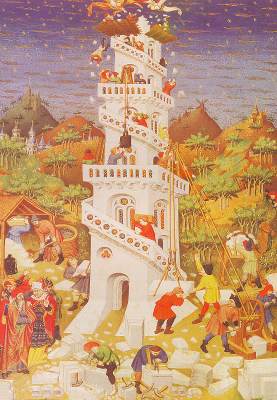
Building of the Tower of Babel – Master of the Duke of Bedford
In my faith tradition, the Feast of Pentecost celebrates the day the babbling stopped, the day the Spirit shifted the crowd’s eyes and ears out of the lonely silos of self-absorption and self-deception — away from their iPhones, iPads, and headsets.
The sound of a mighty wind was so profound, so inescapable and unmistakable, that the company of lonely strangers stopped babbling around the phone tower and noticed the other people around them.
— Gordon C. Stewart, Chaska, Minnesota, Jan. 9, 2019
“Invisibly, almost without notice, we are losing ourselves,” says the quote at the end of this thoughtful reflection. I think of Kosuke Koyama’s metaphor of the three-mile-an-hour God. Why three-miles-per-hour? Because that’s the natural pace of a human being walking.
Physicist, novelist, and essayist Alan Lightman has added his own manifesto, In Praise of Wasting Time. Of course, the title is ironic, because Lightman argues that by putting down our devices and spending time on quiet reflection, we regain some of our lost humanity, peace of mind, and capacity for creativity—not a waste of time, after all, despite the prevailing mentality that we should spend every moment actually doing something. The problem is not only our devices, the internet, and social media. Lightman argues that the world has become much more noisy, fast-paced, and distracting. Partly, he writes, this is because the advances that have enabled the much greater transfer of data, and therefore productivity, have created an environment in which seemingly inexorable market forces push for more time working and less leisure time.
Lightman starts his book with an anecdote from his recent time in a rural…
The Minnesota Scholar, the bi-annual journal of the Minnesota Independent Scholars’ Forum, published this review of Be Still! Departure from Collective Madness in its December 2018 issue.
Psalm 46 tells us, “Be still, and know that I am God.” Gordon C. Stewart, in his collection of essays entitled Be Still! Departure from Collective Madness, meditates on what this means. Is this quietism and withdrawal from the world? Possibly sometimes. But if Jesus bestirred Himself to drive moneylenders from the Temple, how still was He? What consequences would have been inflicted on the sneering Goldman Sachs representatives testifying about their role in the Great Recession described in “American Oligarchy – 4/29/10”? Are stillness and engagement mutually exclusive?
Reverend Stewart did summer internships as a street outreach worker in Philadelphia, worked with a poverty law firm in Minneapolis, and has served in seven congregations and ecumenical campus ministries. Anyone who contributes to Sojourners’ “God’s Politics: Blogging with Jim Wallis and Friends” fits the category of liberal Christian. He recognizes the common ground in the gun debate of fear of the threats of chaos and insecurity and that guns are different realities for rural and urban populations, “The Common Ground Beneath the Gun Debate” and “Reframing the Gun Debate.” However, a description of a call for support from the National Rifle Association indicates he sees the threat from guns, not gun control, “Religion and Politics: Cain and Abel.”
Essays reflect views to be expected from someone with Stewart’s background. He celebrates nature and deplores those who threaten the environment, “Stillness at Blue Spring”, “The World in an Oyster,” and “Climate Change and the Nations.” He deplores a criminal justice system and attitudes which send minorities to prison and death row and makes existing while black perilous, “The Execution of Troy Davis,” “Hands Up! Don’t Carve!” and “Homeland Militarization.” Islamic and other fundamentalisms are seen as evil but the bombings and other military action in retaliation are condemned as, well, “Being Human”, “Creating Hell in the Name of Heaven,” and “Losing Our Heads.” The many sins of capitalism are seen in the context of its victims and protesters, “The Wall Street Tattler”, “American Oligarchy—4/29/”.
The best essays highlight voices of stillness and moments of reflection. Friend Dr. Kosuke Koyama, to whom the book is dedicated, speaks at commemoration of Hiroshima about how the sin of exceptionalism led Japan to self-destruction and threatens the world today, “Only One Sin: Exceptionalism.” Sitting in an Amish rocking chair, Stewart reflects on the forgiveness and kindness extended to the family of a man who murdered Amish school children, “Jacob Miller’s Amish Rocking Chair.” He faces the death of a friend and asks Muslims for prayers and sees that death can be a mercy, “The Waiting Room” and “When Breath Flies Away.” An Airbnb rental in Paris is the apartment of a late Tunisian Sufi poet and novelist whose rooms are filled with books, “The Anguished Heart of God.” He imagines Jesus healing a madman in a Capernaum synagogue in a time too early to have heard the advice that “worshippers should wear crash helmets,” “The Man Who Knew.”
Multiple essays reflect on Stewart’s heritage, especially the coffin makers and others of South Paris, Maine, a town where one is known in relation to the relatives who remain. He sees the tension in St. Augustine, Florida between the local civil rights activists and the celebrities like Martin Luther King and the Southern Christian Leadership Committee (SCLC) who drew more attention. Is it possible to have two Freedom Trails? And is the Civil Rights struggle something historical which happened in the distant past and no longer relevant to later generations?
The essays are preceded by quotes and poems illustrating the theme of the entry. Some of the quoted are well known like Henry David Thoreau, Arnold Toynbee, Wendell Berry, Emily Dickinson, Martin Luther King, Jr., Albert Camus, and Matthew Arnold. Others are welcome discoveries such as Willem Zuurdeeg, a Dutch writer whose parents fought in the Resistance trying to make sense of the fact that civilized Germany could have produced the Nazis,and Stewart’s friend, Steve Shoemaker. The quoteshelp frame efforts to make sense of the world and extract truth from the chaotic events of life.
A collection of essays will, by its nature, be episodic and even disjointed. It is a series of snapshots not a continuous film. Otherwise, it would be a treatise on philosophy or theology. It would be less like life. Although reasoned, the vignettes appeal to emotion which is our ultimate decision-maker. It is a worthwhile work. One may quibble here and there as one will in a conversation, but there are profound truths throughout the work.
As a Baha’i who believes in the oneness of religion, I was hooked at the first essay, “Tide Pools and the Ocean.” Like the proverbial blind men and the elephant, it is easy to mistake one’s tide pool for the ocean, fail to celebrate each tide pool’s unique features, and not see what each really has in common. A good collection of meditations will have something for everyone.
~Steven Miller, President of Minnesota Independent Scholars Forum and participant in a, perhaps, unhealthy number of discussion groups, is a sole practitioner attorney practicing labor and employment for management. He has a B.A. and M.A. from George Peabody College (now part of Vanderbilt University) and a J.D. from Duke University School of Law.
The Minnesota Scholar, Volume 13, Number 2, Dec. 2018.
“All authors want their names to go down in history; I want to keep the smoke coming out of the chimney.” — Mickey Spillane.
Thanks to Steven Miller and Minnesota Scholar editor Evelyn Klein for the smoke from the chimney two years after Be Still!’s publication.

John Buchanan provides in Hold to the Good what he did from the pulpit of Fourth Presbyterian Church in Chicago, and as publisher of The Christian Century: timely reflection on current events in light of biblical texts. His latest post, The Children, shines the light of an often ignored part of the Christmas story — Herod’s Slaughter of the Innocents — on the royal palace’s current cruelty toward children on America’s southern border.







 Views from the Edge