The Cock-Fight

John Boehner and Mitch McConnell

John Boehner and Mitch McConnell

Uh, Oh! Cock-fight!!! 

The GOP House and Senate roosters are at it with each other.

And the loser is…national security and the public image of the GOP. There is no hen house in Congress. Ever tried to herd a bunch of roosters? Cock-a-doodle-do and death to Yankee Doodle Dandy.


How do you know?

How do you know you’re a writer? Ernest Hemingway, William Faulkner, Tennessee Williams, and Virginia Wolff might have “known” because other writers, publishers, and Broadway and Hollywood producers heaped praise on their writings. But the operative word is might. Existential knowing is a different sort of knowing.

Like great athletes, composers, and musicians, great writers are rarely satisfied with their work. They are always reaching beyond themselves. Often they operate from the depths of depression, despair, obsessed with death, the dark depths of the human psyche and the world’s instinct toward self-destruction. Some of the greatest – Hemingway, Wolff, Sylvia Plath, and Edgar Allan Poe – do themselves in.

How do you know you’re a writer? Some would say you “know” it existentially by the ebb and flow between times of creativity and nothingness. When I feel down and the well runs dry as a bone, I know existentially…I might be a writer.

– Gordon C. Stewart, Chaska, MN Feb. 28, 2015, inspired by tour of Ernest Hemingway’s home in Key West, Florida.

Brothers

Our Dad would take a bathroom scale
in both his calloused hands and squeeze
200 pounds. He said his boys
should also press their weight. To fail
meant hearing yet again how he
when in the Navy chinned himself
a hundred times a day. His laugh
at photos when he was skinny
before he read the Charles Atlas
booklet reminded each of us
of Dynamic Tension. We’d take
a towel and pull and tug to make
each tiny bicep that we had
grow big to be as strong as Dad.

– Steve Shoemaker, Urbana, IL, Feb. 27, 2015

The Stories We Tell Ourselves

A month in America’s oldest city, St. Augustine, Florida, makes clear that history is a strange thing. History is the past, but it’s also the telling of it, the renderings of it. The English language does not distinguish between the two – the past as it was – and the past as remembered and interpreted. Only the interpreted past is available to us.

Historians distinguish between the two with the word ‘history’ (the past) and ‘historiography’, defined by the Oxford Dictionary as “the study of historical writings or the writing of history”.

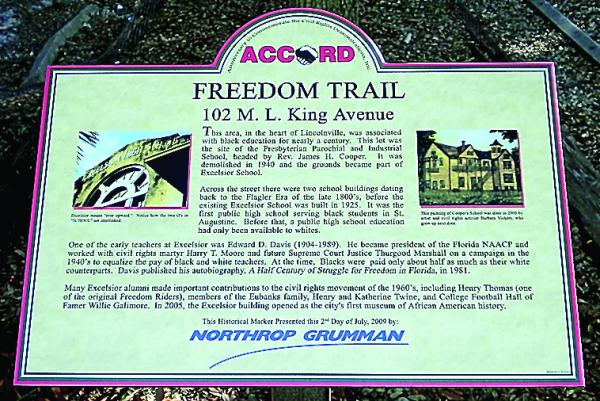
Example of ACCORD Freedom Trail plaques

Example of ACCORD Freedom Trail plaques

Most interesting during our one-month stay in St. Augustine were the different historiographies of the Civil Rights Movement.

Tourists in St. Augustine walk past homes and churches with plaques like this one that tell the story of the brave civil rights history of the ’50s and ’60s on what’s called The Freedom Trail.

The casual tourist is unlikely to notice that the Freedom Trail story is not the only one in town. There are two different sets of plaques. The groups that wrote and erected them represent different, often competing, historiographies.

The more prominent set of plaques the define The Freedom Trail were created by ACCORD.  They highlight the role of the Rev. Dr. Martin Luther King, Jr. and the Southern Christian Leadership Conference.

The other is the project of a group of local citizens led by the Eubanks family, whose father, the Rev. Goldie M. Eubanks, Sr, was Vice President of the St. Augustine Chapter of the National Association for the Advancement of Colored People (NAACP), whose work predated and continued after the arrival of Dr. King and the SCLC in St. Augustine.

The NAACP is the oldest civil rights organization in America. In the 1950s and ’60s, many civil rights leaders came to regard it as too passive, too conservative. The word ‘Colored’ in its name labelled it as out of touch with Back pride.  The Rev. Dr. Martin Luther King, Jr. and the Southern Christian Leadership Conference (SCLC) arose as a bolder, more activist organization, although the the SCLC and the NAACP represented by Dr. King and Roy Wilkins, respectively, worked closely together. To the left of SCLC, the Student Nonviolent Coordinating Committee (SNCC), the Congress on Racial Equality (CORE), arrived on the national scene.

While in St. Augustine, we lived next door to a home on The Freedom Trail identified by ACCORD as important to the Movement in St. Augustine. Some of the men who gathered there every mid-morning until dark seem to identify with Dr. King and the SCLC. Others seem resentful that Dr. King and the SCLC got the praise for the work of Rev. Eubanks, Rev. Thomas, and Dr. Robert Hayling, a courageous local dentist, who paved the way for national media attention to the plight in St. Augustine. The historiography of the latter group is posted on the alternative plaques that focus more on the indigenous leaders who put their lives on the line every day as citizens of St. Augustine.

History and historiography are like that. The four Gospels of the New Testament look at the same time period and events with different memories and different angles on the Jesus story.  The nature of history is that it always leaves itself to interpretation. And the nature of historiography is that it raises the question of the story-teller’s angle.

In light of Dr. King’s later speeches about the intrinsic connection between capitalism, the War in Vietnam, and militarism, it seems a great paradox that it was the Northrop Grumman Corporation, one of the largest Department of Defense contractors, that funded the ACCORD project centered on Dr. King. History and historiography are always strange. Always they involve some concoction of our better selves, self-interest, pride, and sometimes, a heavy dose of irony.


Église Abbatiale Saint-Jouin-de-Marnes (Dennis Aubrey)

Via Lucis Photography of Religious Architecture is a Views from the Edge favorite because of its ability to synthesize art, history, theology, and social commentary centering on the deeper things of the human spirit and the awe of Gothic and Romanesque architecture. In the midst of this post, Dennis Aubrey draws attention to the lion which appears to be spewing foliage. I proposed to Dennis that perhaps the lion is “eating straw like the ox” in Isaiah 11 and 65, Isaiah’s vision of the peaceable kingdom, an interpretation that seems to go well with the church’s sculptural rendering Jesus’ Parable of the Last Judgment in Matthew 25.

Église Abbatiale Saint-Jouin-de-Marnes’s Last Judgment scene suggests an artistic interpretation that eliminates the divide between sheep (saved) and goats (damned), a pictorial witness to the final judgment as universal forgiveness and salvation. To enjoy the original, complete with photographs, scroll down and click on “View the Original”.

Dennis Aubrey's avatar

The church of Saint Jouin de Marnes is known as the Vézelay Poitevin, a tribute to its importance and beauty. It was named after a 4th century hermit named Jovinus from Mouterre-Silly near Loudun. Desiring a retired, contemplative life, he settled on a site of a Roman camp near the road from Poitiers to Angers, ten miles southwest of Mouterre-Silly. The site was called Ension and was in the swamps of the river Dives which flows two miles to the east. In 342 he founded an oratory church which attracted a modest religious community. By the time he died in 370, Jovinus had achieved a great reputation for sanctity and miracles. Over the years, his small community grew in importance, but eventually there was another decline.

In 843, however, the monks of Saint-Martin-de-Vertou in Brittany were forced to abandon their monastery by depredations of the Vikings. With the help…

View original post 968 more words

Lunch at Felix’s Fish Camp

Felix's Fish Camp near Mobile, Alabama

Felix’s Fish Camp near Mobile, Alabama

Driving home to Minnesota from Key West, Florida, Kay and I stop for lunch near Mobile, Alabama. Trip Advisor ranks Felix’s Fish Camp the #8 most highly recommended of 581 restaurants in Mobile, right on the waterfront. An old fish shack; our kinda place!

Our waiter has Southern DNA written all over him. His style is the epitome of Southern hospitality: unhurried, gracious, warm, personable, respectful, friendly. “Yes, Ma’am. No, Sir.”

In his late-2os, Brian is very tall. He kneels down beside the table to get acquainted. He introduces us to Felix’s, talks about the menu, asks about our tastes, and zeroes in on the dishes we might like most.

The man in the next booth overhears the conversation.  He’s smiling. Getting to his feet with the help of his cane, he comes by to say hello. Turns out he’s from Duluth, Minnesota, a traditional stronghold of the Democrat Farm Labor Party. He and his wife closed their chiropractor office in Duluth three years ago to retire near his son in Mobile. He asks what brings us here and what we did for a living. He smiles. “You’re a pastor. You like people. What church?” “Presbyterian,” I say.  “I’m a Lutheran,” he says. “What’s your favorite Scripture? Mine is Psalm 91. I learned it as a child and can still recite it from memory.”

Lunch at Felix's Fish Camp, Mobile, Alabama

Lunch at Felix’s Fish Camp, Mobile, Alabama

Brian delivers the fish, topped with fried oyster, shrimp with cheese grits, and side dishes of almond green beans, cheese grits, and turnip greens to die for.

At just the right moment, as skilled waiters do, Brian returns to ask whether we’d like desert, maybe some lemon pie or Key Lime Pie. The lemon is more unique to Felix’s but he thinks perhaps we might prefer the Key Lime.

After the Key Lime pie, we thank Brian for his extraordinary hospitality and service, promise to write a review on TripAdvisor, pay the bill, and say goodbye.

The relocated Minnesota couple leave at the same time. As the four of us walk way out together, our new friend wishes us a safe trip home and then says “Before you go, I have a question for you. Which Republican do you like for 2016?”

His wife grimaces. We just smile. Maybe he’s forgotten that he’s from Duluth, or maybe he’s being playful one last time…or maybe he’s confusing Christian and Republican. We’ll never know. Life is funny like that.

– Gordon C. Stewart, Chaska, MN, Feb. 26, 2015


Privatization: the Death of Public Life

Dennis Aubrey, photographer of great religious architecture, brought to our attention this edgy view from The Guardian on the deleterious effects of privatization on the city of London.

Photo of Europe's tallest building, The Shard, Lorenzo Piano, architect

Photo of Europe’s tallest building, The Shard, Lorenzo Piano, architect

Click The city that privatized itself to death and ponder the meaning of “us” and the political economy of greed in the U.S.A.


Hey Chicago, waddya say?

Long-suffering Chicago Cubs fans like Steve Shoemaker are excited about this season. The Cubs look like a serious contender in 2015. The club’s new owners have invited fans to write a new song for home games at Wrigley Field. Steve explains his contribution. “Steve Goodman in 1984 wrote ‘Go Cubs Go’.  It is sung by surprised fans after each Cub win. It does not really fit since Goodman wrote it to ENCOURAGE the Cubs. Instead of writing a new song, here is my revision of Goodman’s classic.” Click HERE for a YouTube video of Steve Goodman’s original Go Cubs Go. Here’s Steve’s new rendition:

Go Cubs Go

Baseball season’s underway
We hope ya got ready for a brand new day!
Hey Chicago waddya say?
The Cubs have gone and won today!

We’re singing:
Go Cubs, go!
Go Cubs, go!
Hey Chicago, waddya say!
The Cubs have gone and won today!

Go Cubs, go!
Go Cubs, go!
Hey Chicago, waddya say!
The Cubs have gone and won today!

They got the power, they got the speed,
They are the best in the National League!
Well this is the year and the Cubs are real,
So join us here at Wrigley Field!

We’re singing now:
Go Cubs, go!
Go Cubs, go!
Hey Chicago, waddya say!
The Cubs have gone and won today!

Go Cubs, go!
Go Cubs, go!
Hey Chicago, waddya say!
The Cubs have gone and won today!

Baseball time is here again–
We just saw another win!
So stomp your feet and clap your hands!
Chicago Cubs got the greatest fans!

We’re singing now:
Go Cubs, go!
Go Cubs, go!
Hey Chicago, waddya say!
The Cubs have gone and won today!

Go Cubs, go!
Go Cubs, go!
Hey Chicago, waddya say!
The Cubs have gone and won today!

Go Cubs, go!
Go Cubs, go!
Hey Chicago, waddya say!
The Cubs have gone and won today!

– Steve Shoemaker, Urbana, IL, Feb. 23, 2015

Roosters in the Republican Barnyard

Roosters crowing

Roosters crowing

The cocks are crowing again.

Former failed Republican Presidential aspirant Rudy Giuliani started it by saying he isn’t sure President Obama loves America. He quickly tried to backtrack, explaining he wasn’t questioning Mr. Obama’s patriotism.

My, oh my!

No sooner had the old rooster crowed than that nasty old press asked the young roosters who are strutting and crowing to rule the Republican barnyard to chime in on Giuliani’s cock-a-doodle-do. Scott Walker, who was at the dinner where Giuliani made his statement, refused to comment on Giuliani’s statement one way or the other.

Days later while the issue was still live, a reporter again asked Walker to comment.

Leaning on the strategy that the best defense is a good offense, Walker blamed the press for making too much of statements like Giuliani’s. But it wasn’t the press who said that Mr. Obama wasn’t a native-born American citizen, or that he’s a secret Muslim, or that he hates America. It was members of Walker’s party who said those things. The press asked Mr. Walker if he thought the President was a Christian. In light of the history of character assassination leveled at the President, posing the question “Is President Obama a Christian?” to a young Rooster strutting around the barnyard with his eye on the Oval Office doesn’t seem like a fowl question.

Walker cried fowl. He replied that such questions are why people hate the press. People are tired of the media asking questions the American people don’t care about. Hmmm. Like whether a professing Christian President who quotes the New Testament in his speeches is a secret Muslim? The press card is very much like the race card. You only pull it out when you have no real defense.

In “The Insiders: Why would anyone think Obama doesn’t love America? Plenty of reasons,” a follow-up to the Giuliani story by Ed Rogers in The Washington Post argues that “Obama’s policies, declarations and overall conduct in office make some think he is dissatisfied with America and its self-image.”

Love and satisfaction are two different things. Can one love a country, a person, a group, a party, and be dissatisfied? If the answer is no, say good-bye to Martin Luther King, Jr. Say good-bye to Edward R. Murrow and Daniel Schorr. Say good-bye to the biblical prophet Amos whose tongue was sharper than Al Sharpton’s not because he hated his country but because he genuinely loved it.

The cocks are crowing in the barnyard. “Before the cock crows, you will deny me three times.” Roosters and the betrayal of truth have a long history. Whenever a rooster struts and crows, listen carefully.

Home is where your dog is

Video

When we arrived last evening the little guy couldn’t contain himself. He ran back and forth between us, wagging his tail and jumping for joy. Barclay’s been accident-free for more than a year. When I picked him up the second time, his tummy was slightly wet. He was so relieved to have us home and we were equally relieved. -:) So was Kristin, his care-giver since Dec. 30, who announces our homecoming in this video.

Home is where your dog is.