I am the enemy who must be loved

Bill Britton's avatarRicher By Far

“It took me a long time to learn that God is not the enemy of my enemies. He is not even the enemy of His enemies.” Martin Niemöller

“The acceptance of oneself is the essence of the whole moral problem and the epitome of a whole outlook on life. That I feed the hungry, that I forgive an insult, that I love my enemy in the name of Christ – all these are undoubtedly great virtues. What I do unto the least of my brethren, that I do unto Christ. But what if I should discover that the least among them all, the poorest of all the beggars, the most impudent of all the offenders, the very enemy himself – that these are within me, and that I myself stand in need of the alms of my own kindness – that I myself am the enemy who must be loved…

View original post 322 more words

Verse – Septet Cursing Illness

Waking up to the smell of bacon

Waking up to the smell of bacon

I’ve never really liked the bathroom–
Smelly, necessary pathroom.

Kitchens! Can you smell the bacon?
Kneading, rolling, roastin’, bakin’

Frying, broiling, Bar-B-Queing
Even chickens, we are stewing–

Well? In pot, but sick, on pot…

  • Steve Shoemaker, Urbana, IL, Dec. 4, 2015. Photo of Spanky added by Spanky’s partner in crime on Views from the Edge.

NOTE: Steve has been writing this week from the Mayo Clinic where he’s being treated for pancreatic cancer.  Hour by hour is a roller coaster ride from yesterday’s “Celebrating Illness” to today’s “Cursing Illness.” He can still smell the bacon, but he can’t eat it. But  his good humor is in tact. Steve’s friends and family are celebrating him and cursing the illness while following updates on CaringBridge and cheering on his spirit.


Huckleberry Finn and Steve

Steve Shoemaker, my poet colleague on Views from the Edge, is at Mayo Clinic here in Rochester getting a second opinion on newly diagnosed pancreatic cancer and silent heart attack. He recently shared the news with his friends, many of whom had applauded his recent advocacy for welcoming Syrian refugees.

Here’s what Steve wrote:

In Mark Twain’s “Huckleberry Finn,” the young rascal lets his family, and the whole small Missouri town, think he was drowned in the Mississippi River & his dead body carried down stream… And then Huck snuck back into town in disguise and attended his own funeral.

The frequent truant was amazed at all the nice things said about him–even by his school teachers.

This has been my experience the last few days as my serious cancer diagnosis became known, along with a surprisingly positive article in our partisan Republican News-Gazette about Democrat me being critical of Illinois’ Republican Governor refusing State aid, public or private, to vetted Syrian refugees.

As I spoke & wrote about welcoming Syrians, the outpouring of support & personal praise has been amazing…some of the positive words coming even from my grown children (who seeing me up close for years could have written very differently.)

Of course I know after bad news, and at a funeral, critics are silent or absent. I am grateful for both the good words, and the silence!

Illness, diagnoses, prognoses and treatments are personal. Some keep them not only from others but from themselves. Not so with Steve. This is typical Steve. What’s not to love about a humble rascal?

  • Gordon C. Stewart, Chaska, MN, Nov. 28, 2015

Verse – Septet Celebrating Illness

Some medicines make pain go away–
My visitors know just what to say.

Most doctors speak in just the right tone–
I see nurses smile, yes, through the phone.

Family and friends recall each good time–
Poets send limericks–some even rhyme!

Greet each new sun–I’m still having fun…

  • Steve Shoemaker, Mayo Clinic, Rochester, MN, Dec. 2, 2015. Also posted on Steve’s Caring Bridge page.

Christmas is for Losers

As a loser who has failed more often than not in preaching the Christmas story, I find this blogger’s rendering refreshing. I identify with the shepherds and the bacon. – Gordon

Source: Christmas is for Losers

Nine-tenths of reality on a new/old corner

Thanks to the Chaska Herald for publishing this Opinion commenary last Thursday in advance of the grand opening of Chaska’s redeveloped site, a source of contention and controversy.

PARK PERCEPTION VERSUS REALITY by Gordon Stewart

"Illusion"- W. E. Hill

“Illusion”- W. E. Hill

Wednesday, Dec. 2 — after a hard public debate over Fireman’s Park — the newly developed site, with its event center, curling center, Crooked Pint Ale House, and redeveloped park will open its doors to a divided public.

They say perception is nine-tenths of reality. Listening to the public discussion about redevelopment over the past few years, the old adage helps explain the differences in how various Chaska residents view Chaska’s most prominent street corner.

In teaching psychology, a particular drawing of a woman is used to illustrate the power of perception. Every member of the class is asked to look at the same picture. Some see the beautiful face of a young woman wearing a fancy hat with a plume. Others see a mean old woman with an enormous chin and the kind of nose that belongs next to a witch’s brew in fairy tales.

How could different people see the same reality so differently? Or were they seeing different realities? Some who saw the beautiful young woman could not perceive the old woman. Likewise, those who saw the mean old woman could not see the beautiful young woman. Objectively speaking, both women were in the picture waiting to be perceived.
What we see is shaped by memory and experience.

During the debate before the final decision on its redevelopment, many of us perceived the corner as a beautiful park under assault. The memory was of a pristine Firemen’s Park, a lovely open-space created in honor of Chaska’s firemen, green space surrounding the historic clayhole. It was where we went as children or teenagers to swim, fish, or enjoy a family picnic.

Others had a different impression of the corner. Our memory was the truck manufacturer that stood on the corner, an eyesore that struck visitors more like the witch in the psychology class picture. Passersby did not see a beautiful park or green space; they saw a site with no aesthetic sensibility. It was not a corner to be proud of, and it had nothing to do with Firemen’s Park.

No one seems to have remembered what the corner looked like 10 years ago. It would be hard for anyone to look at that the corner of Highway 41 and Chaska Boulevard and say it was beautiful.
Reality may be nine-tenths perception. But the other one-tenths also counts. Sometimes the buried memory lies in the one-tenth we don’t recall.

One of my first days in Chaska in 2006 I stopped in at the downtown Dunn Bros for a cup of coffee. I asked the young person behind the counter to tell me about Chaska. “Which Chaska?” he replied. “Old Chaska or new Chaska?” I was surprised; I didn’t know there were two. He explained that I was in old Chaska; new Chaska was up the hill.
In American general perception — sad though it may be — new means young and vibrant, like the beautiful young woman. Old means over-the-hill and dying.

All across America, downtowns are either crumbling with boarded-up businesses or they are being successfully redeveloped to preserve, re-populate, and energize them in ways that overcome the old-new divide.
The promise of the new site is that younger people from far and wide will be drawn by its beauty for curling, a pint of ale and a hamburger with a beautiful view of the clayhole, maybe a fishing rod, and a stroll on the new walkways around the old park.

Chaska redevelopment at corner of Chaska Blvd. and State Highway 41

Chaska redevelopment at corner of Chaska Blvd. and State Highway 41

As one of Chaska’s more un-athletic residents, older in age but newer to the city, I’ll be there Wednesday, where the forgotten eyesore stood, to learn a new sport that won’t threaten my health and celebrate the renewed promise of a thriving “old Chaska.”

  • Gordon C. Stewart, Chaska, MN, Dec. 2, 2015

President Obama – 10 Hours Ago

I’m heading to Paris today to join nearly 200 countries for a global conference on climate change. It’s an opportunity to stand in solidarity with our oldest ally, just two weeks removed from the barbaric attacks there, and reaffirm our commitment to protect our people and our way of life from terrorist threats. It’s also an opportunity for the world to stand as one and show that we will not be deterred from building a better future for our children.

What makes this gathering different is that more than 180 nations have already submitted plans to reduce the harmful emissions that help cause climate change. And America’s leadership is helping to drive this progress. In fact, our businesses and workers have shown that it’s possible to make progress towards a low-carbon future while creating new jobs and growing the economy. Our economic output is at all-time highs, but our greenhouse gas emissions are down towards 20-year lows.
So what we’re trying to do in Paris is put in place a long-term framework for further emissions reductions – targets set by each nation, but transparent enough to be verified by other nations. And we’ll work to mobilize support to help the most vulnerable countries expand clean energy and adapt to the effects of climate change we can no longer avoid.
I’m optimistic about what we can achieve – because I’ve already seen America take incredible strides these past seven years. And with that – I’ll see you in Paris.

  • Gordon C. Stewart, Chaska, MN, Nov. 29, 2015. Makes me proud of my President today.

A Presbyterian Call to Welcome Refugees

“Our Call to Support Refugees from Syria and the World”

NOTE: Views from the Edge has added colored highlights to the text.

Presbyterian Church (U.S.A.) congregations have supported refugee resettlement since the refugee crisis created by World War II. The 160th General Assembly (1948) of the Presbyterian Church in the United States of America stated, “The United States should pass legislation to bring in at least four hundred thousand displaced persons during the next four years. … As they arrive, our church people should stand ready to open their homes and provide work for these unfortunate victims of war” (Minutes, PCUSA, 1948, Part I, p. 204). The people from the pews who approved that policy did so because they knew that scripture calls us to shelter the homeless (Isaiah 58:6–12) and welcome the stranger (Matthew 25:31–46).

The call is no less necessary today. Nearly 60 million people are displaced by war and persecution; 30 million of those displaced are children (UNHCR).  The crisis in Syria alone has displaced 11 million (UNHCR). Families are risking their lives and fleeing their homes to seek safety. They are spending months journeying, sleeping outside, paying smugglers for safe passage, and praying for a future for their families in a place that is safe from conflict.

They fear and flee many of the organizations that we also fear: ISIS, Boko Haram, Mara 18, Los Zetas. Right now governors are attempting to block the resettlement of Syrian refugees into their states because members of ISIS are sometimes Syrian. Ask yourself, should a victim’s shared nationality with perpetrators of violence exclude them from protection in this country?

Entering the U.S. as a refugee is not a quick or easy process. Refugees are the single-most scrutinized migrant group to enter the U.S. They undergo rigorous screening by multiple security agencies at multiple times during their pre-arrival processing (U.S. Committee for Refugees and Immigrants). This process can take more than two years. Once they arrive in the United States, they continue to be screened every time they leave and reenter the country and when they apply for employment cards, green cards, or naturalization.

The risk is low and the humanitarian need is great. While, technically, governors cannot dictate where the federal government resettles refugees, the State Department only resettles refugees in areas where they know communities will thrive (USA Today). Governors are saying for their states, “No room at this inn.” Now is the time for the faith community to speak up on behalf of refugees, from all countries. Do not let the noise of a fearful few drown out compassion, facts, and logic. Answer the call to act prayerfully and recommit as an individual, congregation, or mid council through co-sponsorship, volunteer hours, and donations through your local resettlement agencies. Then send or personally deliver a letter, like the one at pcusa.org/immigration, to your governor about the kind of society we should be. If you personally deliver your letter, please take photos and post on Facebook and Twitter using the hashtags #ChooseWelcome and #RefugeesWelcome. …. Thank you!


  • Gordon C. Stewart, Chaska, MN, Nov. 29, 2015.

Eve of the Climate Summit

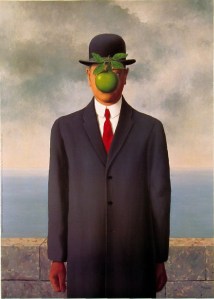
Son of Man, René Magritte (1898-1967)

Son of Man, René Magritte (1898-1967)

Son of Man, René Magritte’s self-portrait with the green apple in front of his face, seems equally appropriate for the First Sunday of Advent and the opening of the United Nations Climate Summit in Paris.

What Magritte meant by hiding his face (except for one eye) with the apple is left to the imagination.

To this viewer the apple’s presence in front of a man of civilized sophistication – bolo hat, buttoned-up dark suit, fitted white shirt, and perfectly knotted red tie – moves imagination in two directions.

The first is often discussed by art critics: the Genesis story of the Fall and the forbidden fruit – the serpent’s whisper that the creatures in the garden could “be like God” by stepping over the one limit imposed on their behavior by a paradisiacal ecosystem.

On this eve of the World Climate Summit, a second interpretation comes to mind – the primacy of nature – the green apple. For all our sophistication, we are nothing without the green planet whose green-ness climate change places at risk.

Magritte’s Son of Man opened me to hear today’s assigned Hebrew Scripture from the Revised Common Lectionary with different ears.

The days are surely coming, says the LORD, when I will fulfill the promise I made to the house of Israel and the house of Judah.

In those days and at that time I will cause a righteous Branch to spring up for David; and he shall execute justice and righteousness in the earth. [Jeremiah 33:12-14]

A righteous branch yet may spring up in Paris. If it does, it will be green. One can pray that the Climate Summit representatives arrive in Paris without their bolo hats, starched white shirts, buttoned-up suits, and power ties, ready to concede finally that, despite all appearances to the contrary, all is nothing without green.

  • Gordon C. Stewart, Chaska, MN, Nov. 29, 2015

Pope Francis, Climate Change, and Literacy

Long-time friend Dan Wagner attended the Vatican consultation on climate change at Pope Francis’s invitation in recognition of Dan’s work in global adult literacy education.

Click A Papal Education to learn more about the   link between, poverty, literacy, and action on climate change.

Daniel A. Wagner is UNESCO Chair in Learning and Literacy, Professor of Education at the University of Pennsylvania, and Director of the International Literacy Institute.

  • Gordon C. Stewart, Chaska, IL, 2015.