The Manatees at Blue Spring

Our hearts are strangely quieted. Calmed. At peace as we watch the West Indian Manatees move through the virgin waters of Blue Spring. We are standing on holy ground.

Manatee at Blue Spring

Manatee at Blue Spring

So gracefully does the Manatee approach the spring head, the deep vertical cave through the limestone that gently empties165 million gallons of water per day into the St. Johns River from the aquifer below, enough for every resident of greater Orlando to drink 50 gallons of water a day. The Manatee knows nothing of Orlando. Nothing of Epcot or Disney World. Nothing of vacations, technology, or malls, or the Holy Land amusement park. She lives where she is . . . in this undisturbed place where she spends her winters to survive the cold by the warm water of Blue Spring.

Her movements are effortless . . . fluid and gentle, like the water around her. Her huge flat tail, like a leaf wafting in a soft breeze, moves her through the aqua blue waters of the pool. Slowly, very slowly, she inches toward the edge of the black oblong opening in the water, the deep black hole in the Earth. Her tail stops moving. She stops. She stays very still. She lowers her head, alike the Virgin Mary pondering the mystery of the Incarnation, as if to bow down to the source of her life.

Blue Spring is its own kind of Temple. A sacred place of the deepest silence where only those natural to this habitat belong. Today I was there, and the beauty of it deepened the sense of wonder of flesh and blood and water and algae and sabal palms and a natural quiet. My head bows, mellowed and calmed, joining the Manatee, bowing over the place deep below the surface from which the pure water flows.

I, Judas

They will say I did it. And I did. We all did. But it doesn’t matter. The kiss, the “shalom”, I gave him in the olive grove was as real as real can be. I kissed him, and everything that was in me was in that kiss. My love, my affection, my admiration, my fear…and my belief that it would wake him up to what was really happening and what he had to do.

The world is a cruel place. It plays by hard rules. He wouldn’t play by the rules, which is why we loved him but also why we pushed him at the end. We pushed him over the cliff.

He’d escaped the cliff once before when his neighbors tried to throw him over it. He walked right through that crowd and went on with his life, and that’s why we gathered around him like newborn kittens with their mother. He became the source of nourishment, the mother whose eyes always saw the good in us, and he taught us to forget about the cliffs. Live to the full. Forget the cliffs! But there comes a time in everyone’s life when you can’t avoid the cliff.

We were standing at the edge of it right there in the Mount of Olives – a fatal cliff of soldiers, clubs, and daggers, a Roman battalion who’d come there, where we always met at night among the olive trees so they couldn’t hear us or see us. I led them there to the private place.

They will say I ratted on him. But I did what I knew I had to do, or thought I had to do, and then scurried away before it was over. I couldn’t watch. I hated those bastards as much as I loved him, hanging there where the skulls were left. As I ran, I looked back over my shoulder at the horror of it, hearing the sounds of the hammers and the grinding of the pulleys hoisting him up on those pieces of imperial lumber, and him screaming with pain suspended mid-air… half way between horizontal and vertical…and I fleeing for my life into fatal despair.

I understand why they’ll say what they they’ll say. They have to say it. Denial is one of God’s great gifts. They had to deny their own responsibility for what happened. We were all in this together, except for the Beloved Disciple, Lazarus, the only one of us who knew already that death is not the final Word, no matter how it comes, the disciple who will disappear into silence in the later texts about what happened. But Lazarus was there watching, listening, seeing what the rest of us could not see until after it was over.

Unlike the others, I didn’t give myself time to get it. I fled the scene, running for my life, never wanting to look back on it, howling in silence, rushing out into the field to hang myself from a tree. Symbolic, some will say: the tree of the knowledge of good and evil and all that … but to me it was just a tree with limbs to throw the rope over, a place to end my pain.

I think now of the olive trees and of hiding among them and wonder why we hid. I think of him as the olive branch that the dove brought to Noah as the violence of the flood receded. And I wonder if that was maybe what he was all about, if the olive branch instead of clubs and daggers and scapegoating was why he let me kiss him there and turn him over before he rebuked Peter for drawing his dagger.

They won’t tell you that we all had daggers. Not just Peter. We were revolutionaries. Ready for the fight. Itching for the fight. Yeshua was the new Joshua who would throw the bums out, restore the fortunes of our people, give us back our land, our destiny, our power to rule ourselves as we had in David’s time and Solomon’s. There was that day in the Temple, Solomon’s Temple, when he went crazy with the whip against the money-changers, snapping the whip wildly, out of control, angry at the abuse of his religion and our’s, tossing the money everywhere, yelling about the money-handlers’ abuse of the poor who could barely afford to buy a pigeon for their sacrifices. For him, it wasn’t just about self-determination. It was about the Romans, about the end of foreign occupation and the collaboration of the religious establishment. But it was deeper than throwing out the foreign occupiers. It was about something so deep that the mind and heart can barely comprehend it: the fearful conspiracy of self-interests that betrays and kills all that is good and pure and decent and loving.

Only Lazarus understood what he was about in standing up to the rule of death enshrined in the Temple and imperial threats. He saw in Yeshua the scapegoat who could unmask the conspiracy, the new Joshua who would shift us from eating the forbidden fruit of the tree of the knowledge of good and evil, dividing the world into the good and the evil, to eating of the fruit of the tree of life.

I broke my neck on the tree of the knowledge of good and evil, certain that I, one of the “good” ones, had become as evil as the soldiers who crucified him, and that there was no redemption, no way to the tree of life, no way to atone, no way to erase the kiss that killed him and was killing me. Death was my just desert and worse. If only I had known that the kiss would be the kiss of death.

It gives me little comfort that they tell me he begged the Father from the cross for forgiveness, like a defense attorney pleading with a judge that those who were crucifying him didn’t know what they were doing. It is what it is. Or so I thought at first. But the weight of his words led me to the sound of them, coming as they did from the high heat of that awful scene, soft and genuine or loudly shrieking, invoking a mercy on us all that made no sense, no sense at all.

Peter will say, as will the church three centuries after my death on the tree and burial in potters field, that “he descended into hell” at his death and preached to those imprisoned there. If anyone was ever there in that place of self-hate, remorse, guilt, despair and hopeless self-loathing, it was I.

He met me there with a holy kiss. “Shalom,” said he. I kissed him back. And left my sorrow in the emptied cell.

– Gordon C. Stewart, January 10, 2014.

Verse on Snow

I only know three
(Expurgated Version)

I only know three of the Inuit words
for snow, and they are, in translation, “the-snow-
that-falls-light-and-fluffy-and-can-be-ignored;”
“the-snow-wet-enough-to-make-two-obscene-snow-
folks-frolicking-out-in-the-yard;” and then last,
“the-white-stuff-that-falls-so-darn-wet-thick-and-fast-
that-shoveling-is-required-just-to-go-out-
for-beer.” (And that last word is said as a SHOUT!)

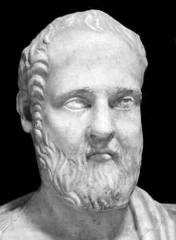
Isocrates, Greek teacher and rhetorician

Isocrates, Greek teacher and rhetorician

Steve (Isocrates) Shoemaker, Urbana, IL, January 9, 2014.

It’s all there in the Christmas story

Verse – Sonnet

A sonnet is made up of fourteen lines
With just ten syllables in each of them–
Which means for people reading on their phones
Some lines are split–which really is a shame.

Almost all of old sonnets had a rhyme
On every other line for the first twelve.
Which works just fine almost all of the time,
But sometimes words are very hard to melve…

The first four lines of this end with “half-rhyme.”
This is a trick that helps a poet make
More choices–not repeating all the time
The same old rhyme… A sonnet may then take

An image to go far beyond the words–
Though some seem quite forced: two flying birds!

– Steve Shoemaker, Urbana, IL, New Years Day, 2014

On the Cusp of Wonder

New Year’s Eve.

Every calendar with its years is a culture’s invention, a way of breaking the eternal rolling of sunrises and sunsets into an order that suits our needs for what?

For celebration? For budgets? For control? For forgiveness? For hope?

All of the above and more?

Between the passing of one year and the dawning of another we sense a shifting, the movement of something that does not exist: time, the human way of marking turf in the eternal rolling of the spheres.

The tides of time pay no attention because, like time itself, the tides are timeless. They know nothing of us. They ebb and flow in ceaseless rounds of who knows what. And we, standing on the shore’s edge between two tides awaken again to the sense of wonder before what we do not control.

Perhaps Isaac Watts had something like that in mind when he paraphrased Psalm 90:

Before the hills in order stood,
or earth received its frame,
from everlasting thou art God
to endless years the same.

A thousand ages in thy sight
are like an evening gone,
short as the watch that ends the night
before the rising sun.

Time, like an ever rolling stream,
bears all its sons away;
they fly forgotten as a dream
dies at the opening day.

Our God, our help in ages past,
our hope for years to come,
be thou our guard while life shall last,
and our eternal home.

– Isaac Watts, 1719

Since the middle of the 19th century, Watt’s paraphrase has been sung to the tune of St. Anne, named after the London parish where Watts was organist. Click HERE for more on Sir Isaac Watts.

Old Friends (an acrostic)

Have you recalled the fun we had
All those long years ago? So young,
Poor, ignorant a girl, a lad–
Perhaps our song would not be sung,
Yet we would gather, drink, and play.

Not caring what the hours were,
Enjoying ourselves every day,
We danced and laughed our fears to cure.

Years have gone by and yet we know
Each time we meet our smiles will show
Awareness of what they forgave:
Real kindness, all our lives to save…

– Steve Shoemaker, Urbana, IL, December 30, 2013

A Long Road

Yes, Race Street went from north to south
in front of my high school. I’d drive
each day from home and risk the wrath
of Mr. Rice when I’d arrive
five minutes late because I’d wait
for both the Larson twins who lived
with three more brothers down the street.

No, that was fifty years ago
and now I live a half mile east
of Race Street, but each day still go
that way to town. I drive right past
the football field where we would cheer
and hold the hands of those we loved.
How did we get from there to here?

– Steve Shoemaker, Urbana, IL, December 28, 2013

Limerick on Heinlein’s Razor

My first thought was that he was horrid.
The language he used was quite florid.
Perhaps he was mean
or not very keen–
is it wrong just to say he was stupid?

Steve Shoemaker’s limerickized version of Heinlein’s razor (sometimes called Hanlon’s razor): “Never attribute to malice that which can be adequately explained by stupidity.”

God the Stranger

I “know” less and less of what I thought I knew. The world has driven me into the unknowing silence out of which James A. Whyte spoke at the funeral in Lockerbie, Scotland in 1989.

During his term as Moderator of the Church of Scotland, The Right Rev. Dr. Professor James A. Whyte , still grieving the death of his wife, was called upon to lead the memorial service after Pan Am Flight 103 was blown out of the sky over Lockerbie. Among the most quoted parts of the sermon is this excerpt:

“That such carnage of the young and of the innocent should have been willed by men in cold and calculated evil, is horror upon horror. What is our response to that?

The desire, the determination, that those who did this should be detected and, if possible, brought to justice, is natural and is right. The uncovering of the truth will not be easy, and evidence that would stand up in a court of law may be hard to obtain.

Justice is one thing. But already one hears in the media the word ‘retaliation’. As far as I know, no responsible politician has used that word, and I hope none ever will, except to disown it. For that way lies the endless cycle of violence upon violence, horror upon horror. And we may be tempted, indeed urged by some, to flex our muscles in response, to show that we are men. To show that we are what? To show that we are prepared to let more young and more innocent die, to let more rescue workers labour in more wreckage to find the grisly proof, not of our virility, but of our inhumanity. That is what retaliation means.”

For James Whyte God is often silent. We are called to enter the space of God’s silence, the silence of the cross, the confusion and horror of the suffering of God at the hands of a world filled with man-made gods: security, freedom, nationalism, religion, muscle, revenge and self-righteousness, cultural supremacy. In the Jesus of the cross, Whyte’s eyes saw not only a naked man but God’s nakedness – a naked God stripped of all power, his arms roped to a cross-beam paradoxically spread wide to embrace the whole world of human suffering and folly.

James Whyte took time out of his busy life in 1991 to act as a conversation partner and mentor for an American pastor whose congregation had granted its pastor a sabbatical leave in St. Andrews. They met twice weekly for two months in his flat over tea and scones, the young American absorbed in the vexations of Christian claims to Christ’s uniqueness and universality, on the one hand, and religious pluralism, on the other, the good Right Rev. Dr. Professor listening attentively, maintaining a poignant silence that respected his mentee’s process. When the pastor left Scotland, he asked his mentor for a copy of prayers James Whyte had offered during worship at the Hope Park Church in St. Andrews. Each of the prayers was as thing of beauty. Each began with a quotation from the Book of Psalms.

James Whyte’s spirituality echoes that of an old Hasidic Rabbi (Barukh of Medzebozh [1757-1811]) reflecting on Psalm 119.

“I live as an alien in the land;
do not hide your commandments from me”
– Psalm 119:19

Rabbi Barukh of Medzebozh said of this psalm:

“The one who life drives into exile and who comes to an alien land has nothing in common with the people there and has no one to talk to. But if a second stranger appears, even though that person may come from quite a different place, the two can confide in each other. And had they not both been strangers, they would never have known such a close relationship. That is what the psalmist means: ‘You, even as I, are a sojourner on earth and have no abiding place for your glory. So do not withdraw from me, but reveal your commandments, that I may become your friend.”
– Martin Buber, <a href="http://www.amazon.com/Tales-Hasidim-Early-Masters-Later/dp/0805209956(

” title=”Link to information on Tales of the Hassidim”>Tales of Hassidim – the Early Masters.

Thanks you, James Whyte, good and faithful servant and friend of God the Stranger. RIP.