American Buncombe: H.L. Mencken

“The larger the mob, the harder the test. In small areas, before small electorates, a first-rate man occasionally fights his way through, carrying even the mob with him by the force of his personality. But when the field is nationwide, and the fight must be waged chiefly at second and third hand, the force of personality cannot so readily make itself felt, then all the odds are on the man who is, intrinsically, the most devious and mediocre — the man who can most adeptly disperse the notions that his mind is a virtual vacuum.

“The Presidency tends, year by year, to go to such men. As democracy is perfected, the office represents, more and more closely, the inner soul of the people. We move toward a lofty ideal. On some great and glorious day the plain folks of the land will reach their heart’s desire at last, and the White House will be adorned by a downright moron.”

  • H.L. Mencken (1880-1956), “Bayard vs. Lionheart,” Baltimore Evening Sun, July 26, 1920, later published in On Politics: A Carnival of Buncombe. Click for a definition of ‘buncombe’.


An American in a Strange Land

The title of Jim Yardley’s essay in the latest New York Times Magazine –“An American in a Strange Land“–reminds me of William Stringfellow’s book An Ethic for Christians and Other Aliens in a Strange Land and the biblical roots of “the strange land” metaphor. But the longer I pondered Yardley’s montage of American life, my heart went back to Jesus’s familiar, albeit misunderstood, invitation to the weary.

“Come to me, all you that are weary and are carrying heavy burdens, and I will give you rest. Take my yoke upon you, and learn from me; for I am gentle and humble in heart, and you will find rest for your souls. For my yoke is easy, and my burden is light.”
[Gospel of Matthew 11:28-29 NRSV].

On his month-long trip across America in search of answers to what had changed during his 10 year absence, Yardley pieced together the vastly different experiences he encountered into a montage that cries out for further explanation. The montage includes the residents of El Paso, Texas, no more than a long baseball throw across the border from Ciudad Juárez, who disdain Donald Trump’s claims about the border.

Jesus’s invitation is offered to the anxious. The church gets that. Trump gets that. They know we are anxious. Anxiety fills the pews and packs the rallies. Anxiety sends folks running to the gun shops and to the offices of the very same government whose existence they decry for permits to conceal-and-carry or for open carry licenses. Anxiety feeds on itself until the size of it no longer fits within the small confines of a king size bed. Few of us in America fit well in our beds these days.

Churches, gun shops, and politicians who thrive on feeding this frenzy sometimes appeal to Jesus’s call to the weary faithful, ignorant of the specific audience to which Jesus invitation was issued—laborers! The “weary” were the landless poor, ploughing the fields the landowner’s field, driven cruelly like an ox-teams (the word “you” is plural) whose yoke chafes and hurts. Their yoke is anything but “easy”; it is ill-fitting. It chafes. It hurts. The landowner’s yoke allows no rest.The burdens are “heavy” (crushing). ‘They are “heavy-laden.”

“Come to me…for my yoke is easy and my burden is light.”

Placed in its First Century context, it is an invitation to what many now describe as the underclass. Its audience is not the middle class, and certainly not the upper class. The invitation is issued to the working poor of a top-down economic system that offered cushions to landowners and yokes for everyone else.

In Jesus’s time the line between the landless poor and the wealthy landowners was more obvious perhaps. You were either in the field, so to speak, or you owned the field managers who managed the laborers. But, as I’ve pondered Yardley’s article about the America that strikes him as strangely different, and as I ponder my own anxiety, it strikes me that most of us share a common sense of having become dispossessed.

The pace of change and the nature of change leave us in a state of conscious, subconscious, and unconscious turmoil. The anxiety that is intrinsic to the human condition – we are mortals who die no matter how hard we fight against death —quickly turns in one of two directions. Both directions spiritualize what was not an individual invitation to block out the world’s realities. In the one, we sweep aside its political-economic reference point (the collective ‘you’) and use it to anesthetize ourselves against the unsettling social realities of our time. No one appreciates that more than the one-percent who own the land. In the other, sharing the misappropriation of Jesus’s words as spiritual only, we run to the gun shops and the politicians who feed the frenzy, hoping to defend and secure ourselves against the coming calamity of an Armageddon bought on by our own government’s “rigged electoral system” that favors Muslims, Mexicans, and LBGTQ over Christians, Euro whites, and heterosexuals.

Reading Jim Yardley’s article days before the 2016 election, I realize how anxious and irritable I have become. I’ll go to church this morning hoping for a word that sends me home with a less anxious heart and mind but that also charges to take sides with the landless poor. Our numbers are growing in America. The greatest irony of all is that a billionaire businessman who doesn’t pay federal taxes, views women as “bitches” in heat, exploits cheap foreign labor, out-sources jobs to the countries he decries as America’s cheating enemies, and has Hitler’s speeches in his bedroom is drawing the landless poor to the voting booth of the democracy he says is fake.

“Come to me, all you that are weary and are carrying heavy burdens, and I will give you rest. Take my yoke upon you, and learn from me; for I am gentle and humble in heart, and you will find rest for your souls.Take my yoke upon. For my yoke is easy and my burden is light.”

I’m trying, as best I know how, to dismantle the old yoke and the old yoke system and to replace it with the more easy, gentle yoke that better fits us all. In the meantime, we all are foreigners and strangers in a strange land.

-Gordon C. Stewart, Chaska, MN 55318

American Echo and Narcissus

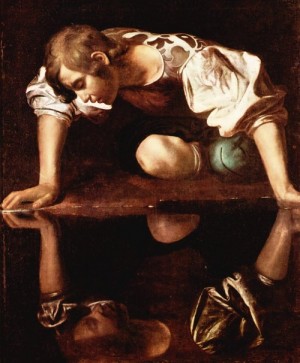
During the course of this election season much has been written about Narcissus, the self-absorbed figure of the classical myth of Narcissus. Less attention has been paid to the larger context in the myth itself and its application to the American political scene: the figure of Echo and the Pond which reflect back Narcissus’s claims for himself.

Without Echo, the scorned, talkative nymph who loses her voice except to echo Narcissus’s words, and without the Pond which reflects back the beautiful image Narcissus lives and dies to see, there would be no Narcissus.

narcissus-caravaggio-300x363

Narcissus painting by Caravaggio

The American Psychiatric Association’s Diagnostic and Statistical Manual of Mental Disorders (DSM-5) describes Narcissistic Personality Disorder as “a pervasive pattern of grandiosity (in fantasy or behavior), need for admiration, and lack of empathy, beginning by early adulthood and present in a variety of contexts . . . .”

The Mayo Clinic summarizes DSM-5’s symptoms of Narcissistic Personality Disorder as follows:

• Having an exaggerated sense of self-importance
• Expecting to be recognized as superior even without achievements that warrant it
• Exaggerating your achievements and talents
• Being preoccupied with fantasies about success, power, brilliance, beauty or the perfect mate
• Believing that you are superior and can only be understood by or associate with equally special people
• Requiring constant admiration
• Having a sense of entitlement
• Expecting special favors and unquestioning compliance with your expectations
• Taking advantage of others to get what you want
• Having an inability or unwillingness to recognize the needs and feelings of others
• Being envious of others and believing others envy youBehaving in an arrogant or haughty manner.

If Donald Trump is elected President, it will be because he successfully channeled long-festering sources of anger—“Make America Great Again” as in a former age when Mexican immigrants, blacks, and non-Christians knew their place in a white, Christian nation with a manifest destiny—or because he echoed the American public’s deep frustration with political gridlock and partisan posturing.

If, on the other hand, Mr. Trump is refused the Oval Office, Echo will continue to be obsessed with his voice. Though not as alarming as a Narcissist with a nuclear arsenal at his command, there is little comfort in a disentitled Narcissus manipulating global media as his mirror.

The socio-psychic health of Echo and the Pond (the social mirror) will determine the extent to which the dynamics of the Narcissus myth become the permanent disorder of American political life.

It may help to remember that, according to Tiresias, the blind prophet of Thebes, Narcissus will “live to a ripe old age, as long as he never knows himself.

How long Narcissism prevails in American society depends on the American Echo and the mirror into which Narcissus looks—whether the American electorate will choose to see Narcissus and ourselves as we really are —a sad man with a public echo without self-knowledge.

In the ancient myth, Narcissus grows increasingly thirsty, but his reflection in the water is more important than slaking his thirst. Enamored with his own reflection but dying of thirst, he refuses to drink because he loses the reflected image whenever he gets close enough to sustain his life. Narcissus dies of thirst, and, according to the Greek myth, at that moment, a lovely flower – a Narcissus (daffodil or joncus) – blooms next to the pond.

narcissus-flower

Narcissus (daffodil)

In the wake of this electoral flirtation of Echo and Narcissus, the story won’t be over no matter who occupies the Oval Office. Yet there remains the hope that something more beautiful and natural than a personality disorder will rise next to the pond of what remains of the American democratic republic, and that Echo will get back her own voice.

• Gordon C. Stewart, Chaska, MN, Oct. 25, 2016

Fall

Leaves are falling. The sap is finished running. Flowers fade — red,  green, yellow, purple falling into brittle brown.

Each season reflects the eternal motion of the seasons we sense within ourselves. Over a lifetime we move from the temporary wrinkles of the newborn babe to the well-worn lines and wrinkles of aging. We love to look at babies; old folks not so much.

In 1857 Adalbert Stifter pondered this in Der Nachsommer (The Post-Summer) published in English under the title Indian Summer:

“Great beauty and youth capture our attention, excite a deep pleasure; however, why shouldn’t our souls gaze at a countenance over which the years have passed? Isn’t there a story there, one unknown, full of pain or beauty, which pours its reflection into the features, a story we can read with some compassion or at least get a slight hint of its meaning? The young point toward the future; the old tell of a past.”

Fall is the favorite time for many of us. At my age, I no longer wonder why.

  • Gordon C. Stewart, Chaska, MN 55318

When Things Go Bump in the Night

Children feel safer when a parent reads them a story and tucks them into bed. The things that go bump in the night are not quite so scary. Mommy or Daddy says not to worry. They’re right there to make sure everything will be alright.

In some ways we are children till the day we die. We feel anxious about our security. Fear still grips us when the sirens blare in the night.

Sometimes children are exposed all day long to the threats to their well-being. They need a parent’s or grandparent’s reassurance. They need the security of knowing that Mommy or Daddy is stronger than whatever might go bump in the night.

As we grow older we learn the difference between real and false reassurance. We know that there is no one to tuck us into bed anymore. But nostalgia for fairy tales and for the parent who will make us safe lingers on. And the candidate who both scares us during the day with stories of the boogieman and tucks us into bed with a fairy tale about himself as the hero gathers the children to himself.

The nightmare is just a few winks away.

  • Gordon C. Stewart, Chaska, MN, September 22, 2016


Author Madness

Had I known it was this complicated, I might have thought twice about publishing a book. Yikes! I like to write. Securing copyright permissions, adhering to the publisher’s requirements for final manuscript submission, converting from Apple’s Pages to Microsoft Word, and completing the marketing survey are much more complicated than auth0r vanity imagined.

Be careful what you ask for. (You might inadvertently end a sentence with a preposition.)

September 10 is the date for final submission of “Be Still! Departure from Collective Madness,” in the once vain hope of making the NYT Best Sellers list. The author’s life is way too complicated!

The Daily Post’s invitation to write something on the word “complicated” is responsible for this waste of your time.

  • Gordon, Chaska, MN, August 14, 2016.


An Evening of Sin

Steve recently published A Sin a Week: Fifty-two Sins Are Described Here in Loving Detail for Folks With the Inclination and Ability to Do Wrong, but Who Have Run Out of Bad Ideas. You can hear Steve’s renditions in an audio book available on Amazon.

This morning he posted this invitation on his CaringBridge page:

A Sin a Week: 52 sins described in loving detail…

Remember my book reading tonight, Thursday, August 11, 7-8 pm @ the Philo Presbyterian Church, 105 E. Jefferson, Philo, IL.

Crackers, cheese, coffee & wine with words about sin. A whole evening with sin.
Free & open to the public. Free parking.

Bring your copy to follow along & see the illustrations. The bookless can use loaners–or just listen happily….

NOTE from Gordon: Steve’s poetry and reflections on life, death, and dying are featured on Views from the Edge. Just enter his name in the search box and he’ll pop up!


When Trump becomes an adjective

Trump is getting Trumpier is the headline of David Brooks’s NYT editorial. Its reference to psychological discussion of the sources of Narcissism and examples of the candidate’s speeches increasingly spiraling out of control are worth the read . . . and cause for prayer.

  • Gordon C. Stewart, Chaska, MN, July 19, 2016

Garrison Keillor: The Punk who would be president

Click The Punk who would be President for Garrison Keillor’s piece on Donald Trump’s presidential aspirations.

This is too good to miss.

“He is a thug and he doesn’t bother to hide it. The only greatness he knows about is himself.

So the country is put to a historic test. If the man is not defeated, then we are not the country we imagine we are.”

  • Garrison Keillor
  • Gordon  C. Stewart, Chaska, MN, June 22, 2016

The Wisdom of Adalbert Stifter

“Don’t the overwhelming majority believe that mankind is the crowning achievement of Creation, that man is better than everything, even things we haven’t yet investigated? And don’t those people who aren’t able to escape the bonds of their own ego think that the entire Universe, even the countless worlds of outer space, is just a backdrop for this ego? And yet it might be quite different.”
― Adalbert Stifter (1805 – 1868), Indian Summer

Click HERE for more about Adalbert Stifter.