Be Still!

Yesterday was a day to celebrate. The publisher of BE STILL! Departure from Collective Madness graciously agreed to used Vincent van Gogh‘s painting from the asylum of Saint-Rimy as the Be Still! Departure from Collective Madness’s cover.

van gogh prisoners exercising

“Prisoners Exercising (After Dore)” – Vincent van Gogh, 1890. Also called “The Prisoners’ Round”

Today Be Still! is going through the final steps before publication by Wipf and Stock Publishers in Eugene, Oregon.

It will take two to three weeks before Be Still! will appear on Amazon. You will find it sooner on the Wipf and Stock site at reduced price. Those in the Greater Twin Cities will be invited to a book launch and book signing party where Be Still! Departure from Collective Madness will be available at reduced cost.

Grace and Peace,

Gordon


Heeding the dream in 2017

Today is a day of searching for wisdom. This period between the November 2016 American election and January 20 presidential inauguration is what Carl Jung called a pause moment. An interruption of the normal to seek a deeper wisdom.

This year two calendars converge. It’s the first day of a new year on the secular calendar, which coincides this year with the First Sunday after Christmas on the Christian liturgical calendar.  This coalescence invites the kind of pause of which Jung spoke. Here’s an excerpt from the assigned Gospel reading for today from the Gospel of Matthew.


Now after [the Wise men] had left, an angel of the Lord appeared to Joseph in a dream and said, “Get up, take the child and his mother, and flee to Egypt, and remain there until I tell you; for Herod is about to search for the child, to destroy him.”

Then Joseph got up, took the child and his mother by night, and went to Egypt, and remained there until the death of Herod. This was to fulfill what had been spoken by the Lord through the prophet, “Out of Egypt I have called my son.”

When Herod saw that he had been tricked by the wise men, he was infuriated, and he sent and killed all the children in and around Bethlehem who were two years old or under, according to the time that he had learned from the wise men. – Matthew 2:13-16

Several things leaped out from the text this year:

  1. The wise men “tricked” Herod. The Greek word translated here as “tricked” derives from sports – the wise men sported, played, mocked, or made a fool of Herod. Whenever Herod sends out agents for the children, wise people find a way to play him.
  2. These “wise men” – magoi in the Greek text – are foreigners from the East. These foreign visitors with a different religious tradition (astrology) are outsiders to the myths of religious and national exceptionalism. They bring gifts for the Christ child before “returned to their own country by another way,” side-stepping Herod and his agenda.
  3. Joseph’s dream and flight into Egypt reverses every expectation. It was from Egypt that Moses and the Hebrew laborers had fled. Now it to Egypt that they flee from Herod, the puppet king of Roman occupation, who had made a mockery of Passover and Exodus. In this pause of 2017, perhaps the angels will forgive updating the text:”Get up, take the child and his mother, and flee to Canada (or) Mexico, and remain there until I tell you; for Herod is about to search for the children to deport them.”
  4. The Holy Family become refugees.

Interpreting biblical texts is a dangerous thing, and sometimes the interpretations go a bit to far! Though that be the case, this Gospel of Matthew text for the First Sunday after Christmas and January 1, 2017 offers an interesting opportunity to do what Carl Jung suggested. Engage the pause. Join the wise. Refuse cooperation with agendas that mock the good news. Take time out from the collective madness to be found again by what is holy and sane.

Grace, Peace, and a Blessed New Year,

Gordon


“Though the cause of evil prosper”

During a moment bordering on lunacy, the group of narcissistic McCormick Theological Seminary friends who call ourselves “The Old Dogs” considered a letter to President Obama suggesting he consider whether he might be called to the pulpit at the end of his second term as President.

Barack Obama shares our theological-ethical tradition which understands Christian faith and practice as intrinsically related to the health of public life. Faith is not a private thing. It’s individual but never private. Every form of faith and practice has implications for the neighbor(s) — the wellbeing of the general public.

“Once to Every Man and Nation” is a hymn on which my seminary friends and I grew up. President Obama learned of it after Rev. Jeremiah Wright took him under his wing at Trinity United Church of Christ while the young Barack was working as a community organizer in Chicago’s impoverished south side.

On this New Year’s Eve, James Russell Lowell‘s hymn strikes me as the hymn of choice for facing 2017 and the post-Obama era in Washington, D.C.  Lowell published this poem — originally 90 line long — under the title “The Present Crisis” in the December 11, 1845 issue of The Boston Courier in protest of America’s War with Mexico. We share here one stanza of Lowell’s poem, adapted for the hymnal, in hopes it might bring some small measure of good cheer for folks who, like us Old Dogs, are concerned  about public life and the world itself of the Eve of 2017:

Though the cause of evil prosper,
Yet the truth alone is strong;
Though her portion be the scaffold,
And upon the throne be wrong;
Yet that scaffold sways the future,
And behind the dim unknown,
Standeth God within the shadow,
Keeping watch above His own.

Faith does not promise a rose garden. It calls us to behold the thrones of wrong and honor truth at all costs.

Grace and Peace to you this New Year’s Eve,

Gordon


Prayer for the New Year

I invite you to consider lighting a candle and offer a prayer this New Year’s Eve and New Year’s Day in the quiet style of the Friends (Quakers) or by using a format such as the one below, slightly adapted from the U.S. Conference of Catholic Bishops.

Prayer For The New Year

On New Year’s Eve or New Year’s Day, the household gathers at the table or at the Christmas tree or manger scene. Many people make New Year’s Day a day of prayer for peace.

Leader: Let us praise the Lord of days and seasons and years, saying:
Glory to God in the highest!
Response: And peace to his people on earth!

The leader may use these or similar words to introduce the blessing:

Our lives are made of days and nights, of seasons and years,
for we are part of a universe of suns and moons and planets.
We mark ends and we make beginnings and, in all, we
praise God for the grace and mercy that fill our days.

Then read the the Scripture from the Book of Genesis 1:14-19:

God said: “Let there be lights in the dome of the sky, to separate day from night. Let them mark the fixed times, the days and the years, and serve as luminaries in the dome of the sky, to shed light upon the earth.” And so it happened: God made the two great lights, the greater one to govern the day, and the lesser one to govern the night; and he made the stars. God set them in the dome of the sky, to shed light upon the earth, to govern the day and the night, and to separate the light from the darkness. God saw how good it was. Evening came, and morning followed—the fourth day.

(The family’s Bible may be used for an alternate reading such as Psalm 90:1-4.)

Reader: The Word of the Lord.
Response: Thanks be to God.

After a time of silence, members of the household offer prayers of thanksgiving for the past year, and of intercession for the year to come …. In conclusion, all join hands for the Lord’s Prayer.

Then the leader continues: “Let us now pray for God’s blessing in the new year.”

After a short silence, parents may place their hands on their children in blessing as the leader says:

Remember us, O God;
from age to age be our comforter.
You have given us the wonder of time,
blessings in days and nights, seasons and years.
Bless your children at the turning of the year
and fill the months ahead with the bright hope
that is ours in the coming of Christ.
You are our God, living and reigning, forever and ever.
R/. Amen.

Another prayer for peace may be said:

Lord, make me an instrument of your peace:
where there is hatred, let me sow love;
where there is injury, pardon;
where there is doubt, faith;
where there is despair, hope;
where there is darkness, light;
where there is sadness, joy.
O divine Master, grant that I may not so much seek
to be consoled as to console,
to be understood as to understand,
to be loved as to love.
For it is in giving that we receive,
it is in pardoning that we are pardoned,
it is in dying that we are born to eternal life.
Response: Amen.

—Attributed to St. Francis of Assisi

Leader: Let us bless the Lord.

All respond: Thanks be to God.

The prayer may conclude with the singing of a Christmas carol.

Whether or not you choose to light a candle and no matter how you do it, if you do, my old friend Steve Shoemaker and his surviving Views from the Edge seminary friend wish you peace of heart and mind as we enter the storm tossed-sea of 2017.

Gordon C. Stewart, Chaska, MN, December 30, 2016.

Tweet for Today:

“#Glory to #God in the #HIGHEST, and #on Earth #peace.” [Gospel of Luke]

Angelic blessings to all who live in #a land of deep darkness!

  • Gordon C. Stewart, Chaska, MN, Christmas Even, December 24, 2016

Old Friends on FaceBook

Ted Bonsall and I became lifelong friends back in Kindergarten in Broomall, Pennsylvania. We played ball in each other’s yards every day for years. I have pictures to prove it!

All these years later, FaceBook invited me to wish Ted (“Russell”) Happy Birthday!”

FaceBook wasn’t around way back in 1947 in Broomall. It didn’t know Ted then and doesn’t seem to know him now. Although Ted died of cancer several years ago, his Facebook page is still up. Like memory itself, his page can never be erased by time.

Miss you, good buddy!

  • Gordon C. Stewart, Chaska, Minnesota, December 22, 2016


The Gophers and the Groper

Until University of Minnesota President Eric Kaler shared with the university football players (“the Gophers”) the investigation report of alleged sexual assault that led to the suspension of 10 of their teammates, the team was ready to boycott the Holiday Bowl. The grizzly details — and lots of parent tweets urging them to protect their own futures — put the young Gophers between a rock and a hard place: stand with your 10 teammates and be tagged forever as condoning sexual assault, or reverse the decision to stand together — all for one and one for all — and admit that some things go far beyond “boys will be boys”.

Early yesterday morning, team spokesman Adam Wolitarsky announced the team’s decision to play in the Holiday Bowl.

Rumor has it that the Gophers immediately received a tweet from someone in New York:

“Win one for the Groper!”


Is Democracy Threatened?

After a brain stretching week with The Nation‘s Katrina Vanden Huevel, John Nichols, Laura Flanders, Sasha Abramsky, Dorian Warren, Peter Kornbluh, Dennis and Elizabeth Kucinich, my head is still spinning. Too much to write about.

We return to Views from the Edge with this thoughtful NYT Sunday Review op-ed that addresses what The Nation speakers, panels, and guests spent the week discussing.

Click HERE to read  “Is Donald Trump a Threat to Democracy?”

  • Gordon C. Stewart, Chaska, MN, Dec. 17, 2016

Pinocchio and Pinochle in America

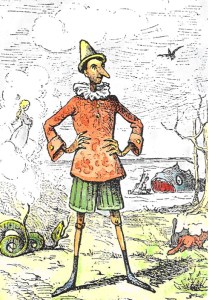
pinocchioWorking in his carpenter shop in Florence, Italy, Geppetto, the marionette-maker, could not have imagined that Pinocchio would become President of the United States of America. Neither could Carlo Collodi whose The Adventures of Pinocchio (1881) painted a more complex, less likable Pinocchio than the Walt Disney film version (1940) that popularized the story in America.

My generation grew up on Pinocchio. How could we not? He was eternally boyish. He was charming. When we told a fib to our parents, we empathized whenever poor little Pinocchio’s nose told on him. Pinocchio was a lovable liar in whom we saw our own flawed but lovable selves without the less attractive dimensions of Collodi’s original Pinocchio who, on the day he is born, cruelly snatches the wig from his marionette maker’s head. From his very first day, Pinocchio has a mind of his own far beyond and quite different from Geppetto’s imagination.

Neither Carloddi nor Geppetto could have imagined that on January 20, 2017 Pinocchio would raise his right hand to take the oath of office as President of the United States. If Geppetto were still able to pull the marionette’s strings, it would not happen. Geppetto would remember his stolen wig. And, if perchance, Geppetto were on the dais when the humanized Pinocchio raises his right hand, he might stretch out his own hand to check whether Pinocchio is wearing his wig.

Pinocchio has a way with words. He calls those who question his integrity ‘liars’ and ‘criminals’ He rallies people with his limited vocabulary. He gropes women and brags about it — it’s not every wooden marionette who gets to do what Geppetto would find deplorable. When he makes promises he cannot keep, his nose grows, but not everyone can see it. It grows slowly, inch-by-inch so that the original image blinds people to its peculiar length.

But there’s another dimension to Pinocchio’s personality that is largely unknown to the general public. He loves to play Pinochle, the game for four that is includes a trump suit, with his family. It’s harder to lie to three family members than it is on stage, and it may be that Pinochle may yet shrink the length of Pinocchio’s nose. Ivanka and Melania didn’t appear in Collldi’s The Adventures of Pinocchio or the Disney version of the story, but their parts in the ongoing story may save us yet.

Those who cringe at the thought of Pinocchio with his groping hands on a nuclear arsenal can always hope Pinocchio’s third wife and favorite daughter will transform the evening Pinochle game as a way to serve the people. In Pinochle the trump suit get spread among the players; no one can dominate. If we’re lucky, Ivanka and Melania will gentle the meanness Pinocchio exhibited when he snatched Geppetto’s wig the day he was ‘born’, keep his nose short, and do for Pinocchio’s what Eva Braun was never able to do: keep his right arm from rising to a salute.

Lazarus and “the rich man”

gustave_dore_lazarus_and_the_rich_man

Gustave Dore print of Lazarus and the rich man. (1890)

Jesus told a parable about a man with a name ‘Lazarus’ – a poor man – and a man who has no name – “a rich man”. The parable begins like this:

“There was a rich man who was dressed in purple and fine linen and who feasted sumptuously every day. And at his gate lay a poor man named Lazarus, covered with sores, who longed to satisfy his hunger with what fell from the rich man’s table; even the dogs would come and lick his sores.” [Luke 16:19-20 NRSV]

The scene then shifts from the difference between their earthly circumstances to the imagined differences between their circumstances in an afterlife. Lazarus is soothed in the bosom of Abraham. The rich man is in torment, pleading that if only he had known, he would have lived differently. He asks Abraham to send Lazarus to his five brothers to warn them. tell his living relatives. If he can come back to them from the dead, they will understand, change their ways, and avoid the coming judgment.

Abraham’s reply?

“‘They have Moses and the prophets; they should listen to them.’ [The rich man said, ‘No, father Abraham; but if someone goes to them from the dead, they will repent.’ [Abraham] said to him, ‘If they do not listen to Moses and the prophets, neither will they be convinced even if someone rises from the dead.’” [Lk. 16:29-31].

Jesus’ parable is not about the dead. It’s about the living. About how are to live together as neighbors. It’s about waking up to destitution and privilege and heeding the parable’s calling to a society beyond these extremes, a society known for its compassion.

Ask your friends to discuss the news in light of Moses’ response to the rich man. Ask your pastor, priest, or minister how she or he connects the dots with the news in 2016. Ask yourself the question as you listen to the morning and evening news. Ask yourself whether you’re getting the parable or whether the parable got you. Ask God for guidance, for mercy, for change, for transformation of a world of us and them. And give thanks for Jesus, Moses, and the prophets.