“[T]here is such a sense of stillness and peace that the wrong sort of movement, even one’s very presence, might be felt as an intrusion….” The photo and words by Oliver Sacks on David Kerrigan’s post rang a familiar bell this morning. We’re back in ‘civilization’ — far from the stillness and peace of the wetland, the birches, oaks, and pines — but knowing the senses of awe and intrusion of which the writer speaks. Thank you, David, for sharing. Thank you, Oliver. RIP.
Gordon C. Stewart, Chaska, MN, Sunday morning, July 29, 2018.
I find myself walking softly on the rich undergrowth beneath the trees, not wanting to crack a twig, to crush or disturb anything in the least — for there is such a sense of stillness and peace that the wrong sort of movement, even one’s very presence, might be felt as an intrusion… The beauty of the forest is extraordinary — but “beauty” is too simple a word, for being here is not just an esthetic experience, but one steeped with mystery, and awe… Standing here…I feel part of a larger, calmer identity; I feel a profound sense of being at home, a sort of companionship with the earth.
Photo: Pine trees stand forming a forest near Briesen, Germany, on Thursday. Brandenburg’s forests produce sustainable wood resources of roughly a million cubic meters. (Patrick Pleul, wsj.com, January…
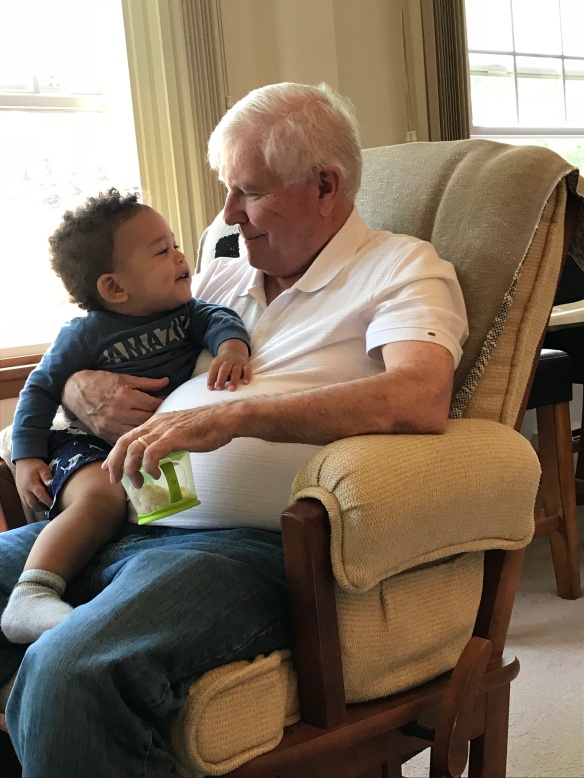
It’s been a while since Elijah and Grandpa had a conversation on Views from the Edge. Elijah celebrated first birthday in late May, and has had a lot to say to Grandpa (“Bumpaa”). His words continue to cheer me. But it’s his baby Cheerios that bring the greater joy. His actions speak louder than words.
Elijah loves Cheerios! He carries them around the house in a plastic cup, plunges his hand into the cup, and pulls out two or three Cheerios. He loves them almost as much as light sockets, computer wires, and the remote to the television. But, when he eats his Cheerios, no one tells him to stop.
Kay and I been out of town last week, enjoying a lovely week at the cabin in the low 70s with breezes from across the wetland, but we missed the little guy! Yesterday Grandma resumed her Friday routine of caring for Elijah. He ran to Grandma and threw his arms in the air asking her to picked him up before he went back for his cup of Cheerios.
Elijah and his Cheerios with Bumpaa
When Grandma sent word that Elijah was calling for me — “Bumpaa? Bumpaa ?” — I joined the two of them at Kristin’s apartment. During our time together, Elijah was dipping his hand into the Cheerios. But he wasn’t just feeding himself. He was sharing his Cheerios. One by one, he reached out his hand to place his precious Cheerios into Grandpa’s mouth. He was doing what human beings are meant to do. He was sharing his Cheerios with Bumpaa, and it came naturally, years before he learns the commandment to love his Bumpaa as himself.
Every day brings a new idea for a T-Shirt. We shared T-Shirt #1 yesterday. We weren’t thinking of a new product line at the time. But this morning another psalmic line caught our eyes and led to the idea of a T-Shirt franchise. We could call it ‘Psalms to Live by in the Twitter Era’ and advertise on Facebook and Twitter. T-Shirt idea #2 reads:
You have loosed your lips for evil,
and harnessed your tongue to a lie.
(Psalm 50:19)
Then, later this morning, we learned that Twitter’s most prominent tweeter is now accusing Twitter of being biased against conservative Senators and senatorial candidates, which led to a second line of T-shirts: ‘Proverbs to Live by in the Era of DJT’. T-Shirt #1 of Proverbs to Live by in the Era of DJT would read:
The man of integrity walks securely,
but he who takes crooked paths will be found out.
He who winks maliciously causes grief,
and a chattering fool comes to ruin.
(Book of Proverbs 10:9-10)
Gordon C. Stewart, on the wetland, where the only chattering and tweeting come from red-wing blackbirds and bluebirds,July 26, 2018.
Sixty years ago I learned to speak inclusively of God. God is not a He any more than He’s a She. God is beyond gender. Or, as Paul Tillich, described it, the Ground-of-Being, or Being-Itself, includes male and female and is beyond male and female. Since being awakened to the danger of gender-specific religious language, I’ve done my best to shed the male pronounsand images on which I was raised.
But there has been a sense of loss that has been harder to define — a less immediate, less intimate, more distant relationship in prayer and meditation. As I have come to reflect on it over the years, other things also have troubled me, not the least of which is my haughtiness, my sense of superiority to those who still use the old pronouns. More than that, however, has been a re-examination of the nature of religious language. Is some religious language good and others bad; some enlightened and others unenlightened; one right and another wrong?
And what to do with the old biblical chestnuts: “The Lord is my shepherd…He maketh me to lie down in green pastures; He leadeth me beside the still waters; He restoreth my soul; He leadeth me in the paths of righteousness for His Name’s sake.” (Psalm 23)?
Then, several months ago, along came a publisher’s invitation to endorse William G. Britton’s Wisdom from the Margin: Daily Readings, that includes voices from a wider spectrum of religious language than the circle in which I live. Britton’s collection includes writers who speak of He and Him. Names like Dallas Willard, Paul Pearsall, and Peter Scazzero are new to me. Others, like Dietrich Bonhoeffer, Soren Kierkegaard, Kathleen Norris, and Thomas Merton are part of my daily bread, but even excerpts from their writings remind me that they were not as cautious as I in their language for God. They understood that the genre of prayer is psalmic poetry, the language of the heart. “He leadeth me… beyond the closed circles of righteousness.”
In what turned out to be the book’s only endorsement, I wrote:
Wisdom from the Margins is what it says it is. It’s that rare collection of readings from the wisest voices, like a menu of gourmet small bites in the quick-fix fast food world where wisdom is made homeless. Each small bite will stay with you throughout the day. If the current American religious landscape is giving you a stomach ache, Wisdom from the Margins is for you.
The publisher mistakenly attributed the endorsement to “Gordon Stewart, producer and co-host of ‘Lug Nutzz Radio’”. Click Gordon ‘Lug Nutzz’ Stewart for the mistaken identity.
Gordon C. Stewart, author of Be Still! Departure from Collective Madness, July 18, 2018
The day a former Director of the CIA publicly declares that a U. S. president’s behavior constitutes “high crimes and misdemeanors” and calls it “treasonous” is not just another day in American politics.John Brennan’s tweet ended with the question for those who continue to support the president: “Where are you?”
It is a question for every U. S. Senator and Congressional Representative who assumed their positions after taking the Congressional oath of office to “support and defend the Constitution of the United States of America against all enemies, foreign and domestic.” The president’s oath is a bit different. I do solemnly swear…. to preserve, protect, and defend the Constitution of the United States of America.”
Although it seems unlikely that Thomas Jefferson or James Madison imagined a future president of the new constitutional republic acting as the nation’s domestic enemy, the framers of the U. S. Constitution were cautious about human nature. They were neither optimistic nor pessimistic. They were realists. They included provisions for Congress to remove a president from office.
Which is why John Brennan asks members of Congress, “Where are you?” It’s one thing to wait for the report of the Special Counsel on Russian interference in a U. S. election; it’s another to ignore the president’s joint press conference with the leader of the country accused of interfering in the 2016 election.
Following a private two hour one-on-one meeting with Vladimir Putin, Donald J. Trump preferred Mr. Putin’s denial of Russian interference to his own Department of Justice latest indictments of twelve Russian intelligence officers for covert operations to influence the 2016 election. The president who took the oath of office to defend and protect the U. S. Constitution from enemies, foreign and domestic, had chosen to take his stand against his own government.
For a former CIA director to take the spotlight runs counter to the low-profile culture of the CIA.John Brennan is not a partisan. His question “Where are you?” will be answered in the weeks to come, as will the other questions: “What will you call it?” and “What — or whom — will you faithfully support and defend?”
Thomas Jefferson,James Madison, and Betsy Ross are listening.
Frederick Buechner’s invitation to “listen to your life” is wise counsel any day, but especially the day after a jarring dream has screamed about what the psalmist called “the sins of my youth.”
The psalmist was lucky. The sins for which he prayed for release happened in his youth; mine are the less innocent ones of adulthood. But the final plea is the same: “Remember not the sins of my youth and my transgressions; remember me according to Your love, and for the sake of Your goodness…” (Psalm 25:6).
Dreams have a different way of remembering. They have a logic of their own, a logic of the unconscious fetching from the hidden reservoir of past experience the guilts and griefs we sought to drown from conscious awareness. Dreams remind us that nothing is lost. Sometimes a dream is its own kind of prayer — the Spirit bearing witness within our spirits; a kind of holy groaning — to be remembered “according to Your love, and for the sake of Your goodness” rather than according to our sins and transgressions.
Franz Kafka
Franz Kafka wrote in a letter to his father, “Life is more than a Chinese puzzle.” Kafka knew that life is at least that — a perplexing puzzle. The pieces of one’s life are hard to fit together into a cohesive whole, perhaps because some of them have shapes and sharp edges we can’t remember or refuse to recognize.
Sometimes these pieces appear in a dream according to a different logic of the deeper listening that remembers us according to a Goodness greater than our own. Only by such grace could the psalmist imagine the recovery of integrity, i.e., the re-integration of the disparate parts of his life history: “Let integrity and uprightness preserve me, for my hope has been in You” (Psalm 25:20).
“Listen to your life…because in the last analysis, all moments are key moments, and life itself is grace” (Frederick Buechner, Now and Then).
This Fourth of July we retreated from the parades and fireworks to the wilderness cabin by the wetland. Although the trumpeter swans left several weeks ago, heading north to Canada for friendlier, cooler climes, the loons and hooded mergansers are still our nearest neighbors — along with the newest arrivals: Yellowjackets!
Last night was quiet. The only sounds were the bull frogs, the loon calls and the faint rustling of the aspen leaves heard through the screen doors and windows. The only light came from the soft rays of the setting sun. It was peaceful. Quiet. Natural. Until the sun went down and the sound and flashes of firecrackers from distant neighbors preferring a noisy celebration of bombs bursting in air lit up, and echoed across, the wetland from afar.
As we were wondering how the loons and mergansers were managing the Fourth of July, we turned on the lights inside the cabin, and were joined by a Yellowjacket that had made its way through the screens that protect us from unwanted neighbors. While the fireworks exploded and flashed outside, the Yellowjacket was drawn to the reading light next to my chair. Reaching for the flyswatter, I took a swipe but missed, and then another before losing sight of the invader. Until, wham! I felt the sting through my shirt!
Suddenly I wished I had a Fifth on the Fourth!
Gordon C. Stewart, on the wetland, the Fifth of July, 2018.
Dennis Aubrey’s writing is as fine as his photography, fathoming the depth and height of the human experience. This Via Lucis piece on the power and complexity of memory shouted out to be shared on Views from the Edge.
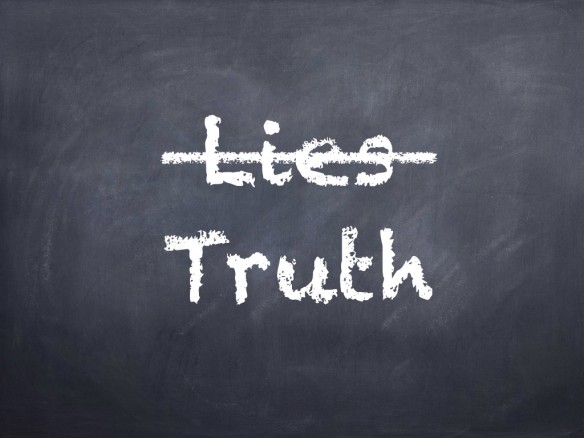
Recognizing truth is a matter of experience because it involves distinguishing the real from the illusory. Experience itself is a product of memory. And memory is even more complex than truth. And so the pattern gets more multi-faceted the deeper we look, like one of Mandlebrot’s mathematical phantasms. What appears at first simple becomes infinitely complicated and intricate.
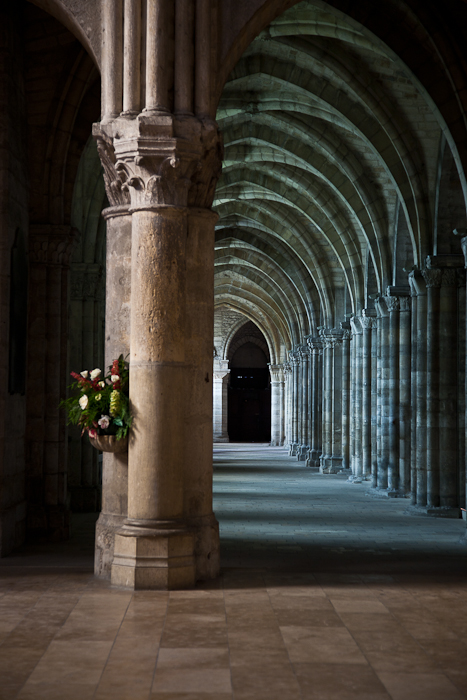
Side aisle, Basilique Saint Remi, Reims (Marne) Photo by PJ Aubrey
Some memories we remember as dreams, in the present tense; others as historical phenomena that stay safely in the past. Some memories carry their meaning with them. Others mean something because of their relationship with something that occurred in the past. Others depend on the future to reveal their significance. This is the web that is woven back and forth, across and through time.
North side aisle, Eglise Saint-Étienne, Vignory (Haute-Marne) Photo by Dennis Aubrey
A friendly young man at the Burger King — I don’t eat Whoppers; I drive to the Burger King in rural Minnesota for the free WiFi — draws my attention. “What’s going on?” he asks, staring at the television monitor behind me and my MacBook Air. I assume he is responding to the breaking news I’d heard moments before on the drive from the cabin to the Burger King — the shooting of journalists in the office of an Annapolis newspaper. He is. He shakes his head; I shake mine. Then the words spill out. “I guess this is what happens when the press is targeted as public enemy number one.” He shakes his head again and walks away.
A few minutes later he returns to speak his support for the Second Amendment and the president. “All this gun stuff . . . we’ve always had guns in school and stuff, only now the media’s making a big deal of it. They’re blowing it up.”
We’re coming up on July 4th weekend. Celebrating the nation’s independence feels different this year. America is different. It’s the First Amendment that is at risk, not the Second.
An Independent Press: the Fourth Estate
The free press, sometimes called “The Fourth Estate” — the people’s independent watchdog of government — has saved us from our worst selves many times. It was the Fourth Estate that brought into our living rooms Edward R. Murrow’s news broadcast that stopped Senator Joseph McCarthy’s pernicious attacks on the integrity of American citizens whose political stripe wasn’t his. It was the Fourth Estate’s publishing of the Pentagon Papers that exposed the dirty secrets behind the Vietnam War, leading Lyndon Baines Johnson to become a one-term president. It was the Washington Post’s publication of Woodward and Burnstein’s investigative report on the Nixon administration’s break-in of Democratic headquarters at the Watergate Hotel that led to the impeachment and resignation of Richard Nixon.
The Fourth Estate exists as the instrument of the people to hold accountable those we elect, and the government agencies they are responsible to oversee on our behalf. The First Estate (the executive branch) and the Second Estate (the legislative branch) have often been critical of the Fourth Estate. Because the U.S. Constitution’s First Amendment guarantees freedom of the press from state control, the Third Estate (the judicial branch) has protected it from the other two branches of government. The Supreme Court has been the court of last resort to protect free speech from Presidents and other elected officials who have been wary of it.
Weary and Wary
There is a world of difference between wariness and assault. The current occupant of the Oval Office has used the nation’s Bully Pulpit to stir up good people like the guy at the Burger King to believe the minority party, once referred to as the “loyal opposition,” is out to destroy their freedom under the Second Amendment. Public perception has been altered. The public enemy no longer is communism, as it was in the McCarthy period. The target is much more in clear public view: the Washington Post, the New York Times, CNN, NBC, CBS, PBS. Every member of the Fourth Estate except FOX News and — who would ever have imagined it? — The National Enquirer. Joe McCarthy is smiling.
A civil society has quickly become less civil. The Bully Pulpit we once expected to give voice to the unity that underlies our pluralism (e pluribus unum); appeal to “the better angels of our nature” (Lincoln); respect the public and private institutions that make us who we are; and mourn tragic events such as today’s shooting in Annapolis, is used to create the public perception that the president’s critics are America’s enemies. This is an abrupt departure from the commonly accepted norms and expectations for civil discourse on which I being raised.
Increasingly, we tend to shout in anger or fall silent. Between the anger and the silence stands a chasm of despair. To some, America is becoming great again. To others, America in 2018, feels more like the aftermath of a coup d’état than a moment of celebration.
The Birth-er Movement: Black Lives Can’t Be President
The young man at the Burger King was an adolescent when Donald Trump funded the Birther movement alleging that Barack Obama, America’s first black president, was illegitimate, a charge not based in fact, “faux” news that stirred the latent fear of poor white Americans to believe President Obama was out to take away their rights. Long before the Electoral College elected him President, Donald Trump had a bully pulpit of his own, and he bullied many into believing the lies about the need to rescue the country from the alleged black Muslim socialist who wanted to take away our guns —until the day he suddenly declared, without apology for his error, that President Obama had been born in the U.S.A, as though the Oracle of truth had spoken definitively — years after his false claim movement had accomplished its aim.
The Third Leg of the Stool
Earlier today, before news of the shooting of journalists in Annapolis, the free press informed the American public of U. S. Supreme Court Associate Justice Anthony Kennedy’s decision to retire, leaving the vacancy on the Court for the President to nominate and the Republican Congress to give, or withhold, its consent and confirmation. The Founders’ intention of a nonpartisan, independent Third Estate — the third leg of the stool of checks and balances that keeps the American democratic republic from falling — was idealistic, to be sure, but an independent judiciary is essential to the architecture of the U.S. Constitution.
As we prepare for this Fourth of July observance, we do well to remember the architecture meant to preserve the nation by means of legislative and judicial boundaries that constrain a bully from running away with the country. Doing my best to be hopeful, I still wonder: can a Whopper accomplish a coup d’état without bloodshed — within the architecture of the American democratic republic?
The Fourth of July 2018 celebration goes down hard. Hold the onions!
Gordon C. Stewart at the Burger King, July 2, 2018.
We Americans are living in the face of evil. I do not speak easily of ‘evil’. Even now, I hesitate using the word.
But I can find no better word to describe what I hear in the tone of voice and the language that distorts truth, idolizes the nation, insults neighbors and allies, reveres the strong men of North Korea and Russia, presents himself as superior to all his predecessors, withdraws from multinational peacemaking and climate accords, divides the world into winners and losers, refuses to criticize white supremacists, separates poor children of color from their parents at the border, demonizes his adversaries, puts an anti-Semitic preacher from the farthest edge of the religious right on the world stage to represent the American people at the dedication of the U. S. embassy’s re-location to Jerusalem, and does it all in the name of making America secure and great again.
In Christian theology, evil has no standing of its own. It is the twisting of the good, the warping of truth, the abandonment of self-knowledge, the rebellion against accountability, the transfer of free-floating anxiety onto an object of fear that can be defeated, and the illusion of the power of the strong man’s to rescue the good.
Th strong man is the opposite of the preacher from Nazareth who lifted up the poor, the meek, the mourning, the leper, the alien, the foreigner, the religiously different (the ‘good’ Samaritan), declaring that the kingdom of God belongs to them, not to the rich, the proud, the well, the patriots, the people of his religion.
How a disciple of Jesus hears the voice of Jesus in the voice of the strong man is a puzzle whose pieces remain hidden until they are exposed for review. Promotion of the good includes the unmasking of evil, the wisdom to discern when the good is turned upside down, and when truth is twisted by the serpent’s trickery.
“Lead us not into temptation, but deliver us from evil” is the cry from the pews of most every Christian church across the world, the echo of the prayer the soon to be crucified Jesus taught his disciples. Tempted to surrender better selves into the hands of evil, how does a disciple of Jesus manage to salute the strong man in the Oval Office and the party that obeys his will? Every day, I scratch my head, but also try to remember.
“Blessed are those who hunger and thirst for righteousness, for they shall be satisfied.”




 Then, later this morning, we learned that Twitter’s most prominent tweeter is now accusing Twitter of being biased against conservative Senators and senatorial candidates, which led to a second line of T-shirts: ‘Proverbs to Live by in the Era of DJT’. T-Shirt #1 of Proverbs to Live by in the Era of DJT would read:




 Views from the Edge