Shepherd of the Hill Presbyterian Church in Chaska has decided to use its space as temporary overnight accommodation for homeless families. The press release and the Chaska Herald’s online story just made its way to AOL.com.
Click HERE for the story. The project is targeting to begin in February, 2013. To help with the project, leave a comment here.
The Dove World Outreach Center (DWOC) is in the news again. Scroll down to the bottom to click the link to the Huffington Post story. Or, you’ve time, read this piece that was published by MPR following the DWOC’s threat to burn the Quran.
How a single voice threatened to spark a forest fire
by Gordon C. Stewart
September 28, 2010
Everyone from time to time feels insignificant. As I did, while watching fires burn across the world, lit by the words of one pastor in Florida. I felt like a spectator in the stands watching the game I care about go terribly wrong, a hostage of verbal terrorism uttered in the name of Christ.
I would imagine that the Rev. Terry Jones and his small congregation also had felt insignificant before they announced the 9/11 Quran burning, and that they were stunned when their pastor’s voice, although terribly misguided, lit the forest on fire without ever burning a Quran. One of their own, one who had felt insignificant, had raised his voice and now had the ear of a commanding general, the secretary of defense and the president of the United States.
The difference between the Rev. Jones and most people is that he has a pulpit. On any given Sunday he speaks and a few people actually listen. Most of us do our ranting and raving in the shower, at the water cooler or with like-minded people at the coffee shop, but we don’t much expect anyone to listen.
But as the Jones story developed, those of us with pulpits were feeling no less beside the point. Then, as I prepared for worship, I was drawn by some old lines about spiritual arson. “Consider what a great forest is set on fire by a small spark. The tongue is a fire … a restless evil, full of deadly poison” and “the seeds of righteousness are sown in peace by those who make peace” (Letter of James 3).
The thought crossed my mind: We could invite a Muslim friend to join me in the pulpit, perhaps my neighbor Muhammad or Abdi or one of their children, whom I meet daily while walking the dogs. I decided to invite Ghafar Lakanwal, a Pashtun Afghan-American cultural diversity trainer, a Muslim and naturalized U.S. citizen, to bring greetings of peace and share some passages about peacemaking from the Quran in our Sunday worship on 9/12.
Our little church in Chaska welcomed Ghafar, and his words about the spiritual “obligation to learn, not burn” still ring in our ears. Our service drew media attention, and Ghafar’s words were heard on the evening news and noticed by a stranger in Australia, who sent a message through the church website. “I was touched,” he wrote, “when I read about your recent Sunday service in the news. … I for one can testify that it has certainly comforted a far away Muslim to know that there are neighbors who will stand together in difficult times. My salaam [to you]. May we all grow together to attain Allah’s pleasure.”
“Ah!” someone will say. How can any Christian rejoice when the author uses the name “Allah” for God? But the reaction to the “name” is misbegotten. It is not the name of God; it’s the Arabic word for what we in English call God. The forest fire lit in defense of “God” in advance of the anniversary of 9/11 reminds us that two kinds of religion potentially exist everywhere people gather to practice their faith. One kind burns. The other kind learns. One hates; the other loves.
As James, writing to those who would follow Jesus, put it: “With [the tongue] we bless the Lord and Father, and with it we curse those who are made in the likeness of God. From the same mouth come blessing and cursing. My brothers and sisters, this ought not to be so” (James 3:9-10). We can set the forest ablaze with our small spark or we can use it to light a candle of hope and peace. But, after the events of this month, none of us can again think that what we say is insignificant.—-
When will we ever learn? Click HERE for the whole story and leave your comment.
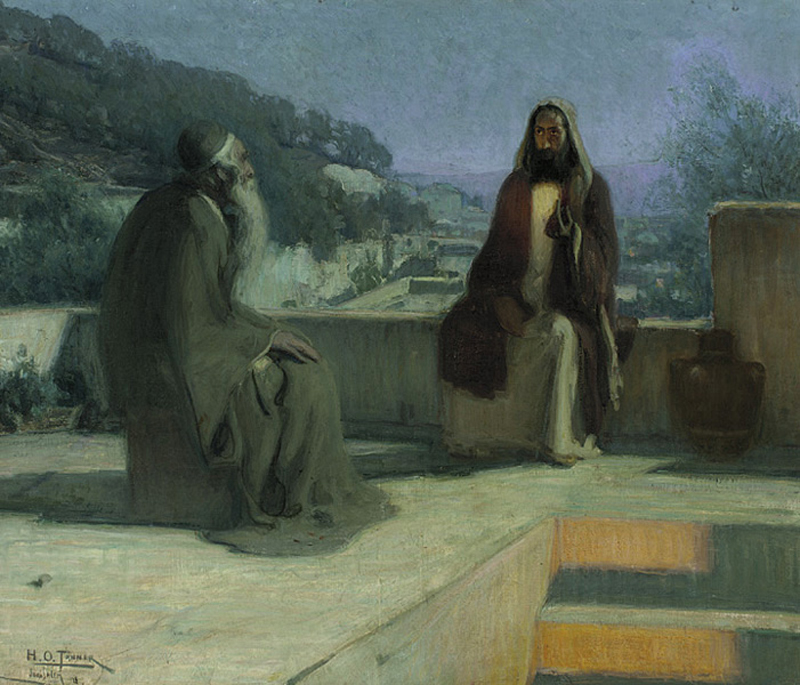
He comes by night. He slips along the buildings of the city streets in hopes that no one will notice. He is a man of position and authority, a learned teacher with a Ph.D. in religion on his way to the kindergarten teacher. “Everything I need to know in life I learned in Kindergarten,” wrote Robert Fulghum. Nicodemus has a sense that he has lost a thing or two along the way, that he needs to start over again.
He’s sent a private message asking for a confidential meeting. The arrangements have been made for the time and place…under the cover of darkness… at Nicodemus’ request.
Dressed in a hooded sweatshirt pulled up around his face and wearing an old trench coat to blend in with displaced people who spend the night on the street, Nicodemus changes his normally stately gait on the way to his secret meeting.
Arriving at the appointed address at the appointed time, he ducks quickly to his left into the alley and darts up the stairs to the flat roof where the kindergarten teacher is waiting.
“Shalom!”
“Shalom aleikem!”
They kiss each other on the cheeks, the left and then the right, as is the custom among their people.
The teacher motions to the wood stool his hands have made for occasions like this. The stool is well-worn by others who have come it at night, some by advance arrangement, others on the spur of the moment, when the darkness outside or within themselves has overwhelmed them and a hot cup of chamomile tea or warm milk won’t help them get back to sleep.
Nicodemus sits on the stool. But there is no second stool or chair. The teacher takes his customary place on the wall at the roof’s edge, his body and face partially lit by a full-moon, the city landscape and the whole world over the teacher’s shoulder, a strange kind of classroom. Nicodemus can see him – sitting calmly, erect, at full attention, his eyes fixed on his eyes, steady and searching and seeing, it seems, what even Nicodemus does not yet know about himself and the real reason he has come.
The man on the wall sits and waits for Nicodemus to break the silence. The wordlessness does not trouble him. He is at home with silence.
“You are a teacher who has come from God because no one can do what you do apart from the presence of God,” declares Nicodemus.
Nicodemus awaits a response to his declaration of honor, but there comes no response except for the eyes beholding him.
Nicodemus fidgets, uncomfortable with the silence. He repeats his declaration, increasing the decibels in case the teacher is hard of hearing, but not so loud as to wake the neighbors, the street people, or the police:
“You are a teacher who has come from God because no one can do what you do apart from the presence of God.”
Jesus gives a slight nod and looks at him from the wall.
“No one can see the kingdom of God unless he is born anew,” he says.
“So it’s about seeing?”
“Yes. It’s about seeing.”
Turning and pointing to the world over his shoulder, he asks Nicodemus, “Do you see this magnificent landscape behind me?… Look at it… Really look… What do you see?”
“I see a mess.”
“Ah, but look again, Nicodemus. You’re looking with the wrong eyes. It is a mess. Anyone can see the mess. If you look, you can see a different outline through the darkness. Maybe you need glasses. Maybe your ears will help you see.”
They fall again into the silence, but the words – “Maybe your ears will help you see” – speak to an inner darkness. Nicodemus looks with his ears at the night landscape and the distant horizon and the stars over the teacher’s shoulder, listening to the faintest sound of a familiar tune they both had learned in kindergarten at the synagogue.
Jesus, is humming. Softly. Without thinking, Nicodemus joins in humming the tune, and then begins to mouth the words, the familiar words spoken quietly by every faithful Jew living under Roman occupation and in the dark nights of the soul, the words sung or spoken in silence by every Jew on the way home from synagogue, a kind of lullaby of faith, a way of seeing with the ears:
“Peace unto you, ministering angels, messengers of the Most High, of the supreme King of kings, the Holy One, blessed be He.” (repeat twice)
“May your coming be in peace angels of peace, messengers of the Most High, of the supreme King of kings, the Holy one, blessed be He. (repeat twice)
“Bless me with peace, angels of peace, messengers of the Most High, of the supreme King of kings, the Holy one, blessed be He.” (repeat twice)
“May your departure be in peace, angels of peace, messengers of the Most High, of the supreme King of kings, the Holy one, blessed be He.” (repeat twice)
“For He will instruct His angels in your behalf, to guard you in all your ways. The Lord will guard your going out and your coming in from now and for evermore.”
Whenever I hear Dave Brubeck, I think of Pentecost. Here’s a video of Brubeck and Al Jarreau that came to mind after reading my friend Steve’s poem (below) on Pentecost and jazz as the music of the Spirit.
PENTECOST (acrostic)
In Memory of Charles Reynolds*
(TO BE READ ALOUD )
Perhaps a jazz improvisation says
Exactly what is thinkable about
New life, fresh breath…the Holy Spirit. Has
There ever been a music without doubt
Except jazz? Faith, improvisation cause
Circles of sound to rise and fly throughout
Our cosmos. Tongues of flame are seen on heads
Singing or playing solos. Then without
Time passing–a new language: Jesus! Jazz!
*Charles Reynolds was Organist at the McKinley Church at the University of Illinois where Steve was the Senior Minister.
– Steve Shoemaker, Urbana, IL. Steve’s Sunday evening program “Keepin’ the Faith” can be heard anytime @ www.will.illinois.edu/keepinthefaith, including archive programs, “two of which,” says Steve, “feature Gordon C. Stewart,my ‘publisher'”.
Words are POWERFUL! They shape our most important decisions.
Language is the primarymechanism of mind control: truth becomes falsehood and falsehood becomes truth; beauty becomes ugliness and ugliness becomes beauty; goodness becomes evil and evil becomes goodness, twisted by the language of innuendo and word association.
American Crossroads’ campaign ad (see yesterday’s “Campaign Ads and the Snake”) is a case in point, an illustration of Timothy Egan’s New York Times piece, “Deconstructing a Demagogue“:
Back in 1994, while plotting his takeover of the House, Gingrich circulated a memo on how to use words as a weapon. It was called “Language: A Key Mechanism of Control.” Republicans were advised to use certain words in describing opponents — sick, pathetic, lie, decay, failure, destroy. That was the year, of course, when Gingrich showed there was no floor to his descent into a dignity-free zone, equating Democratic Party values with the drowning of two young children by their mother, Susan Smith, in South Carolina.
Today, if you listen carefully to any Gingrich takedown, you’ll usually hear words from the control memo.
The cynicism that pervades the American electorate is due, in part, to this demagogic use of language. Words are precious things. Holy things. Sacred things. When they get twisted, they become vulgar and profane, one might even say ‘demonic’ in the sense in which philosophical theologian Paul Tillich defined ‘demonic’ as the twisting of the good. (Paul Tillich, “Life and It’s Ambiguities,” Systematic Theology, Vol. 1, p. 102).
Paul Tillich was one of the first university professors dismissed from his teaching position during the Third Reich. At the invitation of Reinhold Niebuhr, he came to America where he taught at Union Theological Seminary in the City of New York, Harvard Divinity School, and the University of Chicago.
Tillich and his academic colleagues in theology, philosophy, and ethics (Willem Zuurdeeg, Martin Niemoller, Karl Barth, Dietrich Bonhoeffer, and Elie Wiesel) left us a rich legacy of careful analysis of the demagogic use of language.
Looking at America today, some observers argue that Hitler won his war after all. The Third Reich’s use of language and rhetoric is the substance of Language: a Key Mechanism of Control. The prescription that once led a nation regarded as “the most sophisticated culture” to swallow the toxin of twisted truth is with us still. The poison is peddled as cure and candy by candidates bought and sold by the private corporate powers whose Super PAC ads control our airwaves in America.
American Crossroads, led by the cunning of Karl Rove and the funding of the Koch Brothers and other wealthy Right Wing funders, is a Super PAC whose manual of operations is Gingrich’s memo, “Language: a Key Mechanism of [Social] Control,” renamed here as “Demonic Language: the Work of the Snake.”
But the snake does not own the garden. Nor is it the author of language. Truth always has a way of peeking out from behind the bushes. And sometimes it cries out loud and clear, as it does from an old hymn I learned in childhood. It sings from the pews and in my heart in the hymn lyrics penned by James Russell Lowell I especially treasure in times when, watching a campaign ad, I need assurance that the snake has not won.
Once to every man and nation Comes the moment to decide, In the strife of truth with falsehood…. Though the cause of evil prosper, Yet t’is truth alone is strong; Though her portion be the scaffold, And upon the throne be wrong; Yet that scaffold sways the future, And, behind the dim unknown, Standeth God within the shadows, Keeping watch above His own.
– James Russell Lowell, 1845
Click to feel the power of the music on Preston Hawes’ violin.
“American Crossroads” produced a campaign ad that speaks volumes about how far the Far Right will go to shape American voter opinion leading to the November election. Thanks to Unedited Politics for drawing attention to the ad.
Watch the ad, draw your own conclusions, read my comments below, and leave your comment. Or Re-Post this to further the discussion.
When you put together the mind of Karl Rove and the money of the Koch Brothers, THIS is what you get: an ad that appeals to the basest fears and prejudiced of those in the general public who prefer willful ignorance and demagoguery to truth and civility. This is an exercise in the slanderous politics of character assassination that has produced such wide-spread cynicism in America.
Did you notice that the words PUBLIC EQUITY” are in RED?
“American Crossroads” is a Super PAC that cares nothing for public equity. It manipulates facts to give the impression that it cares about the 99%. It doesn’t. It cares nothing for “the little people.” It cares about power. It protects privilege.
This ad is what American Corssroads” is about – racist innuendos (the President’s head shucking and jiving like a rapper or a bobble head doll); twisting or making up facts (i.e. blaming the economic crisis on President Obama when, in fact, it landed on his doorstep as a result of the previous Administration’s failed oversight of financial institutions and financial markets; alleging that the auto industry bailouts and stimulus package killed American jobs and sent them overseas, when, in fact, it saved and created American jobs).
But the question is not about the bailouts that are now widely unpopular. The question here is more basic than any policy: “Are we, the American electorate, wise enough to recognize the hiss of a snake when we hear it.” If not, the snake wins. If Yes, we win.
This afternoon, Views from the Edge will re-publish “The Language of Demagoguery” on the Gingrich memo that became the Machiavellian guide to public control.
Over the Memorial Day Weekend, my only conversations are with Sebastian (Shih Tzu-Bichon Frise), and Maggie (Three quarters West Highland White Terrier and one-quarter Bichon Frise).
Maggie and Sebastian romping in the snow
Sebastian keeps asking, “Where’s Mom?”
“She’s gone to the cemetery.”
“NO!”
“Yes. She’s gone to TWO cemeteries!”
“NO!!!!” “Not TWO.”
“Yes, two cemeteries.”
“No! Mom’s dead?”
“No… she’s gone to the cemeteries.”
“No. You’re pullin’ our tails…she can’t be buried in TWO cemeteries. Only ONE. We’re not stupid.”
“Okay,” I say. “You’re not stupid. You’re both very bright. Mom’s not been taken to the cemetery like you guys will be if you keep peeing on the rugs and on the corner of the new kitchen island …she’s not buried. She’s DRIVING to the cemeteries in the car.”
“DRIVING? In the CAR?”
“Yes…in DAD’S CAR.”
“We’re going for a ride In DAD’s car?”
“No,” I say. “Mom has Dad’s car. She’s gone to the cemeteries…in Lincoln, Nebraska. It’s Memorial Day. Besides, no rides in Dad’s car until you stop peeing in the house.”
“Aw! That’s not fair. We want to go for a ride in the car…right NOW. Like you always say! ‘Where the ____ is Mom?'”
“Bad dog, you’re not supposed to talk like that. Where’d you learn to talk like that?”
“Mom taught us. We love Mom more than you.”
“I don’t care. She’s not here! I’m all you’ve got until Mom gets home.”
“Mom’s home?” They run to the door.
“Oh boy, oh boy, Mom’s home! Mom’s home!”
“No. She’s coming home tomorrow. Maybe, when she brings Dad’s car….”
“Dad’s car? Ride in the car?”
“No. You have to listen. When she gets back from the cemeteries, Dad will take you for a ride in the car…OR…if you keep peeing in the house, Mom will take you both for a ride… to the cemetery.
“No, no…not the cemetery!” shouts Maggie.
Sebastian saunters over to the island.
“You’re pullin’ our tails,” he says. “Mom wouldn’t take us to the cemetery.”
He looks right at me and lifts his leg: “You’re mean. Wait ’til Mom gets home!”
Steve must be working in his garden. This acrostic poem arrived this morning.
compost as mulch
Moisture is retained
Unwanted weeds are smothered
Leaves above are sustained
Cut trees are recycled
Hard hoeing is avoided
– Steve Shoemaker, May 28, 2012, Urbana, IL, host of “Keepin’ the Faith”, can be heard anytime @ www.will.illinois.edu/keepinthefaith, including archive programs.






 Views from the Edge