From Students, teachers should receive…

From students, teachers should receive

much money:  for the smart believe

they learned so much–and from the dull

because they raised unholy Hell.

(after Isocrates, 5th C., BCE)

– a Chreia

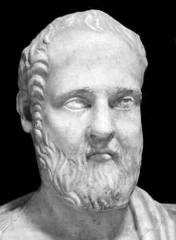
Isocrates, Greek teacher and rhetorician

A chreia in classical Greek culture was a brief, useful (“χρεία” means useful) anecdote attributed by the author to a particular character. In this case it was in honor of Isocrates, an honored rhetorician.The chreiai are remembered primarily for their role in classical Greek education, a system known as paideia in which wisdom was the goal. Children were introduced to simple chreiai almost as soon as they could read. These chreiai served as the means of character formation and the increase of wisdom for living in a civil society.

Later in their education, as they prepared to practice rhetoric (the art of discourse, both written and spoken), these chreiai served as the basis for formal eight paragraph essays in which the student elaborated on the subject of a chreia. The student would praise, paraphrase, explain, contrast, compare, provide an example, make a judgment, and, in conclusion, exhort the reader.

Thanks to my fellow student Steve for sending “after Isocrates.” In honor of my teachers – Gordon Kidder, Mrs. Martino, Mr. Thompson, Ms. Manlove, Harold Miller, Helen Semar, Esther Swenson, Ted Campbell, Lew Briner, Tom Parker, Krister Stendahl, my father and mother –  I’m going to write an eight paragraph essay on this chreia.

Dare to Dream

This morning PhotoBotos posted a magnificent photo by Alex Teuscher (Geneva, Switzerland) of a woman sitting at the mouth of what appears to be a cave. Click on the link http://www.photobotos.com/dare-dream-geneva-switzerland-alex-teuscher/ to see the photograph and read the commentaries by PhotoBotos and Alex, the featured photographer.

Every work of art invites interpretation by the viewer. “Dare to Dream” was intended to create a picture of dreaming and imagination. When I saw it, I couldn’t help but think of other images that inform the picture.

Stunning! I hear echoes from “the cave”: Elijah hiding in the cave; Plato’s cave where all we humans get to see are the shadows on the walls but never the fire behind the catwalk whose light produces the shadows; the dark nights of the soul – depression, sorrow, loneliness, hopelessness, grief – all sitting there inside the cave when there is such splendor all around it.

This picture is different. It sings a different song. The beauty of this piece is that the woman (it strikes me as a young woman, although I suppose it could be John Lennon ) is serene, at one with the beauty and brilliance of the natural world. Freed from the chains that would keep her deep within the cave.  And…she’s not talking on a cell phone or texting! She’s fully present to the beauty. Even the walls of the cave are bathed in the light. This deserves a wider audience. Wonderful.

Drop a comment here to share with others what you see and how it strikes you. And be sure and follow PhotoBotos.com and Via Lucis, two of my favorite sites for meditation.

Father Hardon

Things seem to have quieted down recently regarding the objection of the U.S. Conference of Catholic Bishops (USCCB) to a federal mandate to include contraception in health care coverage.

Back in February Catholic News Service (“Obama’s revised HHS mandate won’t solve problems, USCCB president says”) reported on the story. Cardinal-designate Timothy Dolan, President of the USCCB, “said the bishops are ’very, very enthusiastic’ about the Respect for Rights of Conscience Act, introduced by Rep. Jeff Fortenberry, R-Neb. The cardinal said the legislation would produce an ‘ironclad law simply saying that no administrative decrees of the federal government can ever violate the conscience of a religious believer individually or religious institutions.”

A few days later, my son-law’s neighbor left something on Chris’s doorstep. It was an article from The Catholic Servant about someone named Father Hardon, S. J.  I’d never heard of Father Hardon.

I love the Jesuits. A small group of Presbyterian and Jesuit students met together for beer and theology the last Friday of the month in 1966 in Chicago. The Jesuits are brilliant.

My first impression reading the piece Chris handed me on Fr. Hardon was that it was a spoof, that John Hardon was a fictional priest, or, if the article was serious, I thought it must be misspelling. Surely it was Harden. Or Hardin. Not Hard-on.

I went home and looked him up. There he was…Father John Hard-on.

Hardon seal – Father John Hardon

I found him him on a website dedicated to his memory, including a famous speech of his entitled “Contraception, fatal to the faith?”

“What do we mean by the title,” asks Fr. Hardon, “and what is the thesis of this presentation? We mean that professed Catholics who practice contraception either give up the practice of contraception or they give up their Catholic faith.

“The grave sinfulness of contraception is taught infallibly by the Church’s ordinary universal teaching authority. Therefore, those who defend contraception forfeit their claim to being professed Catholics. Consequently, those who persist in their defense of contraception, deprive themselves of the divine graces which are reserved to bona fide members of the Roman Catholic Church.”

Every one of my priest friends is horrified by Father Hardon. Like him, they are celibate and know how difficult it is to stay morally erect, but, unlike Father Hardon,  they don’t walk around calling men and women who use condoms, diaphragms, or the pill “mortal sinners” who have placed themselves beyond the graces if the Church or its God.

My old buddies from the Bellarmine School of Theology welcomed the Second Vatican Council as a breath of fresh air, as did my Protestant classmates. They are now holding their breath because old Father Hardon is back with a vengeance.

None of my Catholic friends – priests or laity – has lived by what Father Hardon believed was an infallible teaching on contraception. Even if, like Father Hardon, they’ve  never worn a condom, they’re no longer entitled to the graces of the Church or the grace of God.

The elevation of Fr. Hardon (he’s been nominated for sainthood) causes me to grieve the loss of something very, very precious. I grieve it for all my catholic friends. I grieve for my own loss…. And I wonder…

I wonder if my religious conscientious objection to militarism and war might exempt me from paying my federal income taxes. I think I’ll write Rep. Fortenberry for inclusion in the Respect for Rights of Conscience Act.

Grammar quiz

Can you find the split infinitive in “The Only Animal Dumb Enough…”

Valois Cafeteria, Chicago

I just received this email from my friend Steve:”…sitting in Valois Cafeteria in Hyde Park (They have a list on the wall near the menus, ‘President Obama’s Favorites’).

“I was where I was till you interrupted me & pulled me into your hair-styling shop — I hate you guys with Good Hair.

“Would your great insight (and I mean that sincerely, although the Existentialists never quite persuaded me to join their ranks fully) be better or worse if there was not a split infinitive?

“Now back to my Rice Pudding.”

The only animal dumb enough…

Kay, Maggie, Sebastian

“We are the only animal dumb enough to not be where we are.”

The words popped out in the barber chair at Great Clips when Dee, the barber (I still call them barbers), told me that the person who had sat in the chair before me had spent her whole time playing on her iPhone. Never said a word. Never looked up. It sure seemed to Dee that her client was there…in the barber’s chair…but she was somewhere else, while the barber with the real scissors that were cutting her real hair in the real chair at the real Great Clips in the real Chaska Commons was…well…not there. How dumb is that!  “We humans are the only animal dumb enough to not be where we are.”

I spend my days alone with my dogs. Maggie and Sebastian live where they are. They don’t miss a trick – no pun intended; they’re not very well-trained – but they pay attention to every little thing. Every movement I make, every bird that flies across the window, every word spoken, every sound that might hint that Mom’s home, or that Dad is leaving…or taking them for a walk…or a ride in the car. They live where they are.

Sometimes they have to bark to jerk me away from my desk when I pretend I’m not there, checking my emails, surfing the web,  or writing a story. They know I don’t know how to be where I really am. They know that I’m not as smart as they are, but they’re  forgiving of my chronic weakness. They never look down on me.

We human animals think we’re so smart. We are. But what have we lost in ADHD heaven? If it hadn’t been for Maggie and Sebastian, I might not know; the words would never have popped out of my mouth in Dee’s barber’s chair.

When I got home, I shared with my furry companions the conversation with Dad’s groomer and what I had said: “We are the only animal dumb enough to not be where we are.” They were proud of Dad. I returned to my computer and ADHD heaven. They came along side the desk, gave me their paws, and said in unison, “We’re always here for you, Dad.” Then they asked if it was time to go for a ride in the car.

Winds

Winds can destroy a tower:

Steve with a kite on the IL prairie

the trees can break–no power…

but winds can lift a kite!

A hurricane is awesome:

with floods and death quite

gruesome…

but the wind can lift a kite!

Tornadoes rage in summer:

what was a house–now lumber…

but the wind can lift a kite!

A delta or a fighter,

a diamond or a stunter…

Yes, the wind can lift a kite!

A small child can hold the line,

a man’s kite can cheer his wife…

yes, a kite can lift a life…

– Steve Shoemaker, Urbana, IL June 19, 2012

His Own True Self

He sits and smiles,

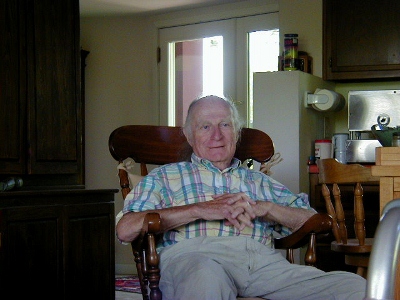
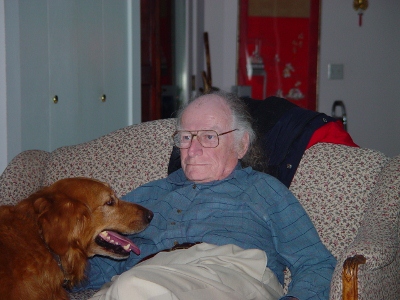
Douglas (“Doug”) Hall at home in Wabasha

His dog Sparky
Resting against his leg,
His eyebrows hanging
Like willow branches.

The bell has tolled
For him, a tolling
Like a wind-song
From the North
Marking the end.

He sits and smiles,
Peaceful, thankful,
Accepting, connecting
With those he loves,
Caring for those he will leave

The earth, his home,
Calls him to itself,
Beyond eternal claims
Or expectations,
He sits at peace

Mortal flesh he knows
Cannot prolong itself,
Nor should it seek what it
Cannot attain
Beyond its measure.

No control of time
Which bears us all away,
No need to storm
The barricades now
Against the end of time.

He sits and smiles
In gratitude
For wonders of sun and shadow,
For all creatures great and small,
For family love and friends.

For these he sits and smiles –
This self-disclaiming man
Who intended nothing
But his own true self
In whatever time was his.

– Gordon C. Stewart, October 2, 2004

Doug Hall was a giant of a man. He was revered throughout the state of Minnesota as the quintessential “street lawyer” in Minneapolis, a nationally known labor lawyer who left his practice to become the founding Director of The Legal Rights Center, Inc, “a law firm of, by, and for the people.” The people were indigent American Indians and African-Americans.

A few days after receiving the call from Doug and Mary with the news that Doug had been diagnosed with terminal cancer, Kay and I spent time with them at the farm near Wabasha, MN. Kay captured a picture of Doug that day with his dog Sparky.I went home and wrote a reflection that later became the opening words of the Memorial Celebration for his life.

A former Chief Judge in Minnesota’s Fourth District Court recalled pulling Doug aside one day into his chambers.

“Doug, I thought you should know a lot of people are talking around the courthouse.”

“Hmmm,” said Doug.

“They’re saying that you’re a communist.”

Re-telling the story all these years later, the Judge starts to laugh and pauses. I beg the question: “What did Doug say?”

Through laughter and tears, he says, “He smiled and said, ‘Hmmm..and what’s their point?'”

His memorial service was a rare event: a collection of street people, former clients, MN Supreme Court Justices, a U.S. District Court Judge who began his legal career with Doug as his mentor, the founders of the American Indian Movement (“AIM”) and African American community leaders, colleagues and friends, Indian drumming, and the sounds of Paul Robeson and Old Joe Hill. The Poem “His Own True Self” opened his Memorial Celebration in Wabasha followed by these words:

We are a diverse bunch.  We are the colors of the rainbow.  We are rich and dead broke.  We are former defendants and former fellow counsel.  We are Supreme Court Justices and District Court Judges – and we are “customers” of the court system and the corrections system.  We are public defenders and prosecutors, probation officers and corrections officers, restorative justice practitioners, legislators, union organizers and people from the streets. But mostly we are just people who all share the same destiny, the same dependence and interdependence.  And no one here is to be treated with more honor than another.

Doug Hall with Sparky

Take Away our Numbness – A Memorial to Sydney Mahkuk

These words were spoken on the sidewalk where 12-year-old Sydney Mahkuk died. Community leaders and Sydney’s family asked me to bring some kind of meaning and hope to the sidewalk where Sydney had been dumped from a car by the side of the funeral home.

November 4, 2005

Gordon C. Stewart

Executive Director, Legal Rights Center, Inc.

Once upon a time a proud people lived on this land. They called themselves Ojibwe, Anishinabe, Dakota, Lakota, and Winnebago. Occasionally a Menominee would visit.  They lived close to the land.  They hunted. They fished. They gave thanks to the Great Spirit for every day.  They saw themselves as part of nature. They rose with the sun. When the sun went down, they gathered in a circle by the light of the campfire.  By the light of the campfire, they listened to the elders, whose stories broke the silence to told the children who they were.  The children went to bed in safety.
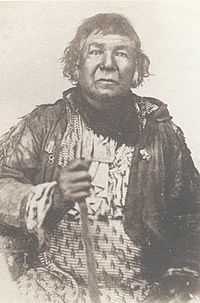
Shabbona, Potawatami Chief, c. 1775 – 1859

They were people of great dignity.  Their ways were good ways.  They respected the land. They respected each other.  They honored their elders.  They cared for the children.  They trained their youth to become adults.  They died with dignity.  They were buried with honor. Earth was their mother. Gitchi Manitu, Wakan Tonka, the Great Spirit, was the common Grandfather of them all.

Then something terrible happened.  A plague came across their land.  It took their land.  It stole their culture.  It laughed at their spiritual practices.  It called them names.  It tore down their tepees, their longhouses and their sweat lodges.  And in their places the plague built big buildings – tall buildings, arrogant buildings, skyscrapers, they called them, that invaded the sky, turning the land into something it is not.  The Ojibwe and Dakota who lived here no longer rose with the sun.  They no longer gathered around the campfire.  They no longer heard the stories of who they were.  They knew only what the white plague had taught them – that unless they joined the plague, they were nobody, and that if they challenged it, they would lose.  They would die.

And so they lived in grief.  A sorrow too hard to bear.  A loss too great to carry.  And the plague offered them relief to numb the pain – firewater that would make them happy in spite of their despair.  Drugs to drive away the memories of who they were.  Escapes to make them numb.  To numb the pain.  Opiates to freeze their tongues.

The elders no longer acted like elders.  The parents were numb with grief.  There were no aunts.  No uncles. No cousins.  No grandparents.  Nobody dared to be a neighbor.  The children were left with no campfire at night – no community to tell them the stories of who they were and who they were not – and so the children and the youth drifted out into the night in search of themselves.  Locked in lonely prisons of confusion, the youth no longer knew Mother Earth as their Mother; they no longer knew how to give thanks to the Great Spirit for the day.  They no longer went to bed with the sun.  They wandered the night in search of the community they had lost and never known.  And the gangs and the drugs and the alcohol offered them the promises of a better life that was the kiss of death.  Ecstasy was no longer a way of life – it was a pill that would make them higher than the skyscrapers that ruined the once humble landscape.  And sometimes the alcohol and the drugs and the gangs that had promised to numb their pain took their lives and they were found in the morning as the sun came up.  They were found by strangers.

Sydney Mahkuk, RIP

Then one day a girl named Sidney, a 12 year-old Menominee-Portawatami, was found beside a funeral home on Columbus Avenue. How she got there nobody knew.  How she died, nobody knew.  But everybody knew why.

The community had unravelled.  It had become dry bones in the valley.

But on that day that the people gathered on the sidewalk on Columbus Avenue to mourn her death, there was a sound from heaven – a rattling, the sound of dry bones coming together, a resurrection of the once proud community. And as a result Sidney Mahkuk’s tragic death the community came together as it had not come together since the plague had begun.

On the day they gathered on Columbus Avenue – a street named after the European explorer who had not discovered their land – on that day, the community woke from its sleep.  It came together – Ojibwe, Dakota, Menominee, Potawatami, Lakota, African-American, Somali, Hispanic, Hmong …and, yes, even the descendants of Columbus.  And on that day, because of a little girl’s unexplained death, they stood together arm in arm and said “Enough” to the plague.  “Enough” to numbness.  They said, “No more. No more. No more death on Columbus’s Avenue.”  And it was more than words.  They looked up at the sun again and really saw it…as if for the first time. They looked down at Mother Earth and saw it, as if for the first time.  And they gave thanks.  Then they looked at each other and they said, “We are a proud people.  We will take back this land.  We will be the people who honor our elders.  We will be the people who support the parents and care for the children.  We will be the people who guide the youth.  We will be a people of hope, not despair.  We will be a people of love, not hate.  We are all Menominee-Potawatami. We are all grandchildren of one Grandfather.  We are the people who care for each other.  We are the people who refuse to go numb.  We are the people who will teach the children of Columbus – starting right here, right now… on Columbus Avenue – how to live in a good way with Mother Earth, in a good way with Iraq, in a good way with the rivers and the sky, the ozone and the sun.  We are the people whose spirituality will help to cure the cancer of the spiritual and economic plague that has left our people in despair.

From that day on, November 4, 2005 at twelve noon, 12 year-old Sidney Mahkuk – our daughter, our granddaughter, our little sister, our friend, our neighbor – would be forever remembered as the one whose deadly silence on this sidewalk spoke so loudly that we could not stay numb.  And we took the city back and brought it back to life.

Merciful God – Wakon Tonka, Gitchi Manitu, God and Father of our Lord Jesus Christ, Jehovah, Allah, Grandfather, Great Spirit who breathes life into all things and receives all life at the end – Your’s is the air we breath, the land on which we walk.  Assure us that your love is stronger than every power to divide or hurt us.  Receive your child Sidney into your eternal care.  Wrap your arms around Glenda, around Sidney’s brothers and sisters, around all the defenseless children of the night, around all of us who mourn their plight and mourn Sidney’s death.  Re-kindle the light of faith and hope. Take from our souls the plague of hate, self-hatred and despair.  Take away the numbness and the apathy.  Make us a people of healing.  A humble and quiet people, but a proud people of love and spiritual strength. A people who are not afraid to feel the pain, who really feel the loss, who feel our feelings and do not fear them.  A people who dare to believe that every tear that falls from our eyes flows into the common stream of human suffering that leads into the ocean of community restored.  A people secure in the knowledge of your love.  Amen.

The Man at the Bar

“Damn” is not his last name,”

Said Herb

To the man on the stool

With the beer at the bar.

….

“What?” said the man with the beer

To Herb,

Drinking his vodka and milk

On the stool at the bar.

….

I said, “God damn!”

Said the man with the beer.

…..

“And I said ‘Damn is not His last name!’”

Cried Herb with his vodka and milk.

…..

“Pow!” came the fist

From the man with the beer.

…..

“What’d you do that for?”

Asked Herb from the floor

To the man with the beer

On the stool at the bar.

– Gordon C. Stewart, June 6, 2012, Chaska, MN

Why is pop culture fascinated with the end of the world?

Minnesota Public Radio’s Public Insight Journalism asked the question after release of the film Seeking a Friend for the End of the Earth. Here’s how I responded.

Ernest Becker’s The Denial of Death makes the case that our culture is death-denying.

One could argue that our fascination with end of the world films and stories is an entertaining and objectified way of dealing with one’s own personal destiny. Every death is “The end of the world.” The end of the world writ large on the planetary screen moves the issue into the world of fiction, fantasy and myth from which, like all cultures before ours, we create meaning in the midst of time.

There are other reasons for our fascination, of course. Supreme among them, in my view, is the dualism and the violence that saturate Western culture: God/Satan, Good/Evil, Moral/Immoral, Saved/Damned, Blessed/Cursed.

It is this misreading of ancient Jewish and Christian texts that makes the will to power the central theme of our time. The late Japanese Christian theologian Kosuke Koyama said that all “sin” has the same root. It is the claim of “exceptionalism.” Under the banner of nationalist exceptionalism’s shameless stealing of the metaphor of “the city set on a hill” away from its proper setting in Jesus’ nonviolent Sermon on the Mount, we assume Western Culture and the U.S.A. to be the Golden City and the agent of divine will. The exercise of that fallacious conviction results in wars of foreign intervention, occupation, and “pre-emptive strikes” in the name of national security.

We have become a national security state. The “end of the world” fascination in our time is heightened by the knowledge that global destruction – nuclear night – is entirely possible. We fear it. We know it. Yet we are also a culture addicted to entertainment where our worst nightmares get projected onto a movie or television screen where we know that what we’re watching is fiction. The fiction is almost always a high-tech version of the old racist and xenophobic dualism my generation grew up on: cowboys and Indians.

Beneath the question of why our culture is fascinated with end of the world is human nature itself. We human beings, like all other animals, are mortal. We may be exceptional in that we are (more) conscious and self-conscious, but first and last, we are animals. We are born. We live. We die.

As conscious animals, we are capable of great feats. We are also, so far as we know, the only animal capable of self-deception, denial, illusion, and species suicide. The denial of death is the great denial, and immortality is the human species’ great illusion.

The fact of death looms over life for each of us existentially and for the species itself from the beginning and in the middle, not just at the end.  Death is our shared destiny. Death is extinction. Our fascination with the end of the world is a strange Molotov cocktail comprised of all of the ingredients of the human condition, most especially the spiritual terror of annihilation, and the illusion of winning. It is the ongoing legacy of the biblical myth of Cain, humanity’s “first-born” who kills his brother Abel, the myth that describes our time and place in history.

If, like in the movie, you had only three weeks left before the end of the world… What would you do?

I’d do what I’m doing now only more consciously. I’d continue to write each morning. I’d do my best to live gratefully, attending to beauty in nature and in art (classical music and paintings) and to family and friends. I’d pray more thoughtfully. I’d walk my dogs more joyfully, stop yelling at them for barking, and find a place on the North Shore to look out to the horizon of Lake Superior. I’d eat lobster and Dungeness crab with lots of hot butter and salt, rib-eye steaks, garlic mashed potatoes. I would avoid Brussels sprouts! I’d end each meal with a Maine blueberry pie, flan, or Graeter’s ice cream, and a Makers Mark Manhattan.  Then I’d settle down on the couch next to the love of my life, Kay, by the fireplace, turn off the news, see if we can make a little fire of our own, get anchored again in the Sermon on the Mount, and return to sources of joy and laughter in the poems of Hafiz. I’d give up being intentional/purposive. I’d live in the moment.