Opting for Silence

Views from the Edge will be closing down for the time being.

Whether on Wednesday morning we wake to election results to our personal liking or to results that confirm, in our opinion, the adage that one should never underestimate the stupidity of the general public, we will not need more words from pundits. We will need something else. Until Views from the Edge can contribute something more than another noisy gong, we’ll opt for silence and see what, if anything, bubbles up that might be worth sharing.

Thanks for all your visits and encouragement.

Until later (maybe),

Grace and Peace,

Gordon

An English Friend in Norman Coutances (Dennis Aubrey)

This lovely post from Via Lucis was almost deleted in the avalanche of campaign soliticitations in this morning’s in-box. Scroll down for the post. It lifted my spirits, prompting the following thank you:

Dennis and PJ, Your post gave me a lift this morning. Such grandeur. I am so weary of campaign television ads, phone calls, and internet solicitations that reduce the human spirit to its smallest proportions. I need the height, the soaring arches, the clean lines – and the reminder that sometimes even barbarity recognizes something else worth preserving. Beautiful shots and great commentary.

An English Friend in Norman Coutances (Dennis Aubrey).

Their post took me to the psalms, and psalm paraphrases set to music. One is Christopher L. Webber’s “I will give thanks with my whole heart,” a paraphrase of Psalm 138 set to the music of Cantionale Germanicum (1628) arranged by J.S. Bach (c. 1708).

All kings on earth who hear Your words,

O Lord, will give you thanks and praise

And tell how great Your glory is,

And they will sing of all Your ways.

The Lord is high, yet scornes the proud,

Protects the lowly on their path;

Although I walk in trouble, Lord,

You keep me safe from my foe’s wrath.

Lord, Your right hand shall save my life

And make Your purpose for me sure;

Do not forsake what You have made;

Your love forever will endure.

– Third, fourth and fifth stanzas

The One who Regained his Sense of Worth

The Gospel of Mark tells the story of the blind beggar who regained his sight. His name in Mark is “‘Bartimaeus’, the Son of Timaeus”. The name is strange because although the word ‘Son’ is in Hebrew (‘Bar’), the name ‘Timaeus’ is  Greek, raising the question of what Mark wants his readers to “see” when the blind Son of Timaeus cries out “Son of David, have mercy on me!”

“The Birth of Freedom” and the NYSE

The New York Stock Exchange was closed down. For two full days the trading bell on Wall Street did not ring. But on Main Street the bells that mis-identify American freedom with Wall Street were ringing in our living rooms, flooding the airwaves with campaign ads about freedom and the loss of it.

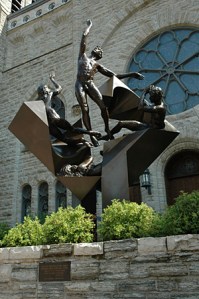
In front of Westminster Presbyterian Church on the Nicollet Mall at the heart of downtown Minneapolis stands an eye-catching sculpture called “The Birth of Freedom.”. The figures are naked, emerging from primal slime, evolving, reaching toward the heavens.

The Birth of Freedom, Paul Granlund

The late Paul Granlund was the sculptor. Westminster commissioned him to give visual expression to the words of the Apostle Paul:

“For freedom Christ has set you free; stand fast therefore, and do not submit again to a yoke of slavery.”  (Galatians 5:1)

There is a freedom from and there is a freedom for.

“For your were called to freedom; only do not use your freedom as an opportunity for the flesh, but through love be servants of one another. For the whole law is fulfilled in one word, ‘You shall love your neighbor as yourself.’ But if you bite and devour one another take heed that you are not consumed by one another.” (Letter to the Galatians 5:13-15)

I listen to the campaign speeches. I hear the freedom talk. I see crowds cheering. I hear loud applause. And I wonder…what kind of freedom is being cheered? What kind of slavery is feared?

The advertisers who write the ads for the candidates and the PACs know the answers to these questions. They know that the psyche of American generations that grew up in the Cold War defines freedom as freedom from “Communism” or “Socialism.” They also know that the Christian Right fears submission to the “godless” whom they believe threatens their religious freedom.

But no one can take away my freedom or yours, and it is misleading to paint one’s political opponent as intending to take it way. For me, as a Christian, the freedom for which we are released (set free) is not freedom from but freedom for communion with my neighbors. It applies not only to personal relationships. It applies equally to the political and economic systems.

This morning the bell rang again at the stock exchange. The biting, devouring, and consuming of each other becomes a way of life again, the adored substitute for freedom. To condone it is to submit again to a yoke of slavery, the most widespread violence where, to quote Jacques Ellul,

“in this competition ‘the best man wins’ – and the weaker, more moral, more sensitive people necessarily lose.

The violence done by the superior may be physical (the most common kind, and it provokes hostile moral reaction), or it may be psychological or spiritual, as when a superior makes use of morality and even of Christianity to inculcate submission and a servile attitude; and this is the most heinous of all forms of violence.”

– Jacques Ellul, Violence: Reflections from a Christian Perspective, Seabury Press, 1969.

Meanwhile Paul Granlund’s “The Birth of Freedom” still stands silently in downtown Minneapolis, calling for the birth of something as yet beyond our imagination.  “Stand fast therefore [in the freedom for which Christ has set you free], and do not submit again to a yoke of slavery.” The Apostle Paul often wrote his letters from jail cells, charged with disturbing the Pax Romana.

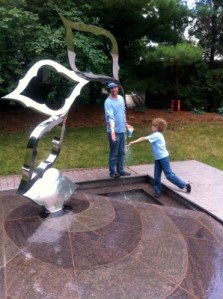
Spirit Tree, Urbana, IL (a Tree City)

…with thanks to John David Mooney

Falling Leaf

It’s best to see at dawn or dusk.

Pines and firs and spruces guard

the tiny park.  The walk of brick

(light and dark) leads to the sound

of falling water.  Then the lights

(L-E-D) that shift and change

from orange to blue lift eyes and hearts,

joining high above a branch,

(no, two or three or four) that point

up and up and up.  The sound behind

Spirit Tree

of running water pulls our sight

from the tree to leaf.  We find

the silver kissing leaves that drip

drops into the pool:  breathe…feel…

– Steve Shoemaker, Urbana, IL, Oct. 29, 2012

“God of the Profits”

Mitt Romney

Moral Mormon, yes, at Church and home.

Is there, though, a hint that he objects

To the rules that women have the same

Trouble with the Priesthood that kept blacks

….

Restricted out of the Church for years?

Or that Morman kindness to the poor

Might be a good model for the U. S.

Nation?  Can we even up the score?

Everybody knows he’s handsome, smart,

Yes, and  rich–but does he have a heart?

An acrostic verse received this morning from Steve Shoemaker, Urbana, IL.

“Best Chicken Soup I’ve Ever Had:”

“Think global; buy local” goes the aphorism. But buying locally gets harder and harder. Locally owned and operated shops are going out of business while the big chain stores eliminate their ability to compete.

Yesterday I wandered into one of those remaining locally owned places in downtown Chaska for a bite to eat. I didn’t mean to, but I did. I started out for Arby’s. I love Arby’s. But the smoke from the parking lot near Arby’s caught my eye. “Smells like hamburgers,” I said to myself, looking for a free lunch.

The smoke was pouring out of a Big Green Egg in front of Ace Hardware several doors down from Cooper’s Market. When it turned out that the hamburgers on the grill were being grilled for the store’s employees – what store does that anymore? – I walked next door to Cooper’s Market.

Coopers has been around a long time. The Cooper family sees itself and its grocery store as part of the community. They live and work here. They believe in this place. They donate tons of food for local charitable events without much recognition.

But their physical location in “Old Chaska” (i.e. downtown) has put them at a competitive disadvantage with Rainbow, Target, and other supermarket chains up the hill in “New Chaska” where I live.

In New Chaska, the corner butcher shop, the locally owned drug store complete with soda fountain, and the candy store that sold kids bubblegum, baseball cards and home-made ice cream when I was a kid are  memories of a by-gone era when neighbors were also the small business people that owned Set Pancost’s Drug Store or Messy Bessy’s candy store. Sorry, Bessy, but that’s what we called the place we went to after school in my home town. The mom-and-pop restaurant with the home-cooked meals still exists at places like Wampach’s in Shakopee, but they’re hard to find, and they’re disappearing fast.

The chicken noodle soup was the best I have ever eaten…anywhere. I was astonished how good it was. I had to tell somebody.  “Did you make this soup?” I asked the woman behind the deli counter.  “Not today,” she said. “I think Jim made it.” “Best chicken soup I’ve ever had.  It was amazing!” She smiled, said thanks, and continued, “We buy everything fresh here. Nothing is frozen. It’s all fresh every day.”

“And what was the spice on the roasted chicken?” “It’s our own blend of spices,” she said. “You won’t find that at Kentucky Fried Chicken,” I said. “I love this place. I’m going to write about this. Your light shouldn’t be hidden under a bushel. People need to know.”

So…if you’re reading this, thinking big global thoughts up or down the street from downtown Chaska, but wanting to buy locally, now you know.

Go to Cooper’s. Then take a trip across Chaska Boulevard for a stop at the Malt Shop for “the best malts in Minnesota” and Dolce Vita’s, the locally owned and operated wine shop that ranks with the very best in New York City or San Francisco. And you won’t have to travel across the globe to get there.

Michelangelo’s Pieta

Pieta – Michaelangelo

My town has a plaster cast

made before the crazy man

took a hammer to the Christ

lying sensuously on

Mary’s big, broad lap.  He’s nude

except for a strip of cloth

she keeps staring at.  A Bride-

…Child-of-God, yet also Mother-

of-God:  she looks sixteen…


Rome’s sculpture is behind glass

now.  Vandals who have seen

sex instead of symbol pass

safely by, kept yards away. 

Here we still come close:  see! pray!

– Steve Shoemaker, host of Keepin’ the Faith, WILL, Urbana, Illinois.

Note: The cast of the Pieta is in the Spurlock Museum of World Cultures at the University of Illinois, Urbana.  


The “Nones” at the coffee shop

The “Nones” are the fastest growing group in the United States religious landscape. Time publicized the story in its March 12, 2012 issue.

Last week Rose French, religion editor of the Star Tribune here in Minneapolis, personalized the Pew Forum research in  “Fastest growing group in religious circles? The ‘Nones’”  (10.15.12).

The story begins with Marz Haney, a young woman who grew up attending an evangelical Christian church every Sunday. But she had questions. And, it appears, the church she attended wasn’t big enough for her big questions.

Questions and doubts are not enemies of faith. They are the friends of faith. They refine, correct, expand, and reform faith. They challenge what Jean-Paul Sartre called “bad faith.”

Sartre, of course, thought that all religious faith was bad. Some of the “Nones” agree with Sartre. Others still profess faith or “spirituality” but live it outside the boundaries of the traditional institutions that no longer hold meaning for them.

“I had some doubts all along. I was sort of in continual doubt about my personal salvation,” says Marz Haney.

That Marz and others have concluded that spirituality/faith/religion is all about personal salvation brings me great sadness. That she would think so is a reflection of the right turn that began to dominate the American religious landscape beginning in the 1950s.

To many of the “Nones”, fear and hate have become the face of Christianity. Sometime in the late ’50s, the televangelists began to change the face of Christianity to the world. Those who tuned in watched and heard the voices of snake oil salesmen selling purple handkerchiefs that would heal, if only you purchased one and put the hanky on your television screen while the evangelist prayed for you. Intelligent faith was turned into an oxymoron. One either is intelligent and without faith, or full of faith and without intelligence.

At the coffee shop recently, the proprietor who greets me “Good Morning, Your Reverence” with a smile, invited me to join a conversation he was having with two other coffee drinkers. “You can help us here,” Mike said. His grin told me this was a set up. “If God created the world, who created God?”

“Hmmm. Interesting question. Really good question. Really, really, really good question. It assumes, of course, that everything is created. That’s the way we think. If something’s here, it has to have been created. But that begs the question endlessly. So….maybe some things are not created. Whatever that is ultimate reality. In theology, the word we use for the ultimately real is ‘God’.”

Several weeks later a young couple sat at the table at The School of the Wise, a coffee shop and wine bar humorously named after the euphemism for speakeasies during the era of Prohibition. The couple had sent a message through the church’s website inviting a conversation about their needs and whether Shepherd of the Hill Church might be a good fit.

They were “Nones”. I love this couple! They made my evening. So honest. So genuine. So open. Wondering and hoping that perhaps Shepherd of the Hill might be a place unlike that mega-church up the road whose very small print declares belief in “the intention, eternal punishment of the wicked”. They were cautious but feeling the need for a community that welcomes rather than scorns, unites rather than divides, thinks as well as feels, and moves them beyond self-absorption in the comfortable but confining precincts of economic privilege.Sitting in a coffee shop with The New York Times on Sunday Morning over a cup of coffee was no longer enough.

Which, of course, is what the gospel is about, as I understand it.

Jesus had one message: “the Kingdom of God/Heaven is at hand.”  A “Kingdom” is a society, a commonwealth. A society is people in relationship. “At hand” means “Now!” The kingdom of Heaven was something like the heaven the young couple and I were experiencing right there at the back table in The School for the Wise – real people in real relationships, exploring ultimate reality over delicious mocha-mint-lattes, looking beyond our privilege and celebrating the magnificence of a moment that is at the very heart of  creation as we know it.

Back To Top