A thoughtful reflection from New Zealand:
Confronting our inclination to violence
Reply

A thoughtful reflection from New Zealand:
“70”
When I say I have reached “Three score and ten,”
most folks today do not recall the phrase-
is from the Bible. They just think of when-
“Four score and seven,” Lincoln said, in days-
of war.
At six-foot-eight I was too tall
for drafting to the war in Viet Nam.
My college friends were sent to fight and fall.
I went to Seminary–just a lamb
far from the wolves, from death, from… (I almost
mis-wrote “…from Agent Orange”–for which no cure
exists–or rhyme.)
I wish that I could boast
my years were spent in waging peace, in pure
activities alone: but many a day
I failed. (It is for mercy that I pray.)

Steve Shoemaker at historic pulpit of Sheldon Jackson in CO.
– Steve Shoemaker, Urbana, IL, December 19, 2012
 If philosophical parsing of the meaning of Sandy Hook was inappropriate just a few days ago, it is mandatory now.
The slaughter of these dear little ones and their teachers was a moment of terrible and terrifying insanity. When Adam put on his body armor and turned his mother’s guns on his own mother and Sandy Hook, insanity broke out to bring grief that chilled the bones of everyone in America.
Today there are calls for gun control and mental health services, and those calls make perfect sense as practical responses, but they will not fix the problem.
There is a more profound collective insanity that pervades our culture and our nation. It’s a tragedy in the sense of the old Greek and Shakespearean theater: a fatal flaw that is doing us in.
Sandy Hook was the latest symptom of the American tragedy: our worship of safety – arming ourselves to the nines – turns out to the death of us. The idolatry of safety is the worship of death itself.
A five year old boy in Minneapolis is playing with his two-year-old brother in their parents’ bedroom. He finds a loaded pistol under their father’s pillow, points it at his brother as one would point a toy gun. His brother is dead. The surviving five-year-old and his parents will never be the same – because a father sought to keep his family safe with the pistol under his pillow.
A mother in Newtown has guns in the home she shares with the disturbed son she loves and seeks to protect from a cruel world. Like so many others in America, the guns were purchased either for safety or for sport, but the results are the antitheses of safety or fun.
Whether in our bedroom at home or in the nation’s Capitol, when the insurance of safety rises to the top of the pyramid of values, death ascends as the power that destroys, the fatal flaw in a natural human instinct toward safety and security.
Freedom and safety are basic human needs. They are American values. Each is important. But neither freedom nor safety is God. Neither one is worthy of enshrinement by itself, and the two of them mixed together make for a Molotov cocktail thrown back into our own bedrooms, at the Sandy Hook Elementary School, Baghdad, and anywhere else that the concern for safety releases the tragic flaw of the Greek theater, Shakespeare, and the American theatre of the absurd.

Pieta – Michaelangelo
While reflecting on Malachi’s strange metaphor of the refiner’s fire, Via Lucis’ post “Stillness Crieth Out” (re-posted here last week) re-focused the sermon. Here are the words from Malachi:
“Behold, I send my messenger to prepare the way for me, and the Lord whom you seek will suddenly come to his temple; the messenger of the covenant in whom you delight, behold, he is coming, says the Lord of hosts. But who can endure the day of his coming, and who can stand when he appears? “For he is like a refiner’s fire and like fuller’s soap….” – Malachi 3:1-2.
Thank you, Dennis Aubrey and PJ McKay, for you splendid insights to to these grand Romanesque and Gothic sacred spaces that still bring the soul to stillness and wonder.
Sometimes as Good as a Dog
Do not say that “It was the will of God.”
Imagine what automatons are like:
no thought, no will, no emotions. A good
dog trained to help the blind can make
the decision not to cross the busy
street even if the master says to heel.
…
A robot just repeats repeats a task.
A human can lovingly pat you on
the back, or choose to stab you in the back.
God seems to prefer life to a machine.
So we are free to love, to choose the good,
and if sometimes we do…we can thank God.
– Steve Shoemaker, Urbana, IL Dec. 15, 2012
“Just put the burro here,” he said,
“She’ll calm the horses of the folks
inside the inn.” And so they tied
me to the pole above the trough.
…
I was surprised he later led
a man and girl into the stall
and pointing to the straw, he said,
“Sleep here, this simple space is all
that’s left tonight, and if the child
is born the cries won’t wake the guests.”
…
He grimaced, but she somehow smiled
and sank down to the ground. Their rests
did not last long. Her labor soon
began and then the baby, wrapped
and warm, was laid under the moon
light bright where we, the stock, were trapped
and fed. I brayed when shepherds dumb
barged in and said a king had come…
– Steve Shoemaker, Urbana, IL, Dec. 11, 2012
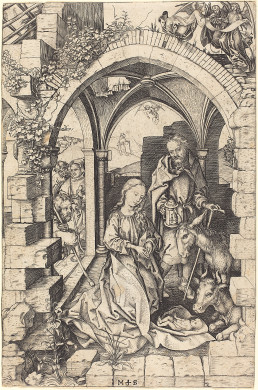
The Nativity, Martin Schongauer,
c. 1470/1475, National Gallery of Art Collection
We are more than animals,
but not as much as we may think
We both must stop to eat and drink:
trough or table, room or stable.
He was placed in a manger.
…
He would become food for us:
bread and wine, life divine,
grace we can taste, pure salvation,
soul and body–redemption!
All from a baby in a manger.
– Steve Shoemaker, Urbana, IL, December 10, 2012
“Stillness crieth out that something Great is nigh.”
We seek connections every day, among our family, our friends, our colleagues, and sometimes even complete strangers. We seek connection with each other, and with life itself. We are surrounded with the tools of connection more now than ever before. The web, email, cell phones, texting, Twitter, Facebook, and social media in general. We can see almost instantly what those we care about in some way are doing or thinking. What we find lacking in human connection, we try to find in other things. We seek to connect with ideas or feelings. We study, play music, paint, sculpt, build and write so that we can connect to that ineffable thing that eludes us. And not finding those ideas or feelings, we settle for something else, something that carries the trappings of meaning while not having anything intrinsic itself. We settle for fashion.
View original post 577 more words
My children have had children, yet this week
this widower may take a teenager
to be a wife. Her family did not seek
a younger, handsome man. A carpenter
I am, not an Adonis– I worship
just Adonai, and follow in the way
of Torah, righteousness.
…
Did Mary slip
from following the way, from purity?
She is with child, yet I have had a dream
like Joseph did of old: an angel said
I should not fear to wed though it may seem
absurd. The child in her has been conceived
by holy spirit, not by sex. His name
should be Emmanuel, yes, God with us,
for he will save his people from their sins.
,,,
I will take Mary for my wife; Jesus
will be his name. God can speak in a dream.
– Steve Shoemaker, Urbana, IL, Dec. 4, 2012

 Views from the Edge