Is there no cure for these?

Gordon C. Stewart April 11, 201

Today the Senate begins a floor debate on gun control that brings to mind an earlier “floor debate” several months ago in Chaska, Minnesota.

Ever since the community Dialogue on “Gun Violence in America,” I’ve searched for answers to what happened.

A crowd of 138 people came out on Tuesday night to chime in following the tragedy at Sandy Hook in Newtown, Connecticut.

As the night wore on, it became clear that there would be no real dialogue, no moderated discussion. No give-and-take. A series of monologues, without interruption and with a time limit, was the best we could expect.

Fear, anger, hostility and suspicion were in the room. The room was hot.

The months following have been a personal search for understanding of what happened that night, and how we in America move forward together on such a divisive issue.
———————————-
Imagine two people going into separate audiologist booths for hearing exams.

John grew up in rural America. Betty grew up in the city.

In their hearing booths Betty and John repeat the word they hear.

“Say the word ‘gun’, says the audiologist.

“Gun.”

Their hearing is good. They say the same word.

—————————–

After the hearing test, John and Mary are taken to different rooms for interviews. A social psychologist wants to know what emotions and thoughts are triggered when they hear the word ‘gun’.

“I’m going to give you a word. After you repeat the word, I want you to give me the other words that come to mind. It’s called “word association”. Don’t think about it. Just say whatever comes to mind.

“Gun”:

    John:

“Safety, protection, coyotes, wolves, cows, cattle, sheet, careful, responsibility, civil right.”

    Betty:

“Run, violence, threat, death, war, robber, gangs, school massacres, NRA, Sandy Hook.”

NRA:

    John:

“Second Amendment, right to bear arms, protector of civil liberties, defender of the Constitution.”

    Betty:

“Right-Wing, powerful, myopic, out-of-touch, vigilantes, white supremacist, radical, dangerous.”

Gun control:

    John:

“Government, anti-democratic, anti-Constitutional, intrusion, loss of freedom, fear, police state, socialism.”

    Betty:

“Safety, safe home, necessity, protection, peace, hope, end of fear.

Kingdom of God:

    John:

“Hmmm… Soul, salvation, heaven?”

    Betty:

“Hmmm… Safe streets, the common good, love?”

————————

Both are church members. They are practicing Christians. Betty and John pray the Lord’s Prayer. “Thy (Your) Kingdom come; Thy (Your) will be done on Earth as it is in heaven.”

Could the common bond of Jesus’ prayer bring the two into the same room in a shared search for understanding and action? Or are the formative cultural experiences so determinative that faith and religion are what Marx said they were – blinders that prevent them from seeing anything but what we’ve already chosen to see?

Perhaps some singing might help – a hymn or two – and reflection on the lyrics, like those of Fred Pratt Green (1969):

O Christ, the healer, we have come
To pray for health, to plead for friends.
How can we fail to be restored,
When reached by love that never ends?

From every ailment flesh endures
Our bodies clamor to be freed;
Yet in our hearts we would confess
That wholeness is our deepest need.

How strong, O Lord, are our desires,
How weak our knowledge of ourselves!
Release in us those healing truths
Unconscious pride resists or shelves.

In conflicts that destroy our health
We recognize the world’s disease;
Our common life declares our ills:
Is there no cure, O Christ, for these
?

An Apple for the Teacher

apple-for-teacher1

gun clip and magazine

gun clip and magazine

Once upon a time…not long ago…an apple was the gift we brought the teacher.

TODAY… a first grader leaves home with gifts of a hair clip and a Time magazine. Her teacher is surprised.

Next day the student returns to school. “I’m sorry,” she says, “I misunderstood. My father meant I should bring you these. He’s a member of the NRA.”

Pete Seeger and the Story of Abiyoyo

Video


Nobody told a story the way Pete Seeger did! Pete always lifted people up. “Lift up your hearts!” he seemed to say, and then he would dance and play. The whole world was his communion table. The child in him never faded. He still calls up the child in us.

The Garden Outside Pleasantville

This is the manuscript of the Easter sermon yesterday at Shepherd of the Hill Presbyterian Church in Chaska, MN. The sermon was an exploration into the contemporary meaning of the text: The Gospel According to John 20:1-18.

In some way or other, I think it’s safe to say that we all have a kind of nostalgia for the innocence and purity of the Garden of Eden…before what we call “the fall.” We have a sense that we are not supposed to be outside the gates of the Garden…out here. At the expulsion of the man and the woman in the story from Genesis, .the cherubim (angels) are posted at the gate to be sure that those who have been expelled cannot get back in. The cherubim and a twirling, flaming sword keep Adam, Eve – you, me, all of us – on this side of the gate, outside the Garden of Eden.

Well it’s a story, of course, but isn’t it our story? Nostalgic for a world where nothing ever goes wrong But illness comes, a marriage goes bad, a relationship with someone you love falls apart just when you think it’s to lead to something more permanent, you lose a job, you suffer depression, you suffer from an illness, you’re left alone in grief over the loss of a loved one. Or you yourself are dying, and there are wars and rumors of wars. We watch the children and wish that we could protect them, but we can’t, even though we are parents and grandchildren, aunts and uncles. Out here…outside the Garden…it’s rough sometimes.

In this morning’s Gospel (John 20:1-18), the Risen Christ’s appearance to Mary takes place in a garden The garden is outside the empty tomb. Until Mary turns and sees the One she supposes to be “the gardener”, the text has said nothing about Jesus being laid to rest in a garden. It says only that Jesus was laid in a tomb in which no one had yet been buried.

Mary has already been there by herself in the early morning darkness. When she sees, to her great horror, that the tomb is empty, she runs to tell “the other disciple” and Peter.

What do they do? Well…these are guys, you know. They race each other to the tomb.

We don’t ever compete, do we, guys!? And Peter loses! The other disciple gets there first, and then Peter follows, huffing and puffing. Peter, bold man that he is, goes in. Peter in this story is like detective Joe Friday in the old Dragnet series: “Just the facts, Ma’am; just the facts!” He sees the facts. The burial cloths are lying there as though the body had evaporated out of them, but the napkin that had covered Jesus’ face, was neatly rolled up in a place by itself. Then the other disciple goes in, sees the same thing. He believes…and then…they just…go home.

Well…what happened to Mary? They leave Mary there? By herself? And it is Mary who gets it – because Mary continues to stand there, weeping. She’s feeling her grief, feeling her sorrow, and it is as she is feeling her sorrow and her grief. It is as she goes down into the horror of the cross, the horror of having stood helplessly at the foot of the cross that she experiences the Risen Christ.

It is there that there is suddenly a garden, a new garden of Paradise.

I don’t know how it is with you, but sometimes I want to live in a perfect world. I want everything to be in its place. I don’t want any problems. I don’t want to feel anything. Someone I love much once said, “I hate feelings!” This is about feelings, brothers and sisters.
There is a certain kind of Christianity that says “No, no, no!” to every “negative” feeling. It wants everything to be happy. Like Steve Martin dancing around with happy feet. All we want is happy feet. But you don’t get happy unless you know sadness. You don’t get to laughter unless you know what it is to cry real tears of sorrow.
—————————————————-

This distorted kind of Christianity, this preference for the perfect world without any negative feelings or experience is humorously by the film Pleasantville.

David, who is played by Toby McGuire, and his sister Jennifer (Reese Witherspoon) lead very different high-school social lives. Jennifer is popular and shallow. David is introverted, keeps to himself, and spends most of his time watching television. David’s favorite show is Pleasantville, a nostalgic throw-back black and white television series about the idyllic Parker family in the late 1950s. The little imaginary town of Pleasantville is, for David, a kind of Garden of Eden in which nothing ever goes wrong. Everyone is nice. No one ever feels pain. They are just, well… so nice.

One evening David and Jennifer fight over the TV. Jennifer wants a concert. David wants to watch Pleasantville. As they fight, the remote control breaks.

A mysterious TV repairman, played by Don Knotts, shows up, quizzes David about Pleasantville, and replaces the remote control with a strange new one. When the TV repairman leave, David and Jennifer resume their fighting, and are sucked through the television set into the black white gray, colorless world of the Parkers’ Pleasantville living room.

They are no longer David and Jennifer. They must pretend to be Bud and Mary Sue Parker, the son and daughter of the Parker family of Pleasantville.

David and Jennifer witness the wholesome nature of the town, such as a group of firemen rescuing a cat from a tree. David has to remind Jennifer that they must stay in character and not disrupt the lives of the town’s citizens, who don’t even notice the difference between the show’s original characters of Bud and Mary Sue, and their role replacements, David and Jennifer. In keeping with the show’s plot, Jennifer dates a boy from high school, but when she has sex with him, a concept unknown to the boy and to everyone else in town, the spell of colorless innocence is broken.

Slowly, Pleasantville begins to change from black and white and grayness to color. Flowers and the faces of people who have experienced bursts of emotion begin to have some color.

David becomes friends with Mr. Johnson, who owns Pleasantville’s cheeseburger and soda fountain. He introduces Mr. Johnson to colorful modern art via a book from the library, sparking in him an interest in painting. Mr. Johnson and Betty Parker fall in love, causing her to leave home, throwing George Parker, Bud and Mary Sue’s father, into confusion. The only people who remain unchanged are the city fathers, led by Big Bob, the mayor who sees the changes eating away at the values of Pleasantville. The city fathers resolve to do something about their increasingly independent wives and their rebellious children.

As the townsfolk become more colorful, a ban on “colored” people is instituted in public places. A riot begins when a nude painting of Betty, painted by Mr. Johnson, appears on the window of Mr. Johnson’s soda fountain. The soda fountain is destroyed, books are burned, and people who are “colored” are harassed in the street. As a reaction, the city fathers announce new rules preventing people from visiting the library, playing loud music, or using paint other than black, white, or gray.

When David and Mr. Johnson protest by painting a colorful mural on a brick wall, depicting their world, they are arrested. Brought to trial in front of the town, David and Mr. Johnson defend their actions, arousing enough anger and indignation in Big Bob, the mayor, that Big Bob becomes colored as well.

Having seen Pleasantville change irrevocably, Jennifer stays to finish her education, but David finally manages to return to the real world by use of his magical remote control.
———————————————————-

Easter is about a full color world. FULL of color. Full of emotion. Ups and downs. It has nothing to do with this imaginary, utopian Garden of Eden that never was and never will be, in which we no longer have to feel much of anything. “I hate feelings!”

There is no return to the Garden in which the man and the woman live in unconscious innocence, no way back into the black and white and gray world of the Garden of Eden from which humankind is expelled.

But this morning we see a colorful woman. She is a colorful woman, this Mary of Magdala, who stays with Jesus all the way through.

According to one tradition in the Church, this Mary was a prostitute. Mary Magdalene comes to Jesus, stays by Jesus, is healed by Jesus. Now she is in deep grief on this morning when, so far as she knows, her Lord was still buried in that tomb following a Roman crucifixion, dead and gone.

It is this Mary who goes out early in the morning, “while it was still dark.” Women don’t go out in the night; they don’t go out unescorted in the dark. But Mary does! And when the other disciple and Peter, the two heroes to whom she had gone for help, abandon her, she is there by herself.

“Why are you weeping?” ask the two angels, one where Jesus’ feet and been and one where his head had been. The cherubim!

These cherubim, who guard the way back into the lost paradise of the Garden of Eden, are there in the tomb. “Why are you weeping?”

Mary’s voice breaks into a stammering primal cry of horror. “They have taken away my Lord, and I do not know where they have laid him! Tell me where he is! Let me hold him!”

She turns around. The gardener greets her. The Risen Christ greets her, but she does know that it is Jesus. She supposes him to “the gardener”. She is in a garden where only the gardener would be early in the morning. The One she assumes to be the gardener greets her. She doesn’t recognize him. He asks the same question, “Woman, why are you weeping? Whom do you seek?” Mary gives the same answer.

Then he calls her name. “Mary!”

Rabboni (Teacher)!!! It’s YOU!!! Is it really YOU?”

How about you? Why are you weeping? ask the Cherubim and Jesus.

“Mary, Mary, Mary!’ Her name is called. Your name is called, the name of the real you. Not some black-and-white-and gray, colorless character in a Pleasantville world, but the real flesh-and-blood, colorful you, the real Mary. The real Bob. The real Jane. The real you in living color.

“Do not hold me,” he says, “for I have not yet ascended to the Father. But go to my brothers and sisters and tell them I am ascending to my Father and your Father, to my God and your God.”

”Go! Go! Go now!”

Tell each other. Tell each other it’s not over. Tell each other you have seen me. Tell each other that Caesar did not have the last word. Tell each other that life is greater than death, greater than might. Tell each other that you have heard the cherubim, standing guard from within an empty tomb, asking you why you are weeping. Tell them that you have heard the Gardener’s own voice in the New Garden outside my empty tomb!

Today the tears of sadness and the cries of horror are turned into the tears of gladness and shouts of exuberant joy:

“Christ is risen!” brothers and sisters, “Christ is risen! Christ is risen!” Alleluia! Alleluia! Alleluia!”


Good Friday 2013

Today is Good Friday.

Two pieces enriched the silence today. The first arrived early this morning.

Testimony

In Mark, the earliest account, the name
is given of the man who from the crowd
was forced to lift and carry the crude wood
cross that some carpenter had made the same
day. Simon of Cyrene is named, and then
the names of his two sons–as if they were
still living and could testify that their
father was one of the witnesses when
Jesus was crucified. Women were named
who saw the body buried in the grave,
and later returned to the empty cave
and found the heavy round stone had been rolled
away. Joseph of Arimathea
had given his own family tomb away.

But you are skeptical and full of doubt
that Christ is risen–you should check it out.
See that his followers who ran away
now risk their own lives when they sing and pray.
His students now have students. Many saw
him after death. They live and testify.
His movement grows, and some react with awe
and pass the story on, still testify…

– Steve Shoemaker, Urbana, IL, Good Friday, 2013

The second arrived this afternoon.

Click HERE to read Dr. Matthew Boulton’s Good Friday reflection in the Indianapolis Star. Matthew carries on the story as President of Christian Theological Seminary in Indianapolis, Indiana. Matt is the son of Wayne, my seminary roommate and best friend since 1964. “They live and testify. His movement grows, and some react with awe and pass the story on, still testify…”

✚ Lessons in Stone (Dennis Aubrey) ✚

✚ Lessons in Stone (Dennis Aubrey) ✚.

Dennis Aubrey’s “Lessons in Stone” took me back three years ago.

I’m sitting in a small room with a Benedictine monk at St. John’s Abbey in Collegeville, MN. It’s the first of six private meetings over a three day silent retreat.

“What brings you here?” asks the spiritual guide. “My step-daughter is dying of cancer.” “What is her name?” “Katherine.” How old is Katherine?” “Thirty-three. She was diagnosed four years ago with Leiomyosarcoma, a rare incurable sarcoma, and is now in her last months in hospice care.”

“So what troubles you? Are you afraid for the state of her soul?” “No,” I respond quickly. “Not at all. It’s not about that. God is Love. I don’t believe in hell.”

“Hmmm,” said the monk. “I see. Interesting. Our tradition says that there is a hell, but that the likelihood is that there’s nobody in it.”

The centerpiece of the tympanum that captured the attention of the little Danish boy in Dennis’ “Lessons in Stone” is the scene of God’s hand reaching to pull Saint Foy toward heaven.

You don’t have to believe in hell as an eternal state to cry out for release from its torments here and now, or to pray for a peace that passes all understanding.

Meeting President Bill Clinton

Steve officially welcoming President Bill Clinton to Champaign-Urbana

Steve officially welcoming President Bill Clinton to Champaign-Urbana

January 28, 1998

He gave the State of the Union address
the night before, and flew on Air Force One
to our college town in the middle-west
to check out press and public reaction.
(The sex with an intern story made news
the week before.) For six years he had met
not politicians, but “Local Heroes”
at airports (Do-Gooders the Democrat
Party chose.)

Our church worked with homeless men.
As Pastor, I was picked to shake his hand
as he came off the plane (in a long line
with 14 other folks.) He called each one
of us by name. He firmly gripped my hand,
looked in my eyes, pretending to be fine…

-Steve Shoemaker, Urbana, IL

Old Friends

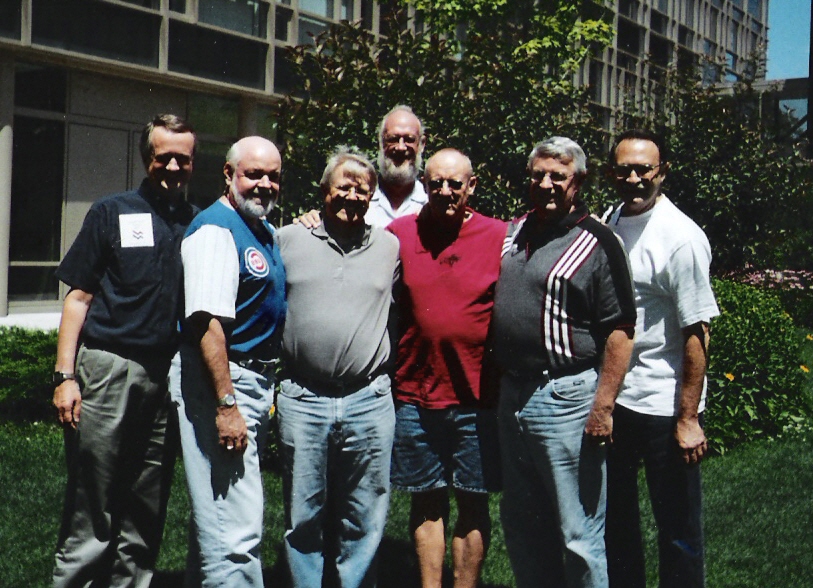
Dale Hartwig (red shirt) and the Chicago Seven Gathering, McCormick Theological Seminary, 2004.

Dale Hartwig (red shirt) and the Chicago Seven Gathering, McCormick Theological Seminary, 2004.

This morning news arrived of the passing of an old friend. Dale is a classmate, one of seven who call ourselves The Chicago Seven. The Seven met annually until 2004 when the gathering was reduced to Six because of Dale’s advancing Parkinson’s. The gatherings have continued to be powerful bonds of friendship, but never again so meaningful as when there were Seven.

MEMORIAL TRIBUTE to be shared at the Celebration of Life & Victory over Death for DALE HARTWIG

Dale was such a joy for all of the Chicago Seven (now Six). His quiet spirituality brought a stillness to the room, or tears, and so much reality and the tenderness of a poet. The last time all seven of us McCormick alums gathered in Chicago, we sat around a long table sharing our thoughts and work. Dale and I were sitting next to each other, as we often did, at one end of the table. When it came his turn, Dale moved some papers in front of me and asked that his words be read. His contribution, as I recall it, was a Greek exegesis from a New Testament text that reminded us of his love for biblical exegesis, he being the only one of us who left seminary to become more proficient in NT Greek than when we left. His sharing also included a poem he had written. As I read it aloud on his behalf – his surrogate voice – he began to weep because his words had been heard! Here’s the poem in memory of that sacred Hartwig moment – one of many – that the rest of us will forever cherish.

“THE SURROGATE VOICE” – GORDON C. STEWART (WRITTEN IN THANKSGIVING FOR THE CHICAGO GATHERING ’04)

As the surrogate voice reads on,
the author sits and sobs
his wrenching tears from primal depth;
from some abyss of joy
or nothingness…or both.

The author’s sighs and piercing sobs-
arrest routine,
invoke a hush,
dumb-found the wordy room.

He cannot speak,
his Parkinson’s tongue tied,
his voice is mute, in solitude confined,
all but sobs too deep for words.
Another now has become
his voice, offering aloud with dummy voice
the muted contribution
in poetic verse the ventriloquist’s voice has penned.

The abyss of muted isolation ope’d,
his words, re-voiced aloud,
hush the seven to sacred silence, all…
except from him, their author.

Whence comes this primal cry:
From depths of deep despair and death,
from loneliness, or depths of joy
We do not know.

The surrogate voice reads on
through author’s sobs and sighs,
through his uncertain gasps for air
and our uncertain care.

The iron prison gates – the guards
of his despair – unlock and open out
to turn his tears from prison’s hole
to tears of comrade joy.

His word is spoken, his voice is heard,
a word expressed
in depth and Primal Blessing,
pardoned from the voiceless hell.

The stone rolls back,
rolls back, rolls back,
from the brother’s prison’s tomb,
the chains of sadness snap and break!

At one, at one, we seven stand,
in Primal Silence before the open tomb,
as tears of loss, of gain, of tongues released
re-Voice unbroken chords of brotherhood.

Rizpah and her children

As the snowstorm cancelled schools in Minnesota last week, 90 year-old Lorraine Garrison was surrounded by family and friends who celebrated her life.

Lorraine’s grandson, Jeff, reminded the minister of the story of Rizpah, the diligent mother who perched her body on the rock after two of her children were hanged by the Gibeonites, and stayed there for five months to keep the birds and animals of prey away. Lorraine was a Rizpah, watching over her adult children and her grandchildren from her room in the nursing home in Chaska.

“Rizpah” – Alfred, Lord Tennyson (1809–1892)

Sin? O, yes, we are sinners, I know—let all that be, 60
And read me a Bible verse of the Lord’s goodwill toward men—
“Full of compassion and mercy, the Lord”—let me hear it again;
“Full of compassion and mercy—long-suffering.” Yes, O, yes!
For the lawyer is born but to murder—the Saviour lives but to bless.

He’ll never put on the black cap except for the worst of the worst, 65
And the first may be last—I have heard it in church—and the last may be first.
Suffering—O, long-suffering—yes, as the Lord must know,
Year after year in the mist and the wind and the shower and the snow.

Heard, have you? what? they have told you he never repented his sin.
How do they know it? are they his mother? are you of his kin? 70
Heard! have you ever heard, when the storm on the downs began,
The wind that’ll wail like a child and the sea that’ll moan like a man?

Election, Election, and Reprobation—it’s all very well.
But I go to-night to my boy, and I shall not find him in Hell.
For I cared so much for my boy that the Lord has look’d into my care, 75
And He means me I’m sure to be happy with Willy, I know not where.

The story comes from Second Book Samuel 21:10-11: “And Rizpah the daughter of Aiah took sackcloth, and spread it for her upon the rock, from the beginning of harvest until water dropped upon them out of heaven, and suffered neither the birds of the air to rest on them by day, nor the beasts of the field by night. And it was told David what Rizpah the daughter of Aiah, the concubine of Saul, had done.”

Thank God for the Rizpahs of this world who will never let Willy get lost.

Verse – Stillbirth

“Don’t kill me!” my young wife cried
as the nurse–quite frantic–pushed
her, the half-born baby, and
gurney down the hallway. “Dead!”
she kept shouting, “The baby is dead…”

E. R. folks, following all
procedures had brought a wheel-
chair to the car at my yell
she was giving birth while still
lying in the back seat.

…………………………”I’ll
carry her,” I growled, and sent
chair careening down the street
with a kick. We’d faced the fact
that the child had died and that
natural birth was the best

three sad weeks before. We cried
then. Now we both just wanted
closure, as they say…to find
out what caused her life to end.
“Just a mystery,” we learned.

It took years before we tried again.

– Steve Shoemaker, Urban, Illinois