“Minnesota Nice” and Better – John Skogmo

Minnesotans are known for Minnesota Nice, a phrase that describes Minnesota’s Scandinavian culture of civility. Sometimes Minnesota Mean lies just below the surface. Other times civility and gentleness pervade a person’s character. John Skogmo was Minnesota Nice at its best. There was no meanness in him.

Minnesotans also don’t like fanfare. That Minneapolis is called “the little apple” refers not only to the city’s size compared to “the Big Apple” but also to Minnesotan’s disdain for big splashes, big stages, and floodlights. ‘Ego’ and ‘Minnesotan’ belong together in the Thesaurus as antonyms.

Working back stage behind-the-scenes is what Minnesotans are about at their best.  John Skogmo’s obituary, laced with subtle humor, is a great tribute. John was a man without guile; his faith was the foundation of the quiet stature universally recognized by his family, friends, church, and work colleagues.

Obituary, published April 12, 2015 [highlights added by VFTE]

John Gunderson Skogmo died April 4, 2015 of cancer. Born in Fergus Falls, MN, July 15, 1947, to James Bertram and Joyce Shirley Skogmo.

John found his calling at age nine, reading his father’s issues of Kiplinger’s financial magazine. He became fascinated with compounding interest and saw the benefits of delayed gratification. As a teenager he ran a concession that sold popcorn, cotton candy, and caramel apples at local events. At the end of the day he laundered money-at the kitchen sink, to get the sugar and grease off his cash intake. He used his earnings to buy shares in the Security State Bank of Fergus Falls and was frequently excused from school to attend shareholders’ meetings.

After graduation he left for the Cities to attend Macalester College, where he received a treasured liberal arts education. He earned a J. D. from the University of Minnesota Law School in 1972 and went to work immediately in the three-person legal department at Northwestern National Bank. Except for a summer at the Cornell University School of Business as a 1978 Bush Foundation Fellow and the bank’s temporary displacement by the 1982 fire, John spent his entire career at the corner of 7th and Marquette, as NWNB became Norwest and then Wells Fargo. He was fortunate to work in several departments before finding his true home in 1989 in Wealth Management, where he applied his stellar relationship skills to helping individuals and families. He was set to retire in June 2015 after 43 years with the bank.

John Skogmo’s volunteer work, much of it behind-the-scenes, helped assure the solvency and stability of some important organizations. As a trustee of Macalester College, he reinvigorated the Alumni Fund at a critical juncture. He worked with Artspace to maintain affordable housing and workspace in gentrifying neighborhoods and was instrumental in establishing the Cowles Center. He served as president of the Friends of the Minneapolis Public Library and was appointed by the city council to the Minneapolis Community Development Agency.

His proudest achievement was his long-term service to Westminster Presbyterian Church as a deacon, trustee, elder, and treasurer. John’s was the voice of prudence in many crucial financial decisions, and his steadfast leadership earned respect for Westminster’s endowment as one of the most wisely managed church funds in the country.

He was predeceased by his parents and a grandniece, Lily Irene Martyn, and is survived by Tom Morin, his partner of 32 years and husband of 1 year; his sister, Shirley Nelson; niece Sharri Martyn and her daughter Claire; nephew Trevor Steeves (Jana) and his children, Elizabeth (Kyle) and Joshua; half-brothers Phillip Skogmo (Yukiko) and David Skogmo (Linda); two aunts and many cousins. Memorial service on Friday, May 1, 2015, at 3:00 PM, at Westminster Presbyterian Church, 1200 Marquette, Minneapolis. Reception following at the Minneapolis Club. Memorials preferred to Westminster or donor’s choice. No Flowers Please. www.Washburn-McReavy.com Edina Chapel 952-920-3996.

– Gordon C. Stewart, Chaska, MN, April 13, 2015
The Day the School Burned Down

“Where were you on April 9, 1956?” The answers are pouring in from the Class of 1960.

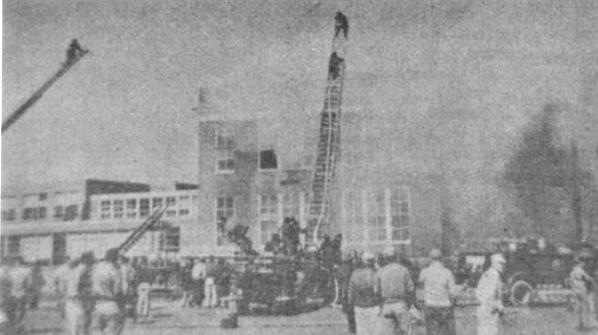
Marple-Newtown Junior High-Senior High School Fire, April 9, 1956

Marple-Newtown Junior High-Senior High School Fire, April 9, 1956

We were in the 8th grade of Marple-Newtown Junior-Senior High School. On that day we were eating lunch, getting ready for our next class when the fire alarm sounded. Must be a fire drill. We knew the drill. So did the teachers. The teachers led us outside, hand-in-hand in the continuous line processional we’d learned in those ridiculous fire drills. The school was going up in flames.

One of my classmates, Dave, remembers it this way:

The Boys’ Room was crowded with guys smoking cigarettes before class, the air was filled with a cloud of tobacco smoke and smells, so we didn’t have any indication that a fire was building below the first floor. Hearing the fire alarm, we stepped out into the hallway to see a trickle of smoke rising from each plank of the hardwood flooring. Seeing that smoke, we knew that the school and the students were facing a serious fire emergency. An orderly evacuation began and although it was a cold day, no one was permitted to go back to their homerooms for their coats.

To a chorus of cheers, we all stood outside shivering for what seemed to be a long time and watched the fire fully consume the building. To a chorus of boos, the fire trucks finally arrived and the volunteer firemen had trouble hooking up the hoses and getting water on the destructive blaze.

The school building was obviously a total loss and since I was cold, I decided to hitchhike home. It was about lunchtime, when I arrived home. My mother immediately descended on me, “…why are you home, are you playing hooky and where is your leather jacket?” “No,” I said. “It wasn’t my fault,” I blurted out, before feeling the back of her hand across my face. “Tell me the truth,” she demanded. I said,”the school burned down,” just before getting a fresh one on the other cheek.

One of the memories we share is the picture of Mr. Harvey, still inside the building, handing the typewriters out the upstairs window from his typing class to Seniors who were ascending and descending a firetruck ladder to save the typewriters until he had to come down himself to loud gasps and cheers.

Fred, remembers being “in typing class a year later using one of those ‘saved’ machines with melted keys.”

Ellie, who wasn’t in the building when the first started, adds something else:

I was approaching the school entrance after lunch at the pizza shop and was met by students rushing out to safety. Still remember that once we were all assembled by homerooms Mr. Rathey went tearfully from group to group checking whether we were all accounted for.

What a surreal day!

Mr. Rathey pointing

Mr. Rathey pointing

The miracle is that we all made it out safely. Before Mr. Rathey, shown here pointing to the school, could see his charges walk across the stage at graduation, he was diagnosed with cancer. The Class of 1960 presented him with a gold watch at his early retirement. Ellie reminded us today of Mr. Rathey’s tearful care on the day the school burned down and in the years that followed.

– Gordon C. Stewart, Chaska, MN, April 9, 2015.

A memory of Ken

The first Good Friday following retirement from active ministry is filled with the memory of a friend named Ken.

On Good Fridays from 2006 through 2013 Ken Beaufoy was the one member of the congregation I could count on to be with me in the Chapel from noon to 3:00 p.m. There were years when there were three or four. But most Good Fridays, it was just the two of us.

The pattern for the three-hours was very simple. Each half-hour began with a reading from the passion narratives of Gospels. A five minute silence followed, ending with a movement from Gabriel Faure’s Requiem. A brief prayer was spoken aloud. Another contemplative silence ended the half-hour segment.

There were times when I looked at Ken and felt as though I knew him the way his beloved wife, Ilse, had known him. Isle had been the third person in the pews before her death in 2007. Ken and Ilse were like no other couple I’d ever known and not only because theirs was the most unlikely of loves. Ken, a British soldier during the occupation of German following the end of World War II, and Ilse, a German soldier decorated with the German Silver Cross for bravery, fell in love during the occupation and made a life together against all odds. Their marriage was a sign of the power of reconciling forgiveness and love.

Two people never adored each other more than Ken and Ilse. During Ilse’s demise, when hope was scarce and hard decisions were made, I saw Ken’s faith up close and personal in his Good Friday moment of saying goodbye to his Ilse. As often happens between a pastor and a congregant, we became blood brothers until Ken died quietly in his sleep.

Today I’m remembering Ken and those six half-hour segments in the Chapel. I read the readings, listen to the movements of Faure’s Requiem – Introit et Kyrie, Offertory, Sanctus, Pie Jesu, Agnus Dei et Lux aeterna, Libera me, and In Paradisum – pray the prayers, and give thanks for a communion deeper than words. It still endures.


Confession is good for the soul

Tears welled up last Sunday listening to the Gospel reading for Passion Sunday: Palm Sunday. The reading was LONG, but it didn’t matter. It pierces the heart, step by step –  the human psyche revealed under an electron microscope, humanity on parade. All in one long reading. The tears that welled up Sunday didn’t fall, but they will later this week during Tenebrae, the service of Light and Shadow by the end of which the church is left in darkness, every worshiper’s candle extinguished by recognition of our participation in betrayal, sleeplessness, flight, and denial. One by one, the individual candles get blown out. All of them.

Holy Week for liturgical Christians is a solemn time of confession. There is no escaping our participation in the passion: our readiness to betray, doze off when asked to “watch with me one hour”, flee in fear for security, throw the switch, consciously or unconsciously, into psychological and public denial. Yet there is, at the same time over it all, the faithfulness, the wakefulness, the courage, the embrace of reality in its horror for the sake of love’s transforming power, the light of Christ himself.

Christians live in the dynamic paradox of faithlessness and faithfulness, sin and grace. We include a Prayer of Confession in the Sunday liturgy. Last Sunday at Trinity Episcopal Church in Excelsior, Minnesota, the Prayer of Confession, which came following a dramatic reading of the Passion Narrative, expressed the conscious and unconscious nature of sin and grace.

God of all mercy, we confess that we have sinned against you, in thought, word, and deed, by what we have done and by what we have left undone. Some sins are plain to us, some sins escape us, some we cannot face. We repent of the sin that enslaves us, the evil we have done, and the evil don on our behalf. Forgive, restore, and strengthen us through our Savior Jesus Christ, that we may not turn from your love, but serve only your will. Amen.

We barely know ourselves. Some sins are plain to us. Some escape us. Others are too painful to face. Holy Week is time to wade into the waters of self-reflection, confident that these waters are the healing waters of the deeper Self, the crucified-risen One who cannot finally be betrayed, fled, denied, or killed.

Sunday’s liturgy ended with the singing of the hymn “My Song Is Love Unknown,” lyrics by Samuel Crossman, 1664, music composed by John Ireland. 


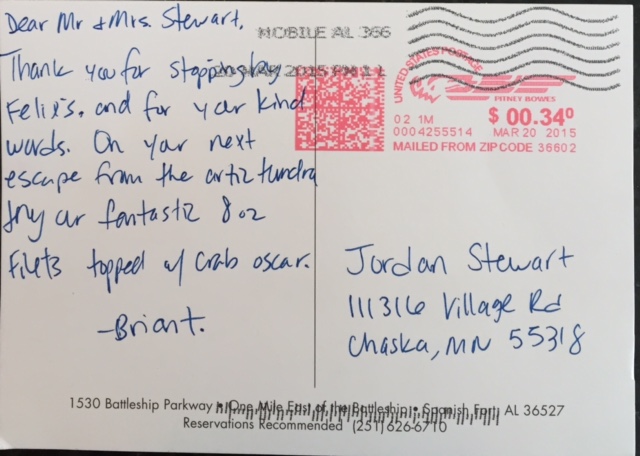
A Note from Briant

Image

We couldn’t believe our eyes when this postcard arrived from our waiter last month in Mobile, Alabama.

Postcard note from Briant, waiter at Felix's Fish Camp Grill in Mobile, AL

Postcard note from Briant, waiter at Felix’s Fish Camp Grill in Mobile, AL

Okay, so he spelled my name wrong. Who cares. We really liked Briant. Enough to write a recommendation on TripAdvisor. Which resulted in the note. Felix’s Fish Camp Grill near Mobile, Alabama knows how to make friends and build its business.

– Gordon C. Stewart, Chaska, MN, March 24, 2015

Felix's Fish Camp Grill postcard

Felix’s Fish Camp Grill postcard

GUEST POST: I went to Gordon College and My Roommate was Gay

Haddayr Copley-Woods posted this on her blog. Haddayr is a writer published by many venues, including aired commentaries on Minnesota Public Radio’s “All Things Considered” program. In light of Views from the Edge’s recent posts on the topic of religion and sexuality, we’re glad to share this first-person story of a student’s dilemma at Gordon College.

Life begins on the other side of despair

It was Jean-Paul Sartre, the French existentialist novelist, philosopher, and playwright, who declined the Nobel Peace Price for Literature in 1964, who said it. “Life begins on the other side of despair.”

Sartre’s statement resonates with those who have stood at the edge of the abyss of the loss of life’s meaning. Some don’t make it to the other side. Some move to the other side of the abyss with no faith but faith in themselves to create meaning they once ascribed to God or some objective moral order. Others arrive on the other side with their inherited faith not only deconstructed, but re-constructed. I am one of the latter.

Reading of the shooting suicide of a 27-year-old Iraq War veteran philosophy student in the library at Mankato State University takes me back to Sartre’s statement about life and despair. Timothy Lee Anderson was an honorably discharged U.S. Army gunner in Iraq. His picture in The Daily Mail shows him in an Iraqi combat zone with his weapon. In the background of the photo, Iraqi women in traditional Muslim dress appear to be crossing the street. How, I ask, does a guy who served as a gunner in the Iraq War choose philosophy as his major when he comes home to the U.S.A.?

Philosophy is not a popular choice these days. Unlike computer science, it’s not job- related. The word ‘philosophy’ derives from two Greek words meaning love (philo) and wisdom (sophia). Philosophy is the love of, and the search for, wisdom.

Wisdom is born of experience, not inheritance. It’s not hard to imagine the dashed, unexamined, inherited convictions of a young Army recruit: a world dependent on American goodness and might; an America with a manifest destiny in the global order; an exceptional nation privileged and responsible, whether by religious or political creed, to bring its blessings to the rest of an ignorant, unenlightened, uncivilized, and sometimes terroristic and defiant world.

Nor is it hard to imagine a soldier’s despair upon return, reflecting on his experience in search of greater wisdom among the philosophers. The early reports of Timothy Lee Anderson’s life experience point to a less than comfortable homecoming with arrests for marijuana and violation of an order for protection. The gun shot he fired at himself on the second floor of the Mankato State University library was a shot of despair, whatever the immediate reasons or circumstances.

The great sorrow is a life that ended too early on the despair side of the yawning abyss of collapsed meaning. It remains to the survivors and the rest of us who look with sadness on Timothy’s tragic departure to learn that claims to religious-national exceptionalism and wisdom go together about as well as bombs and day-care, guns and libraries.

– Gordon C. Stewart, February 3, 2015.


In Memoriam: the MSU Philosophy Student

“The life of the dead is placed in the memory of the living.” – Cicero

The philosophy student who shot himself in the library at Mankato State University yesterday could have been me many years ago. Or is it “could have been ‘I’”? I or me is a question of grammar without much consequence. Philosophy is a question of meaning. Grammarians don’t shoot themselves. Some philosophers do.

I know nothing about the 27-year-old philosophy major at MSU. I don’t need to know more for tears to fall while reading the Star Tribune news report over morning coffee.

A Minnesota State University Mankato student shot and killed himself Monday afternoon in the campus library.

Police were called about 4 p.m. to the library after receiving a report of a suicidal man. After searching Memorial Library, police found the 27-year-old man, a junior philosophy student, on the second floor. Police said he turned the gun on himself and shot.

Police said no one else was in any danger during the incident.

The library was open Monday evening but with access only to the lower level, first and third floors.

I feel sick. It’s sad enough when anyone takes his or her life. It’s sadder still, at least for me, to learn that he was studying philosophy and that he appears to have found a solitary place on the second floor, perhaps among the stacks in the philosophy section of the library, as I imagine it.

He was a junior, as I was when the course in contemporary philosophy plunged me into deep despair. Psychology majors might have called it depression because it looked like that on my face. But there’s a difference between depression and existential despair.

Jean-Paul Sartre’s Being and Nothingness, No Exit and The Flies, and Franz Kafka’s Metamorphosis and The Trial were like nothing I had ever read or heard. They blew my mind to smithereens, leaving me very much alone with the sense of nothingness.

By the time I hit the books in the library that junior year, I ate, drank, and slept philosophy. Of the 18 hours of courses I had decided to carry, only the philosophy course seemed important. Raised in a Christian home, I had always prayed, more or less, giving thanks and asking for blessings on those I loved and the less fortunate. But now prayer seemed a cruel hoax, “bad faith” as Jean-Paul Sartre put it. Why I would return from class and kneel down beside my bed not for “now I lay me down to sleep” but to tell God to go to hell is one of the great ironies, a question grammarians cannot answer.  Had I had a gun that afternoon, my roommate might have found me on the floor in Room 301 of Carnegie Hall.

I know nothing of the circumstances or state of mind of the 27-year-old MSU philosophy student. Perhaps no one will ever know for sure. It may be that his experience bears little or no resemblance to mine all those years ago. It’s not for me to know.

I don’t even know your name, but I sure do feel you! And I feel for those who mourn your loss. “That God does not exist, I cannot deny,” wrote Sartre, “That my whole being cries out for God, I cannot forget” – Jean-Paul Sartre.

Almighty God, Father of mercies and giver of comfort: deal graciously, we pray, with all who mourn; that, casting all their care on You, they may know the consolation of Your love. [The Book of Common Prayer]

Rest in Peace

– Rev. Gordon C. Stewart, Chaska, Minnesota (an hour from Mankato), Feb. 3, 2015.

My Soul Waits in Silence

A contemplative reflection on Psalm 62 at Saint Augustine Beach, Saint Augustine, FL.

For God alone my soul waits in silence, for my hope is from him. I wait in silence. [Psalm 62:5 NRSV]

I wait in silence.

Withdrawing from the noisy men next door in Saint Augustine, I am like the Hermit Crab crawling into the borrowed snail shell on Saint Augustine Beach.

This is the same beach brave souls dared to integrate in 1964, a place where then there was no place to hide, the public white beach where the Hermit Crabs refused to hide when the billy clubs swing to drive them from the white man’s beach. There are no billy clubs on the beach today but the shouting of the world we call civilized still hurts by ears.

How long will you assail a person,
will you batter your victim, all of you,
as you would a leaning wall, a tottering fence? [Ps. 62:3 NRSV]

The world is noisy. Loud. Cacophonous. Bellowing blasts, bewailing, and bedlam in Beirut, Baghdad, and Boston hurt my ears. Hoping to leave it, I come to the beach where the tides know nothing of the color of my skin, my income, my worries or fears.

For God alone my soul waits in silence,
for my hope is from him.
He alone is my rock and my salvation,
my fortress; I shall not be shaken.
On God rests my deliverance and my honour;
my mighty rock, my refuge is in God.  [Ps. 62: 5-7 NRSV]

Hermit Crab crawling into abaondoned snail shell

Hermit Crab crawling into abaondoned snail shell

At low tide I crawl inside the borrowed shell looking for a respite from the noonday heat, my deliverance, my refuge, my fortress. But, even here, the noise follows me.

The blasts, buzzes, and bellowing echo inside the shell. Silence eludes me. Even here, I am a poor man, a mere breath, walking among the vendors and hawkers, resentful, angry, beset, a man of low estate.

Those of low estate are but a breath,
those of high estate are a delusion;
in the balances they go up;
they are together lighter than a breath.
Put no confidence in extortion,
and set no vain hopes on robbery;
if riches increase, do not set your heart on them. [Ps. 62:9-10 NRSV]

Here I am a breath stripped from the delusions of high estates indulged on the other side of the sand dunes that separate the beach from the street.

I wait in silence.

I ponder the speed outside the Hermit Crab’s temporary home, the abandoned snail shell, the speed that is itself an illusion, a flight of hubris washed away by the tides of time. I remember the race to nowhere, the myths of ownership, invulnerability, control, and superiority that race through the minds of low and high estates alike.

I hear the distant shouts and screams from the integration of Saint Augustine Beach that still plunge the despondent men next door into the oblivion of cheap booze, dope, and, maybe, crack. But the longer I wait and listen, my heart grows strangely calmer. Quieter. More at peace.

I come into the deeper Silence of the Breath once heard by the psalmist.

Once God has spoken;
twice have I heard this:
that power belongs to God,
and steadfast love belongs to you, O Lord.
For you repay to all
according to their work. [Ps. 62: 11-12 NRSV]

In the wordless silence I hear the Word I’ve come to the beach to hear:

“Be still, and know that I am God.” [Ps. 46:10 NRSV]

– Gordon C. Stewart, Saint Augustine, Florida, January 31, 2015


Verse – The Laundromat – Pittsboro, N.C., 1969

She was young, white, and pregnant

when they moved

south. She had worked for Civil

Rights for blacks

up north. So seeing two doors

as she faced

the laundromat obscured

the sordid facts

of legal segregation

just before.

“Oh please, Ma’am, take your clothes

over next door,”

the old black woman said.

“Will you have trouble

if I stay?” “Please, Ma’am,

do as I say…”

The young woman had not

heard “Ma’am” before

from someone older, so

she turned her face —

embarrassed for her race –

and went next door.

– Steve Shoemaker, Urbana, IL, Jan. 27, 2015

NOTE: While working on a Ph.D. in Religion at Duke University, Steve pastored two yoked Presbyterian Churches: the 88 member Pittsboro, N.C., (pop. 1,500 then), and Mt. Vernon Springs (55? members) 30 miles west in rural Chatham County. Nadja drove from the Manse in Pittsboro 30 miles north to do Microbiology research at Duke. Son Daniel was born in March, 1970.