In Loco Parentis

Only seniors could have cars

at Wheaton College in the ’60s.

Even though I had a job

in the next town, I had to hitch

a ride with an older classmate.

So we bought a ’47

hearse.  The four of us found 50

bucks, and also found a guy,

a senior, who would swear the car

was his:  the lies took us to heaven./

One of our rebellious Moms

made red velvet side-curtains for

the windows in the back.  Our dates

would laugh at the chrome rollers in

the floor.  No one wanted to drive..

1947 Pontiac hearse

– Steve Shoemaker, Urbana, IL, August 21, 2012

Stamping out Affluenza

Verse – “Dump and Run”

Lisa Heller lost a ring.

Dumpsters came to be her thing!

She taught students at her school

Making trash just wasn’t cool.

Donate stuff that still has use;

Reduce trash, avoid abuse

To the earth.  Take your measure:

Turn the trash into treasure!

Lisa started Dump and Run.

College students have great fun

Giving, sharing–have a sale!

Find a bargain, make a deal!

Help a group that helps the world,

Buy recycled things you need.

Like you avoid  INfluenza,

You can stamp out AFFluenza!

– Steve Shoemaker, Urbana, IL, pays tribute to “Dump and Run”.

Dumping and running at the landfill

  At the end of the academic year, University of Illinois students drop off the “stuff” that might end up in the landfill to the University YMCA to be recycled by other students.

Former Executive Director of the University YMCA and Pastor of McKinley Presbyterian Church at the University of Illinois, Steve continues to host “Keepin’ the Faith” on Illinois Public Radio  every Sunday evening at 5:00 CST.

The Prenuptial Dinner

Prologue

Describing  the prenuptial dinner in Bend, Oregon calls to mind my niece’s twinkle-in-the-eye declaration after her first experience with Japanese Sushi (raw fish): “It was,” you might say, “an experience!” The memorable “experience” was the company more than the food.

Scene 1

The room in the back of the Middle Eastern restaurant in cosmopolitan downtown Bend, Oregon was hard to find, but well-prepared for the 16 family members.

We introduce ourselves to Bonnie, the bride’s mother, and Mike, the bride’s second step-father. The next 25 minutes is a tag-team Bonnie and Mike monologue. We learn all the places they have lived, why they are now moving from Maryland – on the Chesapeake Bay – to Texas, Bonnie’s ancestral home. They have put their house on the market…and their boat with a listing price higher than the market value of our house in Minnesota. Third marriage for both Mike and Bonnie. No interest in knowing anything about us. Monologue. Texas monologue. The first taste of what is to come.

Scene 2 

The bride’s 65 year-old gregarious Uncle Billy Bob (“Uncle Bill”) – married to the bride’s Aunt Frances – makes his grand entrance. Uncle Bill is very large – 6’4” 280 lbs. of massive  proportions wearing a khaki work shirt tucked into suspendered khaki work pants hiked up high above his waistline and a tractor hat.

Uncle Bill’s voice is as loud as his body is big. He is a commanding presence. We’d met the night before when the families were gathering from Oregon, New York, Texas, and Minnesota. He’s been told I’m a minister.

“Have s seat,” he says, glad to see me, pulling a chair from the long table and slapping it with his hand like a command from a drill sergeant. “So you’re a minister. What kind?”

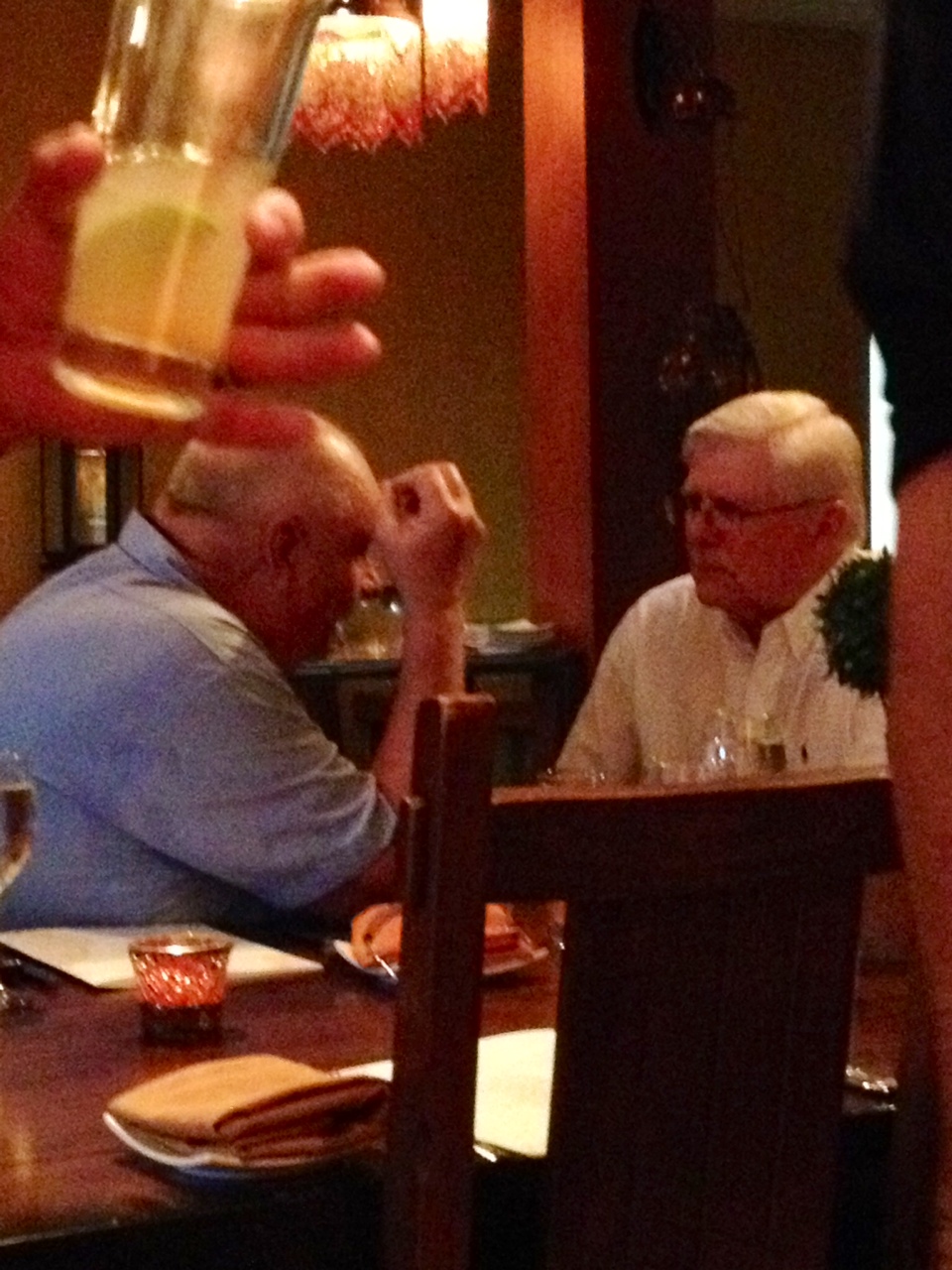
Uncle Bill and Gordon

“Yes sir. Presbyterian,” I say, wondering where this is leading.

“Well, lemme tell ya a story,” says Uncle Bill. “Ma Granddaddy was a Hah Babtist. He married my Grandmomma who was a Hah Church of Chrast.”

“What’s ‘high’ mean?” I ask.

Uncle Bill’s face tells me he’s astonished by my ignorance, a man of the cloth and all that. “Well, sir, there are Hah Babtists and Low Babtists; Hah Church of Chrast and Low Church of Chrast. ‘Hah’ means ‘mine is the only way.’ So my Grandaddy and Grandmomma’s son, ma Daddy, was a heathen. He married a Hah Babtist.

“I was raised Hah Baptist, like ma Momma. Now here’s where the story begins…….”

The waiter interrupts by putting a large platter of hummus and Lebanese pita bread in the middle of the wide table. Billy Bob looks at it. He’s hungry. He’s never seen anything like this. He’s wondering what it is and what to do with it. “Frances!” he calls out to the other side of the room. Frances, who’s recovering from hip surgery, walks to where we’re sitting. “What’s this?” “I don’t know,” says Frances, “I’ll ask Bonnie, maybe she’ll know,” and walks across the room to Bonnie and Mike.

“Now, as I was startin’ to say…you take Frances and me. I was a Hah Babtist; Frances was a Hah Church o’ Chrast.  Now I’m a Low Babtist and she’s a Low Church o’ Chrast.”

Frances returns from the other side of the room.  “It’s chick peas,” says Frances. “Well, I’ll be,” says Uncle Bill, pulling the whole platter in front of him from the middle of the table where others could share it. “Now, what do I do with it?” Before Frances can answer, the large serving spoon is filled with hummus in Uncle Bill’s mouth. “You take the bread and dip it in the chick peas,” says Frances. “Where’s the bread?” “It’s right there,” says Francis, “it’s Middle Eastern.”

“Now the story gets really interesting,” he says. “This is where it begins.”

I’m thinking to myself it’s been 20 minutes and all I’ve said was “What’s high mean?” Uncle Bill doesn’t seem to notice or care. He’s reeled in a minister. Ministers are supposed to be nice people who listen. They just smile, nod, and show interest. This is a monologue by a Texas story-teller with a captive audience.

“I go to my Babtist church and Frances goes to her Church o’ Chrast church. Been doing it for 35 years. Now my minister went off to the Holy Land, I guess they call it and went to the seminar. And you know what the other students told him about why they was at the seminar? Money! They was there for the money. What kinda minister’d you say you was?”

“Presbyterian,” I repeat, “and we’re required to go to seminary in order to be ordained. For us it’s not about money. No one gets more money by going to seminary. Every candidate for ministry goes to seminary because we want our ministers to learn the original biblical languages – Hebrew and Greek – and spend three years in graduate school before serving a congregation.”

“How big was your church?” asks Bill. What was the biggest?”

“3,000.”

“See that’s what I mean? Now we’re just a little church o’ 35 people. We pay our minister $1500 a month which seems pretty dang good to me.”

Apparently Bill has concluded that his audience is a money-grubber, although he never says so. He’s Low Babtist; I’m Presbyterian. I’m sipping a vodka martini; he’s drinking lemonade-iced-tea. He’s livin’ the low life; I’m living the hah life.

Scene 3

I’m thinking to myself,

“Funny how Hah (the only way OR the superior way, religion, culture, accent) manages to find an open door even when we think we’ve locked it behind us. High just re-defines itself according to whatever ways my life seems superior to Billy Bob’s or Billy Bob’s seems to him to be superior to mine.”

I poke fun at Billy Bob’sTexas drawl and monologue and laugh at his call across the room to Frances to rescue him in a Middle Eastern restaurant which is stranger to him than the money-grubbing Presbyterian “seminar” graduate from Minnesota. Each of us has managed to place himself on the perch of Hah looking down at the Low.

But there’s something about the two of us sitting there sipping our different drinks, eating the hummus and pita bread, that unifies us. We kind of like each other…maybe the way opposites are attracted to each other, if for no other reason than that they’re interesting.

“Now lemme tell ya another story… As I was startin’ to say…”

“Bill, I’m sorry, I need to catch up with my wife. It’s been a pleasure.”

“You bet. We got a w h o l e evening to get acquainted. We’ve got plenty o’ time.”

Scene 4

As we sit down for the meal, I sit at one end of the long table of 16 people with Kay on the left and Frances to my right. Uncle Bill sits to France’s right.

At the opposite end of the table sits my son Doug with his partner and two of the bride’s relatives, all now living in New York City. They’re on their second bottle of wine, having a great time, as the waiter brings the entrees to our end of the table. Doug flashes a wave to his Dad.

Uncle Bill turns to the head of our table and asks the money-grubbing Presbyterian minister from the seminar, “Would you say the blessing’ for our end of the table?” I offer the blessing on behalf of all the hah and low Baptists, Church of Christ, and Presbyterian people at our end of the table – thankful for new food and friends, for family, and for grace bigger than any of our highs – thankful, you might say, for “the experience.”

Verse – We never saw the stars

In memory of Rev. Milton Carothers

As two Protestant pastors, we had no
desire to become eremites, but went
to the monastery  to try to slow
our hectic campus lives in a retreat.
The Benedictine Retreat Master split
us quickly.  I was sent to spend the week
with an old monk–a former architect–
who now designed the gardens for his work
(all of the men must sweat as well as pray.)
We carried rocks; he talked incessantly.
Inside the borders made of stone, each day
we’d pull the sinweeds (never silently.)
At all the common  meals there was no talk
allowed–and in our cells, we were alone,
of course.  At 3 a.m. the bells would wake
us for a walk inside the walls (of stone
also) to sing, to pray the Psalms each night.
We saw no sky:  stained glass kept out starlight.

– Steve Shoemaker, Urbana IL

Editor’s note: I know Milton only through Steve’s tribute to him, but those who have served as campus ministers intuitively understand each other in ways that are unique t those who minister within the walls of the ivory tower. Milton, Steve and I share that history. Milton served in North Carolina, Steve in North Carolina and Champaign-Urbana, IL, and I in Wisconsin, New York, and Ohio. Like Milton and Steve, I have known the need to retreat to the Benedictine retreat center to restore my soul in the solitude and rhythms of Benedictine community.

Although I’ve never risen to pray the Psalms within the walls of stone at 3:00 a.m., I’ve often found myself awake within the starless walls of stone my hardened heart has built. Sometimes at 3:00 a.m. I’m lost among the sinweeds. A Psalm rises up within me to melt the stone, release me from the inner prison, remove the starless plastered ceiling. “When I consider the works of your hands, the moon and the stars which Your fingers have made, what is man that You think of him… and yet” and yet.

The Penny Roasters

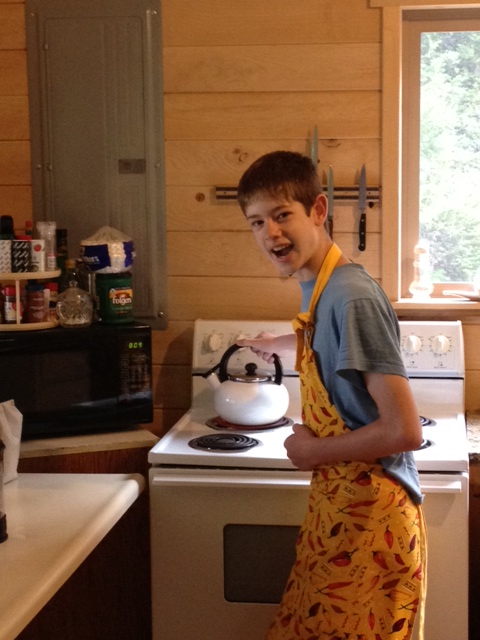
Grandson Jack, proprietor, The Penny Roaster, Bend, OR

The Penny Roasters opens early for breakfast. Jackson Stewart, its proprietor, serves custom coffee, blended to the special tastes of each customer. Jack loves to please – tall, elegant, aproned for cooking, and fully attentive to his customer’s every need.

Amelia, the Penny Roasters’ cheerful hostess, welcomes you to the establishment and shows you to your table. Some people all Amelia “Mimi” but only her closest relatives get to call her that. “Good morning,” she says with a great smile and big eyes with the longest eyelashes you’ll ever see, “welcome to the Penny Roasters.”

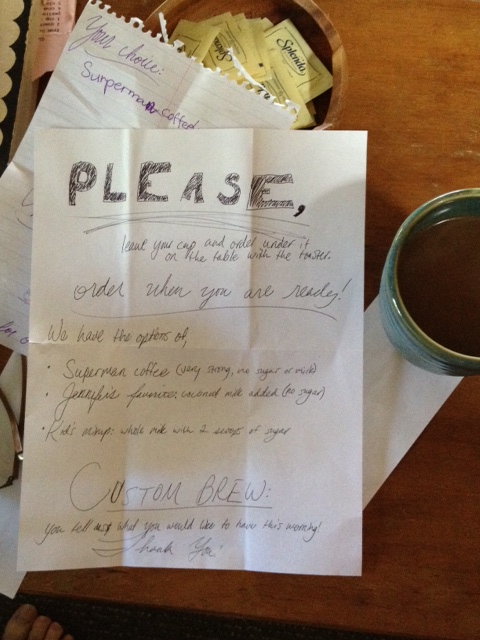
Penny Roasters' menu

The Penny Roasters menu

The table is set with hand-written menus and a coffee cup. The menu includes three regular options: SUPERMAN coffee (very strong, no sugar or milk); Jennifer’s favorite, coconut milk (no sugar); Kid’s mixup: whole milk with 2 scoops of sugar.

The fourth choice is CUSTOM BREW: you tell us what you  would like to have this morning!

Thank you!

You use the pencil to mark the menu.

When the heart is awash in memory, it’s easy to get lost

Click HERE for the link to “When the heart is awash in memory, it’s easy to forget,” the humorous walk-down-memory-lane commentary published today by Minnesota Public Radio. Thank you, MPR

Here’s a photograph of the Andrews Casket Company mill and “trout stream” in Woodstock, ME, the homestead of the Andrews family where Pete was the last Andrews to make his home.

The Andrews Mill in Woodstock, Maine

Father Hardon

Things seem to have quieted down recently regarding the objection of the U.S. Conference of Catholic Bishops (USCCB) to a federal mandate to include contraception in health care coverage.

Back in February Catholic News Service (“Obama’s revised HHS mandate won’t solve problems, USCCB president says”) reported on the story. Cardinal-designate Timothy Dolan, President of the USCCB, “said the bishops are ’very, very enthusiastic’ about the Respect for Rights of Conscience Act, introduced by Rep. Jeff Fortenberry, R-Neb. The cardinal said the legislation would produce an ‘ironclad law simply saying that no administrative decrees of the federal government can ever violate the conscience of a religious believer individually or religious institutions.”

A few days later, my son-law’s neighbor left something on Chris’s doorstep. It was an article from The Catholic Servant about someone named Father Hardon, S. J.  I’d never heard of Father Hardon.

I love the Jesuits. A small group of Presbyterian and Jesuit students met together for beer and theology the last Friday of the month in 1966 in Chicago. The Jesuits are brilliant.

My first impression reading the piece Chris handed me on Fr. Hardon was that it was a spoof, that John Hardon was a fictional priest, or, if the article was serious, I thought it must be misspelling. Surely it was Harden. Or Hardin. Not Hard-on.

I went home and looked him up. There he was…Father John Hard-on.

Hardon seal – Father John Hardon

I found him him on a website dedicated to his memory, including a famous speech of his entitled “Contraception, fatal to the faith?”

“What do we mean by the title,” asks Fr. Hardon, “and what is the thesis of this presentation? We mean that professed Catholics who practice contraception either give up the practice of contraception or they give up their Catholic faith.

“The grave sinfulness of contraception is taught infallibly by the Church’s ordinary universal teaching authority. Therefore, those who defend contraception forfeit their claim to being professed Catholics. Consequently, those who persist in their defense of contraception, deprive themselves of the divine graces which are reserved to bona fide members of the Roman Catholic Church.”

Every one of my priest friends is horrified by Father Hardon. Like him, they are celibate and know how difficult it is to stay morally erect, but, unlike Father Hardon,  they don’t walk around calling men and women who use condoms, diaphragms, or the pill “mortal sinners” who have placed themselves beyond the graces if the Church or its God.

My old buddies from the Bellarmine School of Theology welcomed the Second Vatican Council as a breath of fresh air, as did my Protestant classmates. They are now holding their breath because old Father Hardon is back with a vengeance.

None of my Catholic friends – priests or laity – has lived by what Father Hardon believed was an infallible teaching on contraception. Even if, like Father Hardon, they’ve  never worn a condom, they’re no longer entitled to the graces of the Church or the grace of God.

The elevation of Fr. Hardon (he’s been nominated for sainthood) causes me to grieve the loss of something very, very precious. I grieve it for all my catholic friends. I grieve for my own loss…. And I wonder…

I wonder if my religious conscientious objection to militarism and war might exempt me from paying my federal income taxes. I think I’ll write Rep. Fortenberry for inclusion in the Respect for Rights of Conscience Act.

The only animal dumb enough…

Kay, Maggie, Sebastian

“We are the only animal dumb enough to not be where we are.”

The words popped out in the barber chair at Great Clips when Dee, the barber (I still call them barbers), told me that the person who had sat in the chair before me had spent her whole time playing on her iPhone. Never said a word. Never looked up. It sure seemed to Dee that her client was there…in the barber’s chair…but she was somewhere else, while the barber with the real scissors that were cutting her real hair in the real chair at the real Great Clips in the real Chaska Commons was…well…not there. How dumb is that!  “We humans are the only animal dumb enough to not be where we are.”

I spend my days alone with my dogs. Maggie and Sebastian live where they are. They don’t miss a trick – no pun intended; they’re not very well-trained – but they pay attention to every little thing. Every movement I make, every bird that flies across the window, every word spoken, every sound that might hint that Mom’s home, or that Dad is leaving…or taking them for a walk…or a ride in the car. They live where they are.

Sometimes they have to bark to jerk me away from my desk when I pretend I’m not there, checking my emails, surfing the web,  or writing a story. They know I don’t know how to be where I really am. They know that I’m not as smart as they are, but they’re  forgiving of my chronic weakness. They never look down on me.

We human animals think we’re so smart. We are. But what have we lost in ADHD heaven? If it hadn’t been for Maggie and Sebastian, I might not know; the words would never have popped out of my mouth in Dee’s barber’s chair.

When I got home, I shared with my furry companions the conversation with Dad’s groomer and what I had said: “We are the only animal dumb enough to not be where we are.” They were proud of Dad. I returned to my computer and ADHD heaven. They came along side the desk, gave me their paws, and said in unison, “We’re always here for you, Dad.” Then they asked if it was time to go for a ride in the car.

His Own True Self

He sits and smiles,

Douglas (“Doug”) Hall at home in Wabasha

His dog Sparky
Resting against his leg,
His eyebrows hanging
Like willow branches.

The bell has tolled
For him, a tolling
Like a wind-song
From the North
Marking the end.

He sits and smiles,
Peaceful, thankful,
Accepting, connecting
With those he loves,
Caring for those he will leave

The earth, his home,
Calls him to itself,
Beyond eternal claims
Or expectations,
He sits at peace

Mortal flesh he knows
Cannot prolong itself,
Nor should it seek what it
Cannot attain
Beyond its measure.

No control of time
Which bears us all away,
No need to storm
The barricades now
Against the end of time.

He sits and smiles
In gratitude
For wonders of sun and shadow,
For all creatures great and small,
For family love and friends.

For these he sits and smiles –
This self-disclaiming man
Who intended nothing
But his own true self
In whatever time was his.

– Gordon C. Stewart, October 2, 2004

Doug Hall was a giant of a man. He was revered throughout the state of Minnesota as the quintessential “street lawyer” in Minneapolis, a nationally known labor lawyer who left his practice to become the founding Director of The Legal Rights Center, Inc, “a law firm of, by, and for the people.” The people were indigent American Indians and African-Americans.

A few days after receiving the call from Doug and Mary with the news that Doug had been diagnosed with terminal cancer, Kay and I spent time with them at the farm near Wabasha, MN. Kay captured a picture of Doug that day with his dog Sparky.I went home and wrote a reflection that later became the opening words of the Memorial Celebration for his life.

A former Chief Judge in Minnesota’s Fourth District Court recalled pulling Doug aside one day into his chambers.

“Doug, I thought you should know a lot of people are talking around the courthouse.”

“Hmmm,” said Doug.

“They’re saying that you’re a communist.”

Re-telling the story all these years later, the Judge starts to laugh and pauses. I beg the question: “What did Doug say?”

Through laughter and tears, he says, “He smiled and said, ‘Hmmm..and what’s their point?'”

His memorial service was a rare event: a collection of street people, former clients, MN Supreme Court Justices, a U.S. District Court Judge who began his legal career with Doug as his mentor, the founders of the American Indian Movement (“AIM”) and African American community leaders, colleagues and friends, Indian drumming, and the sounds of Paul Robeson and Old Joe Hill. The Poem “His Own True Self” opened his Memorial Celebration in Wabasha followed by these words:

We are a diverse bunch.  We are the colors of the rainbow.  We are rich and dead broke.  We are former defendants and former fellow counsel.  We are Supreme Court Justices and District Court Judges – and we are “customers” of the court system and the corrections system.  We are public defenders and prosecutors, probation officers and corrections officers, restorative justice practitioners, legislators, union organizers and people from the streets. But mostly we are just people who all share the same destiny, the same dependence and interdependence.  And no one here is to be treated with more honor than another.

Doug Hall with Sparky

Take Away our Numbness – A Memorial to Sydney Mahkuk

These words were spoken on the sidewalk where 12-year-old Sydney Mahkuk died. Community leaders and Sydney’s family asked me to bring some kind of meaning and hope to the sidewalk where Sydney had been dumped from a car by the side of the funeral home.

November 4, 2005

Gordon C. Stewart

Executive Director, Legal Rights Center, Inc.

Once upon a time a proud people lived on this land. They called themselves Ojibwe, Anishinabe, Dakota, Lakota, and Winnebago. Occasionally a Menominee would visit.  They lived close to the land.  They hunted. They fished. They gave thanks to the Great Spirit for every day.  They saw themselves as part of nature. They rose with the sun. When the sun went down, they gathered in a circle by the light of the campfire.  By the light of the campfire, they listened to the elders, whose stories broke the silence to told the children who they were.  The children went to bed in safety.

Shabbona, Potawatami Chief, c. 1775 – 1859

They were people of great dignity.  Their ways were good ways.  They respected the land. They respected each other.  They honored their elders.  They cared for the children.  They trained their youth to become adults.  They died with dignity.  They were buried with honor. Earth was their mother. Gitchi Manitu, Wakan Tonka, the Great Spirit, was the common Grandfather of them all.

Then something terrible happened.  A plague came across their land.  It took their land.  It stole their culture.  It laughed at their spiritual practices.  It called them names.  It tore down their tepees, their longhouses and their sweat lodges.  And in their places the plague built big buildings – tall buildings, arrogant buildings, skyscrapers, they called them, that invaded the sky, turning the land into something it is not.  The Ojibwe and Dakota who lived here no longer rose with the sun.  They no longer gathered around the campfire.  They no longer heard the stories of who they were.  They knew only what the white plague had taught them – that unless they joined the plague, they were nobody, and that if they challenged it, they would lose.  They would die.

And so they lived in grief.  A sorrow too hard to bear.  A loss too great to carry.  And the plague offered them relief to numb the pain – firewater that would make them happy in spite of their despair.  Drugs to drive away the memories of who they were.  Escapes to make them numb.  To numb the pain.  Opiates to freeze their tongues.

The elders no longer acted like elders.  The parents were numb with grief.  There were no aunts.  No uncles. No cousins.  No grandparents.  Nobody dared to be a neighbor.  The children were left with no campfire at night – no community to tell them the stories of who they were and who they were not – and so the children and the youth drifted out into the night in search of themselves.  Locked in lonely prisons of confusion, the youth no longer knew Mother Earth as their Mother; they no longer knew how to give thanks to the Great Spirit for the day.  They no longer went to bed with the sun.  They wandered the night in search of the community they had lost and never known.  And the gangs and the drugs and the alcohol offered them the promises of a better life that was the kiss of death.  Ecstasy was no longer a way of life – it was a pill that would make them higher than the skyscrapers that ruined the once humble landscape.  And sometimes the alcohol and the drugs and the gangs that had promised to numb their pain took their lives and they were found in the morning as the sun came up.  They were found by strangers.

Sydney Mahkuk, RIP

Then one day a girl named Sidney, a 12 year-old Menominee-Portawatami, was found beside a funeral home on Columbus Avenue. How she got there nobody knew.  How she died, nobody knew.  But everybody knew why.

The community had unravelled.  It had become dry bones in the valley.

But on that day that the people gathered on the sidewalk on Columbus Avenue to mourn her death, there was a sound from heaven – a rattling, the sound of dry bones coming together, a resurrection of the once proud community. And as a result Sidney Mahkuk’s tragic death the community came together as it had not come together since the plague had begun.

On the day they gathered on Columbus Avenue – a street named after the European explorer who had not discovered their land – on that day, the community woke from its sleep.  It came together – Ojibwe, Dakota, Menominee, Potawatami, Lakota, African-American, Somali, Hispanic, Hmong …and, yes, even the descendants of Columbus.  And on that day, because of a little girl’s unexplained death, they stood together arm in arm and said “Enough” to the plague.  “Enough” to numbness.  They said, “No more. No more. No more death on Columbus’s Avenue.”  And it was more than words.  They looked up at the sun again and really saw it…as if for the first time. They looked down at Mother Earth and saw it, as if for the first time.  And they gave thanks.  Then they looked at each other and they said, “We are a proud people.  We will take back this land.  We will be the people who honor our elders.  We will be the people who support the parents and care for the children.  We will be the people who guide the youth.  We will be a people of hope, not despair.  We will be a people of love, not hate.  We are all Menominee-Potawatami. We are all grandchildren of one Grandfather.  We are the people who care for each other.  We are the people who refuse to go numb.  We are the people who will teach the children of Columbus – starting right here, right now… on Columbus Avenue – how to live in a good way with Mother Earth, in a good way with Iraq, in a good way with the rivers and the sky, the ozone and the sun.  We are the people whose spirituality will help to cure the cancer of the spiritual and economic plague that has left our people in despair.

From that day on, November 4, 2005 at twelve noon, 12 year-old Sidney Mahkuk – our daughter, our granddaughter, our little sister, our friend, our neighbor – would be forever remembered as the one whose deadly silence on this sidewalk spoke so loudly that we could not stay numb.  And we took the city back and brought it back to life.

Merciful God – Wakon Tonka, Gitchi Manitu, God and Father of our Lord Jesus Christ, Jehovah, Allah, Grandfather, Great Spirit who breathes life into all things and receives all life at the end – Your’s is the air we breath, the land on which we walk.  Assure us that your love is stronger than every power to divide or hurt us.  Receive your child Sidney into your eternal care.  Wrap your arms around Glenda, around Sidney’s brothers and sisters, around all the defenseless children of the night, around all of us who mourn their plight and mourn Sidney’s death.  Re-kindle the light of faith and hope. Take from our souls the plague of hate, self-hatred and despair.  Take away the numbness and the apathy.  Make us a people of healing.  A humble and quiet people, but a proud people of love and spiritual strength. A people who are not afraid to feel the pain, who really feel the loss, who feel our feelings and do not fear them.  A people who dare to believe that every tear that falls from our eyes flows into the common stream of human suffering that leads into the ocean of community restored.  A people secure in the knowledge of your love.  Amen.