The Path Walker and the Road Builder

It’s 5th period in the Advanced Placement Art Class at the high school of an up-scale Minnesota suburb.

The African visitor who grew up walking the paths in Chad has been invited by the art teacher and the staff person whose job is to generate multicultural and cross-cultural consciousness. Koffi is standing in front of the Advanced Placement Art Class. The high-tech classroom with wi-fi displays the visiting artist’s Flicker portfolio on the large screen, reducing his art, it seems to me, to just one or two more commodities for sale, quickly deleted by the pressing of a key on the keypad. This is the world of the road builders…on the way to some advanced place.

The pitch-black, slender, physically fit path-walking landscape artist from Africa speaks in his third language to the privileged, mostly white, mostly single-language college-bound American students in the Advanced Placement Art Class of the road-builder society.

The road builders, says Wendell Berry (“The Native Hill”, The Art if the Common-Place), are the descendants of the placeless people who cut the forests, leveled the trees, and bulldozed their way to their ideas of what the world should be. They are the ancestors of Europeans who fled their familiar places to escape them. To build something better. Something freer perhaps, less restricted not only by law and custom but, more fundamentally, by the limits of creaturely life: time and space. They landed on the soil of the path walkers, the indigenous people whose foot paths wound their way harmlessly following the contours of the hills, rivers, streams and valleys. The artist from Chad, who represents the spirituality of the harmless foot paths and natural contours our road builder ancestors have disdained is standing before the Western Advanced Placement Art  Class.

“The road builders…were placeless people. That is why they ‘knew but little’. Having left Europe far behind” says Berry, “they had not yet in any meaningful sense arrived in America, not yet having devoted themselves to any part of it in a way that would produce the intricate knowledge of it necessary to live in it without destroying it. Because they belonged to no place, it was almost inevitable that they should behave violently toward the places they came to. We still have not, in any meaningful way, arrived in America. And in spite of our great reservoir of facts and methods, in comparison to the deep earthly wisdom of established peoples we still know but little.”

The Advanced Placement students watch the paintings flash across the screen in the school the road builders have built, but they show little interest or curiosity. They ask no questions of the flesh and blood African path walker whose paintings are of the natural habitat and his sisters and brothers, the elephants, lions, tigers, zebras, and giraffes,  who are disappearing because of poachers who profit from the ivory tusks of the elephants and the rhinos.

“I’m surprised and more than a little disappointed,” I say to Koffi after that class.

“Many Americans think we’re stupid. We’re from Africa. They think Africans are uncivilized,” he replies in the least preferred of the three languages he speaks fluently.

Who and what is more civil and civilized, I wonder. Many of us know that something has been lost. Something is dreadfully wrong. The students in the class and their generation are likely “greener” than my generation. But they also have drunk the poison of a linear view of history as advancement and progress. They are advancing…a step above the rest…in the Advanced Placement Class on their way to the prestigious universities that will induct them into the road builders society.

I am increasingly drawn to the simple insight of the Genesis writer who calls the prototypes of humanity “Earthlings” (the literal English rendering of the original Hebrew text) meant to delight within the limits of time and space. We are of the earth, dust to dust, ashes to ashes creatures who live in one time and one place at one time, not in every place all the time, and not all the time forever nowhere.

…..

I am on vacation…in a pool…in the Florida sun… where I dreamed of being five days ago in the Advanced Placement Art class back in  frigid Minnesota. The place is Orlando, the quintessential city of the road builders. The time is 10:00 a.m. EST. The date is January 16, 2013.

I am thinking about the path man and the students back in Minnesota when it suddenly dawns on me that even here…on vacation with no obligations, no goals to meet, no deadlines, nothing to do… I am acting like a road builder.

I alone…in the pool…doing my prescribed water exercises for my back and neck. “Lift left leg. Extend both arms. Pull arms to side as left leg goes down and right leg lifts. Keep abdomen tight. Keep neck and upper back muscles relaxed.”

Doing these exercises does not require movement from one side of the pool to the other. But I am making a highway in the water, always moving forward, advancing to the other side. ”One, two, three steps…nine, ten, eleven.” Turn. Repeat trip to other side. Repeat until the counting of strokes reaches 100. And I ask why.

I get out of the pool, dry off, and have trouble just being here…alone…in the Florida sun…by a pool surrounded by palm trees and tropical birds. I turn on the MacBook Air and, as I do, I realize that I have no good reason to turn on the MacBook Air other than to be somewhere else than where I really AM… right now, in this place…I’ve entered the world of the Flicker screen. My spirit never settles anywhere except during my afternoon nap with my two furry friends back home when the warmth of their bodies calms my spirit into a kind of joyful resting place. My dogs are not here. They’re at home in Minnesota wondering where the not-so-furry member of the pack is.

I turn of off the MacBook Air and reach over for the hard copy of The Art of the Common-Place, a book meant precisely for a reflective moment like this.

“Novalis, the German romantic poet and philosopher, once remarked that all proper philosophizing is driven instinctively by the longing to be at home in the world, by the desire to bring to peace the restlessness that pervades much of human life,” writes Norman Wirzba in the Introduction to the book

“Our failure – as evidenced in flights to virtual worlds and the growing reliance on ‘life enhancing’ drugs, antidepressants, antacids, and stress management techniques – suggest a pervasive unwillingness or inability to make this world a home, to find in our places and communities, our bodies and our work, a joyful resting place.”

A tiny lizard that has lost its tail scampers up to the arm of the lounge chair next to mine. I stay still. We look at each other…the lizard looks into the eyes of the road builder whose ancestors paved over his natural habitat; the road builder stares into the eyes of the lizard.

The lizard senses the threat…his chest and throat blow up like an orange balloon to camouflage itself into safety, then sucks the balloon back in just as quickly as the road builder moves. The lizard runs scampers back into the green foliage planted poolside by the resort’s developers, the “superior” species, the road builders of Western culture who were not content with the more humble paths that followed the natural contours and limits of time and place here in Orlando.

Here in the Florida sun by the pool it is as though a tiny ancestor of the serpent in the Garden story of Genesis 3 has returned with an altogether different question. If in the Genesis myth the serpent seduces the Earthlings into believing that they will be “like God,” the lizard now returns to the despoiled garden to ask the suddenly alert but still- advancing, far from home, restless, pool road-building vacationer in the lizard’s home:

“Do you still really think you’re God?”

A Joyful Resting Place in Time

I am on vacation…in a pool…in the Florida sun… where I wished to be several days ago back in frigid Minnesota.  I am here…but…not quite here. I am moving forward to something even in the water…not standing still in this pool. I am doing my prescribed water exercises. “Lift left knee. Extend arms. Pull arms to side as left knee goes down and right leg lifts. Keep abdomen tight. Keep neck and upper back muscles relaxed. Repeat.”

I’m doing the exercises, but even in this pool, I think I have to be moving forward, advancing to the other side. One, two, three steps. Eleven. Turn, repeat to other side. Count steps to give sense of progress.

Even in the Florida sun in this quiet pool with no distractions, I seem to feel I must accomplish something. Be on my way to something. If I’m in the middle of the pool, I’m working to get to the other side. When I reach the far side, I turn and start pulling for the opposite side. Until the counting of strokes reaches 100.  Then I change the exercise routine…and repeat…one, two, three, four, five, eleven, reach goal, turn, repeat until I count 100 strokes.

I get out of the pool, dry off, take my place in the lounge chair. I’m having trouble just being here…alone…in the Florida sun…by a pool surrounded by palm trees and tropical birds. I turn on the MacBook Air and, as I do, I recall that I am refusing to be here…where I really AM…right now. My spirit is placeless.

A tiny lizard perches on the arm of the lounge chair next to mine. I look at it; it stares at me. The lizard throat blows up like an orange balloon bigger than its head. I move. The lizard scampers away. This is the place where the lizard lives. I do not. I am human, able to be everywhere at any time, but homeless, scurrying like the lizard for a resting place.

I put down my passenger ticket to everywhere and nowhere…the MacBook Air… and reach over for the hard copy of The Art of the Common-Place: the Agrarian Essays of Wendell Berry I’ve brought for a quiet moment like this…a time to think….a time to dig deeper to get some perspective on life and the world. I open to the Introduction.

“Novalis, the German romantic poet and philosopher, once remarked that all proper philosophizing is driven instinctively by the longing to be at home in the world, by the desire to bring to peace the restlessness that pervades much of human life,” writes Norman Wirzba.

“Our failure – as evidenced in flights to virtual worlds and the growing reliance on ‘life enhancing’ drugs, antidepressants, antacids, and stress management techniques – suggests a pervasive unwillingness or inability to make this world a home, to find in our places and communities, our bodies and our work, a joyful resting place.”

The closest I get to that resting place is my daily afternoon nap back in Minnesota. I am not alone in the nap. Maggie and Sebastian join me in the siesta. Maggie cuddles up close to my head; Sebastian rests against my thigh, reminding their cerebral, restless friend, though without intention, that I really am in one place…at home…in the same time and space with them. If I am distracted when the time comes for the daily nap, Sebastian comes to get me and herds me up upstairs. “Come on, Dad, it’s nap time.” He and Maggie are attuned to time and place, the angle of the sun, the rhythms of day and night and our location in space while Dad is racing around the world and the universe on his MacBook Air looking for a resting place when the resting place is right upstairs in Chaska, Minnesota.

We humans think we are superior to the lizard who scampers down from the lounge chair, a superior species to the West Highland White Terrier and the Shitzu-Bichon Frise, yet we are less at home within the limits of creation itself…the limits of time and place…here in the Garden…where we are restless until we are timeless and spaceless…erasing all limits on the MacBook Air or the iPad…until we become…like God.

Discontent with embodied existence and valuing little, we scurry away, not seeing, not touching, not hearing, not feeling anything much but one, two, three, four…eleven on our way to nowhere in particular where perhaps the MacBook Air will take us vicariously to a joyful resting place…outside the Garden of time-bound lizards and dogs and human beings…a delusional placeless place beyond dust to dust, ashes to ashes… and we miss the whole experience…on the way to some place which is no place.

I want to learn to be in one place at one time. I want to live less anxiously. More present, one might say, to embodied life in this one spot where I really am…this one place… and find within it a joyful resting place.

“The People’s Gas Company” SEQUEL

“Adult Night Terrors”

They called it an efficiency

apartment with  just one room, one

short trundle bed/couch (so fun

for us, still newlyweds, could be

enjoyed, but rather awkwardly.)

My young wife held me by the wrist,

the torn sheet in my hands. I’d dreamed

I’d fought the foreman, kicked and screamed:

his torture made me use my fist–

a warrior from a pacifist!

– Steve Shoemaker, Urbana, IL, January 8, 2013

The Story of Dick and Dorothy…and Lee

His name was Lee.  He was a quiet man.

He was friendly enough – just not terribly outgoing.

He wasn’t the sort of person who would call attention to himself.

Lee lived across the street from Dick and Dorothy.

Like Lee, Dick and Dorothy didn’t socialize much – not at all in fact.

And their house was quiet – their house was really quiet!  You see, Dick and Dorothy hadn’t spoken to one another in years.  Their only child, Susan, was grown and gone.  Back in those days, divorces were extremely rare.  You lived together “till death do us part” – even if the differences were irreconcilable and the hostile silence was deafening.

Dick and Dorothy had a dog named Trixie.  It was obvious if Trixie needed water.  What was not so obvious was whether or not Trixie had been fed.  So Dick and Dorothy had silently devised a system to clarify this matter without having to speak to one another.   If you fed Trixie, you placed her bowlful of food in a different location in the kitchen than it had been previously.

Dick and Dorothy and Trixie may have invented the progressive dinner.

During January of 1967, there was a terrible blizzard.  Every weekday Dick commuted to and from Chicago – 26 miles one way – and by the time he got home at 6:00 p.m., his driveway was filled with almost two feet of drifted snow!  The car never made it up the gentle grade to the garage.  In fact, it barely made it into the driveway.  The rear end of the car was a traffic hazard in the street.

Lee was watching from his cozy living room as Dick trudged to his garage to fetch a snow shovel.  So Lee did what any good neighbor would do.  He bundled up, grabbed his own shovel, and headed across the street to help his friend.  The wind was howling and the snow was still coming down.

It took them 45 minutes to get Dick’s car to the garage.  After thanking Lee profusely for his help, Dick invited his neighbor into the kitchen to get warm over a cup of coffee.  Dorothy joined them at the kitchen table.

At first, the conversation was awkward.  Lee knew the dynamics of this dysfunctional household.  Dick made a comment.  Lee replied.  Dorothy made a comment.  Lee replied.  This went on for a while.

But then – something happened.  Something changed.  Dorothy made a comment.  And DICK REPLIED.  Then, DOROTHY REPLIED.  Lee had the good sense – or perhaps the divine wisdom – to keep his mouth shut and just wait and see what would happen next.

That was the beginning for Dick and Dorothy.  They began to talk.  They started communicating with one another in other ways than by moving the dog dish.  The healing began. The relationship was renewed.

Lee was the catalyst.  Where there had been hatred – Lee sowed the seed of love.

Lee wasn’t an outspoken champion of peace and justice and reconciliation.

Maybe Lee was just at the right place at the right time.

Was Lee an angel?  Dick and Dorothy’s daughter, Susan, will tell you he was.

I think he was too.  I know I’m proud of him.  Lee was my father.

– Harry Lee Strong, Pastor, United Church of the San Juans in Ridgeway, CO, January 3, 2013. Harry is a dear friend and former classmate, McCormick Theological Seminary Class of ’67. Like frequent contributor Steve Shoemaker, Harry is one of six former classmates who gather annually for a week of fellowship and reflection.

Bonfire

Even the embers warm

Univ. of Illinois Campus YMCA bonfire
Univ. of Illinois Campus Y bonfire

If we move our chairs and logs

Close enough.  The flames

Began roaring, jumping

High above our heads

As balsam branches, pines

Burned first furiously.

Reflections off glasses,

Earrings, flash like the stars

Above in the moonless night.*

Two kites, tethered, can be heard,

Not seen, above the prairie.

Marshmallows ignite if held too long

Near the glowing coals

S’Mores give a sugar rush

After the tangy stuffed mushrooms.

No one can remember a ghost story

Or campfire song. The troubles

Of Job are all forgotten

As the sparks fly upward.

* In the photo there is a moon. This was photo-shopped out in the poem–poetic license.God seems to have chosen to have the Bible written this way, also;  some things were omitted (or added) for the sake of the form or sound of the poem or story.

– Steve Shoemaker, Urbana, IL, Dec. 1, 2012

The photograph is of University of Illinois students who were engaged in service projects at the oldest student organization, the University Y (1873), where Steve served as Executive Director.

The Gift of Green Again

Spencer Swanson

Spencer Swanson, a 16 year-old student at the Integrated Arts Academy in Chaska,  died tragically on October 15 when an errant arrow from his good friend’s bow ricocheted and hit Spencer

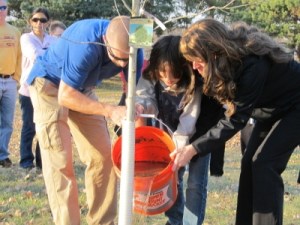
At 3:00 p.m. yesterday, November 20, Spencer’s schoolmates who study visual arts, cultinary arts and horticulture, gathered with Spencer’s family to dedicate a new 10′ tall red oak tree in his memory.

I never met Spencer, his friend, or their families. I attended yesterday’s dedication at the invitation of John Hopkins, a member of Shepherd of the Hill who teaches horticulture at the school. “The kids have put this program together,” said John. “If you’re not doing anything at 3:00, swing by.”

Spencer’s death had hit everyone at the school hard. I went to show support from the wider Chaska community for the students who had put this program together, as the program said,

“To comfort and help restore the hearts affected by the hurt of Spencer’s death.”

The printed program featured not only a carefully selected poem of Pakistani poet Faiz Ahmed Faiz, “When Autumn Came”  but art created from closer to home by the students of the Arts Academy.

Brieann’s drawing depicts her fallen schoolmate as a tree growing taller with the caption “Grow till Tall”; Dominika, another of Spencer’s schoolmates, wrote and read aloud her poem “I can see a lot of life in you”:

Hold on to the memories of

the ones we love and lost.

Take time to say what’s right.

Take time to forgive and not

fight. Each day’s a gift and

not a given right. You have to

wonder and find out what’s

your light.  Is it the One to

come?

Each day is new and full of life.

Listen through the whistling wind.

Your time is here

be content don’t linger.”

There were words there on the hill… but not many. There was quiet…. No cell phones ringing. No one texting. No one looking around in boredom. Just all of us, young and old, at home, for a moment, in the sacred silence of the community standing together to celebrate life in Spencer’s honor.

tree dedication

“To plant a tree is to give body and life to one’s dreams of a better world,” wrote Russell Page.

The red oak will grow over the years to great height and girth, spreading its branches for the birds and the squirrels, reminding each of us to honor the gift of life and the gift of the community of thoughtful speech and silence.

This is the way that autumn came to the trees:

it stripped them down to the skin,

left their ebony bodies naked.

It shook out their hearts, the yellow leaves,

scattered them over the ground.

Anyone could trample them out of shape

undisturbed by a single moan of protest.

The birds that herald dreams

were exiled from their song,

each voice torn out of its throat.

They dropped into the dust

even before the hunter strung his bow.

Oh, God of May have mercy.

Bless these withered bodies

with the passion of your resurrection;

make their dead veins flow with blood again.

Give some tree the gift of green again.

Let one bird sing.

Faiz Ahmed Faiz

The “Nones” at the coffee shop

The “Nones” are the fastest growing group in the United States religious landscape. Time publicized the story in its March 12, 2012 issue.

Last week Rose French, religion editor of the Star Tribune here in Minneapolis, personalized the Pew Forum research in  “Fastest growing group in religious circles? The ‘Nones’”  (10.15.12).

The story begins with Marz Haney, a young woman who grew up attending an evangelical Christian church every Sunday. But she had questions. And, it appears, the church she attended wasn’t big enough for her big questions.

Questions and doubts are not enemies of faith. They are the friends of faith. They refine, correct, expand, and reform faith. They challenge what Jean-Paul Sartre called “bad faith.”

Sartre, of course, thought that all religious faith was bad. Some of the “Nones” agree with Sartre. Others still profess faith or “spirituality” but live it outside the boundaries of the traditional institutions that no longer hold meaning for them.

“I had some doubts all along. I was sort of in continual doubt about my personal salvation,” says Marz Haney.

That Marz and others have concluded that spirituality/faith/religion is all about personal salvation brings me great sadness. That she would think so is a reflection of the right turn that began to dominate the American religious landscape beginning in the 1950s.

To many of the “Nones”, fear and hate have become the face of Christianity. Sometime in the late ’50s, the televangelists began to change the face of Christianity to the world. Those who tuned in watched and heard the voices of snake oil salesmen selling purple handkerchiefs that would heal, if only you purchased one and put the hanky on your television screen while the evangelist prayed for you. Intelligent faith was turned into an oxymoron. One either is intelligent and without faith, or full of faith and without intelligence.

At the coffee shop recently, the proprietor who greets me “Good Morning, Your Reverence” with a smile, invited me to join a conversation he was having with two other coffee drinkers. “You can help us here,” Mike said. His grin told me this was a set up. “If God created the world, who created God?”

“Hmmm. Interesting question. Really good question. Really, really, really good question. It assumes, of course, that everything is created. That’s the way we think. If something’s here, it has to have been created. But that begs the question endlessly. So….maybe some things are not created. Whatever that is ultimate reality. In theology, the word we use for the ultimately real is ‘God’.”

Several weeks later a young couple sat at the table at The School of the Wise, a coffee shop and wine bar humorously named after the euphemism for speakeasies during the era of Prohibition. The couple had sent a message through the church’s website inviting a conversation about their needs and whether Shepherd of the Hill Church might be a good fit.

They were “Nones”. I love this couple! They made my evening. So honest. So genuine. So open. Wondering and hoping that perhaps Shepherd of the Hill might be a place unlike that mega-church up the road whose very small print declares belief in “the intention, eternal punishment of the wicked”. They were cautious but feeling the need for a community that welcomes rather than scorns, unites rather than divides, thinks as well as feels, and moves them beyond self-absorption in the comfortable but confining precincts of economic privilege.Sitting in a coffee shop with The New York Times on Sunday Morning over a cup of coffee was no longer enough.

Which, of course, is what the gospel is about, as I understand it.

Jesus had one message: “the Kingdom of God/Heaven is at hand.”  A “Kingdom” is a society, a commonwealth. A society is people in relationship. “At hand” means “Now!” The kingdom of Heaven was something like the heaven the young couple and I were experiencing right there at the back table in The School for the Wise – real people in real relationships, exploring ultimate reality over delicious mocha-mint-lattes, looking beyond our privilege and celebrating the magnificence of a moment that is at the very heart of  creation as we know it.

Back To Top

A Back Porch Conversation on Human Needs Satisfaction

Today “In the company of hysterical women” referred to Abraham Maslow’s hierarchy of needs in the post “Living Below the Line – Day 2”. The reference to Maslow led to bringing this draft commentary out from the file drawer where it’s been gathering dust since early August.  Here’s the reflection

Defining Human Needs and Their Satisfaction

Terry Gips, Sustainability Associates

Terry Gips, President of Sustainability Associates (click HERE for description), introduced me to Chilean philosopher-economist Manfred Max- Neef’s ground-breaking re-conception of human needs and needs-satisfaction. Max-Neef’s framework offers a different view from Abraham Maslow’s pyramid-hierarchical model of self-actualization that prevails in the West. While the Maslow model is typically Western in centering on the individual, the Max-Neef paradigm looks at the larger culture and society in terms of needs and needs-satisfyers. It’s focus is the community.

The basic human needs are listed here, along with a rating scale to measure how we’re doing (a person, group, nation, world).

Needs satisfaction rating: scale of 1 to 5 (5 = fully satisfied)

Subsistence              1 2 3 4 5                                           

Protection                  1 2 3 4 5

Affection                     1 2 3 4 5

Understanding            1 2 3 4 5

Participation                1 2 3 4 5

Idleness/Leisure          1 2 3 4 5

Creation                       1 2 3 4 5

Identity                        1 2 3 4 5

Freedom                      1 2 3 4 5

–          Manfred Max-Neef – Matrix, Human Scale Development

According to this framework, food and shelter, for example, are not regarded as needs, but as satisfiers of the fundamental need fo subsist.

In much the same way, education (either formal or informal), study, investigation, early stimulation and meditation are satisfiers of the need for Understanding. Curative systems, preventive systems and health schemes in general are satisfiers of the need for Protection.

There is no one-to-one correspondence between needs and satisfiers. A satisfier may contribute simultaneously to the satisfaction of different needs or, conversely, a need may require various satisfiers in order to be met. Not even these relations are fixed. They may vary according to time, place and circumstance. For example, a mother breastfeeding her baby is simultaneously satisfying the infant’s needs for Subsistence, Protection, Affection and Identity.

Think now of “The American Dream” – a phrase coined 1931 by J.T. Adams (1878-1949), U.S. writer and historian, in Epic of America. Here are the words that introduced the aspiration of “the American Dream” to the U.S. national lexicon:

“The American Dream is that dream of a land in which life should be better and richer and fuller for everyone, with opportunity for each according to ability or achievement. It is a difficult dream for the European upper classes to interpret adequately, and too many of us ourselves have grown weary and mistrustful of it. It is not a dream of motor cars and high wages merely, but a dream of social order in which each man and each woman shall be able to attain to the fullest stature of which they are innately capable, and be recognized by others for what they are, regardless of the fortuitous circumstances of birth or position.”

Sipping coffee on Terry Gip’s porch with five seminary classmates, the discussion took a nose dive into theological and economic despair as the Christian pastors lamented the victory of environmental degradation, greed, concentration of wealth, militarism, and consumerism in American life. We were like the prophet Amos, or so we must have thought, thundering our cries of “Woe to you” when Terry, a person of deep and active Jewish faith, asked us to stop and think.

“We won’t get anywhere by negativity,” he said, or something like that. You guys are Christian pastors. People need good news. The old model is a model of scarcity; that’s not good news. We have to re-define abundance. Think about it. You can change the world if you take seriously what Jesus said by preaching a theology and ethic of abundance. We should be talking about a world of abundance, not scarcity.

Jesus: “I have come that you may have life, and have it abundantly.”

We left Terry’s porch wondering what it would look like to alter the approach to the proclamation of abundance re-defined in light of Jesus and Manfred Max-Neef’s human scale development. The “yoke” (responsibility) that brings satisfaction and rest, not only to the soul but to the body politic, is the shared yoke of humility and sharing.

The American Dream is again up for grabs on the road to the November election. I listen to every campaign ad asking which dream is being promoted, and the six Christian pastors go into the pulpit Sunday mornings chastened and deepened by a faithful Jewish brother who seemed to know our Lord, the Jewish rabbi, better than the Christian pastors on his back porch!

We never felt so far from him

The Grand Canyon


Dad thought Dave and I were going to hell,

since we had left his fundamentalist

God.  My brother sent me Bertrand Russell,

“Why I am NOT a Christian.”

                                       Atheist,

he–liberal Presbyterian, me–

stood at the rim and watched the rising sun/

paint all the colors far below.  “Maybe

there is a God…” Dave said.  But his was one

cry like “O God!” at orgasm, sincere,

but not a creed.  My faith was mixed with doubt.

              Before he died Dad told his own pastor

to preach to us, his sons, to call us out

at his funeral.  So “Just As I Am”

was played.  We never felt so far from him.

– Steve Shoemaker, Urbana, IL, September 16, 2012

Of Tide Pools and the Ocean

“Wisdom cries out in the street; in the squares she raises her voice. At the busiest corner she cries out; at the entrance of the city gates, she speaks:

‘How long, O simple ones, will you love being simple? How long will scoffers delight in their scoffing and fools hate knowledge?’” (Proverbs 1:20-22)

We come here this morning in mourning, seeking light in the midst of a great darkness created by religious hatred.

Listening to and watching the news from the Middle East and the viral videos that call the founder of Islam “Mo” is deeply disturbing. Once again, religious fanaticism betrays its claim to bear witness to the One who remains shrouded in mystery. The fires that were set by a flame-throwing video raise the question “Will religious fanaticism prevail?

“There are only kinds of religion: one burns, the other learns.”

Those words were spoken from this pulpit two years ago. They came not from the preacher. They came from Ghafar Lackanwal, a Muslim Afghani-American, who came at our invitation after the Christian pastor in Florida threatened to burn the Quran. Ghafar accepted our invitation. He opened his Quran, read from his Book, and brought greetings peace to this congregation.

The two kinds of religion are not Christianity and Islam, or Islam and Judaism. The two kinds of religion are intransigent fundamentalism, on the one hand, and the humble search for wisdom’s guidance, on the other.

Ninety years ago a great preacher lost his pulpit for asking the question “Shall the fundamentalist win?” Harry Emerson Fosdick asked the question in 1922. He was subsequently removed from his pulpit, but he John D. Rockefeller built a church called “Riverside” where Fosdick would become one of America’s best known and most loved preachers. Some called him “America’s counselor” because of the radio broadcasts of his sermon across the country. “Shall the fundamentalists win?” By fundamentalists he meant those who claim absolute truth, denying all other claims to truth or wisdom.

Ninety years later I’m asking myself the same question.

Like Fosdick, I spent my boyhood summers on the coast of the Atlantic Ocean. The ocean became my teacher. It became, you might say, my enduring metaphor for God.

As a boy I would spend hours lost in the magnificence of the tide pools that dotted the coast of Rockport, Massachusetts.  Wading in the tide pools is still my favorite thing to do. I did it again last month with my grandchildren at Coquille Point on the Pacific Coast of Oregon.

The tide pools are filled with fresh sea water. They are the temporary homes that give shelter to the starfish, crabs, periwinkles, sea anemones left there for a few hours at low tide. They are not the ocean itself.

Perhaps religion is like a tide pool, a small pool of ocean water that tastes the Ocean while pointing to the vast mystery of the Ocean on which its life depends. The tide pools hold a few drops of a vast sea. They are filled with the Ocean, but they are not the Ocean. Their health depends on the eternal rolling of the tides to refresh them.

Wading in a tide pools, it’s easy to lose track of time.

But there are other tide pools far back from the water’s edge, created by the unusually high waves of a storm. Unreachable by the normal daily tides that would refresh them, they are cut off from the Ocean that gave them life. They are without oxygen, yellow, and covered by green-yellow slime. Their original beauty has left them to the flies.

Perhaps the human soul or, a religious tradition, is like a tide pool.

“Since when has the Pacific Ocean been poured into a pint cup,” asked Fosdick, “that the God of this vast universe should be fully comprehended in human words?” One tea-cup will reveal the quality of the whole ocean. Yet it will not reveal all the truth about the ocean.

“When one considers the reach of the sea over the rim of the world; thinks of the depths that no eye can pierce…, one dare not try to put these into a tea-cup. So God sweeps out beyond the reach of human symbols. At once so true and so inadequate are all our words….”

As a Christian pastor, I can only take responsibility from within the tide pool of my Christian faith tradition.  Muslim Imams like Minneapolis Imam Makram El-Amin, are doing the same in theirs.  “We will stand,” he said, “in unity against these attacks and the appalling killing of the diplomat who was there on a peaceful mission” (“State Muslims denounce attacks,” Star Tribune, Sept. 13). Every Christian pastor is called to do the same in the wake of the viral film that poisoned the Ocean from a yellow tide pool in Florida.

This morning I ask you to listen to three prayers. Ask yourself who spoke them. A rabbi, an imam, or a Christian pastor.

1) O God Source of Life, Creator of Peace. . .
Help Your children, anguished and confused,
To understand the futility of hatred and violence
And grant them the ability to stretch across
Political, religious and national boundaries
So they may confront horror and fear
By continuing together
In the search for justice, peace and truth. . . .
With every fiber of our being
We beg You, O God,
To help us not to fail nor falter. Amen

2) In the Name of God, The Everlasting Merciful, The Cherisher
Of the Worlds and Worthy of all Praise,
Our Lord: You have created us from a single (pair) of a male
And a female and made us into Nations and Tribes that we may
Know one another (not that we may despise each other) so
Help us to love each other and take the hatred and anger from our
Hearts so that the People of The Book (Christians, Jews and Muslims)
In the Middle East may live in Peace and Justice. Amen

3)Two peoples, one land,
Three faiths, one root,
One earth, one mother,
One sky, one beginning, one future, one destiny,
One broken heart,
One God.
We pray to You:
Grant us a vision of unity.
May we see the many in the one and the one in the many.
May you, Life of All the Worlds, Source of All Amazing Differences
Help us to see clearly.
Guide us gently and firmly toward each other,
Toward peace. Amen.

The first prayer comes from the lips of Rabbi H. Rolando Matalon from Congregation B’nai Jeshurunin  New York, NY. The second comes from Dawud Ahmad Assad of the Council of Mosques here in the USA. The third comes from the National Council of Churches of Christ.

Each of them is humble. Each of them looks to the larger Ocean to refresh us. Each begs for wisdom to guide us. Each honors the God and Creator of all.

There are only two kinds of religion. One burns; the other learns. “How long will you love being simple? How long will scoffers delight in their scoffing and fools hate knowledge?”

When any religious tradition mistakes its pool for the Ocean itself, denying the existence of neighboring tide pools along the edges of Eternity, fundamentalism wins. Things turn yellow and nasty. For those of us who are disciples of Jesus, there is only one enduring question by which our tide pool can remain open and fresh: “How shall we love the Lord our God with all our mind, hearts, soul, and strength and our neighbor as ourselves?”

Only the daily refreshment of the tides can keep the tide pools fresh. Otherwise we watch the news, asking Fosdick’s old question, and hope and pray that fundamentalism and fanaticism will not win.

– Sermon preached by Gordon C. Stewart at Shepherd of the Hill Presbyterian Church, Chaska, MN Sunday, September 16, 2012.

Alaskan tide pool photo by Susan Linz