✚ Lessons in Stone (Dennis Aubrey) ✚

✚ Lessons in Stone (Dennis Aubrey) ✚.

Dennis Aubrey’s “Lessons in Stone” took me back three years ago.

I’m sitting in a small room with a Benedictine monk at St. John’s Abbey in Collegeville, MN. It’s the first of six private meetings over a three day silent retreat.

“What brings you here?” asks the spiritual guide. “My step-daughter is dying of cancer.” “What is her name?” “Katherine.” How old is Katherine?” “Thirty-three. She was diagnosed four years ago with Leiomyosarcoma, a rare incurable sarcoma, and is now in her last months in hospice care.”

“So what troubles you? Are you afraid for the state of her soul?” “No,” I respond quickly. “Not at all. It’s not about that. God is Love. I don’t believe in hell.”

“Hmmm,” said the monk. “I see. Interesting. Our tradition says that there is a hell, but that the likelihood is that there’s nobody in it.”

The centerpiece of the tympanum that captured the attention of the little Danish boy in Dennis’ “Lessons in Stone” is the scene of God’s hand reaching to pull Saint Foy toward heaven.

You don’t have to believe in hell as an eternal state to cry out for release from its torments here and now, or to pray for a peace that passes all understanding.

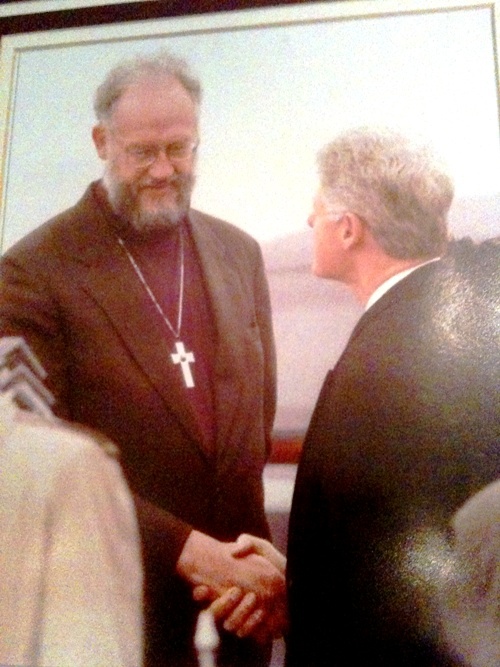
Meeting President Bill Clinton

Steve officially welcoming President Bill Clinton to Champaign-Urbana

Steve officially welcoming President Bill Clinton to Champaign-Urbana

January 28, 1998

He gave the State of the Union address
the night before, and flew on Air Force One
to our college town in the middle-west
to check out press and public reaction.
(The sex with an intern story made news
the week before.) For six years he had met
not politicians, but “Local Heroes”
at airports (Do-Gooders the Democrat
Party chose.)

Our church worked with homeless men.
As Pastor, I was picked to shake his hand
as he came off the plane (in a long line
with 14 other folks.) He called each one
of us by name. He firmly gripped my hand,
looked in my eyes, pretending to be fine…

-Steve Shoemaker, Urbana, IL

Old Friends

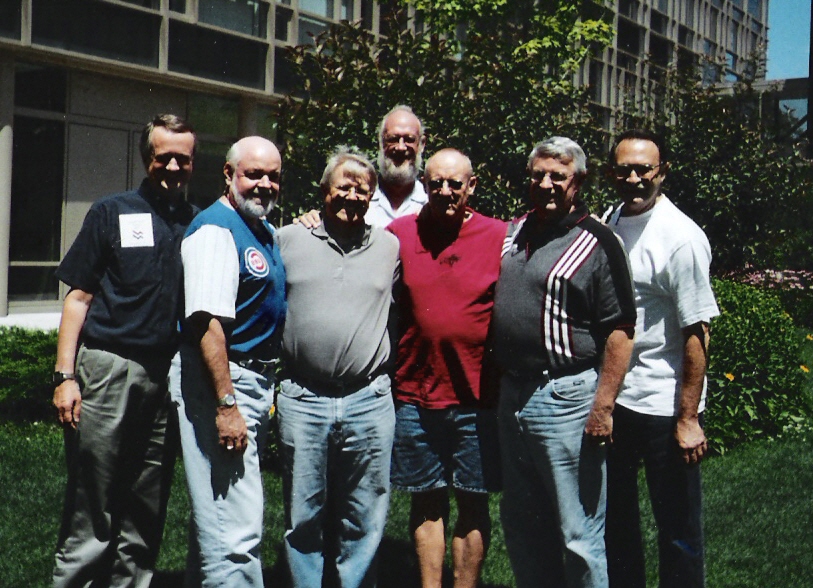
Dale Hartwig (red shirt) and the Chicago Seven Gathering, McCormick Theological Seminary, 2004.

Dale Hartwig (red shirt) and the Chicago Seven Gathering, McCormick Theological Seminary, 2004.

This morning news arrived of the passing of an old friend. Dale is a classmate, one of seven who call ourselves The Chicago Seven. The Seven met annually until 2004 when the gathering was reduced to Six because of Dale’s advancing Parkinson’s. The gatherings have continued to be powerful bonds of friendship, but never again so meaningful as when there were Seven.

MEMORIAL TRIBUTE to be shared at the Celebration of Life & Victory over Death for DALE HARTWIG

Dale was such a joy for all of the Chicago Seven (now Six). His quiet spirituality brought a stillness to the room, or tears, and so much reality and the tenderness of a poet. The last time all seven of us McCormick alums gathered in Chicago, we sat around a long table sharing our thoughts and work. Dale and I were sitting next to each other, as we often did, at one end of the table. When it came his turn, Dale moved some papers in front of me and asked that his words be read. His contribution, as I recall it, was a Greek exegesis from a New Testament text that reminded us of his love for biblical exegesis, he being the only one of us who left seminary to become more proficient in NT Greek than when we left. His sharing also included a poem he had written. As I read it aloud on his behalf – his surrogate voice – he began to weep because his words had been heard! Here’s the poem in memory of that sacred Hartwig moment – one of many – that the rest of us will forever cherish.

“THE SURROGATE VOICE” – GORDON C. STEWART (WRITTEN IN THANKSGIVING FOR THE CHICAGO GATHERING ’04)

As the surrogate voice reads on,
the author sits and sobs
his wrenching tears from primal depth;
from some abyss of joy
or nothingness…or both.

The author’s sighs and piercing sobs-
arrest routine,
invoke a hush,
dumb-found the wordy room.

He cannot speak,
his Parkinson’s tongue tied,
his voice is mute, in solitude confined,
all but sobs too deep for words.
Another now has become
his voice, offering aloud with dummy voice
the muted contribution
in poetic verse the ventriloquist’s voice has penned.

The abyss of muted isolation ope’d,
his words, re-voiced aloud,
hush the seven to sacred silence, all…
except from him, their author.

Whence comes this primal cry:
From depths of deep despair and death,
from loneliness, or depths of joy
We do not know.

The surrogate voice reads on
through author’s sobs and sighs,
through his uncertain gasps for air
and our uncertain care.

The iron prison gates – the guards
of his despair – unlock and open out
to turn his tears from prison’s hole
to tears of comrade joy.

His word is spoken, his voice is heard,
a word expressed
in depth and Primal Blessing,
pardoned from the voiceless hell.

The stone rolls back,
rolls back, rolls back,
from the brother’s prison’s tomb,
the chains of sadness snap and break!

At one, at one, we seven stand,
in Primal Silence before the open tomb,
as tears of loss, of gain, of tongues released
re-Voice unbroken chords of brotherhood.

Rizpah and her children

As the snowstorm cancelled schools in Minnesota last week, 90 year-old Lorraine Garrison was surrounded by family and friends who celebrated her life.

Lorraine’s grandson, Jeff, reminded the minister of the story of Rizpah, the diligent mother who perched her body on the rock after two of her children were hanged by the Gibeonites, and stayed there for five months to keep the birds and animals of prey away. Lorraine was a Rizpah, watching over her adult children and her grandchildren from her room in the nursing home in Chaska.

“Rizpah” – Alfred, Lord Tennyson (1809–1892)

Sin? O, yes, we are sinners, I know—let all that be, 60
And read me a Bible verse of the Lord’s goodwill toward men—
“Full of compassion and mercy, the Lord”—let me hear it again;
“Full of compassion and mercy—long-suffering.” Yes, O, yes!
For the lawyer is born but to murder—the Saviour lives but to bless.

He’ll never put on the black cap except for the worst of the worst, 65
And the first may be last—I have heard it in church—and the last may be first.
Suffering—O, long-suffering—yes, as the Lord must know,
Year after year in the mist and the wind and the shower and the snow.

Heard, have you? what? they have told you he never repented his sin.
How do they know it? are they his mother? are you of his kin? 70
Heard! have you ever heard, when the storm on the downs began,
The wind that’ll wail like a child and the sea that’ll moan like a man?

Election, Election, and Reprobation—it’s all very well.
But I go to-night to my boy, and I shall not find him in Hell.
For I cared so much for my boy that the Lord has look’d into my care, 75
And He means me I’m sure to be happy with Willy, I know not where.

The story comes from Second Book Samuel 21:10-11: “And Rizpah the daughter of Aiah took sackcloth, and spread it for her upon the rock, from the beginning of harvest until water dropped upon them out of heaven, and suffered neither the birds of the air to rest on them by day, nor the beasts of the field by night. And it was told David what Rizpah the daughter of Aiah, the concubine of Saul, had done.”

Thank God for the Rizpahs of this world who will never let Willy get lost.

Verse – Stillbirth

“Don’t kill me!” my young wife cried
as the nurse–quite frantic–pushed
her, the half-born baby, and
gurney down the hallway. “Dead!”
she kept shouting, “The baby is dead…”

E. R. folks, following all
procedures had brought a wheel-
chair to the car at my yell
she was giving birth while still
lying in the back seat.

…………………………”I’ll
carry her,” I growled, and sent
chair careening down the street
with a kick. We’d faced the fact
that the child had died and that
natural birth was the best

three sad weeks before. We cried
then. Now we both just wanted
closure, as they say…to find
out what caused her life to end.
“Just a mystery,” we learned.

It took years before we tried again.

– Steve Shoemaker, Urban, Illinois

Brubeck, Hirt, and Respighi

Verse — We Never Played Rock ‘n’ Roll

I’d take a couple of LPs (they’d spin
at 33 and a third RPM)
and bike down the concrete sidewalk–not in
the street that’s made of brick. I’d dodge the limb
of the old elm in front of Katie’s house
and fly around the corner at the T
to where Paul lived. Two other high school guys
left bikes by the garage. We’d holler, “Hi!”
to Mrs. Duker and head downstairs to where
Paul’s dad had a great stereo. We’d play
some Brubeck or Al Hirt–we loved to hear
the “modern”jazz of the ’50s. We’d stay
and listen to Respighi’s Pines of Rome.
Band guys: we never wanted to go home…

– Steve Shoemaker, Urbana, IL, March 8, 2013

I look in the mirror and what do I see?

“I look in the mirror and what do I see? A toothless wonder comin’ after me. I want to be young again” I’m thinking after the tooth extraction. It’s my rendition of Swing low, sweet chariot’s “I looked over Jordan and what did I see….”

Who is this older me and the Me that’s comin’ after me? Has God ever lost a tooth? Has God ever looked in the mirror and protested the reflection? Has God ever stepped on the scale in the morning, counted the days on the calendar, googled the weather channel, picked up the dog’s poop, poured Mirilax in the coffee to stay “regular”? Taken three Ibuprofen to keep the swelling down? Has God ever come to the end of a day and wondered why the dentist said “Good Morning!”

A strange lullaby?

Last night I sang the refrain of this song to a dying woman. I sang it softly, followed by “Swing low, sweet chariot.” Her breathing became calmer. She raised an eyebrow.

Earlier in the day a Roman Catholic friend poured out her heart about the state of the church and her hopes that the Spirit that refreshed the Church in the Second Vatican Council will breathe fresh air into the conclave to select the successor to Benedict XVI. She was bemoaning the loss of respect for the right of conscience. I thought of Rosa Parks sitting alone in the front of the bus, changing the world, one woman at the time. All afternoon “Ain’t gonna let nobody turn me ’round” kept playing in my head. It bubbled up from deep in my soul.

It’s a familiar tune to everyone in the Civil Rights Movement. It was meant to urge us to keep on walking…keep on marching to the Promised Land of racial justice and freedom. But at Lorraine’s bedside last night, it took on a whole new meaning. It became a lullaby. “You’re goin’ home now. Ain’t nobody gonna turn you ’round.”

Five hours later, after years of walking, the chariot swung low. Rest in Peace.

Harry Bellafonte: Sing your Song

Video

Verse – Collie

We bought our collie puppy from a farm
about two hours drive away. We’d read
a lot about the woman breeder from
the Internet, saw pictures of the stud,
the dam, and former Champions. A pet
was all we wanted, but a pure-bred dog
was beautiful as well. Good temperament
was guaranteed. The pup we chose grew big
and sweet by nine months, but at just a year
was very sick from a genetic flaw.
The vets had salves and drops and pills that wore
us out (and cost as much a month as food.)
The breeder never bred the pair again,
and Blazer has become our greatest friend…

– Steve Shoemaker, Urbana, IL, Feb. 21, 2013