Remembering Ernie Banks

There is no bigger Cub’s fan than Harry Strong. Ernie Banks – “Mr. Cub” – who died Friday night, was his hero. And Harry KNOWS baseball.  So much so that the editor of American Sports: A History of Icons, Idols, and Ideas [published by ABC-CLIO, LLC in 2013], invited Harry to write the entry on Ernie Banks.

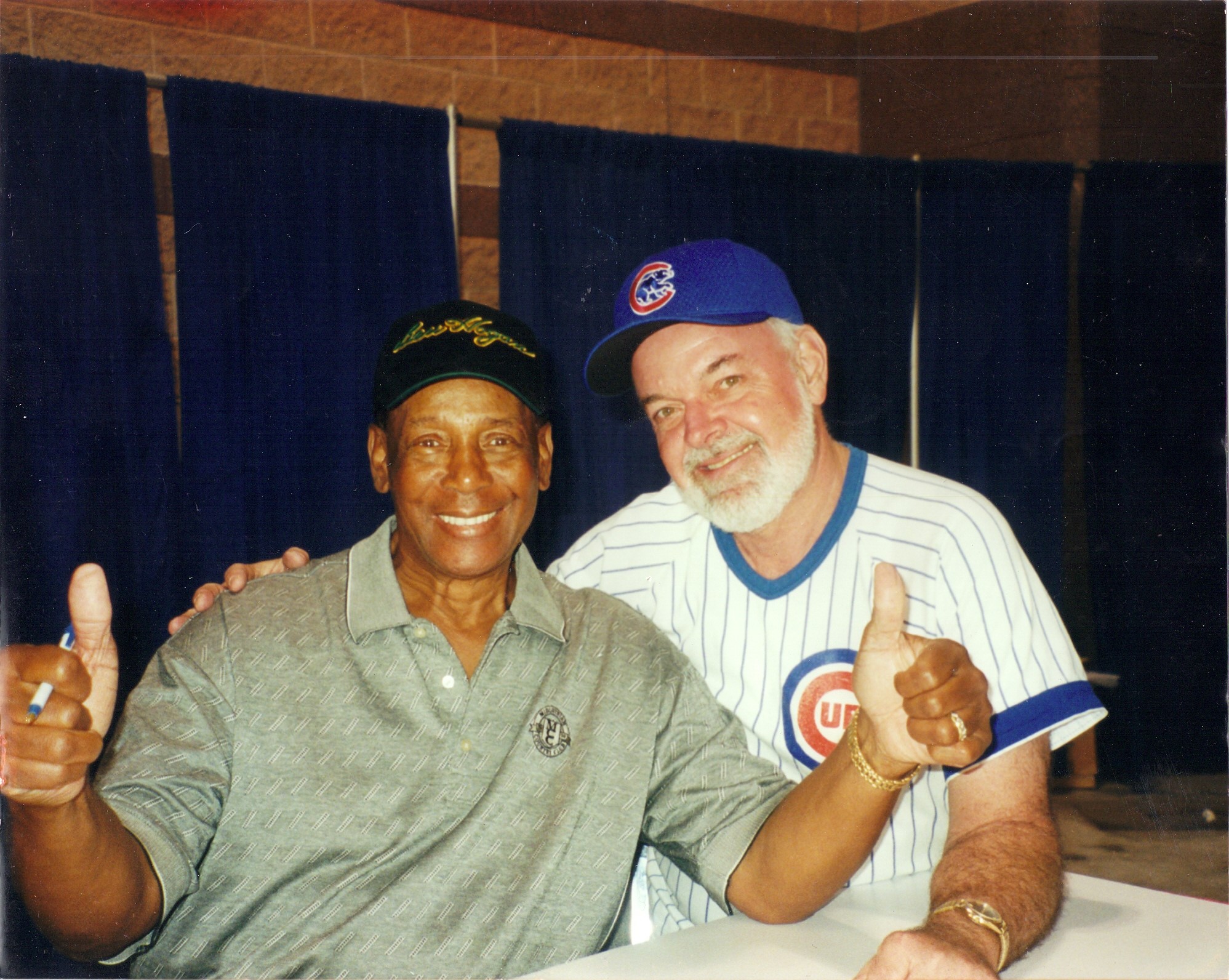
Harry sent the following photograph and email to six close friends who gather annually:

I only met him once, but it’s a day I’ll never forget. In July 2004, while I was serving as interim pastor at the Morrisville Presbyterian Church in Morrisville, Pennsylvania, just across the river from Trenton, I learned that Ernie would be appearing at a Baseball Card Show in Atlantic City about two hours away and signing autographs from 1:00 – 3:00 p.m. I informed Anna [Harry’s wife] that WE WERE DEFINITELY DRIVING TO ATLANTIC CITY immediately following the benediction at the 11:00 a.m. service since this might be my only chance to meet this hero whom I’d idolized since I was 10!

Traffic was heavy. The trip took longer than I’d hoped, so we did not arrive at the Card Show in Atlantic City until 2:45 p.m. I hoped and prayed Ernie would still be there, but our late arrival proved to be most fortunate if not providential. When we found Ernie and his agent in a large room behind a table, they were the only ones in the room. Apparently, all the other attendees hoping to meet him had come early and moved on to other baseball celebrities and exhibits. Apparently, all the other attendees hoping to meet him had come early and moved on to other baseball celebrities and exhibits.

Ernie and his agent greeted us warmly. I told Ernie I had grown up in the shadow of Wrigley Field before moving to Glen Ellyn in 1951. I told him that Phil Cavarretta, Cub first baseman and later Ernie’s first manager, had moved into the apartment in which my parents and I had lived after our move. I confessed that I had idolized Ernie as a child and that I owned all of his baseball cards from 1954 until his retirement in 1971. I had brought along several items of memorabilia hoping that Ernie would sign them. There was an established signing fee for each individual piece, but Ernie signed a card, ball, cap, poster, and several other items all for the price of one item.

Mr. Cub (L) & Mr. Strong (R)

Mr. Cub (L) & Mr. Strong (R)

He also consented to pose with me for a picture, which Anna snapped.

About that time, Louis Armstrong’s “Hello Dolly” began playing over the sound system in the room. Ernie and I began singing along with “Satchmo,” while Ernie’s agent took Anna by the arm and they began to waltz around the room together.

By the end of the dance it was after 3:00 p.m., so Anna and I offered our sincere thanks for their gracious welcome, their time, and Ernie’s generous signatures. As they bid us farewell, I noticed that Ernie was limping badly. I asked if the pain was in his knees and he acknowledged indeed it was. Then I told him that by age 53 I had been walking with a cane because of the pain in my right knee due to the loss of cartilage, so that I was hobbling around “bone-on bone.” BUT – I had found an orthopedic surgeon in Trenton who was willing to perform knee-replacement surgery for me at a relatively young age for such a procedure.  I told him I had been pain-free for 8 years and demonstrated for him my ability to jump up and down and squat like Jody Davis behind home plate. I urged him to give serious consideration to having the knee(s) replaced (which he later did). I’m sure he received all kinds of solicited (and unsolicited) advice regarding the procedure – but I was thrilled to learn later that indeed he had had both knees replaced and that he enjoyed many more years of more comfortable mobility on the golf course and elsewhere.

After that memorable afternoon in Atlantic City, Anna met him twice, at HoHoKam Park, the Cubs former Spring Training home in Mesa, Arizona. Both times I was too busy attempting to secure autographs from present and future Cub “stars” along the right field line before the start of the Cactus League game. (My loss.)

The first time, Anna waited patiently while Mr. Cub spent time talking with an older woman so she could greet Ernie again and remind him of our meeting a few years before in Atlantic City, when he and I had performed while she and Ernie’s agent danced to “Hello Dolly.” Ernie greeted Anna warmly, seemed to recall their earlier meeting, and signed her Cubs cap, which I am wearing as I type.

Anna’s later encounter with Ernie came a few years later when she saw him beneath the stands at HoHoKam Park. Unfortunately, that was a less pleasant meeting. Anna found Ernie disoriented and confused, attempting to make his way to the press box for an interview. After speaking with Ernie briefly, she quickly grabbed the attention of an usher who was able to assist Ernie in getting to the press box.

As a lifelong Cub fan, I will forever cherish the opportunity I had to spend a few minutes with this gifted ball player and remarkable man!

P.S. As I reread my article just now, I was struck by this quote from Ernie I’d included [in the American Sports entry]:

“When I die, I want my ashes to be spread over Wrigley Field with the wind blowing out!”

— Rev. Harry Lee Strong, H.R.  Prescott, AZ 
EDITOR”S NOTE: The Cubs have a real shot at going to the World Series this year. Perhaps, in honor of Mr. Cub, they’ll win it all in “the Friendly Confines” of Wrigley Field “with the wind blowing out”.

Mr. Cub and Dr. Borg

Ernie Banks, known with great affection against his protestations as “Mr. Cub”, died yesterday, two days after theologian Marcus Borg.

Each excelled in his respective field, Ernie in the ivy-covered walls of  “the Friendly Confines” of Wrigley Field, Marcus in the ivy-covered walls of the academy. Though their fields were different, their way of life was the same. It was humble.

Ernie objected to the “Mr. Cub” title, arguing that the designation should be shared among team members who excelled each year.

Marcus responded to the question “How do you know you’re right?” with “I don’t know. I don’t know that I’m right.”

Each was humble, and each anticipated death.

“I may have ten years left. Not sure I want more. There comes a time to let go. And I could, with gratitude, sooner than that. My life has been very blessed.”

Dr. Marcus Borg (Mar. 11, 1942 – Jan. 21, 2015) to former student and friend, the Very Reverend Barkley Thompson, October, 2014.

“When I die, I want my ashes to be spread over Wrigley Field with the wind blowing out!”

–  “Mr. Cub” – Ernie Banks (Jan. 31, 1931 – Jan. 23, 2015)

Thank you, Gentlemen, for the memories. R.I.P.

Verse – The Chicago Shortstop Smiles in Heaven

Ernie Banks rocks a robe that’s Cubs blue.
Pennant hopes are eternal, it’s true,
Wrigley’s sky might be gray,
Mr. Cub will still say:
“It’s a beautiful day–let’s play two!”

– Steve Shoemaker, Urbana, IL, Jan. 25, in memory of Mr. Cub, Ernie Banks.

Ernie Banks (Jan. 31, 1931 – Jan. 23, 2015), the MLB Hall of Fame shortstop affectionately known by the ever-hopeful Cubs fans of Wrigley Field as Mr. Cub, died yesterday at the age of 83.

Incredibly American: the ARU

“It’s incredibly un-American. My DNA is offended by it.”

“It” is the National Basketball Association’s salary cap policy. The speaker is Michele Roberts, the new executive of the NBA Players’ Association (NBAPA), speaking in an interview with ESPN. Click HERE to hear the voice and read more. It’s hardly the DNA of America’s union movement.

pullman newsThe NBAPA is the spoiled great-grandchild of America’s early union movement and costly strikes like the American Railway Union’s sympathy strike in the Pullman strike in 1894.

Professional sports in America is just like America. Sort of. A little bit. Kind of.

There’s management and there’s labor. The NBA team owners (management) and the NBA players (labor) are sparring in preparation for their next big event: re-negotiation of the NBA collective bargaining agreement in 2017.

So, In that regard, the NBA is sort of like the rest of America, except for the likes of Walmart where there is no players’ union, just a company without “incredibly un-American” things like salary caps because they pay their employees peanuts.

But NBA players aren’t making peanuts. They’re making millions. A lot of millions!

It’s hard to feel sorry for a player hauling in an $80,000,000 contract, even if his name is LeBron James or Kobe Bryant. It’s also hard to feel respect for a union that represents only the elitest of the elites while other team employees are picking up the peanut shells after the games and working at Walmart.

My DNA is offended by that. It’s offended by the 1%. It’s offended by the owners. It’s offended by the players’ union. It’s offended by the greed and the self-absorption that sees the fair distribution of extravagant wealth among a small fraction of America’s 1% as a justice issue.

Justice is salary caps and earning caps at the top and an earnings floor at the bottom for the folks who pick up the peanut shells after the NBA games and have no bargaining rights at Walmart.

“It’s incredibly un-American. My DNA is offended by it.”

“There is certainly…something wrong in that form of unionism whose leaders are the lieutenants of capitalism.”—Eugene V. Debs (1855-1926) who, while serving a 10-year sentence in a federal penitentiary following the Pullman Strike, received more than a million votes as Socialist candidate for President.


Paul Molitor: a memory

Paul Molitor

Paul Molitor

Paul Molitor [ML Baseball Hall of Fame] was hired yesterday as the new Manager of the Minnesota Twins.

In 1994 Mr. Molitor stood ahead of me in line at a McDonalds at the Minneapolis-St. Paul Airport. It was Sunday around noon. I had rushed there from morning worship at Westminster Presbyterian Church in downtown Minneapolis with no time to remove the clerical collar I’d worn in worship.

“Good Morning, Father,” he said, assuming, I suppose, I was a Roman Catholic priest, or perhaps, just being respectful. “Good Morning, Mr. Molitor, what a pleasant surprise.”

We got our BigMacs or some other unhealthy fast food and sat down together, as I recall it, at Paul Molitor’s invitation.

What I remember is his respectful nature and his humility. I congratulated him for his amazing performance in the 1993 World Series was the best performance I’d ever seen by a ball player. He was named MVP in the series in which he led the Toronto Blue Jays to win the series. He batted 500, reached base 57.9 % of his at bats, Had two doubles, two triples, two home runs, eight Runs Batted In, and a 1.000 Slugging Average.  Nobody does that. No one before. No one since.

He responded something like. “I was lucky. Thank you, Father.” He’s number one in my book. He’s make a great manager.


Verse – The Face of Baseball

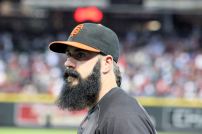
The football guys wear yoga pants,Fear_the_Beard,_Brian_Wilson
The B-ball boys show skin and tats,
We each comb out our beard,
Or grow mustaches weird,
So women know we’re such cool cats.

– Steve Shoemaker, October 16, 2014

Fall Football in South Bend

Tullamore Dew Irish Whiskey

Tullamore Dew Irish Whiskey

Those brats were the best tailgate food,
And the cobbler sure lightened our mood,
But the flush on our faces,
And our staggering paces,
Proves the whiskey from Ireland was good!

– Steve Shoemaker, Urbana, IL, October 2, 2014

Editor’s Note: This is the second of four pieces sent to Views from the Edge this morning. South Bend, Indiana is the home of the “Fightin’ Irish” of Notre Dame. Tailgate parties in the parking lots of football stadia have become a tradition before American football games.

Time

walking
dancing
heartbeat
breathing
poems
music
all have
rhythm
living
dying

– Steve Shoemaker, Urbana, IL, May 30, 2014


– Steve Shoemaker, Urbana, IL, May 30, 2014

iPhones and Baseball

It’s baseball season in the era of the iPhone.

There’s silence in the Minnesota Twins clubhouse, wrote StarTribune sports writer Jim Souhan last week while covering the Twins preparing for the new season during spring training.
The players sit quietly in front of their lockers before and after games glued to their iPhones. Right next to each other… on a TEAM. The clubhouse that once rocked with laughter, card games, and the loud voices of Twins leaders Kirby Puckett and Kent Hrbek on their way to a World Series is now like a morgue.

Teams that win have chemistry. You don’t build chemistry on iPhones. You don’t win a World Series playing with phantoms or staring into the pool for your own reflection – reading what the sports writers are saying about your individual performance. You win by bonding with the people around you. Men who play 162 games over a season find ways to keep the clubhouse loose. Boyish pranks like filling David Ortiz’s undershorts with ice so he wouldn’t notice that you had smeared his trousers with peanut butter. Stunts like reserve catcher Mike Redmond strutting naked through a tense clubhouse bellowing out a solo that cracks open the ice after a bad game. A baseball season is a long time, a long grind with losing streaks and winning streaks and long road trips where your only friends are your teammates.

Baseball teams that make it to the World Series are not quiet. They have some fun. They play. Not just on the field but on the buses, the planes, and in the restaurants and hotels where the team stays for a week or more far from home.

Twins fans can hope that when the new generation of Twins players sit by their lockers with their iPhones, they will come across Jim Souhan’s advice in this morning’s StarTRibune.

“Show us something this year.
“Heck, show us anything.
“Show us some fire, some grit; some passion, some promise.
“Show us that three years of unprofessional play was a detour, not a destination.

“Show us that you care about something other than paychecks and per diems.

Joe Mauer is the best player on the Twins, a future Hall of Famer. But he’s as emotionally flat as flatbread or a flat tire. He’s predictable. No strolls through the clubhouse singing an aria to break open the silence, no shaving cream pies, no jokes, no ice in another players under shorts or peanut butter, just a peanut butter and jelly sandwich on white bread eaten along in front of his locker, waiting to take hie new position at first base. If there’s passion in Joe, it doesn’t show.

Give us some passion. Bring on Kirk Gibson coming to the plate in the World Series on knees so bad he could barely walk, throwing his fire into a swing that pushed the ball over the fence with nothing but the pure grit from the fire in his belly, hobbling around the bases like a man recovering from hip surgery. Give me Kirk, Joe.

New rule: No iPhones, iPads, or any other such distractive devices in the clubhouse. Put ’em down. Get to know each other before you take the field. I’d wager that the first team to institute that rule would go the World Series not because they’re the most talented but because they care about each other and they care about playing as a team.