
Donald Trump and the Presbyterians

Donald Trump and Ben Carson

Candidate for President Donald Trump’s sideswipe at fellow Republican candidate Ben Carson’s Seventh Day Adventist faith calls for a response from those who are what Mr. Trump is not – a Presbyterian.

Although Mr. Trump attended Sunday School and was confirmed at the First Presbyterian Church of Jamaica in Queens, NY, he is not a member of a Presbyterian Church. His church of choice on Easter and Christmas is Marble Collegiate Church, the historic Reformed Church in America congregation in midtown Manhattan best known for the Rev. Dr. Norman Vincent Peale, author of The Power of Positive Thinking.

“I am Presbyterian Protestant. I go to Marble Collegiate Church,” he told reporters in Greenville, S.C.  Two funny thing about that: 1) Marble Collegiate Church is not a Presbyterian church, and 2) even if it were,  Mr. Trump is not a member there, according to the church itself.

Why does it matter?

Who cares?  UNTIL Mr. Trump presents himself as a Presbyterian in contrast to another candidate’s Seventh Day Adventist faith in a way that is typically very un-presbyterian.

“I’m a Presbyterian. I’m a Presbyterian. I’m a Presbyterian!” he proclaimed with pride, insinuating that he is in the mainstream while Dr. Carson’s Seventh Day Adventism (SDA) is a fringe group outside the mainstream of American religious life. He seemed unaware that 1) Seventh Day Adventists are one of the fastest growing churches both in the U.S. and the world with a worldwide membership of 18.1 million, and 2) unlike the overwhelmingly white Presbyterian Church to which he claims to belong, the SDA is full of color and immigrants.

As to his own faith, Trump’s answer to Frank Luntz’ question of whether he’s ever asked for forgiveness offers further insight:

“I am not sure I have. I just go on and try to do a better job from there. I don’t think so,” he said. “I think if I do something wrong, I think, I just try and make it right. I don’t bring God into that picture. I don’t.”

Trump said that while he hasn’t asked God for forgiveness, he does participate in Holy Communion.

“When I drink my little wine — which is about the only wine I drink — and have my little cracker, I guess that is a form of asking for forgiveness, and I do that as often as possible because I feel cleansed,” he said. “I think in terms of ‘let’s go on and let’s make it right.'”

The Presbyterian-Reformed Tradition

There are a few things about the Presbyterian-Reformed tradition of the Christian faith that Mr. Trump seems not to know or has forgotten:

  1. The Reformed-Presbyterian faith shuns ostentation.
  2. Simplicity is a characteristic of the Christian life.
  3. “The sins forbidden by the First Commandment” include “self-seeking, and all other inordinate and immoderate setting of our mind, will, and affections upon other things;…hardness of heart, pride, presumption, carnal security” (Larger Catechism, Q 1).
  4. Confession of sin – both in private prayer and in the “Confession of Sin” in every Sunday service of worship – is a daily spiritual discipline of Christian life and practice.
  5. Divine grace and the forgiveness are the sources of personal and communal renewal and reconciliation.
  6. Respect for other religions -“Christians find parallels between other religions and their own and must approach all religions with openness and respect” (Confessions of 1967 IIB3) – and humility about one’s own religious claims are called for before God.

Local Presbyterians and Seventh Day Adventists

Momoh Freeman

Momoh Freeman

Every Sunday for seven years Momoh Freeman, a gifted Liberian refugee musician, served as Director of Music at Shepherd of the Hill Presbyterian Church in Chaska; on Saturdays he served in the same capacity at a Seventh Day Adventist Church in Minneapolis. The beliefs and practices of the two congregations are distinctly different in many respects, but we became fast friends.

The SDA Choir, comprised of Liberian-Americans, Liberian refugees, and African Americans, performed in concert at Shepherd of the Hill at our invitation, singing both African hymns and Handel’s Hallelujah Chorus a cappella!

We Presbyterians joined our SDA friends in Minneapolis for Saturday worship, including the foot-washing ritual that preceded the Sacrament of Holy Communion to which we were also welcome. None of us went to the table “drink my little wine…and have my little cracker.”

A remedy of humble faith

Considering the disrespect in the run up to a presidential nomination, a good foot-washing seems in order.

When Jesus washed Peter’s feet, Peter replied, “Lord, not my feet only but also my hands and my head!” (John 13.9)

  • Gordon C. Stewart, Presbyterian Teaching Elder (i.e., Minister of Word and Sacrament) H.R., Chaska, Minnesota, October 28, 2015


A Picture of God

A Kindergarten teacher observed the children drawing pictures in her classroom. As she walked around the room, one little girl was totally absorbed in her drawing when the teacher asked what she was drawing.

“I’m drawing God!”

“But no one knows what God looks like,” said the teacher.

The girl kept drawing. Without a hitch and without looking up, she replied, “They will in a minute.”

As part of their research, psychologists have asked children to draw pictures of God looking for correspondences between the children see their parents and how they imagine God.

“God the Father” of trinitarian Christian theology was of particular interest. The children’s drawings turn out to be vastly different, depending upon positive or negative experiences with their fathers. Some drew God as kind and loving; others drew God as fearful and violent.

Sigmund Freud, Karl Marx, and Ludwig Feuerbach would not be surprised. Each in his own way saw ‘God’ as a human projection, not a Divine reality. Yet there is something about even the most disbelieving of us that is still drawn to try to draw God.

Maybe the little girl in the kindergarten class had heard in church the line that “No one has ever seen God, but if we love one another, God lives in us and his love is made complete in us” (I John 4:12). Maybe she was drawing Love.

  • Gordon C. Stewart, Chaska, MN, Nov. 5, 2015.

Non-verbal Communication: Cain looking at us

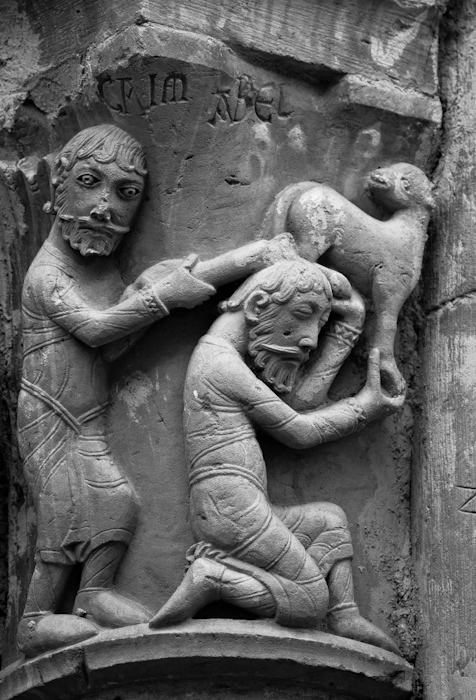
Cain and Abel – the mythical story of the first two children of humanity – in the Book of Genesis (Genesis 4:1-16) is about something that never happened way back when but about what is always happening with us: the inexplicable violence to which humankind turns against itself. It’s about the yawning abyss of violence into which we plunge when we can’t make sense out of life or when things don’t go our way.

Yesterday’s brief post on Via Lucis Photography of Religious Architecture focuses on a capital of Cain and Abel in a Romanesque church.

Photograph by Dennis Aubrey of Via Lucis Photography of Religious Architecture

Photograph by Dennis Aubrey of Via Lucis Photography of Religious Architecture

Like the Genesis writer, the Medieval artist whose hand crafted the story in stone many centuries later was doing theology and anthropology. The biblical author told the story with words; the Medieval sculptor told it with non-verbal communication.

The face of Cain on Via Lucis held my attention long after I’d gone on with the day. It kept returning to mind.

Cain’s head isn’t turned toward Abel whom he is pummeling to death with his stave. He’s looking away from Cain at someone or something else, as if to say the viewer, “So, you think I’m cruel. You think I’m different. You’re looking in the mirror.”

In the biblical story God tells Cain, “sin is crouching at the door; its desire is for you, but you must master it.” The Medieval sculptor’s art seems to be saying it in stone. Cain’s head is cocked, his eyes looking at us. At you. At me.  And, perhaps, at God, to whose failure to rescue Abel he shifts responsibility: “Am I my brother’s keeper?”  The capital seems to say Cain knows he owns us and the endless history of violence in which the blood of the silent victims cries out from the ground, unless and until we – persons, groups, religions, races, cultures, nations, a species – master the sin that’s forever crouching at our door.

  • Gordon C. Stewart, Chaska, MN, October 16, 2015


A prisoner of my own violence

Pope Francis quoted the American Cistercian monk Thomas Merton in his address to Congress.

“I came into the world. Free by nature, in the image of God, I was nevertheless the prisoner of my own violence and my own selfishness, in the image of the world into which I was born. That world was the picture of Hell, full of men like myself, loving God, and yet hating him; born to love him, living instead in fear of hopeless self-contradictory hungers.”

Perhaps Mark had something like that in mind when he attributed to Jesus a grotesque instruction about following in the way of Christ. The images of Mark 9 are ludicrous, violent, grotesque.  Cut off a foot or a hand. Tear out your eye if it causes you to “stumble” — if it causes you to lead a child toward the fire of hell.  It is better to enter the Kingdom of God with one eye than to enter hell with two.

Author Flannery O’Connor seems to have known the genius of these jarring metaphors.

“I use the grotesque the way I do because people are deaf and dumb and need help to see and hear.”

Watching the news of grotesque crimes against humanity, we ask how anyone could behead another human being. How, indeed? And always in the name of God, in the name of righteousness, the children of light against the children of darkness.

Jesus’ words from Mark 9 were read aloud last Sunday in many churches around the world. They are as off-putting now as they were spoken into an earlier violent time, a world that was for Jesus and for Mark what Merton’s was for him: a picture of hell.

But for Jesus, the word we translate “hell” was not a place of divine punishment. It was the name of a place outside of Jerusalem. Paul Nuechterlein writes in last week’s Girardian Reflections:

‘Gehenna’ in Mark’s Greek rendering would have been ‘Ben Hinnom’ in Jesus’ own Hebrew/Aramaic. It’s the valley referred to in Jeremiah 7:30-33:

For the people of Judah have done evil in my sight, says the LORD; they have set their abominations in the house that is called by my name, defiling it. And they go on building the high place of Topheth, which is in the valley of the son of Hinnom, to burn their sons and their daughters in the fire — which I did not command, nor did it come into my mind. Therefore, the days are surely coming, says the LORD, when it will no more be called Topheth, or the valley of the son of Hinnom, but the valley of Slaughter: for they will bury in Topheth until there is no more room. The corpses of this people will be food for the birds of the air, and for the animals of the earth; and no one will frighten them away.

‘Hell,’ ‘Gehenna,’ ‘ben Hinnom’ is the place of human sacred violence that has never even come into God’s mind. It is our violence that we need to fear, not God’s. Jesus is speaking grotesquely of lesser sacrificial violence like cutting off one’s hand, as being better than amped-up sacrificial violence like the child sacrifice of Jeremiah’s day — or the Nazi Holocaust of our day. [bold print added by VFTE]

Self-criticism, prayerful introspection, the opening of one’s own divided heart to Divine judgment and mercy are the stuff of which heaven is made; hell would be when we remain prisoners of our own selfish violence, a place filled with people just like me.

  • Gordon C. Stewart, Chaska, MN, September 28, 2015.

America – In Search of Wisdom

Though we Americans disagree profoundly on many profound matters, we are often united by a deeper conviction regarding good and evil.

Today in America we’re taking sides. Left-Right. Democrat-Republican. Christian-non-christian. Religious-nonreligious. good-evil. All of the splits have something to do with perceptions of the dichotomy of good and evil, the good guys and the bad guys.

Wisdom is always the victim. Wisdom is crucified by the race to goodness. It sits in the middle of dichotomous thinking, a way of life that Danish Philosopher-theologian Soren Kierkegaard (1813-1838), who was anything but a joiner, called double-mindedness.

In the Bible wisdom is personified as female.  In the Book of Proverbs Wisdom is like a concerned mother calling to her children who prefer simpleness to insight:

“You that are simple, turn in here!” To those without sense she says,

“Come, eat of my bread and drink of the wine I have mixed.

“Lay aside immaturity, and live, and walk in the way of insight.” Provers 9:4-6

Wisdom is maternal. Wisdom calls her wayward children – the simple ones — to “turn in here” to her house. “Come, eat of my bread and drink of the wine I have mixed. Wisdom’ children are mature.

Could it be that the beatitude of Jesus “blessed are the pure in heart” is a call to return to Wisdom’s house of insight where the unity of all things is unbroken, instead of a call to simpleness? Simplicity of heart, then, is not simplicity of mind but rather to will one thing only: the goodness of wisdom (unity), as described by D. Anthony Storm‘s comments on  Kierkegaard’s Purity of Heart Is to Will One Thing Only:

God is presented as “simple”. I use this term in the same sense as Aquinas. God is singular of nature, and is not divided or contrary in any way. By this, I do not refer to unitarian versus trinitarian theology, but simply that Kierkegaard sees God as a unity of thought, will, and being. The nature of God is changeless (see The Changelessness of God). Man, on the other hand, is divided by nature. [Italics edited for purposes of emphasis]

Wisdom holds all things together, honoring the unity already present in the nature of reality itself. It seeks the simpleness or singleness with is God, not the simple-mindedness of the warring children of light and darkness, joining the right “side” in a battle of good versus evil. The heart of Wisdom recognizes and celebrates goodness, justice, and truth in whatever venue they appear.

“You that are simple – those without sense, you that are immature – turn in here!”

  • Gordon C. Stewart, Chaska, MN, August 16, 2015


On Hiroshima Day 2015 – Like a Child Piling Blocks

Like a child piling blocks
Your words construct new dreams,
Towering poet.

Gentle and strong, as trees
Bend gracefully in wind,
You stand – and I bow.

One of the great pleasures in life has been the unexpected friendship with Japanese theologian Kosuke Koyama.

Ko, as his friends called him with great affection, and his wife Lois, a native Minnesotan, came to Minneapolis following retirement from a distinguished teaching position at Union Theological Seminary in the City of New York. I knew him only by reputation: John D. Rockefeller, Jr. Professor of World Christianity Emeritus; cutting edge Asian liberation theologian and leader in Thailand, Singapore, New Zealand, and the United States; author of Water Buffalo Theology, No Handle on the Cross, Three Mile an Hour God, Mt. Fuji and Mt. Sinai, among others; pioneer in Buddhist-Christian intersection and inter-religious dialogue; spell-binding keynote speaker at the Fifth Assembly of the World Council of Churches in Nairobi, Kenya.

The friendship that developed, if friendship can be defined to include mentors and those they mentor, great minds and ordinary ones, people of stature and those who look up to them, the wise and the less wise, was particularly impactful because my father had been an Army Air Force Chaplain in the South Pacific in World War II.

During the March, 1945 firebombing of Tokyo, the planes came from my father’s air base. Though my father rarely spoke about the war, there was a certain sullenness that would come over him whenever I would ask him for stories. Now, after my father’s passing, I was learning from Ko what the war had meant to the 15 year-old Japanese boy being baptized in Tokyo while the bombs dropped all around his church.

The pastor who baptized him instructed him. “Kosuke, you are a disciple of Jesus Christ. You must love your neighbors…even the Americans.”

For the rest of his life Ko pursued the daunting question of what neighbor love means. Who is the enemy? Who is the neighbor? Are they one and the same? Late in his life, before he and Lois moved from Minneapolis to live with their son in Massachusetts, he had come to the conclusion that there is only one sin: exceptionalism. At first it struck me as strange. Can one really reduce the meaning and scope of sin to exceptionalism? What is exceptionalism, and why is it sinful?

At the time of our discussion, the phrase “American exceptionalism” – the claim that the United States is exceptional among the nations – was making the news. It was this view that led to the invasions and wars in Afghanistan and Iraq – the unexamined belief that the Afghanis and the Iraqis would welcome us with open arms as liberators – that captured in a phrase the previously largely unspoken popular conviction that America is exceptional.

In this American belligerence Ko heard the latest form of an old claim that had brought such devastation on his people and the people of the world. The voices from the White House, the State Department, and the Department of Defense, though they spoke English, sounded all too familiar, impervious to criticism and restraint on the nation’s military and economic adventures.

Nine years ago today, on Hiroshima Day, 2006 he spoke to a small crowd at the Peace Garden in Minneapolis at the exact hour the bomb incinerated Hiroshima. His voice rang with a quiet authority that only comes from the depths of experience. Here’s an excerpt from that speech:

“During the war (1941-45) the Japanese people were bombarded by the official propaganda that Japan is the divine nation, for the emperor is divine. The word ‘Divine’ was profusely used.This was Japanese wartime ‘dishonest religion’, or shall we call it ‘mendacious theology’? This ‘god-talk’ presented an immature god who spoke only Japanese and was undereducated about other cultures and international relations. Trusting in this parochial god, Japan destroyed itself. “

“Then,he said to make his point to his American listeners, “dear friends, do not trust a god who speaks only English, and has no understanding of Arabic or islamic culture and history. If you follow such a small town god you may be infected with the poison of exceptionalism: ‘I am ok. You are not ok.’ For the last 5,000 years the self-righteous passion of ‘I am ok. You are not ok’ has perpetuated war and destruction. War ’has never been and it will never be’ able to solve international conflicts, says Pope John Paul II.”

Two paragraphs later, Koyama spoke in terms that speak to the policy of drones and other advanced military technology:

“In spite of the remarkable advances humanity has made in science/technological [sic], our moral and spiritual growth has been stunted. Humankind seems addicted to destruction even with nuclear weapons and biological weapons. Today there are 639 million small arms actively present in the world (National Catholic Reporter, June 30, 2006).Fear propaganda always kills Hope. Violence is called sacrifice. Children killed in war are cruelly called a part of the ‘collateral damage’.”

Today, Hiroshima Day, 2015 I wish I could break bread with Ko and my father to discuss the meaning of it all, and share with Dad the haiku poems published in The New York Times following Ko’s death, written in his honor by his colleague at Union, Peggy Shriver, testaments to hope in belligerent times:

Smiling East-West spirit,
You move with sun and Son,
Shining Peace on us.

+++++

Like a child piling blocks
Your words construct new dreams,
Towering poet.

+++++

Gentle and strong, as trees
Bend gracefully in wind,
You stand – and I bow.

  • Gordon C. Stewart, Chaska, MN, August 6, 2015

Our Common Home: Pope Francis and Bernie Sanders

Pope Francis’s Encyclical Laudato Si‘: On Care for Our Common Home has caught the world’s attention. (Scroll down for the Encyclical Letter’s opening paragraphs.)

In our view, Pope Francis and Bill McKibben of 350.org are prophetic figures, i.e., they seem to utter a Word not totally their own. So does Sen. Bernie Sanders (I, VT), who is, not by accident, Bill McKibben’s close friend from Vermont, and the ONLY candidate to place climate change action among the top priorites of his presidential campaign. He speaks boldly, and his message echoes the cry of Luudato Si‘ for action now for the sake of the planet. There is no obfuscation.

“The United States must lead the world in tackling climate change, if we are to make certain that this planet is habitable for our children and grandchildren. We must transform our energy system away from polluting fossil fuels, and towards energy efficiency and sustainability.” – Excerpt from Sen. Bernie Sanders’s campaign priority on Climate Change and the Environment.

Religion, science, and politics each deal with reality, superstition, and obfuscation. The Pope’s call for global action requires political legs to make it walk. Political engagement is not optional at this moment in the history of planetary development. In that regard, no other presidential candidate is so clear on climate change and sustainability as Bernie Sanders. No other candidate speaks with such passionate conviction or knowledge. Pope Francis is a man of God, a modern John the Baptizer appearing in the wilderness, following the lead of Bill McKibben, the scientific consensus, and The Pontifical Academy of Sciences’s research and counsel.

The Pope’s position on nature, born of a more ancient wisdom than the mechanistic “man over nature” view of postindustrial society, is thoroughly catholic, the0logically classical, and steeped in scientific research.  “Man over nature” and “history over nature” are figments of our imagination. Nature always wins. We ARE nature and nature is us.

1. “LAUDATO SI’, mi’ Signore” – “Praise be to you, my Lord”. In the words of this beautiful canticle, Saint Francis of Assisi reminds us that our common home is like a sister with whom we share our life and a beautiful mother who opens her arms to embrace us. “Praise be to you, my Lord, through our Sister, Mother Earth, who sustains and governs us, and who produces various fruit with coloured flowers and herbs”.[1]

2. This sister now cries out to us because of the harm we have inflicted on her by our irresponsible use and abuse of the goods with which God has endowed her. We have come to see ourselves as her lords and masters, entitled to plunder her at will. The violence present in our hearts, wounded by sin, is also reflected in the symptoms of sickness evident in the soil, in the water, in the air and in all forms of life. This is why the earth herself, burdened and laid waste, is among the most abandoned and maltreated of our poor; she “groans in travail” (Rom 8:22). We have forgotten that we ourselves are dust of the earth (cf. Gen 2:7); our very bodies are made up of her elements, we breathe her air and we receive life and refreshment from her waters.

[1] Canticle of the Creatures, in Francis of Assisi: Early Documents, vol. 1, New York-London-Manila, 1999, 113-114.

– Gordon C. Stewart, Chaska, MN. July 28, 2015

Daily Riches: Pimping Religion, Confronting Empire – Part I (Dan Clendenin)

Bill Britton's avatarRicher By Far

“Amos wrote 2,800 years ago, but his prophecy reads like today’s newspaper. He lived under king Jeroboam [whose] kingdom was characterized by territorial expansion, aggressive militarism, and unprecedented economic prosperity. Times were good. Or so people thought. The people of the day interpreted their good fortune as God’s favor. Amos says that the people were intensely and sincerely religious. But theirs was a privatized religion of personal benefit. They ignored the poor, the widow, the alien, and the orphan. …Making things worse, Israel’s religious leaders sanctioned the political and economic status quo. They pimped their religion for Jeroboam’s empire. Enter Amos. Amos preached from the pessimistic and unpatriotic fringe. He was blue collar … neither a prophet nor even the son of a prophet in the professional sense of the term. Amos was a shepherd, a farmer, and a tender of fig trees. He was a small town boy who…

View original post 314 more words

When Religion Becomes Sinful

Mark H Miller's avatarMark H. Miller's Blog

My clergy colleague, Mike Murray, recommended a new book that builds bridges between right and left-wingers, between those who are conservative/fundamentalist and liberal/progressives. Have started it, The Righteous Mind by Jonathan Haidt.

But was interrupted this morning when reading a Huffington Post article about someone with whom I have next to nothing in common theologically, Evangelist Pat Robertson. I’m pretty sure a bridge between the two of can never be built—especially on his version of the purpose for God to kill children. Even the more general indictment that God “kills children.”

I’m pretty sure clergy, no matter their tilt theologically, would find it reprehensible that “God takes the life of a child.” Yes, I’ve had grieving parents and relatives tell me about a young girl’s death, “God needs her for God’s Children’s Choir in heaven.” Or, “All death is God’s Will.” Or, “This is the fault of the parents for…

View original post 455 more words

The Paradox of Pentecost — Presence and Absence

A stranger than strange text for today’s Feast of Pentecost, the day the Church celebrates the coming of the Spirit, the Advocate, reads:

“I tell you the truth: it is to your advantage that I go away, for if I do not go away, the Advocate will not come to you…” [Gospel according to John 16:7].

It is Jesus in John’s Gospel who speaks these words to his disciples. They scratch their heads, like confused children being dropped off at camp against their will. They already sense the homesickness that will come. The thought of being abandoned brings anguish, the foreboding of oncoming forlornness.

The experience of absence, endemic to the human condition, is essential to faith. The feeling of anguished forlornness builds courage, and faith, of one sort or another, with or without an advocate.

Enter Jean-Paul Sartre’s reflections on anguish and forlornness. Fully conscious without religious crutches, I experience the anguish of my responsibility for myself and others, and the forlornness that realizes that I am alone in my decision-making. The decisions are mine along. No one but I am responsible.

Like the disciples, we want it to be otherwise. Some of us pray as though the feelings were a hoax, the Devil’s trickery or God’s pre-ordaining, as though our course were charted by another decision-maker disbelieved by Sartre. But regardless of our faith or faith denials, the truth is that to be human is to know this sense of anguish and forlornness.

Dietrich Bonhoeffer, the brilliant theologian imprisoned and executed by the Third Reich, caught the sense of it in a letter he wrote from a prison cell.

“The only way to be honest is to recognize that we have to live in the world etsi deus non daretur. And this is just what we do see — before God! So our coming of age forces us to a true recognition of our situation visa a vis God. God is teaching us that we must live as [people] who can get along very well without him. The God who is with us is the God who forsakes us (Mark 15:34). God who makes us live in the world without using him as a working hypothesis is the God before whom we are ever standing. Before God and with him we live without God. God allows himself to be edged out of the world and onto the cross. God is weak and powerless in the world, which is exactly the way, the only way, in which he can be with us and help us. Mark 8:17 makes it crystal clear that it is not by his omnipotence that Christ helps us, but by his weakness and his suffering.” [Dietrich Bonhoeffer, Letters and Papers from Prison, pp 219-220, McMillan Company, 1953, translated from German by Reginald H. Fuller.]

Bonhoeffer’s writing acknowledges the anguish and forlornness that precede the disappearance of the divine usurper of human freedom and responsibility. In place of the bad-faith God who keeps her children in diapers, there comes the advantage of Christ’s going away — the arrival of the Advocate who brings the unexpected joy of coming of age.

“I tell you the truth: it is to your advantage that I go away, for if I do not go away, the Advocate will not come to you; but if I go, I will send him to you” [Gospel according to John 16:7].

– Gordon C. Stewart, Chaska, MN, May 24, 2015 – Feast of Pentecost.