“I don’t know that I’m right”

Marcus Borg‘s answer to the question “How do you know you’re right?” is spot on.

“I don’t. I don’t know that I ‘m right.”

Barkley Thompson reports the exchange in yesterday’s posting on God in the Midst of the City following Dr. Borg’s deathre-posted today on Views from the Edge as “Tribute to Marcus Borg (1942-2015)”.

I never met Marcus Borg. I wish I had. We were born in 1942 within a few months of each other. You might say we grew up next door to each other in different towns. There’s something about time that situates people in the same location, asking the same or similar questions, searching the same search, vexed, in our case, by the early horrors of World War II, German concentration camps, the Holocaust, and the American bombings of Hiroshima and Nagasaki. As children of faith we grew up asking how we could square a loving God with the stacked bodies of Auschwitz and Hiroshima, the economic disparities of poverty and injustice of racial segregation.  As happened to a lesser extent with some of his peers, Marcus developed a theology and Christology that rose out of these compelling questions about the real world that had shaped him, and the irrepressable hope for something better that drove him deeper and wider as he grew older and wiser.

Marcus’s humble response to the questioner who asked how he knew he was right -“I don’t know. I don’t know that I’m right” – is one for the ages. If only we could clone it to create a humbler humanity of neighborliness across all the terror our world is making, we might fetch the blessing from the curse of absolute religious certainty.

“God’s dream for us is not simply peace of mind, but peace on earth.”- Marcus J.Borg & John Dominic Crossan, The First Christmas, 2007, HarperOne.

– Gordon C. Stewart, Chaska, MN, January 22, 2015


Tribute to Marcus Borg (1942 – 2015)

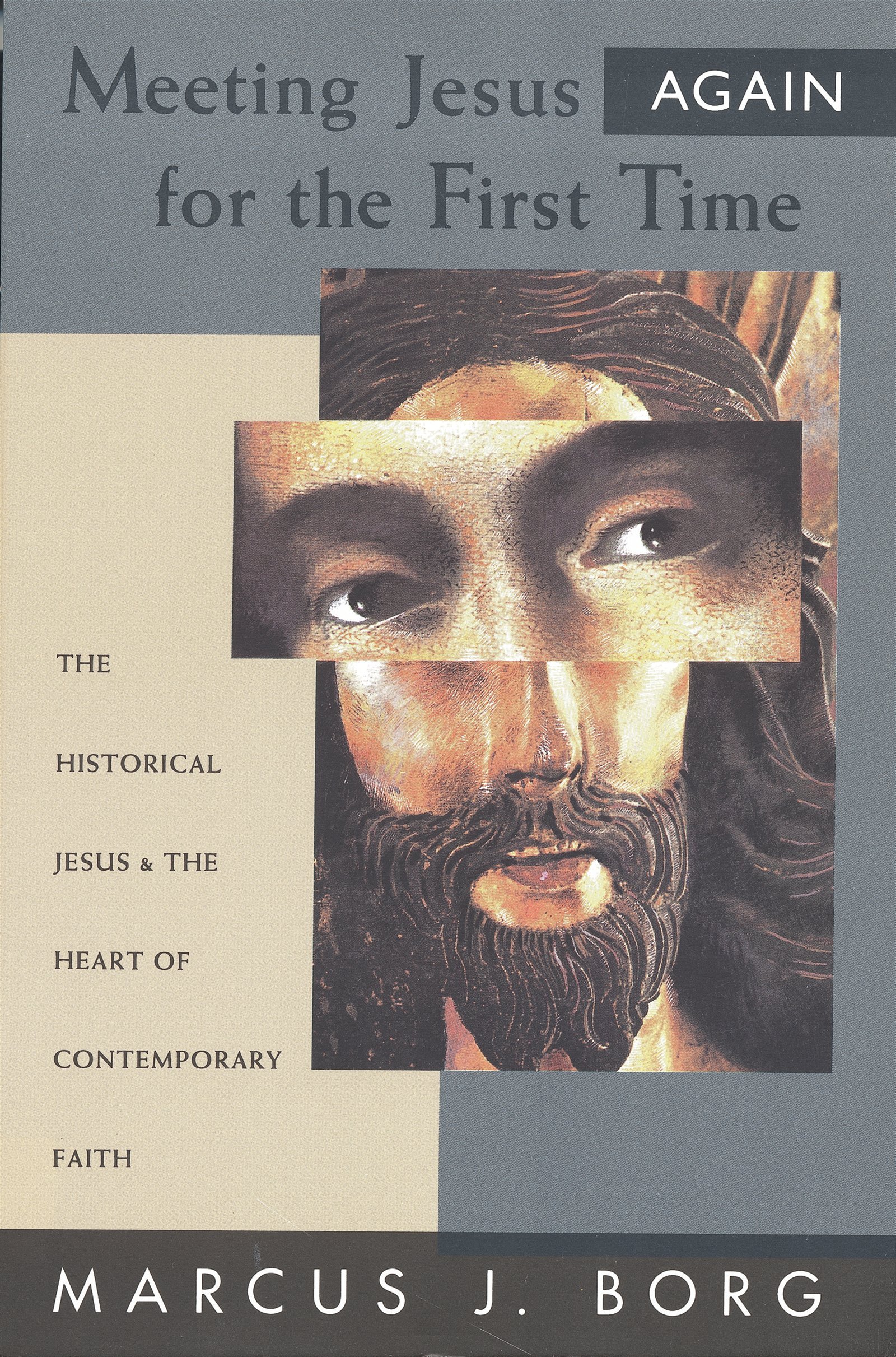
Cover of Marcus Borg book

Cover of Marcus Borg book

Marcus Borg’s writing and teaching affected millions.  Steve Shoemaker received an email of Marcus’s death yesterday from Barkley Thompson, who had quickly writtten the following tribute to Marcus on his blog “God in the Midst of the City“.

My friend, Marcus Borg
WEDNESDAY, JANUARY 21, 2015 / THE VERY REVEREND BARKLEY THOMPSON

Marcus Borg died this morning after a prolonged illness. I received a phone call this afternoon from a Cathedral parishioner and friend of Marcus, relaying the news to me.

I first became aware of Marcus Borg when I was a sophomore at Hendrix College. His landmark book, Jesus: A New Vision had just been released. It hit me at exactly the right time. I was a philosophy & religion major who knew God and increasingly knew about God, but I had little room or need for Jesus. Marcus’ book gave me an entirely new access point: to consider Jesus as Jesus had been historically, as a wisdom teacher, a healer, a social prophet, and more.

Marcus Borg

Marcus Borg

I first heard Marcus speak at Hendrix. He was the epitome of a college professor, right down to the cardigan sweater and pipe. He spoke calmly and with passion, and the first time I heard him in person was also the first time I understood how those tho things–calm and passion–could coincide.

I heard Marcus speak several other times over the years, but it was after I’d become a priest that I came to know him personally. When he was the annual Dodson Lecturer at St. John’s-Roanoke, he and I went to dinner. I was starstruck and wanted to quiz him about his research and his approach to Christianity. He’d have none of it. Marcus wanted only to talk about me, about St. John’s, about our ministry, and about my experience as a young priest in the Episcopal Church. He was solely interested in me, and I’ve never forgotten it.

Several shared meals and opportunities for fellowship later, my Christology has become higher and higher as the years have gone by. In ways I could not have done all those years ago in college, I now attest without hesitation that Jesus the Christ is God Incarnate, the hinge of history, the defeater of death, and the fulfillment in a single human life of God’s hopes for the whole world. And yet, my approach to Holy Scripture, my social convictions, and my love for the Episcopal Church mirror Marcus’ own perspectives quite closely. I once introduced Marcus to a church audience by saying, “I agree with roughly 75% of what Marcus will say to you this evening.” When he stepped into the pulpit, Marcus quipped, “I’m tempted to forego my notes and discuss with Barkley the other 25%!”

Unlike so many other writers in the field of religion (on both ends of the spectrum), Marcus was humble. Once one of my parishioners asked him during Q&A, “But how do you know that you’re right?” He paused, looked at her thoughtfully, and said, “I don’t know. I don’t know that I’m right.”

Very many people who had left the Christian faith have returned to it through Marcus’ evangelism (though he would grimace at my use of the word, I suspect). Marcus was a Christian, a follower of Jesus Christ in word and in deed. He understood Jesus (and especially the Resurrection) differently than I do. But the veracity of his faith was clear. And calm. And passionate.

Marcus and I last corresponded in late November. I’d asked how he was doing, and he responded, “I may have ten years left. Not sure I want more. There comes a time to let go. And I could, with gratitude, sooner than that. My life has been very blessed.”

Like Abraham, Marcus was blessed so that he could be a blessing. He blessed my life, and I am grateful.

NOTE: Since February 2013, Barkley serves as the eighth dean and twentieth rector of historic Christ Church Cathedral in Houston, Texas.  Click HERE for more information about the him.


God wounded in Paris

Today’s news from Paris is chilling. Still reeling from the Charlie Hebdo attack, hostages are taken in a Kosher (Jewish) market in Paris. Fear of extremist Islamic terrorism spreads across France.

During a gathering of twelve of us at The Reformed Roundtable in Indianapolis two days ago, South African anti-Apartheid leader  the Rev. Dr. Allan Boesak quoted none other than John Calvin, according to whom whenever a human being wounds another, God is wounded.

The killers and hostage-takers in Paris claim the name of Allah. Their abuse of the name is an affront to faithful Muslims who reject violence and terror as much as adherents of Judaism, Christianity, Hinduism, and Buddhism. Religion itself, whatever its form and doctrine, is to be measured by its compassion.

Events in Paris remind me of Dr. Boesak’s statement and the Very Rev. James A. Whyte‘s sermon at the January 9, 1989 memorial service after Pan Am flight 103 carrying 259 passengers exploded over Lockerbie December 22, 1988. Eleven more were killed on the ground in the small town of Lockerbie.  The Church of Scotland reluctantly called it’s Moderator, James Whyte, out of mourning his wife’s death for his to preach at the memorial service for the victims of the terror at Lockerbie.

In that sermon he proposed a vexing answer to the vexing question: Where was God when the plane went down? “God,” he said, “was on the plane.” 

“Justice, yes; retaliation no,” he declared. “For if we move in the way of retaliation we move right outside of the fellowship of Christ’s suffering, outside of the Divine consolation. There is nothing that way but bitterness and the destruction of our own humanity.”

Four hundred years after Calvin’s statement and decades before James Whyte’s sermon at Lockerbie, Dietrich Bonhoeffer wrote the following from his prison cell before he was hanged by the Nazi’s whose “God” was without compassion. Bonhoeffer wrote as a disciple of Jesus, the Crucified, but his picture of God as suffering and the call to stand with God in God’s suffering int he world of human cruelty represents the compassionate faith shared by compassionate people of every stripe.

Christians range themselves with God in his suffering; that is what distinguishes them…. As Jesus asked in Gethsemane, “Could ye not watch with me one hour?” That is the exact opposite of what the religious man expects from God. Man is challenged to participate in the sufferings of God at the hands of a godless world. He must therefore plunge himself into the life of a godless world, without attempting to gloss over its ungodliness with a veneer of religion or try to transfigure it. He must live a ‘worldly” life and so participate in the suffering of God. He may live a worldly life as one emancipated from all false religions and obligations. To be a Christian does not mean to be religious in a particular way, to cultivate some particular form of asceticism (as a sinner, a penitent or a saint), but to he a man. It is not some religious act which makes a Christian what he is, but participation in the suffering of God in the life of the world.  [Bolded type added]

Dietrich Bonhoeffer, Letters and Papers from Prison

Today God is wounded again…in Paris, and we participate in the suffering of God at the hands of a cruel world.


God as Policeman or Lover

Sebastian Moore, OSB

Sebastian Moore, OSB

In the eyes of Views from the Edge, the  late Dom Sebastian Moore, O.S.B. (12.17.1917 – 02.21-2014) of Downside Abbey, England, is one of our time’s more interesting thinkers.

Steeped in the psychology of Carl Jung, the spiritual discipline of the Benedictine Order, the theology of Bernard Lonergan, S.J., and the mimetic theory of Rene Girard, his eyes were penetrating, his vision both deep and far-reaching. During a long life os spiritual searching, he wrote in his book The Inner Loneliness:

[O]nce you see the self as naturally self-centered, you deny that the self wants God above all things, and you degrade God from being the fulfiller, the lover, into being the policeman. Paul’s conversion, through the stunning vision of Jesus he had on the road to Damascus, was from God the policeman to God the lover.

[The Inner Loneliness, Crossroads Press, 1982, p.49]

We met briefly in 1971 at a meeting of campus ministers in Milwaukee. He was chaplain at Marquette University at the same time I served as campus minister at the University of Wisconsin-Whitewater. Gathered at the Episcopal Campus Ministry Center at UW-Milwaukee, I wondered who this strange monk was who seemed to observe everyone very closely without saying more than a word or two. I’m not sure I even knew his name. I just knew he was unusual.

Twenty-six years later, during a period of personal and professional turmoil, a therapist mentioned the name Sebastian Moore. I purchased The Crucified Jesus Is No Stranger and saw his picture on the jacket. His perspective left me in awe and anchors me still. I’ve been knocked off my horse on the way to way to Damascus. Every real conversion is the turning from God the policeman to God the Lover.

The Angel Gabriel and Mary

A sermonic reflection for the Fourth Sunday of Advent, Dec. 21, 2014, Gordon C. Stewart.

Text: Luke 1:26-38

The Annunciation {El Greco]

The Annunciation {El Greco]

Mary has every reason to fear the appearance of Gabriel. Every demure depiction to the contrary, the Angel Gabriel’s “annunciation” to Mary is no private affair. It’s a public matter of the first order. Gabriel  is the archangel commissioned to destroy the offspring of the rebellious angels and human women. (see below). Mary shrinks back.

“Do not be afraid,” says Gabriel.

Why should she not be afraid? This is not just any angel.

This is the Angel Gabriel, whose trumpet will summon the people, sweep away the occupation forces that substitute their rule for the Kingdom of love and delight. This is an angel of revolution. The Archangel of conflict who inspires both hope and fear.

”Do not be afraid!”

El Greco’s painting of the Annunciation illustrates the problem of textual interpretation.
Gabriel’s appearance is not frightening. It’s very…how shall we say? Feminine. Even to the point of appearing perhaps pregnant himself. The great masters did not paint an angel messenger as male, even when his name is Gabriel or Michael, the only two angels named in Holy Scripture.

Gabriel in Hebrew means “God is my Warrior”. Gabriel is a warrior angel, announcing to Mary that she too is to become a warrior, a mother whose birth-giving will lead to conflict with the Empire and the religious authorities who collaborate with it.

As described by New Testament scholar Carol Newsom, any annunciation by Gabriel inspires fear.

In the Book of Daniel, Gabriel is preeminently an angel of eschatological revelation. He is sent to Daniel to explain a vision of ‘the time appointed for the end’ (Dan. 8:15-26)…. Gabriel’s functions are more varied in I Enoch. In the Book of the Watchers (I Enoch 1- 36) he is listed as ‘the one of the holy angels who is in charge of paradise and the dragons and the cherubim (20:2). He is commissioned to destroy the offspring of the rebellious angels and human women (10:9-10)….

In the War Scrolls from Qumran (IQM) the names of 4 archangels, Michael, Gabriel, Sariel, and Raphael, are written on the shields of the 4 towers of the army. The positioning of the 4 archangels around the throne of God or other sacred space has a long subsequent history in both Jewish and Christian tradition…. [Carol Newsom, “Gabriel.” The Anchor Bible Dictionary, Vol. 2]

So why does Gabriel look the way he does in the art museums and literature of Christian interpretation? Why does the original Gabriel look so benign? And why does Mary look so calm, perhaps even demure, as in El Greco’s Annunciation?

The Jesus story has been neutered. The End Time has been re-interpreted by the Constantinian Church as a paradise beyond time, a state of afterlife, not this life. In no way political. In no way economic. In no way conflictual. Peaceful. Serene. Calm. Quiet Passive. “Let it be to me according to your word.” Never disquieting. Never disrupting. Never revolutionary.

Gabriel has been transformed, neutered, emasculated, rendered harmless by the Constantine religion whose adherents can no longer see the conflict between Christ, or his mother, Mary, and his father, Joseph, with the systems of unbridled greed and poverty under which they live. The Gabriel spoken of in most pulpits is not the Angel Gabriel that came to Mary.

We’ve turned Gabriel into our own image. But though we may tame him in our hearts and minds, our paintings and our sermons, we can erase neither the need to be afraid nor his invitation to fear not. Gabriel’s finger points at us, asking whether we will rally to the trumpet sound, the sound of his coming. We can repaint the young girl Mary as an icon of passive obedience and tranquility. But it will be a different Mary than the courageous one painted by the Gospel of Luke.

Luke and his Mary know that “Do not be afraid!” makes no sense unless there really is something to fear, and that we cannot overcome fear unless we hear Gabriel’s word of favor, “Hail, O favored one! The LORD is with you. Blessed are you among women…You shall conceive….”Do not be afraid…. For with God nothing will be impossible.”

“Then Mary said, ‘Here am I, the servant of the Lord; let it be to me according to your word.’

“Then the angel departed from her” for parts unknown to make his visits down through the ages, making the impossible possible.  Word has it he appeared last week in Washington, D.C. and Havana, Cuba to turn the impossible into the possible, a new Order being born from the old.

If you listen with faith, you might hear him. If you look, you will see him.


In the Footsteps of Mary

A sermonic reflection on America today, Dec. 14, 2014.

Today’s texts speak indirectly to the national outrage over the deaths in Ferguson, Cleveland, and Staten Island and to the larger context of the economic Law – Capitalism – under which they’ve taken place.

The Spirit falls upon Isaiah

…to provide for those who mourn in Zion– to give them a garland instead of ashes, the oil of gladness instead of mourning, the mantle of praise instead of a faint spirit….They shall build up the ancient ruins, they shall raise up the former devastations; they shall repair the ruined cities, the devastations of many generations. (Is. 61:2-4)

I am in mourning. Even in the midst of Zion. Though I already taste the fruit of the Kingdom of God which is yet to come in fullness, I am in mourning. In ashes. Faint in spirit. Living among the ancient ruins, the former devastations, the ruined cities, the devastations brought on by many generations including my own.

There is anger out there. Lots of it. There are calls for justice out there. There are “die-ins” on Interstate Highways blocking traffic, interrupting business as usual. And it’s good. It’s right. It’s an American thing to do.

But, like most movements, this one will pass in a few weeks or maybe months. It will go the way of Occupy Wall Street.

For while protesters were were being hand-cuffed for “die-ins”, Congress was taking the hand-cuffs off Wall Street and the “too-big-to-fail” banks. The Dodd-Frank restrictions enacted following the 2008 meltdown were being quietly removed by hidden-away paragraphs in the down-to-the-wire spending bill. There will be no more hand-cuffs. No more probation. No more accountability to the American people. The legal limits on dealing in the “derivatives” market were being deleted on Capitol Hill, and, perhaps worse, the Dodd-Frank provision prohibiting a second government bailout was replaced by a commitment to bail them out again.

While on Capitol Hill the Law was being re-written to deliver automatic bail to Wall Street, individuals protesting law enforcement tyranny on the streets were hauled off to jail hoping a friend would bail them out.

Only within the larger economic puzzle do the various pieces begin to make sense.

For all of America’s national wealth, we are among the poorest of nations. We are a classist society bordering on a caste society. Class has always been the issue in America. Race and class have always gone hand-in-hand, but classism has other hands as well.

The wider context surrounding the law enforcement racial divide is the classism embedded in a global capitalist economic structure.

We are living still amid the “ancient” devastations brought on by rich white slave traders who captured Africans like animals for a zoo to work their plantations for profit. Racism is a class issue, an ownership issue, an issue of economic privilege, before it is anything else. The coupling of race and class is as clear now as it ever was, despite the Civil Rights Movement and the election of America’s first African American president.

Capitalism is the issue. The accumulation of wealth. The increasing concentration of wealth. The hoarding of wealth. Wealth disparity, power disparity, racial disparity, electoral disparity, legal disparity; what’s enforced and what’s not; who’s in handcuffs and who’s not; who’s bailed out and who’s not; who’s charged and who isn’t; who’s in prison for what and who’s not; who’s on probation or parole and who’s not; who’s elected to Congress and who’s not; who owns what and who doesn’t; who can pay for an election and who can’t – are all about class, the control of the means of production and capital and the expropriation of cheap labor and natural resources that can’t talk back.

Enter now into this world the psalmist of today’s readings who dared to dream of a great reversal of fortunes:

When the LORD restored the fortunes of Zion, we were like those who dream.

Then our mouth was filled with laughter, and our tongue with shouts of joy; then it was said among the nations, “The LORD has done great things for them.”

“The LORD has done great things for us, and we rejoiced.

Restore our fortunes, O LORD, like the watercourses in the Negeb.

May those who sow in tears reap with shouts of joy.

Those who go out weeping, bearing the seed for sowing, shall come home with shouts of joy, carrying their sheaves.”[Psalm 126:1-6]

The tears of weeping bear the seeds for sowing and reaping of the sheaves of the new economic order. It is no accident that the psalmist mixes the metaphors of weeping, seeds, sowing, and shouts of joy, and sheaves. It is, as it were, a vision for the Earth itself. Honest weeping is the beginning – the sowing – that leads to earthly transformation and shouts of joy.

Mary, the newly pregnant peasant girl, becomes the representative, singing her song amid the ancient devastations, announcing the hope that will engage the powers of class “to provide for those who mourn” [Is.61:1]:

My soul magnifies the Lord, and my spirit rejoices in God my Savior, for he has looked with favor on the lowliness of his servant. Surely, from now on all generations will call me blessed; for the Mighty One has done great things for me, and holy is his name. His mercy is for those who fear him from generation to generation. He has shown strength with his arm; he has scattered the proud in the thoughts of their hearts. He has brought down the powerful from their thrones, and lifted up the lowly; he has filled the hungry with good things, and sent the rich away empty. He has helped his servant Israel, in remembrance of his mercy, according to the promise he made to our ancestors, to Abraham and to his descendants forever.” [Luke 1:46b-55]

Put differently by Philip Clayton, Ingraham Professor of Theology at Claremont School of Theology, we are living

“…at the dawn of a new form of human civilization. Individuals, societies, and nations are now deciding whether to keep fighting to preserve the dying order, or whether to take leadership in building the new. It’s not a matter of waiting for more data; we already know what the old practices are doing to our planet, and we know what it takes to build a global society that is socially, economically, and environmentally sustainable. The ones who make the greatest difference are those who work and live with wisdom, with diplomacy, and with restraint, placing the good of the whole planet first.” [Philip Clayton and Justin Heinzekehr, Organic Marxism: An Alternative to Capitalism and Ecological Catastrophe, Process Century Press, 2014]

I’m still mourning. But I feel better. I know that the mourning is a holy thing, the hint of a coming “garland instead of ashes, the oil of gladness instead of mourning, the mantle of praise instead of a faint spirit” and so, I write. I pray. I sing. I mourn to the tune of Isaiah. I march to the dream of the Psalmist. I walk in the footsteps of Mary.

– Rev. Gordon C. Stewart, Honorably Retired, Views from the Edge, Third Sunday of Advent, Dec. 14, 2014.

Good News and Hard News – Nature and Capitalism

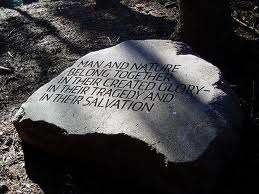
Paul Tillich quote in Tillich Park, New Harmony, IN: "Man and nature belong together in their created glory - in their tragedy and in their salvation."

Paul Tillich quote in Tillich Park, New Harmony, IN: “Man and nature belong together in their created glory – in their tragedy and in their salvation.”

A spiritual reflection for the Second Sunday of Advent, December 7, 2014.

The beginning of the GOOD news is HARD news, according to John the Baptist, calling people out into the wilderness. “We must change,” he said.  “Repent” by which the Judeo-Christian tradition means a 180 degree turn. “About face!” Only by turning will we be delivered from the consequences of the actions that have led us here.

For John the Baptist and the writer of the Gospel of Mark’s opening paragraph (Mark 1:1-8) the system at issue was Roman imperialism, an economic system centered in Rome, expanding out, and enforced by, military invasions, subjugation, religious tolerance (so long as the religious practice did not interfere with Roman prerogatives) and occupation.

One could repeat the sentence in 2014 with little change: “the system at issue [is [American] imperialism, an economic system centered in [Washington] expanding out, and enforced by, military invasions, subjugation, religious tolerance (so long as the local religious practice [does] not interfere with [American] prerogatives) and occupation.”

It is our spiritual, moral, economic, cultural and political captivity to a global system that cannot satisfy our real needs or the world’s that produces a longing in our hearts, a readiness to make the lonely trip to the wilderness.

We’re a weary people in 2014. Wearied and still disheartened 11 years after the “Shock and Awe” that took down Saddam Hussein on the pretense that he had weapons of mass destruction (WMDs) that threatened us, the Administration’s manufactured association of Saddam Hussein as the cause of 9/11. We’re wearied of lies and misrepresentations. Weary from budget fights that barely reference 10 years of un-budgeted military expenses, the loss of thousands of American soldiers’ lives and as many as 100,000 Iraqi civilians, a military venture undertaken on the assumption that the Iraqi people would welcome our presence as the beginning of democracy and a “free market” economy that would lift them all up.

That belief in the goodness of American intentions hit the rocks as quickly as Saddam’s statue hit the pavement in Baghdad. All the while we were wearied by the earlier invasion of Afghanistan, whose original justification was a quick elimination Osama bin Ladin and Al-Qaida untempered by realistic knowledge of the long history of the military interventions that mired the invaders in quagmires such as the Soviet Union found itself before leaving in defeat. To the Afghans it didn’t matter whether the troops were Soviet or American. They were the same. They were the occupation forces of an imperial power destined to fail.

In the midst of the weariness about what was happening abroad, the financial system at home took the American economy to the brink of disaster in 2008. Occupy Wall Street rose to the top of the news cycles. Although the movement fizzled over time, as such movements inevitably do, it caught the attention of television viewers, internet surfers, and newspaper and magazine readers. Occupy Wall Street and the spot light it placed on “crony capitalism” became a hot topic around water coolers at work and the table in the coffee shops.

For the first time in recent memory, capitalism was no longer sacred, no longer off limits. Time’s front cover asked the question whether Capitalism was dead. But, as with Occupy, public attention is short-lived. Amnesia sets in when people are weary. How soon we forget…until some new John the Baptist issues the cry for a 180 degree turn for the sake of something better.

Maybe Naomi Klein is edition of John the Baptist. This Changes Everything: Capitalism vs. the Climate, reviewed by the New York Times – places the over-riding systemic issue squarely before the general public again. Senator Bernie Sanders, America’s only socialist Senator who names climate action as among his four top priorities, is gaining attention as a possible presidential candidate. Elizabeth Warren, the Senate’s bulldog on holding Wall Street accountable is creating a wave of populist momentum. Put them with Bill McKibbon and 350.org and you begin to hear the echo of John’s all to the hard truth that is the beginning of the good news.

The hard truth that precedes good news is the discovery of the myth that has coupled democracy with capitalism in the American psyche, while demonizing socialism as democracy’s opposite. Ideological blinders are to nations and peoples what blinders are to horses on a race track: they limit vision to the straight-ahead narrow limits of the track. Ideological blinders prevent the owners’ horses from thoughts of anything but the track on which they’ve been placed to race each other.

But when the climate is changing our track in ways that compel our attention, and when we ask how we will make it through the changes together, the bigger question of the economic system – the race track itself – comes into view by virtue of necessity. It calls us off the track into the wilderness of Nature.

The words ‘economy’ and ‘economics’ derive from the Greek words for ‘house’ and ‘the management of the household’.  Economics not about markets, free or otherwise, or about the technicians and pundits who monitor investments and predict quarterly outcomes. It is not an academic discipline, the exclusive province of experts on Wall Street or in university Economics departments who understand how the free market works.

Economics is a spiritual perspective like the one on Paul Tillich’s marker in Tillich Park in New Harmony, Indiana. “Man and nature,” he said, “belong together in their created glory – in their tragedy and in their salvation.” There is no humanity with nature; the human calling of our time is to reshape our lives for the wellbeing of the one house in which all life lives.

During this Advent season of longing expectation, John the Baptist with his axe aimed at the root of the tree reminds us that economics is the spiritual issue of the first order. The good news is what the Hebrew Bible calls “the Day of the Lord” and John the Baptist and Jesus of Nazareth called “The Kingdom [i.e. Society] of God”. The hard news is we’ve been running on the wrong track, or, you might say, barking up the wrong tree.

The planet – this home we call “nature”, without which no person, society or form of life exists – is an economy that requires different management. The economy for which our hearts long is the one house imagined by the psalmist and announced by John in the wilderness beyond the Pax Romana: the good news awaiting our longing hearts to embrace it, a planetary home where “righteousness and peace will kiss each other” (Psalm 85:10) and wars will be no more.

The beginning of the GOOD news is HARD news. “Repent, for the kingdom of heaven is at hand.”

– Gordon C. Stewart, Chaska, MN, December 7, 2014

The Reign of Christ

I’ve often wondered
why he included
me

in parables of goat
and sheep, of tare and
wheat

of a woman on a floor
to find her one
lost coin

of a manly crowd
with stones to throw at
“her”

of ramming rams and
bleating ewes and one
little lamb

of pride and loathing
of specks and logs in
eyes

of sight and light
of day and sleepless
nights

of father running to
greet his son from
empty sty

of water and wine
and miracles that healed
the sick and

called forth Lazarus
from the tomb, unwrapping
him and me

– GCS, Nov. 24, 2014 – early Monday morning the day following Christ the King (Reign of Christ) Sunday.

Sheep and Goats

Being without a pulpit doesn’t stop the yearning for study and communication. Today Dean Seal stood for the first time in the pulpit where I once stood. I rejoice with Dean and the dear people of Shepherd of the Hill as they begin this new ministry together.

But I also sense the loss of the community that has been Kay and my home for the past eight and a half years. So I do what I have always done. I look at the texts for the day, ponder their meaning, and write about them.

The Hebrew Bible text for today – the last Sunday in the Christian liturgical calendar, “the Reign of Christ” Sunday – is from Ezekiel 34. It reads, in part:

I myself  [i.e. God] will be the shepherd of my sheep, and I will make them lie down, says the Lord GOD.

I will seek the lost, and I will bring back the strayed, and I will bind up the injured, and I will strengthen the weak, but the fat and the strong I will destroy. I will feed them with justice.

Therefore, thus says the Lord GOD to them: I myself will judge between the fat sheep and the lean sheep.

Because you pushed with flank and shoulder, and butted at all the weak animals with your horns until you scattered them far and wide,

I will save my flock, and they shall no longer be ravaged; and I will judge between sheep and sheep.


– Ezekiel 34:15-22

Ezekiel is spoken to the exiles, the aliens in a strange land – you might call them “immigrants” or “exiles” or “refugees”. Or “undocumented workers” who labor for peanuts without the protection of the law.

Ezekiel’s 34th chapter looks to David, the leader of the nation, to be God’s agent to rescue them. Or maybe, in our time, a distant relative named Barack.

During the time I worked outside the church at the Legal Rights Center in Minneapolis, a group of undocumented workers came to the Center. The Hispanic/Latino Community Advocate had identified their need and had convinced them that the LRC was a safe place to bring their case.

Six Mexican “employees” of a cleaning service that sub-contracted for janitorial services at the Mall of America in Bloomington, Minnesota had not received their wages for the past six weeks. The company knew their workers had no recourse. The law was against them; deportation was always one step away. The employer was confident in its privileged position. Those who withheld their wages had not yet read Ezekiel’s proclamation: “I will seek the lost, and I will bring back the strayed, and I will bind up the injured, and I will strengthen the weak, but the fat and the strong I will destroy. I will feed them with justice.”

It took one phone call to the employer to get these men the wages they and their families had been wrongfully denied.

Let those who oppose Immigration reform legislation in the United States of America read Ezekiel, or sit in on the conversation at the Legal Rights Center. Then let them think again about President Obama’s compassionate speech on immigration policy reform and pass the bipartisan bill languishing the House of Representatives.


The President’s Speech

President Obama rang the bell last night in his speech on immigration. The President is a Constitutional lawyer. He is also a man of faith, a thoughtful Christian who interprets the Bible the way Abraham Lincoln did, and, like Lincoln before him, the President preached to a divided nation from the White House.

He used the bully pulpit to stop the bullying.

“Scripture tells us, we shall not oppress a stranger, for we know the heart of a stranger — we were strangers once, too. My fellow Americans, we are and always will be a nation of immigrants. We were strangers once, too.”

This morning Speaker of the House John Boehner, who for the past year-and-a-half has personally blocked a vote in the House on the bipartisan Senate immigration reform bill, filed a lawsuit, alleging the President has exceeded his authority. Mr. Boehner and others also threaten impeachment.

Very few of us understand the Constitutional separation of powers well enough to assess knowledgeably whether the President has or has not exceeded his executive authority, but given similar actions by every recent President, both Democrat and Republican, the Las Vegas odds-makers would surely lay heavy odds in favor of the Constitutional lawyer in the White House.

Catholic, Protestant, Jewish, Muslim and secular humanist leaders have led the fight for immigration reform for many years. They have commended the President’s actions and have renewed the call for Congress to pass bipartisan reform.

Because they’re not bomb-throwing religious extremists, there likely will be little media coverage of these religious leaders support for the President’s speech and actions. Like Mr. Obama, their faith, and the faith of the people and congregations they represent, are thoughtful and fairly quiet in demeanor. They don’t make headlines. But once in a while, one of gets to preach from the White House.

In the habit of some preachers who invite response from the pews following prayers or a sermon, “Let all the people say ‘Amen!’