Thanks to Dennis Aubrey of Via Lucis for sharing Heinrich Schutz’s rendering of David’s lament, “My son, Absalom!” in response to “Holy Tears: David, Absalom…and Us” posted here on Views from the Edge this morning.
A sermon inspired by the personal story of a king who was losing it and his son, Absalom, leading to the larger question of how we define abundance in our time. If you can get by the first minute and have the time – it’s dreadfully long 🙂 it might be of interest. Please let me know your responses to the last part of the sermon re-defining the idea of abundance.
There’s a sermon on Cable Mountain waiting to be preached.
The View from St. Timothy’s Memorial Chapel
Southern Cross, Montana is a ghost town, a former mining community on Cable Mountain west of Anaconda. It’s also the site of St. Timothy’s Memorial Chapel, a tribute to the glory of God in loving memory of Timothy Dillon Bowman, the 18-year-old son who died tragically in a car accident following his freshman year at Stanford.
St. Timothy’s Memorial Chapel, Southern Cross, MT
Amid the abandoned buildings of the Anaconda Mining Company, one might say that St. Timothy’s Memorial Chapel stands as a witness to 20th century theologian Paul Tillich’s believe that
Preliminary notes from “the editor”: 1) “The Lectionary scriptures” to which Steve Shoemaker refers are suggested readings for each Sunday; 2) Douglas John Hall is emeritus Professor of Theology at McGill University in Montreal, Quebec and a prolific author on God and human suffering.
Verse — What to Preach?
(With thanks to Douglas John Hall.)
The Lectionary scriptures are a start,
and in the newer testament, the word
of Jesus burns and leaves a scar: the heart
is moved, the mind is taught. The acts of God,
the miracles, may be hard to believe,
but are (in fast close-up) no stranger than
from vine to wine, from seed to bread, from eve
to dawn, that I see every day. And when
the older testament is read, I hear
the call to love my foes, to greet the new,
the alien with cheer, to feed the poor:
all lessons good and clear–but hard to do…
….
The Preacher may well be afraid to say it,
but don’t blame failure of the Holy Spirit!
– Steve Shoemaker, Urbana, IL, July 6, 2012.
Steve is a classmate from McCormick Theological Seminary in Chicago, a retired Presbyterian minister, poet, and activist living on the prairie near the University of Illinois. Steve was Pastor and Director of the McKinley Presbyterian Church and Foundation at the University of Illinois. He concluded his ministry as Executive Director of the University YMCA at the University of Illinois, a vigorous campus student center as big in heart and mind as Steve. His voice is heard every Sunday evening as host of “Keepin’ the Faith” – an interview show on Illinois Public Radio at the University of Illinois, WILL AM.
A sermon from Shepherd of the Hill in Chaska…with a humorous wrinkle.
Click “What is your name?” to sit on the re-telling of the New Testament story of the man who was “occupied” by the Legion, living among the tombs. “My name is ‘Legion’,” he said, “for we are many” (Gospel of Mark 5:1-20).
This “mind-numbing” sermon was inspired by the obituary of a young man named Josh who suffered “10 years of mind-numbing public schooling.” It was preached at Shepherd of the Hill Presbyterian Church in Chaska, Minnesota, “sharing the message of God’s unconditional love for everyone.”
Ever read an obituary that raised your eyebrows? Ever left a funeral thinking it was case of mistaken identity?
This week my old friend Bob Young shared this obituary with the annual gathering of seminary classmate. Bob has a wry sense of humor. We knew something was coming by the twinkle in Bob’s eye.
This obituary is the exception to phony. It appeared in the Ponca City News:
Joshua Micheal (nope, not a typo it’s really spelled that way) McMahan left this world April 18, 2012. He was loved, hated, praised, and cursed by relatives and friends alike. He ultimately passed as a result of being stubborn, refusing to follow doctors’ (or anyone else for that matters) orders, and raising hell for a little more than three decades. He lived life on his own terms.
Josh was born on Sept. 16, 1978, to Linda Burgert Waller. Josh was a beautiful, unique, kind, and loving spirit man. Joshie endured around ten mind-numbing years of public schooling. He had worked as a pizza delivery boy and call center representative before shockingly becoming independently “wealthy.”
He loved music, beer, movies, vodka, television, and women, but not necessarily in that order. He was also an awesome drummer!/vocalist? and was in several bands over the years. He lived in Ponca City his entire life except for the past year where he was forced to put up with his sister and brother-in-law out in the middle of nowhere — a little piece of terra firma aptly called Haskell.
He is survived by Rosie, his long-time canine companion; a sister, Melanie Waller Ochoa; a brother-in-law, DJ Ochoa; a best friend/brother, Cliff Crull; three nieces, Miranda, Emma, and Camille; and one nephew, Maxx. Josh had no children of his own (at least none that we know of). He was preceded in death by Mom Linda, Grandma Nina Burgert, and Grandpa Joe Burgert.
A remembrance service will be held at 2 p.m. April 25 in the chapel of Trout Funeral Home where you may re-tell the stories he can no longer share. Anyone dressed in a suit or Sunday’s best will be promptly escorted back to their vehicle. Just kidding … we’ll accept you as you are — just as Josh would have in life. Please be wary for any children’s sake, there may be profanity and/or alcohol involved. If you have a special memory or maybe just want to irritate Josh for all eternity, please bring a magnet or sticker to attach to his casket for evermore.
In lieu of flowers or memorial gifts, please give generously, in Josh’s honor, to rockstarmusiceducation.org.
JRock will be placed to rest in the St. Mary’s section of Odd Fellows (the irony) Cemetery in Ponca City and I’m sure he would invite you to come by later and have a laugh on him — literally.
As Bob read aloud Josh’s obituary in his droll manner, we had a great laugh, just as Josh would have wanted, and we felt accepted as we really are. Lord knows we’re all likely “to pass as a result of being stubborn.”
We had a round in Josh’s honor and prayed (not really) that, if someone decides to tell the truth in our obituaries, the writer will have a lively sense of humor…and a whole lot of grace.
Harry followed the obituary with the laughter with the story of a man named Alfred.
Alfred left Russia at the age of 18. After spending a year in Paris studying chemistry, he moved to the United States. After five years, he returned to Russia and began working in his father’s factory making military equipment for the Crimean War. In 1859, at the war’s end, the company went bankrupt. The family moved back to Sweden, and Alfred soon began experimenting with explosives. In 1864, when Alfred was 29, a huge explosion in the family’s Swedish factory killed five people, including Alfred’s younger brother Emil. Dramatically affected by the event, Alfred set out to develop a safer explosive. In 1867, he patented a mixture of nitroglycerin and an absorbent substance, producing what he named “Dynamite.”
In 1888, Alfred’s brother Ludvig died while in France. A French newspaper erroneously published Alfred’s obituary instead of Ludvig’s, noted that Alfred had died a very wealthy man as a result of inventing dynamite. Alfred was irked that the wrong obituary had been published. But he was more disturbed – deeply embarrassed, in fact – by a true obituary about his life. Disappointed with how he would be remembered, he decided to do something different with his life.
Alfred died of a stroke on December 10, 1896, in San Remo, Italy. After taxes and bequests to individuals, he left the majority of his estate to fund the Nobel Prizes. His name was Alfred Nobel.
—————————————–
Somewhere between Josh and Alfred there is you. Somewhere between the two there is I.
If you could write your own obituary, what would it say?
In her book Bird by Bird, Anne Lamott lays her life bare in print. Anne herself is a rare bird. She found her way to a church like Shepherd – small, humble, a bit odd, very loving and very joyful – in Marin City, California whose people accepted her as she was: depressed, addicted to alcohol and drugs, promiscuous, seriously depressed and feeling lost.
In Bird by Bird’s Acknowledgements, she wrote “I want to mention once again that I do not think I’d even be alive today if not for the people of St. Andrews Presbyterian Church, Marin City, California.
But this is the paragraph I want you to remember as you think about the rest of your life and how you will pull together the pieces. The words were written for aspiring writers. But, for our purposes this morning, I ask you to think of life as a kind of writing. It’s a paragraph in a chapter on Perfectionism.
“Your day’s work might turn out to have been a mess. So what? [Kurt] Vonnegut said, ‘When I write, I feel like an armless legless man with a crayon in his mouth.’ So go ahead and make big sprawls and mistakes. Use up lot of paper. Perfectionism is a mean, frozen form of idealism, while messes are the artist’s true friend. What people somehow…forgot to mention when we were children was that we need to make messes in order to find out who we are and why we are here – and, by extension, what we’re supposed to be writing.”
How would you want your obituary to read?
I’d be pleased if mine read something like the following, a mixture of Josh’s and Alfred’s, although it won’t be up to me. It will be written by Kay and family. I won’t get to read it or censor it.
Gordon Campbell Stewart died of a stroke. Actually he didn’t. He died because he wouldn’t listen to his wife, his friends or his doctors and because he had chosen to believe his dogs who thought his nightly bowls of ice cream and cashews would last forever, just like him.
He was a lot like his dog Maggie. Stubborn, occasionally amusing, playful, and very annoying when he didn’t get what he wanted. He was a preacher man, or so he thought, although those who slept through years of his mind-numbing sermons often brought pillows and blankets, and sometimes a flask to church. Fortunately for him, Gordon never noticed.
After many years of self-absorption, he discovered the joy of being mortal. He stopped worrying about tomorrow. He learned to appreciate the fullness of the moment. He learned to listen to the birds…well, actually…since he could no longer hear them, he learned to watch the birds and to imagine their songs after his hearing had gone. He watched the clouds and felt the wind, the snow, and the rain. He found solace in rainbows and rabbits, in squirrels, chip-monks, purple martins and woodpeckers.
He stopped trying to be perfect. He gave thanks for the messes as much as for the cleaning up. Because it was out of the messiness of his life that God shaped him into something more real. It was out of the death of pretense that the truth looked back at him in the mirror until he came to love himself. He gave up suits and expensive shoes. He wore the same pair of pants four days in a row…relaxed fit jeans…and extra large shirts to cover the paunch that eventually killed him.
In the silence of his shrinking world, he turned increasingly inward, sitting at the window at his computer, blogging hour by hour, and going deeper into the once bottomless pit of himself where he found not emptiness but fullness.
Out of the fullness, he has asked that the few people who gather around his ashes sing the strong traditional hymns that meant the world – literally “the world” to him – in hopes that the words and the music would lift you up. “O God our help in ages past, our hope for years to come, our shelter from the stormy blast, and our Eternal Home.” “All creatures of our God and King, Lift up your voice and with us sing, Alleluia! Alleluia! Thou burning sun with golden beam, Thou silver moon with softer beam, Alleluia! Alleluia! Alleluia! Alleluia! Alleluia!”
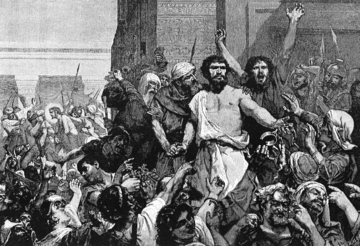
There were two – not one, but two – Jesuses, each known as “Barabbas” (“son of the father”) – who stood before Pilate. One was released into the crowd. The other was executed. Both are very much with us still. This sermon was preached at Shepherd of the Hill Presbyterian Church in Chaska, Minnesota, a place for the mind and heart sharing the message of God’s unconditional love for everyone.
President Obama’s support for gay marriage made headlines yesterday. In Minnesota the issue will come before the voters in November: Should the Minnesota State Constitution be amended to define “marriage” as between a man and a woman? One of my colleagues weighed in on the question from the pulpit of the Oak Grove Presbyterian Church. I post it here because it says more clearly than I what I believe.
“Standing on the Side of Love”
Oak Grove Presbyterian Church
Galatians 3:26-28
Bill Chadwick
Sunday,April 29, 2012
Today I invite us to think together about the amendment that is before the voters of Minnesota this fall that would place into the state constitution the requirement that marriage is reserved for one man and one woman.
I have a pastor friend, now retired, who loved to rile people up. If I might play amateur psychologist, my theory is that as the child of an alcoholic he was uncomfortable when things were calm. Well, my parents were teetotalers. As am I. I love calm. I hate conflict. I would much rather not talk about the amendment. I do so only because of the ordination vows I took almost 35 years ago. I am preaching today about the Marriage Amendment only because I am attempting to follow faithfully my Lord and Savior, Jesus Christ. I might be mistaken. I once again remind you, that in the Presbyterian way of doing things, “Just because the preacher says it, doesn’t mean you have to buy it.”
I believe that to be faithful the Church always needs to take a stand, just like it did against slavery, just like it did in favor of human rights for women, for people of color. The Church ALWAYS needs to take a stand on behalf of human rights for all of God’s children. And especially so when it comes to fair treatment of LGBT folk, since the church has consistently led the way in their persecution.
When my grandchildren ask, “What did you do when the issue of human rights for gay people was still being debated?” I don’t want to have to say to them, “Well, as you know, Grandpa doesn’t like conflict, and I didn’t want to offend people, and I was afraid it might affect contributions, so I kept my mouth shut.” I especially don’t want to say that if the questioning grandchild happened to have been born gay.
There is so much to say that I couldn’t do it in one sermon, so I put a bunch of stuff in the bulletin handout. What I would like to do primarily in the sermon is to tell stories, most of them personal.
My story. It has been a long journey for me to get to where I am today. The Presbyterian Church was just starting to talk about the ordination of gay people when I graduated from seminary 35 years ago. The following year was the first vote at General Assembly, when the proposal was roundly defeated. In the lead-up to that vote I preached a sermon using Acts 10 and 11 as my basis. That is the story of Peter praying at midday on the rooftop in the city of Joppa. He has a vision in which a sheet comes down from heaven laden with all kinds of animals, clean and unclean (according to Jewish dietary laws), and Peter hears a voice saying, “Rise, Peter, kill and eat.” And Peter protests, “Surely not, Lord. Nothing impure or unclean has ever entered my mouth.” The voice spoke from heaven a second time, “Do not call anything impure that God has made clean.” This happened three times. Immediately following, he encounters Cornelius, a Roman centurion who has had his own vision. Long story short, Peter realizes what the vision was trying to tell him: It’s time to change his mind! The gospel is not just for Jews, God’s love is for uncircumcised Gentiles as well. That is absolutely mind-blowing for Peter! It’s against the scriptures. It’s against tradition. But God was doing a new thing and commanding Peter to get on board.
So the gist of my 1978 sermon was this: I am still not quite ready to ordain homosexual individuals, but I am open to the possibility that the Spirit might someday change my mind.
Over the next few years I continued reading the latest Biblical scholarship and scientific research. I met and became friends with several very committed Christian people who happened to be gay. They had undergone extensive therapy and prayer for years and still couldn’t change who they were. I finally came to the conclusion that people simply are born who they are; gay people clearly have God-given gifts for ministry and that we should welcome all God’s children to use their gifts in ministry in ordained positions.
And we should encourage people to form committed relationships. I was happy to bless civil unions.
But marriage?… It somehow didn’t seem right to me to call a same-sex commitment “marriage.” Why? Just pure emotion, tradition, inertia.
Nothing logical about it. I am embarrassed to say that it was only a few years ago that I moved to the point of fully supporting marriage equality.
Another story. My younger brother, John, and I were extremely close growing up. I was so excited when he and his wife started having children. I didn’t have any of my own yet. I loved being an uncle. Many of you had the joy of watching Claire and Jim grow up here at Oak Grove. A couple of GREAT kids! Claire grew up, fell in love with a wonderful man, and married him two years ago. Jim grew up, but when he falls in love he will not be able to marry the one he loves. By the time Jim was three or four years old, I was very sure that he was gay. Jim didn’t choose to be gay. Why shouldn’t Jim be able to share the same right to marriage as his sister does? Jim has told me that a lot of his relatives got married at Oak Grove and it would mean a lot to him to someday be married here.
One comic has said, “Let gays marry. Why shouldn’t they be as miserable as the rest of us?” That may be kind of a funny line. But I’m not miserable. My marriage means the world to me. On Tuesday Kris and I celebrated our 24th wedding anniversary. My marriage is a place of safety, welcome, commitment, companionship, intimacy, trust. That can all happen without marriage. But our relationship is acknowledged, encouraged and celebrated by the world and by the church. Why should Jim be excluded from that acknowledgement, encouragement and celebration because of an accident of birth?
Marriage says “We are family” in a way that no other word does.
About two months ago while flipping through the TV channels one evening I came across a presentation of the Broadway play, Memphis, which won the Tony Award for best musical in 2010. Have any of you seen it? I wasn’t familiar with it, but the TV program was just starting. I was quickly captivated and I watched the entire thing. And then a few weeks ago a touring production came to the Ordway in St. Paul and Kris and I went to it and thoroughly enjoyed it. (Unlike most straight men I love musical theater.) The play is set in the 1950s and is loosely based on the career of a Memphis radio disc jockey. In the musical the lead character is called Huey Calhoun and through the course of the play Huey meets a wonderful singer named Felicia, and eventually they fall in love. Huey asks her to marry him and she says, “Yes. Yes, I love you with all of my heart and I would marry you, Huey, …if I could.” She means, if it were legal. But he is white, and she is black. In Memphis in the 1950s it was against the law for a white person and a black person to marry.
Doesn’t that just make you shake your head in sadness? In amazement? I am utterly confident that fifty years from now—or probably less, maybe half that—almost everyone will be shaking their heads about the current ban on gay marriage in the same way that almost everyone shakes their heads at the ban on interracial marriage of a half-century ago.
Even if this amendment passes, it is just a temporary bump in the road on the way to the inevitable. According to the Gallup Poll (May, 2011) 70% of young people in America favor gay marriage. When the loudest voices opposing gay marriage come from the Church, it’s one more nail in the coffin…of the Church. The Church is brushed aside by the younger generation as being narrow-minded, judgmental and irrelevant.
You sometimes hear the statement, “Gay marriage is a threat to heterosexual marriage.” How so? Two of our very good friends, Suzanne and Diane, were legally married in Massachusetts eight years ago. My wife, Kris, flew out to be in the wedding. We see them socially on a regular basis. Eight years. Their marriage has not affected my marriage one bit. Any more than your marriage (pointing to congregation) or your marriage affects my marriage. Whom you choose to love does not affect whom I choose to love.
Another story. About a woman named Ruth. (I’m indebted to St. Paul theologian David Weiss for this insight.) You (probably) know Ruth’s words, even if you don’t know her story: “Wherever you go, I will go; wherever you live, I will live. Your people will be my people, and your God will be my God.” (Where do we so often hear these words?) This is one of the most often quoted texts at straight marriages. But these words were spoken by Ruth to her mother-in-law, Naomi. These words were spoken by a woman whose people, the Moabites, were condemned in the Bible – forever. She has no business pledging – and fulfilling – a vow of faithfulness like God’s own promised faithfulness. But while her love for Naomi was ethnically and culturally odd and her (later) marriage to Boaz (a Hebrew) was religiously dubious, thanks to her odd love and dubious marriage she became the great-grandmother of King David. Her off-limits love became a blessing.
I could give other germane Biblical stories: The stories of Rahab, Hosea, the parable of the Good Samaritan, several women in Jesus’ life, and others. As Weiss notes, “The Bible is full of stories about a God who welcomes surprising people into God’s family. Stories about heroes and heroines whose praise-worthiness lies in their promised faithfulness to another person.” (See Weiss’s book, To the Tune of a Welcoming God: Lyrical reflections on Sexuality, Spirituality and the Wideness of God’s Welcome (2008, Langdon Street Press).
If you support marriage equality, what can you do? Outfront Minnesota is an organization working to defeat the Amendment. The Outfront folks expect that there will be an onslaught of misleading advertising this summer financed by the Mormon Church and others. An Outfront trainer noted, “We believe that the way forward is not to be found in loud and angry debate with the opposition. We think this only entrenches people. Rather, our research finds that the single most effective way to advance our position is through one to one conversations. So, our strategy over the next months is to facilitate a million conversations. And, we have scheduled numerous trainings to help people plan those conversations, and feel comfortable having them.” You can find information on the Outfront website. Please hold gentle conversations with your friends and neighbors.
Final story. Tuesday afternoon I was toiling away in my study when our receptionist came and knocked on my door to inform me that there was a man here who has just moved from another town and he is looking for a new church and wanted to know about Oak Grove. I’m always eager to tell folks about Oak Grove so I bounded out to greet him. We introduced one another and then walked out into the hall where I started to give him a little tour and tell him about the church. But he stopped just outside the office and interrupted me, “You have a flag out front,” referring to the rainbow flag.
“Yes,” I said. And I was thinking “Hmm. This could go either way.” (I remind you that in 2008 a man came into a church in Tennessee with anger in his heart at what he called “liberal gay-lovers” and he opened fire, wounding seven and killing two.) This was not in the back of my mind; this was in the front of my mind. Was this man in front of me happy that we had the flag or was he here to set me straight, so to speak?
He continued. “Does the flag mean you welcome everyone?”
“Yes, that’s what it means.”
A big grin spread across his face and he pumped my hand again. “That’s what I’m looking for!” And for the next twenty minutes he told me about his spiritual journey and how he had been hurt by some of his previous church experiences. He said he was looking for a church that would preach positive messages and where everyone was welcome. At the conclusion of our conversation he shook my hand again and said, “I’ll see you Sunday at 8:15.” (And he was here. And he received a very warm welcome from you Oak Grovers.)
We are in the season of Eastertide. The essence of Easter is the message that Love wins. Why take the temporary detour of this amendment?



 Views from the Edge