Josh, Alfred, and You

This “mind-numbing” sermon was inspired by the obituary of a young man named Josh who suffered “10 years of mind-numbing public schooling.” It was preached at Shepherd of the Hill Presbyterian Church in Chaska, Minnesota, “sharing the message of God’s unconditional love for everyone.”

Ever read an obituary that raised your eyebrows? Ever left a funeral thinking it was case of mistaken identity?

This week my old friend Bob Young shared this obituary with the annual gathering of seminary classmate. Bob has a wry sense of humor. We knew something was coming by the twinkle in Bob’s eye.

This obituary is the exception to phony. It appeared in the Ponca City News:

Joshua Micheal (nope, not a typo it’s really spelled that way) McMahan left this world April 18, 2012. He was loved, hated, praised, and cursed by relatives and friends alike. He ultimately passed as a result of being stubborn, refusing to follow doctors’ (or anyone else for that matters) orders, and raising hell for a little more than three decades. He lived life on his own terms.

Josh was born on Sept. 16, 1978, to Linda Burgert Waller. Josh was a beautiful, unique, kind, and loving spirit man. Joshie endured around ten mind-numbing years of public schooling. He had worked as a pizza delivery boy and call center representative before shockingly becoming independently “wealthy.”

He loved music, beer, movies, vodka, television, and women, but not necessarily in that order. He was also an awesome drummer!/vocalist? and was in several bands over the years. He lived in Ponca City his entire life except for the past year where he was forced to put up with his sister and brother-in-law out in the middle of nowhere — a little piece of terra firma aptly called Haskell.

He is survived by Rosie, his long-time canine companion; a sister, Melanie Waller Ochoa; a brother-in-law, DJ Ochoa; a best friend/brother, Cliff Crull; three nieces, Miranda, Emma, and Camille; and one nephew, Maxx. Josh had no children of his own (at least none that we know of). He was preceded in death by Mom Linda, Grandma Nina Burgert, and Grandpa Joe Burgert.

A remembrance service will be held at 2 p.m. April 25 in the chapel of Trout Funeral Home where you may re-tell the stories he can no longer share. Anyone dressed in a suit or Sunday’s best will be promptly escorted back to their vehicle. Just kidding … we’ll accept you as you are — just as Josh would have in life. Please be wary for any children’s sake, there may be profanity and/or alcohol involved. If you have a special memory or maybe just want to irritate Josh for all eternity, please bring a magnet or sticker to attach to his casket for evermore.

In lieu of flowers or memorial gifts, please give generously, in Josh’s honor, to rockstarmusiceducation.org.

JRock will be placed to rest in the St. Mary’s section of Odd Fellows (the irony) Cemetery in Ponca City and I’m sure he would invite you to come by later and have a laugh on him — literally.

As Bob read aloud Josh’s obituary in his droll manner, we had a great laugh, just as Josh would have wanted, and we felt accepted as we really are. Lord knows we’re all likely “to pass as a result of being stubborn.”

We had a round in Josh’s honor and prayed (not really) that, if someone decides to tell the truth in our obituaries, the writer will have a lively sense of humor…and a whole lot of grace.

Harry followed the obituary with the laughter with the story of a man named Alfred.

Alfred left Russia at the age of 18. After spending a year in Paris studying chemistry, he moved to the United States. After five years, he returned to Russia and began working in his father’s factory making military equipment for the Crimean War. In 1859, at the war’s end, the company went bankrupt. The family moved back to Sweden, and Alfred soon began experimenting with explosives. In 1864, when Alfred was 29, a huge explosion in the family’s Swedish factory killed five people, including Alfred’s younger brother Emil. Dramatically affected by the event, Alfred set out to develop a safer explosive. In 1867, he patented a mixture of nitroglycerin and an absorbent substance, producing what he named “Dynamite.”

In 1888, Alfred’s brother Ludvig died while in France. A French newspaper erroneously published Alfred’s obituary instead of Ludvig’s, noted that Alfred had died a very wealthy man as a result of inventing dynamite. Alfred was irked that the wrong obituary had been published. But he was more disturbed – deeply embarrassed, in fact – by a true obituary about his life. Disappointed with how he would be remembered, he decided to do something different with his life.

Alfred died of a stroke on December 10, 1896, in San Remo, Italy. After taxes and bequests to individuals, he left the majority of his estate to fund the Nobel Prizes. His name was Alfred Nobel.

—————————————–

Somewhere between Josh and Alfred there is you. Somewhere between the two there is I.

If you could write your own obituary, what would it say?

In her book Bird by Bird, Anne Lamott lays her life bare in print. Anne herself is a rare bird. She found her way to a church like Shepherd – small, humble, a bit odd, very loving and very joyful – in Marin City, California whose people accepted her as she was: depressed, addicted to alcohol and drugs, promiscuous, seriously depressed and feeling lost.

In Bird by Bird’s Acknowledgements, she wrote  “I want to mention once again that I do not think I’d even be alive today if not for the people of St. Andrews Presbyterian Church, Marin City, California.

But this is the paragraph I want you to remember as you think about the rest of your life and how you will pull together the pieces. The words were written for aspiring writers.  But, for our purposes this morning, I ask you to think of life as a kind of writing.  It’s a paragraph in a chapter on Perfectionism.

“Your day’s work might turn out to have been a mess. So what? [Kurt] Vonnegut said, ‘When I write, I feel like an armless legless man with a crayon in his mouth.’ So go ahead and make big sprawls and mistakes. Use up lot of paper. Perfectionism is a mean, frozen form of idealism, while messes are the artist’s true friend. What people somehow…forgot to mention when we were children was that we need to make messes in order to find out who we are and why we are here – and, by extension, what we’re supposed to be writing.”

How would you want your obituary to read?

I’d be pleased if mine read something like the following, a mixture of Josh’s and Alfred’s, although it won’t be up to me. It will be written by Kay and family. I won’t get to read it or censor it.

Gordon Campbell Stewart died of a stroke. Actually he didn’t. He died because he wouldn’t listen to his wife, his friends or his doctors and because he had chosen to believe his dogs who thought his nightly bowls of ice cream and cashews would last forever, just like him.

He was a lot like his dog Maggie. Stubborn, occasionally amusing, playful, and very annoying when he didn’t get what he wanted.  He was a preacher man, or so he thought, although those who slept through years of his mind-numbing sermons often brought pillows and blankets, and sometimes a flask to church. Fortunately for him, Gordon never noticed.

After many years of self-absorption, he discovered the joy of being mortal. He stopped worrying about tomorrow.  He learned to appreciate the fullness of the moment. He learned to listen to the birds…well, actually…since he could no longer hear them, he learned to watch the birds and to imagine their songs after his hearing had gone. He watched the clouds and felt the wind, the snow, and the rain. He found solace in rainbows and rabbits, in squirrels, chip-monks, purple martins and woodpeckers.

He stopped trying to be perfect. He gave thanks for the messes as much as for the cleaning up. Because it was out of the messiness of his life that God shaped him into something more real. It was out of the death of pretense that the truth looked back at him in the mirror until he came to love himself. He gave up suits and expensive shoes. He wore the same pair of pants four days in a row…relaxed fit jeans…and extra large shirts to cover the paunch that eventually killed him.

In the silence of his shrinking world, he turned increasingly inward, sitting at the window at his computer, blogging hour by hour, and going deeper into the once bottomless pit of himself where he found not emptiness but fullness.

Out of the fullness, he has asked that the few people who gather around his ashes sing the strong traditional hymns that meant the world – literally “the world” to him – in hopes that the words and the music would lift you up.  “O God our help in ages past, our hope for years to come, our shelter from the stormy blast, and our Eternal Home.”  “All creatures of our God and King, Lift up your voice and with us sing, Alleluia! Alleluia! Thou burning sun with golden beam, Thou silver moon with softer beam, Alleluia! Alleluia! Alleluia! Alleluia! Alleluia!”
Sermon: Barabbas

There were two – not one, but two – Jesuses, each known as “Barabbas” (“son of the father”) – who stood before Pilate. One was released into the crowd. The other was executed. Both are very much with us still. This sermon was preached at Shepherd of the Hill Presbyterian Church in Chaska, Minnesota, a place for the mind and heart sharing the message of God’s unconditional love for everyone.

.

Love Will Win

President Obama’s support for gay marriage made headlines yesterday. In Minnesota the issue will come before the voters in November: Should the Minnesota State Constitution be amended to define “marriage” as between a man and a woman? One of my colleagues weighed in on the question from the pulpit of the Oak Grove Presbyterian Church. I post it here because it says more clearly than I what I believe.

“Standing on the Side of Love”
Oak Grove Presbyterian Church
Galatians 3:26-28
Bill Chadwick
Sunday,April 29, 2012

Today I invite us to think together about the amendment that is before the voters of Minnesota this fall that would place into the state constitution the requirement that marriage is reserved for one man and one woman.

I have a pastor friend, now retired, who loved to rile people up.  If I might play amateur psychologist, my theory is that as the child of an alcoholic he was uncomfortable when things were calm.  Well, my parents were teetotalers.  As am I.  I love calm.  I hate conflict.  I would much rather not talk about the amendment.  I do so only because of the ordination vows I took almost 35 years ago.  I am preaching today about the Marriage Amendment only because I am attempting to follow faithfully my Lord and Savior, Jesus Christ.  I might be mistaken.  I once again remind you, that in the Presbyterian way of doing things, “Just because the preacher says it, doesn’t mean you have to buy it.”

I believe that to be faithful the Church always needs to take a stand, just like it did against slavery, just like it did in favor of human rights for women, for people of color.  The Church ALWAYS needs to take a stand on behalf of human rights for all of God’s children.  And especially so when it comes to fair treatment of LGBT folk, since the church has consistently led the way in their persecution.

When my grandchildren ask, “What did you do when the issue of human rights for gay people was still being debated?” I don’t want to have to say to them, “Well, as you know, Grandpa doesn’t like conflict, and I didn’t want to offend people, and I was afraid it might affect contributions, so I kept my mouth shut.”  I especially don’t want to say that if the questioning grandchild happened to have been born gay.

There is so much to say that I couldn’t do it in one sermon, so I put a bunch of stuff in the bulletin handout.  What I would like to do primarily in the sermon is to tell stories, most of them personal.

My story.  It has been a long journey for me to get to where I am today.  The Presbyterian Church was just starting to talk about the ordination of gay people when I graduated from seminary 35 years ago.  The following year was the first vote at General Assembly, when the proposal was roundly defeated.  In the lead-up to that vote I preached a sermon using Acts 10 and 11 as my basis.  That is the story of Peter praying at midday on the rooftop in the city of Joppa.  He has a vision in which a sheet comes down from heaven laden with all kinds of animals, clean and unclean (according to Jewish dietary laws), and Peter hears a voice saying, “Rise, Peter, kill and eat.” And Peter protests, “Surely not, Lord.  Nothing impure or unclean has ever entered my mouth.”  The voice spoke from heaven a second time, “Do not call anything impure that God has made clean.”  This happened three times.  Immediately following, he encounters Cornelius, a Roman centurion who has had his own vision.  Long story short, Peter realizes what the vision was trying to tell him:  It’s time to change his mind!  The gospel is not just for Jews, God’s love is for uncircumcised Gentiles as well.  That is absolutely mind-blowing for Peter!  It’s against the scriptures.  It’s against tradition.  But God was doing a new thing and commanding Peter to get on board.

So the gist of my 1978 sermon was this:  I am still not quite ready to ordain homosexual individuals, but I am open to the possibility that the Spirit might someday change my mind.

Over the next few years I continued reading the latest Biblical scholarship and scientific research.  I met and became friends with several very committed Christian people who happened to be gay.  They had undergone extensive therapy and prayer for years and still couldn’t change who they were.  I finally came to the conclusion that people simply are born who they are; gay people clearly have God-given gifts for ministry and that we should welcome all God’s children to use their gifts in ministry in ordained positions.

And we should encourage people to form committed relationships.  I was happy to bless civil unions.

But marriage?…  It somehow didn’t seem right to me to call a same-sex commitment “marriage.”  Why?  Just pure emotion, tradition, inertia.

Nothing logical about it.  I am embarrassed to say that it was only a few years ago that I moved to the point of fully supporting marriage equality.

Another story.  My younger brother, John, and I were extremely close growing up.  I was so excited when he and his wife started having children.  I didn’t have any of my own yet.  I loved being an uncle.  Many of you had the joy of watching Claire and Jim grow up here at Oak Grove.  A couple of GREAT kids!  Claire grew up, fell in love with a wonderful man, and married him two years ago.  Jim grew up, but when he falls in love he will not be able to marry the one he loves.  By the time Jim was three or four years old, I was very sure that he was gay.  Jim didn’t choose to be gay.  Why shouldn’t Jim be able to share the same right to marriage as his sister does?  Jim has told me that a lot of his relatives got married at Oak Grove and it would mean a lot to him to someday be married here.

One comic has said, “Let gays marry.  Why shouldn’t they be as miserable as the rest of us?”  That may be kind of a funny line.  But I’m not miserable.  My marriage means the world to me.  On Tuesday Kris and I celebrated our 24th wedding anniversary.  My marriage is a place of safety, welcome, commitment, companionship, intimacy, trust.  That can all happen without marriage.  But our relationship is acknowledged, encouraged and celebrated by the world and by the church.  Why should Jim be excluded from that acknowledgement, encouragement and celebration because of an accident of birth?

Marriage says “We are family” in a way that no other word does.

About two months ago while flipping through the TV channels one evening I came across a presentation of the Broadway play, Memphis, which won the Tony Award for best musical in 2010Have any of you seen it?  I wasn’t familiar with it, but the TV program was just starting.  I was quickly captivated and I watched the entire thing.  And then a few weeks ago a touring production came to the Ordway in St. Paul and Kris and I went to it and thoroughly enjoyed it.  (Unlike most straight men I love musical theater.)  The play is set in the 1950s and is loosely based on the career of a Memphis radio disc jockey.  In the musical the lead character is called Huey Calhoun and through the course of the play Huey meets a wonderful singer named Felicia, and eventually they fall in love.   Huey asks her to marry him and she says, “Yes.   Yes, I love you with all of my heart and I would marry you, Huey, …if I could.”  She means, if it were legal.  But he is white, and she is black.  In Memphis in the 1950s it was against the law  for a white person and a black person to marry.

Doesn’t that just make you shake your head in sadness?  In amazement?  I am utterly confident that fifty years from now—or probably less, maybe half that—almost everyone will be shaking their heads about the current ban on gay marriage in the same way that almost everyone shakes their heads at the ban on interracial marriage of a half-century ago.

Even if this amendment passes, it is just a temporary bump in the road on the way to the inevitable.  According to the Gallup Poll (May, 2011) 70% of young people in America favor gay marriage.  When the loudest voices opposing gay marriage come from the Church, it’s one more nail in the coffin…of the Church.  The Church is brushed aside by the younger generation as being narrow-minded, judgmental and irrelevant.

You sometimes hear the statement, “Gay marriage is a threat to heterosexual marriage.”  How so?   Two of our very good friends, Suzanne and Diane, were legally married in Massachusetts eight years ago.  My wife, Kris, flew out to be in the wedding.  We see them socially on a regular basis.  Eight years.  Their marriage has not affected my marriage one bit.  Any more than your marriage (pointing to congregation) or your marriage affects my marriage.  Whom you choose to love does not affect whom I choose to love.

Another story.  About a woman named Ruth.  (I’m indebted to St. Paul theologian David Weiss for this insight.)  You (probably) know Ruth’s words, even if you don’t know her story: “Wherever you go, I will go; wherever you live, I will live. Your people will be my people, and your God will be my God.”   (Where do we so often hear these words?)  This is one of the most often quoted texts at straight marriages.  But these words were spoken by Ruth to her mother-in-law, Naomi.  These words were spoken by a woman whose people, the Moabites, were condemned in the Bible – forever.  She has no business pledging – and fulfilling – a vow of faithfulness like God’s own promised faithfulness. But while her love for Naomi was ethnically and culturally odd and her (later) marriage to Boaz (a Hebrew) was religiously dubious, thanks to her odd love and dubious marriage she became the great-grandmother of King David. Her off-limits love became a blessing. 

I could give other germane Biblical stories:  The stories of Rahab, Hosea, the parable of the Good Samaritan, several women in Jesus’ life, and others.  As Weiss notes, “The Bible is full of stories about a God who welcomes surprising people into God’s family. Stories about heroes and heroines whose praise-worthiness lies in their promised faithfulness to another person.”   (See Weiss’s book, To the Tune of a Welcoming God: Lyrical reflections on Sexuality, Spirituality and the Wideness of God’s Welcome (2008, Langdon Street Press).

If you support marriage equality, what can you do?  Outfront Minnesota is an organization working to defeat the Amendment.  The Outfront folks expect that there will be an onslaught of misleading advertising this summer financed by the Mormon Church and others.  An Outfront trainer noted, “We believe that the way forward is not to be found in loud and angry debate with the opposition.  We think this only entrenches people.  Rather, our research finds that the single most effective way to advance our position is through one to one conversations. So, our strategy over the next months is to facilitate a million conversations. And, we have scheduled numerous trainings to help people plan those conversations, and feel comfortable having them.”  You can find information on the Outfront website.  Please hold gentle conversations with your friends and neighbors.

Final story.  Tuesday afternoon I was toiling away in my study when our receptionist came and knocked on my door to inform me that there was a man here who has just moved from another town and he is looking for a new church and wanted to know about Oak Grove.  I’m always eager to tell folks about Oak Grove so I bounded out to greet him.  We introduced one another and then walked out into the hall where I started to give him a little tour and tell him about the church.  But he stopped just outside the office and interrupted me, “You have a flag out front,” referring to the rainbow flag.

“Yes,” I said.  And I was thinking “Hmm. This could go either way.”  (I remind you that in 2008 a man came into a church in Tennessee with anger in his heart at what he called “liberal gay-lovers” and he opened fire, wounding seven and killing two.)  This was not in the back of my mind; this was in the front of my mind.  Was this man in front of me happy that we had the flag or was he here to set me straight, so to speak?

He continued.  “Does the flag mean you welcome everyone?”

“Yes, that’s what it means.”

A big grin spread across his face and he pumped my hand again.  “That’s what I’m looking for!”  And for the next twenty minutes he told me about his spiritual journey and how he had been hurt by some of his previous church experiences. He said he was looking for a church that would preach positive messages and where everyone was welcome.  At the conclusion of our conversation he shook my hand again and said, “I’ll see you Sunday at 8:15.”  (And he was here.  And he received a very warm welcome from you Oak Grovers.)

We are in the season of Eastertide.  The essence of Easter is the message that Love wins. Why take the temporary detour of this amendment?

 Love will win.

Sermon: The Estate Sale and a Thousand Years

Click 

This sermon, inspired by a visit to an estate sale and Via Lucis’ photographs of Gothic and Romanesque architecture, was preached at Shepherd of the Hill Presbyterian Church in Chaska, MN.

Jesus Barabbas

Give Us Barabbas

There are two Jesuses – two different Sons of the Father. One is executed; the other is released. Both are with us still.

Here’s the sermon at Shepherd of the Hill Presbyterian Church in Chaska, MN, a place for the mind and heart on YouTube:

YouTube: “” 

A Visit to Rockefeller Center

This post is by historian and friend Gary Severson. I asked him to put his reflection in writing not because it says someting nice about you-know-who, but because I thought it should reach a larger audience. Views from the Edge added the photos of Atlas holding up the world to supplement Gary’s commentary.

Rockefeller Center Plaza with sculpture of Atlas

Rockefeller Center Plaza with sculpture of Atlas

“When in NYC this past week I made my way to Rockefeller Center just to see a part  of the city I had never seen.  As it turns out my NYC experience in Rockefeller Center related to Gordon’s sermon this morning, The Estate Sale & 1000 years”. His sermon related to the impermanence of many things in our society including its architecture. Gordon was surprised to see the estate sale he attended taking place at an “art deco’ style house that was totally out-of-place in a neighborhood of Tudor houses.  This is a style that has disappeared compared to more traditional styles.

“As I arrived in Rockefeller Center Plaza I was taken by the immense architecture of places like NBC, News Corp., Time Life, Citibank etc. The tremendous sense of the power represented by these buildings was overwhelming in the sense that they represent a huge influence in terms of their ability to generate propaganda about America.”These buildings are generally of a sterile style described as spires of steel & glass. I stopped to talk to a security guard and by his demeanor it was clear he even took on the arrogance these buildings exuded. I walked into another RC building where I saw a $137,000 necklace in a window display & saw the clerk inside & thought that isn’t a place I would be welcome in either. As I turned around I noticed a sign that said “Onassis Museum”. I went in and could see it was free admission and contained 100 or so priceless sculptures, tiles, metal work etc. from Greece & Rome.

“As I listen to Gordon’s sermon I realize I’d been experiencing what he is describing in terms of permanence and impermanence. These skyscrapers in Rockefeller Center will be imploded while these ancient artworks represent eternal ideas right here in the midst of the impermanence of these modern buildings.  In fact the exhibit in the Aristotle Onassis Museum was about the changes taking place in the artwork of the period in the transition from paganism to Christianity.

“When I left I saw across the street St. Patrick’s Cathedral, built during the Civil War. It rivals the cathedrals of Europe. It stands out in stark contrast to the surrounding modern glass structures with its spires pointing 300 ft. into the air.  I went in and again saw the amazing sanctuary with its 250 ft. ceiling & spectacular stained glass windows.

Saint Patrick Cathedral

“Here we have a building that is already 160 yrs. old and will outlast the surrounding towers of crystalized guilt, a reference to the attempt by modern man to deny his mortality by replacing traditional religious worship with the worship of Earthly money and power.  Today’s sermon was a wonderful example for me of the connections we can make between our seeming separate spiritual & everyday lives to create meanings that allow us to gain a deeper understanding of who we are.”

– Gary Severson, Chaska, MN

Atlas and St. Patrick Cathedral

Atlas and St. Patrick Cathedral

A Lightness of Being

Dew Drops on a Spider's Web

Dew Drops on a Spider’s Web – Kay Stewart Photography

This spider’s web, covered with early morning dew – a natural miracle nearly invisible to the naked eye – was in the corner of a flower box on our deck. Kay, whose camera is always nosing around for the things we do not see, took this photograph. The poem was inspired by the smallness I felt – the beauty of smallness – seen in the magnificence if a spider’s web in morning light and in e. e. cummings’ poem “who are you, little i”.

“A Lightness of Being” – Gordon C. Stewart

who are you, little i, sitting above

the world so high (e. e. cummins)

on the high perch home

hammers and saws have made

on land filled and leveled by

bulldozers and gas-guzzling graders?

then i see it in the morning sun

the all-but-imperceptible home

spun from inside a spider self,

wet with drops strung like beads

so small, so delicate, so light

they leave the spider’s home intact,

a natural grace respecting strength

and weakness – a lightness of being

that does not crush or break

this hidden part – this most amazing part –

of a larger Web of life we barely see

The Charcoal Fire — 10 Years Ago

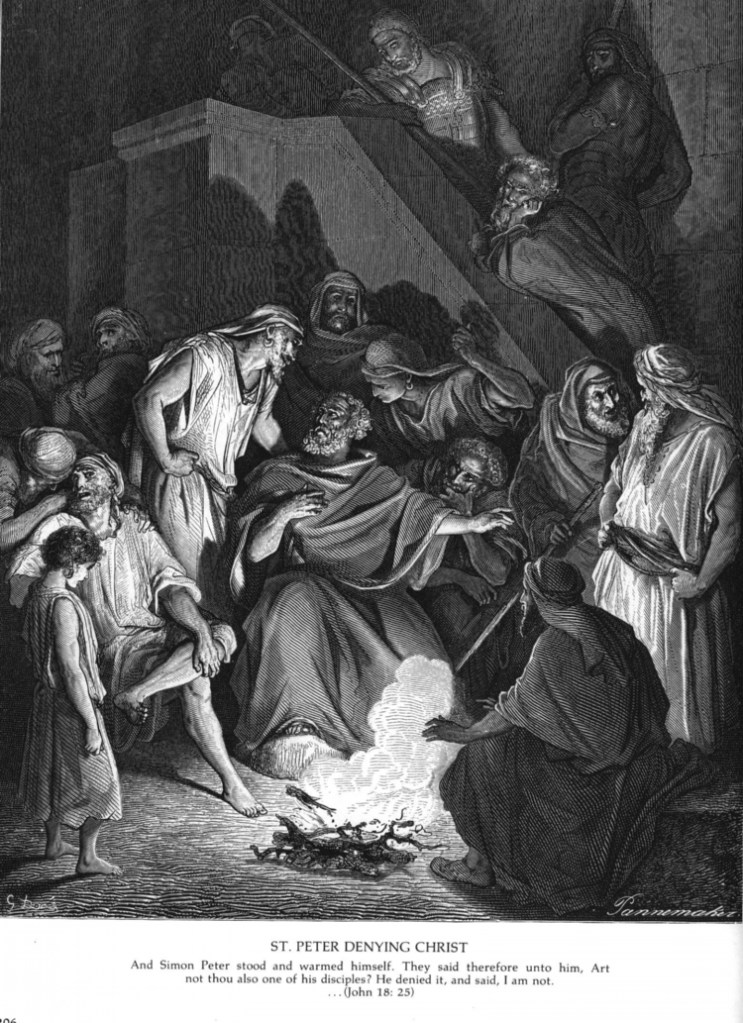
As the sun rose this [Easter] morning, a few of us warmed ourselves around a fire outside the church. Two charcoal fires were recalled, involving Peter, “the Rock” who crumbled like a piece of shale, and the risen Christ, who would re-create the scene to change the story from denial to welcome, forgiveness, and a commissioning to love.

Steve Shoemaker Verse, “The Charcoal Fire”

THE CHARCOAL FIRE

Charcoal Fire
Three times
Denial:

I do not know the man

Charcoal Fire
Three times
Forgiveness:

Do you love me?
Do you love me?
Do you love me?

Charcoal Fire
Three Times
Commission:

Feed my sheep
Feed my sheep
Feed my sheep

Steve Shoemaker
Urbana, IL
April 8, 2012

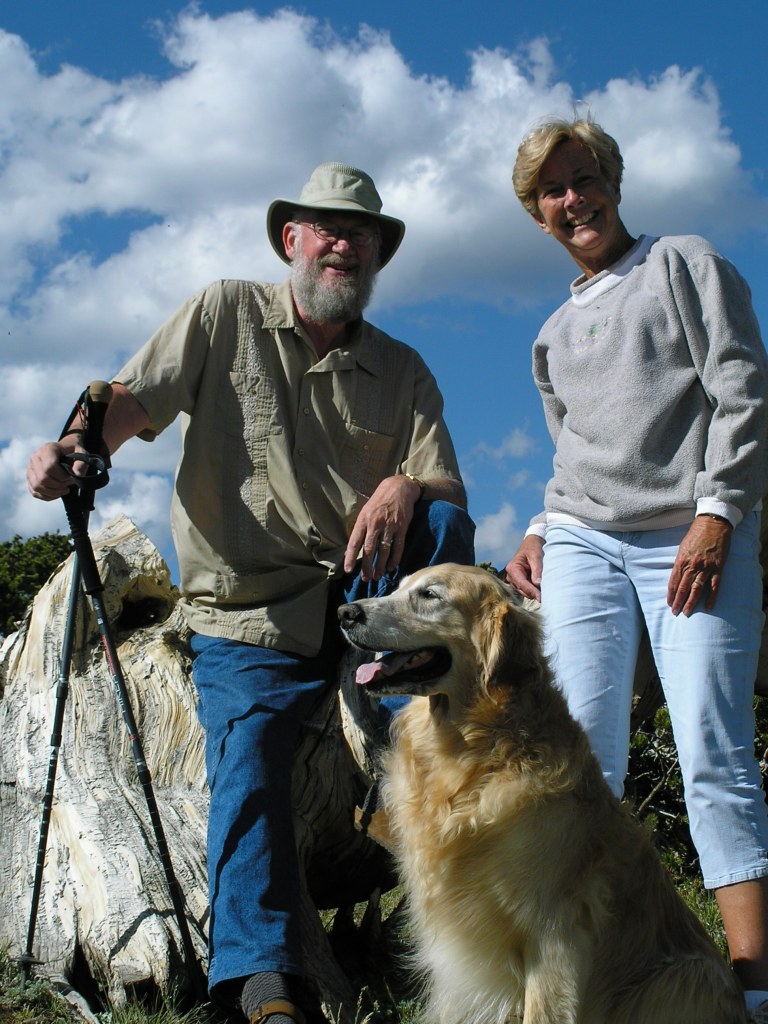
Gordon C. Stewart, author of Be Still! Departure from Collective Madness (2017 Wipf and Stock), edited and republished in memory of Steve Shoemaker. Steve is sitting on a Bristlecone Pine stump above the tree line in Colorado during a gathering of seminary friends. Mutual friend Anna Strong and canine companion stand by him.

Sojourners Today

This morning Sojourners chose to publish last Sunday’s sermon (posted yesterday on “Views from the Edge”) on it blog, “God’s Politics:  a Blog with Jim Wallis and Friends”. Click THE STONES ARE SINGING for the Sojourners post to read and hear it, “like” it (If you do :-)), post a comment,or send it to a friend by email.

Once again, special thanks to Dennis Aubrey and Via Lucis (click the link for today’s Good Friday photos) for permission to use his magnificent photographs and written description of his time in the Basilica of Mary Magdalene in Vezelay, France.

Reading Dennis’ words from the pulpit near the end of the sermon, I had to stop. It was as though years of trying to understand had come together into a single moment. When  the Gospel writer has Jesus respond to his critics with “I tell you, if these keep silent, the very stones will cry out,” he is quoting from the Scriptures of his Jewish faith – Ode against the Chaldeans in the Book of Habakkuk “The stone shall cry out from the wall, and the beam out of the framework shall answer it. Woe to him that builds a town with blood, and establishes a city by iniquity.” (Hab. 2:11-12)


The stones are singing

Sometimes things just seem to come together all of a sudden. This was one of those moments.

This sermon created itself when four texts converged. “But one of the soldiers pierced his side with a spear, and at once there came out blood and water” (Gospel of John 19:34).  “She has done a beautiful thing to me. … Truly, I say to you, wherever this gospel is preached in the whole world, what she has done will be told in memory of her” (Gospel of Matthew 26:10, 13). “I tell you, if these were silent, the very stones would cry out” (Gospel of Luke 19:40). And, last but by no means least, the piece that pulled them all together: “Elle Chante, Pere” (Dennis Aubrey, Via Lucis Photography), used with permission of Dennis Aubrey. Yesterday, Good Friday, Via Lucis re-posted the sermon. CLICK HERE for Denniis’s comments and those of others on Via Lucis.

Click the title to hear and see

 “THE STONES ARE SINGING

Albert Camus once said that your life is “the slow trek to recover the two or three simple images in whose presence [your] heart first moved.”

Sebastian Moore recovered one of those images after he had wandered into church at vespers on the Feast of the Sacred Heart.

In his book, The Inner Loneliness, he describes that moment of awakening. It came one evening after lots of pasta, a lot of spaghetti, and a lot of wine. “As I entered the church, I heard the familiar words [in Latin] ‘One of the soldiers opened his side with a spear, and immediately there came forth blood and water.’ And I had what can only describe as a sense of fullness of truth. Somehow, everything that was to be said about life and its renewing was in those words. Somehow my life, my destiny, was in those words.”

The image that moved his heart became one to which he returns daily, as do I. For the piercing of the side of the helpless man hanging on the cross happened not just then and there at Golgotha; it happens here and there and everywhere that torture own souls and the souls of others because we, or they, have failed to measure up to what we expected.  Strangely, it is in the piercing that brings blood that we are cleansed by the living water that pours from his side.

Do you see your life in the words and in the image of the spearing of his side, in the blood, but also the water that heals, restores and renews, flowing from his pierced side?

A second image came to me this week on a photography blog of religious architecture by Dennis Aubrey.

“There are sights impossible to forget,” writes a blogger I’ve been following, a photographer. His name is Dennis Aubrey. He takes magnificent photographs of great church architecture and accompanies his images with equally spell-binding words describing his experience sitting in those sacred spaces.

Dennis Aubrey tells the story of walking into a basilica. It’s the Basilica of the Magdalene – dedicated to Mary Magdalene, who is thought to be the woman in the Gospel stories who poured out the expensive ointment on Jesus and then wiped his feet with her hair. The scene for the photograph and the writing that describes his experience is the Basilica of Mary Magdalene in Vézelay, France.

”There are sights impossible to forget,” he writes, “the first glimpse of your child, or the look on the face of a your beloved at a moment of perfect happiness. My first sight of Vézelay[i] was such a moment of perfection for me, a small medieval town clustered on a steep hill with a single narrow road winding its way to the top of the rise where stands the Basilica of Mary Magdalene.

“To appreciate Vézelay is to watch sunlight move like a living thing across walls of stone, then suddenly create a vision of indescribable, aching beauty. It is to watch shadows deepen around a priest sitting solitary in a side chapel waiting patiently for a penitent to come for confession. It is to hear the songs of nuns echo off the vaulted ceiling and ring like bells in the human soul. David sang in the Psalms, ‘You, O Lord, will be my light; by you, my God, the dark will be made bright for me,’ and in Vézelay this is palpable.

“So many days PJ and I have brought camera equipment into the church and have seen and captured images that make me wonder if it is even us taking the pictures. It is enough to sit and watch and wait, and suddenly the shot appears, as if summoned by the Magdalene herself. It has never failed to occur, and I don’t imagine that it ever will. In September 2008, at the end of two full days of shooting in the church, I sat on the stone wall leading down to the crypt where Mary’s relics have been kept for so long, venerated by so many. The originals were destroyed in the paroxysm of the French Revolution, but new ones have been placed in this crypt and are visited to this day. I was quiet and trying to remain inconspicuous because the priest was in the side chapel of Saint Teresa of Ávila hearing confession. Every once in a while, a young man or an elderly woman would come and sit next to him on a small wooden stool. With heads huddled together they would murmur quiet words of repentance and forgiveness. At the end, a sign of blessing and then footsteps echoed on the flagstones. It seemed to me, sitting near, the church was silent and reverent, fulfilling its very purpose even if it was only a single person seeking the expiation of sins.

“In this silence, a new thought entered my consciousness, something never expressed before. With this thought came a tumult of emotions, a release of waves of images and thoughts and feelings. I suddenly understood the need for God; even if I did not acknowledge that need for myself, I knew with certainty that it existed. It was a terrifying moment, unsettling and disturbing. I struggled to lock this transient understanding firmly in my mind so as not to forget, so that it did not turn into a mere anecdote. After some time a sound entered my consciousness, emanating from the pillars, the walls, arches, from the blocks
of granite themselves. I don’t know how long I sat there, rapt, listening, as the flow coursed through me in a flood that grew in intensity. And all the while, this faint sound of music.

“Eventually, I became aware of being watched, of not being alone in my thoughts. I turned to see a strong young priest standing next to me, with a small and knowing smile.

“’Elle chante, Pere,’ I said, ‘elle chante aujourd ’hui‘(‘She sings, Father, she sings today.’) His smile broadened, he nodded, and he went off down the aisle, leaving me with my thoughts. And on this day, Magdalene was singing, her very stones ringing with song.”

On this day – on the way to his death –  when they told him to silence his disciples, Jesus replied, “I tell you, if these were silent, the very stones will sing out” – and they still do!


[i} After Note: A bit of history from Dennis Aubrey: “On Easter Sunday 1146, on the great open hillside to the north of the basilica, Saint Bernard of Clairvaux preached the Second Crusade to an enormous multitude gathered to hear him — King Louis VII, princes and peasants, clergy and laity. A few years later, two kings, Phillipe Augustus of France and Richard the Lion-hearted of England, assembled their forces here to begin the Third Crusade.

“Vézelay was also the site of a violent century-long social and political struggle among several parties — the monks and abbots of the abbey of Vézelay, the great abbots of Cluny, the Count of Nevers, and the merchants of Vézelay. The disputes over control of the fees and the rights of the various parties escalated to such heights that in 1106 the Abbot Artaud of Vézelay was murdered by townspeople. Three popes and two French kings tried to mediate a settlement, but the forces of history were in opposition, not just the rights of the nobility, the Church, or an emerging mercantile class.

“Eventually the power of the abbey waned, the legitimacy of the relics of Mary Magdalene was disputed by monks in Provence, and a pope eventually denied their authenticity. The pilgrims stopped visiting and the economy suffered. With the Renaissance, things human replaced things divine, and Vézelay sank into oblivion, a silent monument to the glories of the Romanesque revival in France.”