Non-verbal Communication: Cain looking at us

Cain and Abel – the mythical story of the first two children of humanity – in the Book of Genesis (Genesis 4:1-16) is about something that never happened way back when but about what is always happening with us: the inexplicable violence to which humankind turns against itself. It’s about the yawning abyss of violence into which we plunge when we can’t make sense out of life or when things don’t go our way.

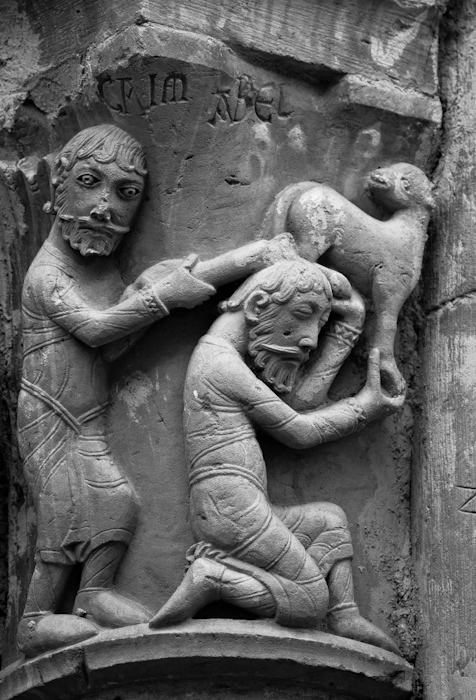
Yesterday’s brief post on Via Lucis Photography of Religious Architecture focuses on a capital of Cain and Abel in a Romanesque church.

Photograph by Dennis Aubrey of Via Lucis Photography of Religious Architecture

Photograph by Dennis Aubrey of Via Lucis Photography of Religious Architecture

Like the Genesis writer, the Medieval artist whose hand crafted the story in stone many centuries later was doing theology and anthropology. The biblical author told the story with words; the Medieval sculptor told it with non-verbal communication.

The face of Cain on Via Lucis held my attention long after I’d gone on with the day. It kept returning to mind.

Cain’s head isn’t turned toward Abel whom he is pummeling to death with his stave. He’s looking away from Cain at someone or something else, as if to say the viewer, “So, you think I’m cruel. You think I’m different. You’re looking in the mirror.”

In the biblical story God tells Cain, “sin is crouching at the door; its desire is for you, but you must master it.” The Medieval sculptor’s art seems to be saying it in stone. Cain’s head is cocked, his eyes looking at us. At you. At me.  And, perhaps, at God, to whose failure to rescue Abel he shifts responsibility: “Am I my brother’s keeper?”  The capital seems to say Cain knows he owns us and the endless history of violence in which the blood of the silent victims cries out from the ground, unless and until we – persons, groups, religions, races, cultures, nations, a species – master the sin that’s forever crouching at our door.

  • Gordon C. Stewart, Chaska, MN, October 16, 2015


Hope from the Bowels of Forsakenness

Vulnerable. Weak. Lonely. Frightened. Anxious. Forlorn. Forsaken.

The hospitalized teenager suffering a sudden, undiagnosed illness of the bowels, wondering whether he’s dying, fearful there is no cure, came to my attention during the day. The consciousness of it remain through the night. Awakening in the morning, I look for something that will speak to the helpless feeling of his parents and grandparents.

Opening the Psalter, the opening verse of Psalm 22 leaps from the page — “My God, my God, why have you forsaken me?” — the tortured cry from the cross Jesus quoted many centuries after Psalm 22 had embedded itself in the collective consciousness of the Jewish people.

That the Newer Testament Gospels would put these words on Jesus’s lips is, it strikes me this morning, a Jewish code to look deeper for something much more complex, both tragically realistic and surprisingly hopeful in the psalm’s entirety. Though the forsakenness cry repeats itself immediately — “Why are You so far from helping me, and from the words of my groaning?” — Psalm 22 goes on to recall poetically the existential-spiritual history of Israel’s suffering at the hands of the nations and its deliverance from the same, ending with “They (i.e., our descendants) shall come and make known to a people yet unborn the saving deeds that He has done.”

Jesus’s cry from the cross strikes me as the kind of cry we might read or hear in the writings of Auschwitz survivor Elie Wiesel – honest yet faithful to the Jewish tradition because the tradition itself expresses the horror of god-forsakenness and faith in the absent God at the same time.

Jesus on the cross has this history in his bowels and his bones. The teenager in the hospital has no active faith community, no wisdom tradition or practice, except for the faith and prayers of his grandparents whose faith has been kept at a distance for many years.

The week before learning of the teenager’s plight I had been filled with questions about another young man: the 26 year-old who gunned down the nine students in Oregon who suffered a nano-second of god-forsakenness in the classrooms where they had presumed to be safe from death at the community college that became their execution chamber. The grizzly scene of the shooter asking people about their faith, telling those who rose that they were about to meet their Maker, chilled me to the bone, raising the question of what the shooter’s experience of Christians had been that would so fill him with anger at them and their religion. Was he one of the many in America who, for reasons explainable or inexplicable, feel forsaken and despised? Alone. Isolated. Scorned. Forlorn. Angry.

To be human is to be intrinsically vulnerable. We are all at risk; all headed inevitably toward death. We are not immortal, eternal, timeless, invulnerable. Was the young man turned executioner mocking his death row victim’s belief in an afterlife? Was he saying loudly that there is nothing on the other side of death – a message to the world that this is all there is and that religion is a cruel hoax?

Death is our common lot, but the irony is that it does not wait until the end; it takes hold of us in the middle – between birth and death – as much as at the end. The foreshadowing of it sends us running for cover, running for relief, for an escape. It appears under the guises of control, power, invulnerability. Sometimes its disguise is a pistol or an assault rifle. Other times its disguise is religion that entertains illusions of immortality, belief systems that include and exclude, like “are you a Christian?”

This morning I’m freshly struck by the entire Psalm whose first line has echoed through the centuries every Good Friday: “Eloi, Eloi, lama sabachtani?” —“My God, my God, why have your forsaken me?”. I’m wishing our bowels could hear it, feel it, digest it, weep it, and find the hope and trust that smiles the conviction that the forsakenness we feel is not the final word.

  • Gordon C. Stewart, Chaska, MN October 8, 2015

A Hopeful Prayer for Healing

A prayer for a sick person named “C______”:

Gracious God,

We know how to pray for sick C______, and, indeed, for anyone (including ourselves). Your child, Jesus, taught us to pray for daily bread, forgiveness, for You not to lead us into temptation, AND TO DELIVER US FROM EVIL!

Cancer is evil (as are heart attacks, brain tumors, diseases beyond number, and your last enemy, death.) Deliver C______, and us all. We pray for healing and full health.

We also know, however, even Jesus did not heal everyone, that not all His prayers were answered, even His prayer “If possible, may this cup pass from me.”

If healing is impossible, remind us of Psalm 23, and that in the shadow of death, we can know You are with us, fear no evil, and be comforted. Amen.

  • Steve Shoemaker, Urbana, IL, October 7, 2015

Daily Riches: Without Excuse or Defense Before God (Thomas Merton)

Pope Francis quoted Thomas Merton. Here’s more thought-provoking Merton.

Bill Britton's avatarRicher By Far

“ …we should let ourselves be brought naked and defenceless into the center of that dread where we stand alone before God in our nothingness, without explanation, without theories, completely dependent upon his providential care, in dire need of the gift of his grace, his mercy and the light of faith. …But when the time comes to enter the darkness in which we are naked and helpless and alone; in which we see the insufficiency of our greatest strength and the hollowness of our strongest virtues; in which we have nothing of our own to rely on, and nothing in our nature to support us, and nothing in the world to guide us or give us light – then we find out whether or not we live by faith.” Thomas Merton

“I saw the Lord, high and exalted, seated on a throne;
 and the train of his robe filled the…

View original post 318 more words

A prisoner of my own violence

Pope Francis quoted the American Cistercian monk Thomas Merton in his address to Congress.

“I came into the world. Free by nature, in the image of God, I was nevertheless the prisoner of my own violence and my own selfishness, in the image of the world into which I was born. That world was the picture of Hell, full of men like myself, loving God, and yet hating him; born to love him, living instead in fear of hopeless self-contradictory hungers.”

Perhaps Mark had something like that in mind when he attributed to Jesus a grotesque instruction about following in the way of Christ. The images of Mark 9 are ludicrous, violent, grotesque.  Cut off a foot or a hand. Tear out your eye if it causes you to “stumble” — if it causes you to lead a child toward the fire of hell.  It is better to enter the Kingdom of God with one eye than to enter hell with two.

Author Flannery O’Connor seems to have known the genius of these jarring metaphors.

“I use the grotesque the way I do because people are deaf and dumb and need help to see and hear.”

Watching the news of grotesque crimes against humanity, we ask how anyone could behead another human being. How, indeed? And always in the name of God, in the name of righteousness, the children of light against the children of darkness.

Jesus’ words from Mark 9 were read aloud last Sunday in many churches around the world. They are as off-putting now as they were spoken into an earlier violent time, a world that was for Jesus and for Mark what Merton’s was for him: a picture of hell.

But for Jesus, the word we translate “hell” was not a place of divine punishment. It was the name of a place outside of Jerusalem. Paul Nuechterlein writes in last week’s Girardian Reflections:

‘Gehenna’ in Mark’s Greek rendering would have been ‘Ben Hinnom’ in Jesus’ own Hebrew/Aramaic. It’s the valley referred to in Jeremiah 7:30-33:

For the people of Judah have done evil in my sight, says the LORD; they have set their abominations in the house that is called by my name, defiling it. And they go on building the high place of Topheth, which is in the valley of the son of Hinnom, to burn their sons and their daughters in the fire — which I did not command, nor did it come into my mind. Therefore, the days are surely coming, says the LORD, when it will no more be called Topheth, or the valley of the son of Hinnom, but the valley of Slaughter: for they will bury in Topheth until there is no more room. The corpses of this people will be food for the birds of the air, and for the animals of the earth; and no one will frighten them away.

‘Hell,’ ‘Gehenna,’ ‘ben Hinnom’ is the place of human sacred violence that has never even come into God’s mind. It is our violence that we need to fear, not God’s. Jesus is speaking grotesquely of lesser sacrificial violence like cutting off one’s hand, as being better than amped-up sacrificial violence like the child sacrifice of Jeremiah’s day — or the Nazi Holocaust of our day. [bold print added by VFTE]

Self-criticism, prayerful introspection, the opening of one’s own divided heart to Divine judgment and mercy are the stuff of which heaven is made; hell would be when we remain prisoners of our own selfish violence, a place filled with people just like me.

  • Gordon C. Stewart, Chaska, MN, September 28, 2015.

Pope Francis and Speaker Boehner

Is it a coincidence that Speaker John Boehner announced his resignation the morning after his invited guest, Pope Francis, spoke to a joint session of Congress?

Pope Francis and John Boehner - Joint Session of Congress

Pope Francis and John Boehner – Joint Session of Congress

Before his address to Congress yesterday Pope Francis turned to the two former altar boys behind him on the dais.  He looked quickly at Vice President Joe Biden; he looked much longer into the eyes of his host, Speaker John Boehner. It was warm but it also seemed like something else – a moment between a priest and penitent?

The Speaker wiped his eyes, as any faithful Catholic would be prone to do.  He cried, as he often does, but this time as if to ask in humility, “Who am I, John Boehner, a mere altar boy, to share this powerful platform with the Holy Father? I am not worthy that you should come under my roof.”

One had to ponder Mr. Boehner’s inner turmoil listening to the Pope’s words gently reprimand leaders who forget the Golden Rule, push aside the poor, ignore or criminalize immigrants and migrants, prefer aggression to dialogue, ignore the common good for private gain, put people on death row, and refuse to act responsibly on climate change.

What do you do sitting behind the Pope?

You take out your handkerchief at the great privilege of hosting the Pontiff and the honor of being in his presence, but perhaps also because you recognize the prevalence of sin, as in Francis’ quotation from Thomas Merton (see quotation below) or his choice of the socialist Dorothy Day of the Catholic Worker Movement as one of four Americans to emulate.  And, if you haven’t already done so in your private time with the merciful Pope Francis, you might go to confession, repent, and do penance.

This morning John Boehner announced his resignation as Speaker of the House at the end of October. Preparing to speak to the United Nations in New York, one can imagine Pope Francis blessing John while lamenting Boehner’s colleagues’ loud cheering, wondering whether anyone but Joe and Johnny was paying attention the day before.

  • Gordon C. Stewart, Chaska, MN, Sept. 25, 2015

Quote from Pope Francis commendation of Thomas Merton as an American example to follow:

A century ago, at the beginning of the Great War, which Pope Benedict XV termed a “pointless slaughter”, another notable American was born: the Cistercian monk Thomas Merton. He remains a source of spiritual inspiration and a guide for many people. In his autobiography he wrote: “I came into the world. Free by nature, in the image of God, I was nevertheless the prisoner of my own violence and my own selfishness, in the image of the world into which I was born. That world was the picture of Hell, full of men like myself, loving God, and yet hating him; born to love him, living instead in fear of hopeless self-contradictory hungers”. Merton was above all a man of prayer, a thinker who challenged the certitudes of his time and opened new horizons for souls and for the Church. He was also a man of dialogue, a promoter of peace between peoples and religions.

[Bold print added for emphasis by Views from the Edge]

Do prairie grasses ever get depressed?


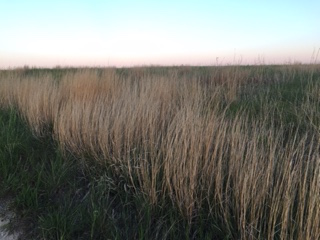
Prairie grassland, Photo by Kay Stewart

Prairie grassland, Photo by Kay Stewart

Each alone and
all together
planted on
the prairie plain
we go nowhere
in sleet and snow
wind and rain
scorching heat
and frigid cold
sun and drought
quarter moons
half moons
three-quarter moons
full moons
no moons
starless nights
and starlit nights
we stay and wait
for nothing in
particular knowing
who and where
we are — a prairie
grassland sown
for us to be our
own true selves
together and alone.

– Gordon C. Stewart, Hutton Niobrara Ranch Wildlife Sanctuary near Bassett, Nebraska, September 23, 2015.

Morning Fog and the Horizon

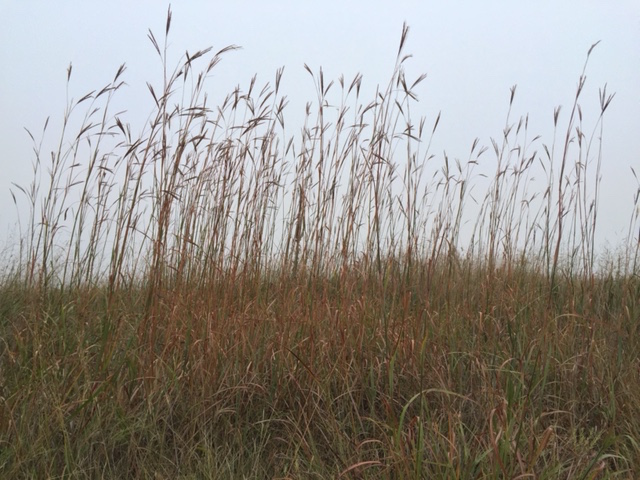
The horizon disappears behind the morning fog.Prairie grasses in fog

Tall grasses that yesterday colored the prairie as far as eye could see are still there. Only the nearest 100 feet of the rusty red, yellow, and brown prairie grasses now appears, the rest only imagined behind the gray mist curtain.

The Nebraska prairie and its earth-tone colors are native to Kay. They’ve been less appreciated by her husband, raised on the tree-covered hills and the bright ocean blues and greens, dotted occasionally with sumac red and willow yellow, of the Northeast Coast.

The Hutton Niobrara Ranch Wildlife Sanctuary, this 5,000 acre wildlife refuge of Audubon of Kansas, feels unspoiled by human hands, except for the indigenous people who long ago vanished with the buffalo along the Niobrara River.

By noon the fog is still here. So are the earthen colors. What’s changed is the Yankee’s fresh appreciation for the intrinsic beauty of the browns, yellows, and rusty reds he once viewed as the dull, faded colors of boredom and decay.

The Earth is a splendid place to live. Morning fog blew in years ago over Old Garden Beach in Rockport, Massachusetts leaving only the gray granite, red sumac and pink primrosed white picket fence visible to the eye. Then and now, there and here, life is wrapped in mist and wonder. The horizon disappears in morning fog.

  • Gordon C. Stewart, Hutton House, Hutton Niobrara Ranch Wildlife Sanctuary, somewhere near Bassett, Nebraska, September 22, 2015.

Daily Riches: Cutting Through Political and Religious Illusions (Vernon Howard, Thomas Merton and Dietrich Bonhoeffer)

Bill Britton's avatarRicher By Far

“Every day that you attempt to see things as they are in truth is a supremely successful day.” Vernon Howard

“It seems to me that the most basic problem is not political, it is apolitical and human. One of the most important things to do is to keep cutting deliberately through political lines and barriers and emphasizing the fact that these are largely fabrications and that there is another dimension, a genuine reality, totally opposed to the fictions of politics…. My own peculiar task in my Church and in my world has been that of the solitary explorer who, instead of jumping on all the latest bandwagons at once, is bound to search the existential depths of faith in its silences, its ambiguities, and in those certainties which lie deeper than the bottom of anxiety. In those depths there are no easy answers, no pat solutions to anything. It is…

View original post 297 more words

The Mason of God (Dennis Aubrey)

Dennis Aubrey's avatar

In a world where what passes for news are articles about the megalomaniac Donald Trump, the Kardashians, and the Jenners, we occasionally find something worth consideration.

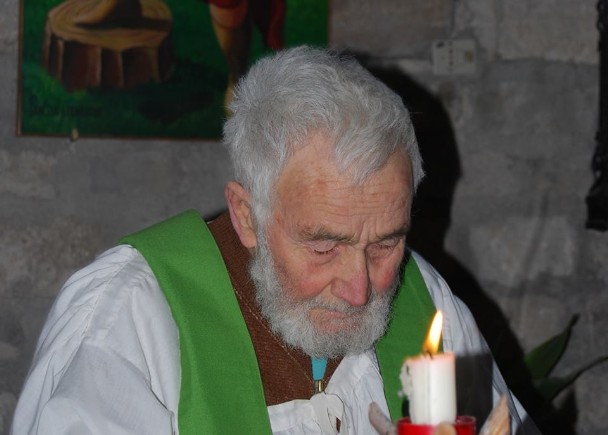
On August 25 a funeral mass was celebrated in the Italian town of Montefortino at the chiesa della Madonna dell’Ambro. The recipient of the mass was a Capuchin friar, Padre Pietro Lavini who lived as a hermit in the Sibylline Mountains near Rubbiano Montefortino and along the Gola dell’Infernaccio, the Gorge of Hell. A thousand people attended the service of the man who died two weeks prior, on August 9, 2015.

Why did they come to this mass? What did Padre Pietro accomplish with his life as a hermit?

Padre Pietro Lavini, photo from Santuario Madonna dell'Ambro Padre Pietro Lavini, photo from Santuario Madonna dell’Ambro

In 1971, Padre Pietro discovered the ruins of the Eremo di Santo Leonardo, an abandoned 12th century Benedictine monastery in the wilds of the Sibyllines. All…

View original post 251 more words