Eve of the Climate Summit

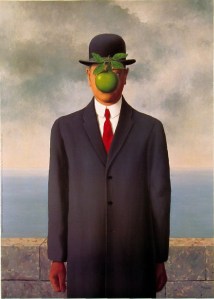
Son of Man, René Magritte (1898-1967)

Son of Man, René Magritte (1898-1967)

Son of Man, René Magritte’s self-portrait with the green apple in front of his face, seems equally appropriate for the First Sunday of Advent and the opening of the United Nations Climate Summit in Paris.

What Magritte meant by hiding his face (except for one eye) with the apple is left to the imagination.

To this viewer the apple’s presence in front of a man of civilized sophistication – bolo hat, buttoned-up dark suit, fitted white shirt, and perfectly knotted red tie – moves imagination in two directions.

The first is often discussed by art critics: the Genesis story of the Fall and the forbidden fruit – the serpent’s whisper that the creatures in the garden could “be like God” by stepping over the one limit imposed on their behavior by a paradisiacal ecosystem.

On this eve of the World Climate Summit, a second interpretation comes to mind – the primacy of nature – the green apple. For all our sophistication, we are nothing without the green planet whose green-ness climate change places at risk.

Magritte’s Son of Man opened me to hear today’s assigned Hebrew Scripture from the Revised Common Lectionary with different ears.

The days are surely coming, says the LORD, when I will fulfill the promise I made to the house of Israel and the house of Judah.

In those days and at that time I will cause a righteous Branch to spring up for David; and he shall execute justice and righteousness in the earth. [Jeremiah 33:12-14]

A righteous branch yet may spring up in Paris. If it does, it will be green. One can pray that the Climate Summit representatives arrive in Paris without their bolo hats, starched white shirts, buttoned-up suits, and power ties, ready to concede finally that, despite all appearances to the contrary, all is nothing without green.

  • Gordon C. Stewart, Chaska, MN, Nov. 29, 2015

Standing Up for Others

The front page of today’s Champaign-Urbana News-Gazette carries a feature article on Steve Shoemaker, as in Views from the Edge with Gordon and Steve. This photo of “Welcome the Stranger” includes a note from Steve’s daughter, one in which Steve’s friends heartily concur.

Steve Shoemaker: "Welcome the Stranger"

Steve Shoemaker: “Welcome the Stranger”


Verse – A Septet of Gratitude

Seven blessings seven prayers,
Leave for now our many cares.
Light a candle, sing a song,
Join with others, do no wrong.
Friends and family, music, art,
Books, food, knowledge–play a part;
Thoughts arrive: thanks, I’m alive.

  • Steve Shoemaker, Urbana, IL, Nov. 25, 2015

Thanksgiving

“If the only prayer you said in your whole life was, ‘Thank you,’ that would suffice”. – Meister Eckhart (1260-1328).

  • Gordon C. Stewart, Lincoln, NE, Thanksgiving Day, 11.26.25

A Prayer for “Mommies and Daddies”

What would happen if the children wrote all the prayers?  Children age 3 through 5th Grade at Trinity Episcopal wrote The Prayers of the People used in worship the last few weeks. Each prayer was followed by a brief reflective silence.  One of the children led the prayers.

Let us pray for our neighbors and our neighborhood.

Let us pray for our families and friends: our mommies and daddies, our grandparents and great-grandparents.

Let us pray for the world and the universes.

Let us pray for our pets and the animals of the world: Millie, Cokie, puppies and cats.

Let us pray for those who have illnesses, our sick grandparents, heart disease, cancer, and memory loss.

Let us pray for those going through rough times, mentally and physically.

Let us pray for those who have died everywhere and those who have died that are close to us.

Let us pray for everyone.

[The Prayers of the People concluded with a prayer written by the priest who works with these little ones:]

Holy and gracious God, we are too often blinded by trivial matters. May our attention be diverted now from these things, and may we become as little children, trusting and seeking with love to cross bridges we have not crossed in the past.

Amen!

  • Gordon C. Stewart, Chaska, MN, October 23, 2015.

Sermon: Testify to the Truth

Yesterday’s Christ the King Sunday sermon by Rev. Anne Miner-Pearson on John 18:33-37 at Trinity Episcopal Church in Excelsior deserves a greater audience. We’re pleased to publish it on Views from the Edge.

“Testify to the Truth”

Pontius Pilate with his Prisoner - Antonio Ciseri

Ecce homo – “Here is the man”

Pilate and Jesus are an odd couple. We usually meet them in Holy Week when their conversation is part of Jesus’ journey to his crucifixion. Because Good Friday and the cross are looming closer and larger, we pause only briefly in Pilate’s headquarters. But today is Christ the King Sunday and we encounter this odd couple under different circumstances. We are on the cusp of the Church year – the end of 52 Sundays facing into Sunday, Advent I, awaiting God’s move to enter human flesh as Jesus, beginning his life in birth like us, and ending his life in death like us.

Yet, before our church year begins, tradition asks us to pause and hold on to the bigger story of Jesus. There is a larger and more eternal back-story to the one that opens with shepherds, a star, some straw in a manger and even Mary. There is another birth story in John’s gospel and we enter toward the end as Pilate and Jesus talk. What an unlikely conversation it is. Pilate, Pontius Pilate, the 5th prefect of the Roman province of Judaea calls – no, “summons” – an accused religious heretic to his headquarters. Pilate has already questioned the Jewish leaders and could be done with the matter. Undoubtedly, he has more important issues awaiting his attention than dealing with the process leading to a crucifixion. They happen all the time and aren’t on his radar.

So, they are an odd couple. A man with impeccable Roman familial and political credentials, Pilate stands in expensive robes, perfumed and fresh from his morning bath. Jesus’ home address is Nazareth. His profession listed as carpenter. His clothing hardly deserve the name – practically rags after the torture and stripping, smelly from sweat and blood. But Jesus is no country bumpkin. He knows at least 4 languages – Aramaic, Hebrew, Greek and the Latin he uses with Pilate. However, Jesus’ linguistic skills don’t make him a king. Yet, that is the direction the conversation goes.

“Are you the king of the Jews?”, Pilate begins, a question Jesus later returns to. “My kingdom is not from this world.”, Jesus answers. “So you are a king?”, Pilate inquires. With that question, Pilate introduces what makes him and Jesus the oddest pair. They are both “kings”, but the descriptions are polar opposites: Power-Love, Higher-Lower, Divided-One, Hold on-Give away, Boundaried-Open, Petty-Generous, Unjust-Just, Manipulating- Embracing, Triumphant-Humble.

Yet, Jesus, without actually answering, takes the title of “king” in a whole different direction. “For this I was born, and for this I came into the world, to testify to the truth.” Here Jesus tells his own “nativity” story, but remember, this is John’s gospel. To understand what Jesus is saying to Pilate as his earthly life is about to end, we have to go back to the beginning, way back to the beginning to understand Jesus’ kind of king.

“In the beginning was the Word and the Word was with God, and the Word was God. He was in the beginning with God. All things came into being through him, and without him, not one thing came into being. What has come into being in him was life, and the life was the light of all people….. And the Word became flesh and lived among us…”

Jesus understands himself as king and where his kingdom is from radically different. Pilate doesn’t get it. The crowds don’t get it. Even Jesus’ close disciples haven’t gotten it yet. In that humble peasant, from the virgin womb of Mary, God entered the world, breaking through all categories, possibilities and imaginings. The Word of God who first spoke all creation and universes into being now has spoken again. A second holy Word took form but this time the birth came as God was and is willing to become empty. The apostle Paul captures it in the mystical hymn in Philippians: “…thought he was in the form of God, did not regard equality with God… but emptied himself, … being born in human likeness.” Jesus’ kingdom is not from this world, but in this world, grounded in and flowing from the eternal God, what we now call the Trinity: God, Creator, God, Christ, and God, Spirit.

It’s like when God birthed the created worlds, God already had another birth in mind. God’s Word would speak another creation. The Spirit Breath who give human life and form from the dust was not finished. The Trinity was not complete until the human experience could join in the circle, the abundant, ever-flowing Love. And now God’s experience in human form nears the end, the pain and suffering of crucifixion.

But, ponder this thought by a contemporary mystic, Bernadette Roberts. Maybe the hardest thing for Jesus was not the crucifixion, but the incarnation – to leave the circle and connection of Love to learn and teach how to hold on to and live in that flow of Love caught in bodily form. And we can picture that Circle, can’t we, the world of Christ the King, the kingdom Jesus is from. It’s the picture we see on the icon of the Trinity by Rublev.

Angels at Mamre Trinity, Rublev

Angels at Mamre Trinity, Rublev

We all know it – the beloved the one we take with us on vacation and hold up for photos on Facebook. I brought my personal one this morning and it’s on the altar. It was “written” in 2000, (the verb used when making an icon) by Eugenia. At that time, she was imprisoned in the largest women’s prison in Europe, outside of St Petersburg, Russia. Her crime was counterfeiting. However, Father Nicolai, pastor to the prison, thought her counterfeiting skills could be redeemed. Released under Father Nicolai’s watch, Eugenia was taught icon “writing” to help support her 3 daughters. Before she paints the copy of an icon, Eugenia goes through all the traditional rituals, including prayer and fasting.

Through the vision of a monk on Mount Athos, Greece, around 1260, and the hand and heart of an alcoholic felon, we see the “dance of the Trinity” – gathering in communion, gazing in a circle of love, pouring out within and beyond that Love to all creation. Given the three figures dominating the scene in their bright robes and adoring gazes, perhaps you have missed a small detail in the icon. I have. It was just pointed out to me recently. It’s under the table, a small brown box.

An ancient story about the the Rublev icon is that originally there was a mirror on top of the box. So, as one sits in front the icon and ponders the kingdom of God, the Trinity, one is able to see oneself as the fourth figure in the circle, at the table, in the flowing love always moving, expanding, tumbling out to all creation, in all time. From the beginning, God envisioned a fourth place in the Love.

Jesus said, “For this I was born, and for this I came into the world, to testify to the truth.” “Pilate asked him, ‘What is truth?'” Jesus spoke no answer that day. His life was and is the answer. The truth Jesus lived and died is that each of us, Eugenia, Pilate, all people have a place at God’s Table, in God’s heart, in Christ the King’s kingdom. Our response is to see ourselves in the mirror and claim our place. Amen.

“Fear is the ammunition of terror”

On November 17, the  Office of the General Assembly of the Presbyterian Church (USA) issued the following letter from its top official following terrorist attacks in Paris, Beirut, Baghdad, and Egypt:

“We are a world grieving. We mourn the many deaths, not only in Paris, but also in Beirut, Baghdad, and Egypt. Any sense of security we have had is badly compromised by these horrific events; moreover, our fear of ISIS grows with every successful execution of its violent agenda.

“Much has been taken from us but we still hold the choice as to how we react in our grief and fear. Many politicians have rushed from grief to fearful judgment. More than half of the governors of our states have attempted to protect their citizens by issuing declarations denying entry of Syrian refugees into their states (as if all of the potential terrorists are Syrian). Some have gone so far as to call for denial of entry to all refugees at the present time, as if that will guarantee safety to the citizens of their state.

“As U.S. governors pledge to refuse Syrian refugees within their states and some presidential hopefuls promise to abandon the refugee program altogether, we the people have a choice to make. We can choose to follow those who would have us hide in fear or we can choose hope.

“Our nation, for decades, has chosen hope and welcome for those fleeing war and persecution. Since 1975, more than three million refugees have found safety and security within our nation’s borders. Right now 11 million Syrians cannot go to school, tend to their land, or raise their children in the place they know as home. They cannot do these things because they, themselves, have been terrorized for far too long by numerous factions, including their own government.

“Do we choose to abandon our plan to protect these Syrians because the people who have been threatening them are now threatening the West as well? ISIS has taken lives; they have taken our sense of security. Do we now hand over our hope and compassion to them?

“Obviously, we need to move forward with a disciplined response, expediting security checks such as those employed by the U.S. refugee admission program. To refuse certain persons who are fleeing terror and persecution because they are “Syrian” or of some other particular ethnic group is unjust and may be illegal under U.S. law. We can be disciplined and, at the same time, led to love beyond our own limited, fearful vision.

“After the crucifixion of Jesus, the disciples hid in fear. They locked the doors but God had another plan. Jesus appeared to them and said, “Peace be with you. As the Father has sent me, so I send you” (Jn. 20:21). We were not meant to hide. We were meant to walk out in hope and compassion. Author, poet, and peace activist Wendell Berry wrote, “Healing is impossible in loneliness; it is the opposite of loneliness. Conviviality is healing. To be healed we must come with all the other creatures to the feast of Creation” (The Art of the Commonplace: The Agrarian Essays, “The Body and the Earth,” p. 99). The way to end terror is to prove that those who demonize us are wrong. We are not a heartless secular culture. We must witness to the Gospel with generous hospitality. To hide in fear is a mistake. Fear is the ammunition of terror. Hope is the best defense.

Gradye Parsons, Stated Clerk

Office of the General Assembly, Presbyterian Church (USA)

Louisville, KY

  • Gordon C. Stewart, Chaska, MN, Nov. 21, 2015.

Church ready to house Syrian refugees

News on Philo Presbyterian Church and Muslim Syrian refugees

News on Philo Presbyterian Church and Muslim Syrian refugees

Muslim Clerics declare “ISIS is un-Islamic”

Before Beirut and Paris, 1,ooo+ Muslim clerics in India issued a Fatwa against ISIS  declaring, “The acts of the Islamic State are inhuman and un-Islamic.” The Associated Press report was published September 9, 2015. Click the link above to read the story.

Also in September, NPR aired Prominent Muslim Sheikh Issues Fatwa Against ISIS Violence, re-aired yesterday. Posts like these deserve wider attention.

Meanwhile, a very small Christian church in the little town of Philo, Illinois, drew attention in the local paper for its consideration of hosting Muslim Syrian refugees.

News on Philo Presbyterian Church and Muslim Syrian refugees

News on Philo Presbyterian Church and Muslim Syrian refugees

  • Gordon C. Stewart, Chaska, MN, November 18, 2015.


O God of Earth and Altar

While the world holds its breath after the attacks in Paris, we’ve searched for hymns that express in music a word worth hearing.

“O God of Earth and Altar” expresses a sense of prayerful resilience and supplication.The lyrics, written by G.K. Chesterton in 1906, were revised, in part, by Jane Parker Huber to address global terrorism:

From all that terror teaches, From lies of pen and voice, From all the easy speeches That make our hearts rejoice, From sale and profanation of honor and the sword, from sleep and from damnation, deliver us, good Lord.”

Already U.S. governors have made “easy speeches” about not accepting any Syrian refugees in their states, although it is not within their jurisdiction to decide. And, while we pray, the arms industry is preying on war’s alarms to increase production,  sales and profits in the name of our safety and security.

Here’s “O God of Earth and Altar” sung to Chesterton’s original lyrics.