Trapped in the Schemes They Have Devised

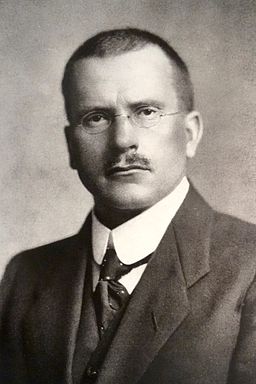
Carl Jung
Carl Gustav Jung (1875-1961)

Over the years I’ve had a problem with the “us versus them” voice of some psalms of the Book of Psalms. The division of humankind into the ‘righteous’ and the ‘wicked’ leaves me cold. Often I have wanted to recommend to the psalmist a session or two on a Jungian analyst’s couch to get in touch with the ‘shadow’. But, in other times, like the one through which we’re living in America, the psalmist’s poetry is without parallel in giving voice to what I feel. Psalm 10 is one of them.

Psalm 10 is a cry for help in a time of trouble when God seems far off, as though hiding, while “the wicked arrogantly persecute the poor” (v.1), but it also holds a conviction that the persecution is only for the moment. Why? Because, already, the arrogant “are trapped in the schemes they have devised” (verse 2).

Their ways are devious at all times; 

Your judgments are far above out of their sight; 

they defy all their enemies.

They say in their heart, “I shall not be shaken;

no harm shall come to me ever” (v.5).

….

Their mouth is full of cursing, deceit, and oppression;

under their tongue are mischief and wrong (v. 7).

…. 

They lurk in ambush in public squares

and in secret places they murder the innocent;

they spy out the helpless. 

They lie in wait, like a lion in a covert,

they lie in wait to seize upon the lowly

they seize the lowly and drag them away in their net.

The innocent are broken and humbled before them;

the helpless fall before their power (vs. 7-9).

Sometimes the most poignant insights come from the psalmist’s couch. I read the Psalms most every day. I still remember what I’ve learned from Jung about my ‘shadow’ and the fear within me that paints ‘the other’ as wicked, wrong, or wretched. I know that the finger that accuses others often points back at my own sorry self. But the faith I was taught and still practice equally reminds me that anger has a rightful place when the lowly are broken, humbled, and dragged away in the net of the powerful. I remember the ‘righteous’ anger of Amos and the rest of the prophets. I remember Jesus.
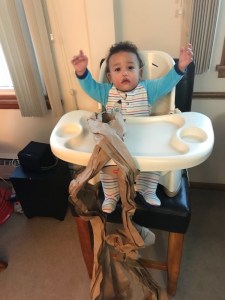
Elijah in high chair
Grandson Elijah safe at home.

I see my grandson, Elijah, safe at home with his family in Minnesota, and think of all the children wrenched from their parent arms at the Mexican border. I live in hope that, though innocent children have been carried away to unknown places by the Administration’s net, it is only a matter of time before those who have made them orphans are themselves “trapped in the schemes they have devised.”

– Gordon C. Stewart in the wilderness, August 29, 2018.
The Day My Head Hurt

images_headache-drawing-12You’ve had days like this. I know you have. Days when everything hurts. Days when you open your eyes and can’t see, or wish you couldn’t see. Days when, if you have hearing aids, you put them away. Days when your head hurts, though you have no headache. Days when what you cherish is belittled, twisted, misrepresented, and assaulted.

The dedication of the U.S. Embassy in Jerusalem was a day like that. NPR ran the story that gave voice to why it hurts so badly in 2018. The American Administration’s selection of Robert Jeffress and John Hagee, both evangelical religious exclusivists with views that are marginal to the American mainstream, rubbed against the grain of traditional American values of respect, propriety, and decency. At no time in my memory has the United States handed the people’s microphone to representatives know for insulting the host nation’s religion and way of life. But NPR can’t voice the part that hurts this writer.

I look and listen as a retired Christian pastor who claims the same tradition President Trump calls his own. We were both confirmed in the Presbyterian Church (USA). Some of us remember what the president seems to have forgotten in confirmation classes. The Presbyterian-Reformed tradition of the Christian faith does not claim exceptional status among the world’s many religions. It calls for respect. The Presbyterian Church’s Confession of 1967 expresses it this way.

Christians find parallels between other religions and their own and must approach all religions with openness and respect. Repeatedly God has used the insight of non-Christians to challenge the church to renewal. But the reconciling word of the gospel is God’s judgment upon all forms of religion, including the Christian. [Confession of 1967, 9.24]

God is bigger than any belief, creed, or religion. Claims to divine favoritism that confine the Divine within the borders of national or religious geography blaspheme God’s ubiquitous presence and freedom. As the late Kosuke Koyama put it, the God of Jesus is a spacious God! Not a house god or national god.

We also believe that the reconciling gospel of Christ calls the church and its people search actively  for cooperation and peace, “even at risk to national security“.

C 67The president’s overtures to North Korea and Russia have given reason to wonder whether perhaps he is following that spirit of The Confession of 1967. But, then, I hear the name calling, the insults, the braggadocio, and remember the dedication of the U.S. Embassy in Jerusalem, and the headache threatens to become a migraine. But I have learned over the years since confirmation class that, though the loudest voices often hold the microphone, there is an inverse relation between loudness and truth, volume and good sense, loud clashing cymbals and the still small Voice that cannot be silenced.

  • Gordon C. Stewart, Chaska, MN, August 20, 2018,


No one owns a woodpecker!

Pileated_Woodpecker_(9597212081),_crop

Pileated Woodpecker

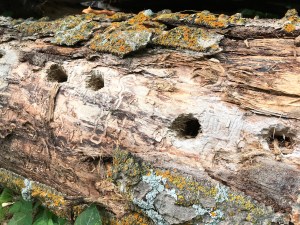
It was only a matter of time. Its girth was huge — much too big to get our arms around. Its top had fallen off. What remained was filled with gaping holes, but still standing at the southwest edge of the land with the cabin by the wetland. 

The tree had stood here decades before we imagined ourselves to be its owners last August. We paid good money to buy the property, including the naked tree that had not yet fallen. It was only a matter of time before it fell. It concerned us that it would topple on someone playing on the back of the yard — Barclay, the canine member of the family, one of the grandchildren, or the grounds-keeper who comes by every three weeks — but not enough to take it down. It continued to stand there with a still attached heavy limb causing it to lean slightly toward he east. It would fall of its own weight or by a lightning strike in due time. 

IMG_1546Tom, the Mennonite grounds-keeper, found the upper parts of the dead tree on the lawn last week while we were away. Its five-feet girth logs now serve as a barrier between the woods and the open space where the cabin sits. There’s no one left to remember how old the tree was, and what remains of it is too rotten to identify the rings. But the fallen tree that once fed the pileated woodpeckers continues to serve the community as a grocery for ground-feeding birds and other animals that feast on the termites and carpenter ants that once drew the woodpeckers.
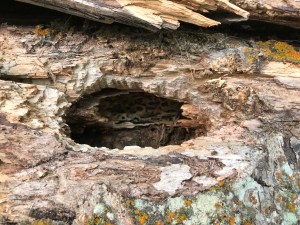
IMG_1547Property is only a matter of time. No one owns a woodpecker. No one owns an insect!

  • Gordon C. Stewart on the wetland, August 16, 2018.

The Dream of Brain Surgery

It was just a dream. Or was it?

1-The-Trial

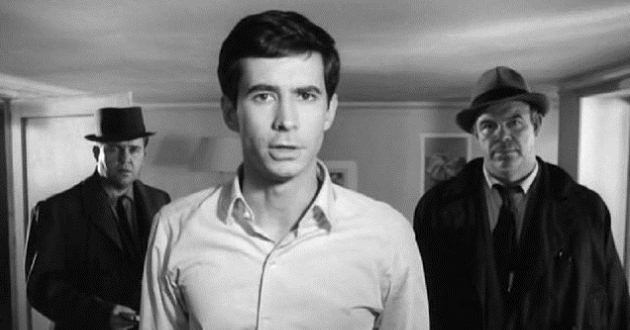
‘Josef K.’ in the film rendition of Franz Kafka’s The Trial

It woke me three nights ago, but it won’t go away. Against every conscious attempt to push it away, it is still demanding my full attention.

I had a headache that wouldn’t go away. A surgeon opened my brain and was pulling an animal from the side of my head: a big, brown rat, resisting the surprised surgeon’s efforts, and then another, while the other part of me in the dream watched and cringed. That was it. That was the dream.

From the time I was very young, nothing frightens me as much as a rat. I was five years old when I saw my first rat after the family moved into the 120 year-old house on Church Lane — the one with the open cistern and the huge hole in the basement wall. A rat would scurry across the kitchen floor after leaping from the kitchen cabinet my mother had just opened. At night I could hear the rats moving in the wall next to my bed in the upstairs bedroom. Occasionally a family cat would kill one and offer it to my mother as a present; the sight of the gift sent chills up my mother’s spine as much as if it had been alive. Mom was scared to death of rats. So was I.

The rats I learned to hate were not pet rats or the white rats of laboratory experiments. They were sewer rats who lived in the open cistern with the tunnel to our basement, like the beady-eyed creature that leaped at my father when he blew him out of the opening in the basement wall with a shotgun. I’ll be 76 in a few days, but in my mind, it happened yesterday. 

Which brings me back to the brain surgery dream three nights ago. The pain in my head came from the rat that lived there. The rat wasn’t leaping from a cupboard or scurrying through the walls; it lived inside my head. I was helpless to remove it. It took surgical intervention, and its presence in my head surprised the surgeon as much as the part of me that was observing the procedure.

The rat represents everything I don’t want to be. It’s ugly. It’s dirty. It’s sneaky. It’s vile. It doesn’t operate in the daylight. It does it’s business in the dark of night. And, if you don’t kill it, it may kill you. Even if you shoot it, it will leap for your jugular.

It doesn’t take a Jungian dream interpreter to “get” the symbolism of the rat inside my head. I have been, and still am, my own worst enemy. You can run from the evil inside you, but the guilt remains. Betrayal, deceit, denial, divorce, hiding in kitchen cupboards, scurrying in bedroom walls, living in the cistern beside the house where the human beings live.

I’ve long known the truth of Carl Sandburg’s poem “The Wilderness”: “O, I got a zoo, I got a menagerie, inside my ribs, under my bony head…”. Like the rest of the human race, I, too, have a wolf in me, and a fox, a hog, a baboon, a fish, an eagle, and a mockingbird in me. But I have an animal not listed in Sandburg’s menagerie. I got a rat inside my bony head.

Childhood fears never die. And, like a former pope who hated his predecessor so much that he became him, if one isn’t careful, one becomes what one fears and hates.

Where is the surgeon who can remove it? What practices can pull the rat from my head and the free me of the horror inside my ribs? Or, is the challenge to live with it the same way I’ve come to terms with the other members of the menagerie of me — to go face-to-face, eyeball-to-eyeball, and, after all these years of running from it, muster the courage to make friends with my own worst enemy?

Rat on a green background

The rats of my childhood disappeared when the opening in the basement wall was closed with brick and mortar and the cistern was filled with concrete. It will take more than bricks and concrete to remove the one in my head, but the process has started, and for that, I’m thankful.

“The self is a relation which relates itself to its own self,” wrote Soren Kierkegaard in The Sickness Unto Death. I was both the subject and the object in the dream, the self relating to its own self. There is light in the darkness. Hope abounds.

Gordon C. Stewart, Chaska, MN, August 2, 2018.

Sunday Morning

“[T]here is such a sense of stillness and peace that the wrong sort of movement, even one’s very presence, might be felt as an intrusion….” The photo and words by Oliver Sacks on David Kerrigan’s post rang a familiar bell this morning. We’re back in ‘civilization’ — far from the stillness and peace of the wetland, the birches, oaks, and pines — but knowing the senses of awe and intrusion of which the writer speaks. Thank you, David, for sharing. Thank you, Oliver. RIP.

  • Gordon C. Stewart, Chaska, MN, Sunday morning, July 29, 2018.

Live & Learn's avatarLive & Learn

I find myself walking softly on the rich undergrowth beneath the trees, not wanting to crack a twig, to crush or disturb anything in the least — for there is such a sense of stillness and peace that the wrong sort of movement, even one’s very presence, might be felt as an intrusion… The beauty of the forest is extraordinary — but “beauty” is too simple a word, for being here is not just an esthetic experience, but one steeped with mystery, and awe… Standing here…I feel part of a larger, calmer identity; I feel a profound sense of being at home, a sort of companionship with the earth.

~ Oliver SacksThe Island of the Colorblind


Notes:

  • Quote Source: Brainpickings
  • Photo: Pine trees stand forming a forest near Briesen, Germany, on Thursday. Brandenburg’s forests produce sustainable wood resources of roughly a million cubic meters. (Patrick Pleul, wsj.com, January…

View original post 3 more words

Words to Live by in the Twitter Era

Every day brings a new idea for a T-Shirt. We shared T-Shirt #1 yesterday. We weren’t thinking of a new product line at the time. But this morning another psalmic line caught our eyes and led to the idea of a T-Shirt franchise. We could call it ‘Psalms to Live by in the Twitter Era’ and advertise on Facebook and Twitter. T-Shirt idea #2 reads:

You have loosed your lips for evil,

and harnessed your tongue to a lie. 

(Psalm 50:19)

1*wH41mwA4_K9A6Zr26Pq6_wThen, later this morning, we learned that Twitter’s most prominent tweeter is now accusing Twitter of being biased against conservative Senators and senatorial candidates, which led to a second line of T-shirts: ‘Proverbs to Live by in the Era of DJT’. T-Shirt #1 of Proverbs to Live by in the Era of DJT would read: 


The man of integrity walks securely,

but he who takes crooked paths will be found out.

He who winks maliciously causes grief,

and a chattering fool comes to ruin.

(Book of Proverbs 10:9-10)

  • Gordon C. Stewart, on the wetland, where the only chattering and tweeting come from red-wing blackbirds and bluebirds, July 26, 2018.

Ancient wisdom on the art of deception

sojourner_truth_with_lincoln_a

Sojourner Truth and President Abraham Lincoln

Monday, after we’d read aloud Psalm 52, Kay proposed we create T-shirts with a simple message: ‘Psalm 52’. She was joking, of course. We’re not the sort to wear our religion on our chests! She had in mind the following lines.

You tyrant, why do you boast of wickedness

…all day long?

You plot ruin;

your tongue is like a sharpened razor,

O worker of deception.

You love evil more than good

and lying more than speaking the truth.

You love all words that hurt,

O you deceitful tongue.

O that God would demolish you utterly,

topple you, and snatch you from your dwelling…!

Yesterday we picked up a copy of the latest Star Tribune. The editorial, “Trump practices art of deception,” called Sunday night’s sharpened razor tweet from the White House to Iranian President Rouhani “another alarming distraction to take the spotlight from other news, such as the fiasco in Helsinki…” (Star Tribune, July 24, 2018).

Ancient wisdom is called ‘ancient’ because it’s old. It’s called ‘wisdom’ because it speaks plainly to things that never seem to go away. But you can’t put a whole psalm or an editorial on a T-shirt! The above picture of President Lincoln and Sojourner Truth would get the truth part. But a simple psalm # points to the ongoing tension between truth and the practiced art of deception.

‘PSALM 52!’

  • Gordon C. Stewart on the wetland, July 25, 2018

Leave Rage Alone

Stillness defines life at the cabin. It’s quiet. The only sounds are bird calls. It is this stillness that draws us here by the wetland. But my heart is not still. It’s preoccupied with evil. This morning’s assigned psalm from The Book of Common Worship (BCW) speaks to my condition.

Do not fret yourself because of evildoers…

For they shall soon wither like the grass…

Be still before the LORD…

Do not fret yourself over the one who prospers,

the one who succeeds in evil schemes.

Refrain from anger, leave rage alone;

do not fret yourself; it leads only to evil. (Ps. 37, BCW)

“Leave rage alone.” 

Last night, after a quiet swim, I put my hearing aids back in, returned to the cabin for dinner, and listened to last Monday’s episode of The Beat, a podcast downloaded from a to Kay’s iPhone by means of WiFi earlier in the day. Back home in Chaska, we watch The Beat with Ari Melber because it suits our outrage over what is happening to America. But listening to the podcast welcomed back the toxic rage I forsake for the quiet beauty of the disconnected cabin on the wetland. It felt like a fatal assault.

1947 Pontiac hearse

Steve Shoemaker’s 1947 Hearse

Midway through the podcast, I removed my hearing aids to distance myself from the sceptic fret of rage. I was swimming in poison. It was the tone of voice that felt like death or a foreign invasion. 

The pond and the wetland are changing every day. So is the world. The Trumpeter Swans that brought such joy a month ago are gone. So are the red-wing blackbirds that earlier had feasted on the cat-n-nine tails. And the grass? Like the cat-n-nine tails, the grass is green and growing again. But the psalm reminds me that the green grass will fade to brown this autumn about the time the Trumpeter Swans return from Canada.

Meanwhile the calendar reminds me to call the company that empties the sceptic tank before it gets full and no longer works.

  • Gordon C. Stewart by the wetland, July 19, 2018.

Remember me according to …

Frederick Buechner

Frederick Buechner

Frederick Buechner’s invitation to “listen to your life” is wise counsel any day, but especially the day after a jarring dream has screamed about what the psalmist called “the sins of my youth.” 

The psalmist was lucky. The sins for which he prayed for release happened in his youth; mine are the less innocent ones of adulthood. But the final plea is the same: “Remember not the sins of my youth and my transgressions; remember me according to Your love, and for the sake of Your goodness…” (Psalm 25:6).

Dreams have a different way of remembering. They have a logic of their own, a logic of the unconscious fetching from the hidden reservoir of past experience the guilts and griefs we sought to drown from conscious awareness. Dreams remind us that nothing is lost. Sometimes a dream is its own kind of prayer — the Spirit bearing witness within our spirits; a kind of holy groaning — to be remembered “according to Your love, and for the sake of Your goodness” rather than according to our sins and transgressions.

FranzKafka

Franz Kafka

Franz Kafka wrote in a letter to his father, “Life is more than a Chinese puzzle.” Kafka knew that life is at least that — a perplexing puzzle. The pieces of one’s life are hard to fit together into a cohesive whole, perhaps because some of them have shapes and sharp edges we can’t remember or refuse to recognize.

Sometimes these pieces appear in a dream according to a different logic of the deeper listening that remembers us according to a Goodness greater than our own. Only by such grace could the psalmist imagine the recovery of integrity, i.e., the re-integration of the disparate parts of his life history: “Let integrity and uprightness preserve me, for my hope has been in You” (Psalm 25:20).

“Listen to your life…because in the last analysis, all moments are key moments, and life itself is grace” (Frederick Buechner, Now and Then).

  • Gordon C. Stewart, on the wetland, July 16, 2018.

Long before the children were separated

He will look with favor on the prayers of the homeless;

he will not despise their plea. (Ps. 102:17)

It was the psalmist who said it (Psalm 102:17). Not the New York Times or the Washington Post. Long before the children were separated from their parents at the Mexican border.

I lie awake and groan:

I am like a sparrow, lonely on a house-top. (Ps. 102:7)

The loneliness is known. Expressed. Likened to a small bird alone on some else’s house-top. The plight is seen from the place above every house-top. The groans of the captive are heard on high.

The LORD looked down from his holy place on high;

from the heavens he beheld the earth;

that he might hear the groan of the captive,

and set free those condemned to die… (Ps. 102:19-20)

The voice from the holy place on high echoes among the people who had forgotten who they are. The partisan and the complacent hear the children crying in the Pit of cruelty. They remember their better selves. Because of a national outcry across party lines the separation policy that began six weeks ago comes to a sudden end with an overdue stroke of a pen.

He redeems your life from the Pit;

and crowns you with mercy and loving-kindness. (Ps. 103:4)

The LORD is full of compassion and mercy,

slow to anger and of great mercy. (Ps. 103:8)

Families will no longer be separated at the Mexican border. But 2,300-plus children who have been separated from their parents remain at-large, their identities and whereabouts unknown. Their plight makes America less again.

Every day I turn to psalms for sanity.

Gordon C. Stewart, June 22, 2018