“Our real choice is between holy and unholy madness: open your eyes and look around you — madness is in the saddle anyhow.”
Norman O. Brown,“Apocalypse: the Place of Mystery in the Mind” address at Columbia University, May 31, 1960
Every one of us is at least a little bit mad: sanctum and sputum
People of my Judeo-Christian tradition are prone to agree with Franz Kafka’s out of the ordinary observation: “the Bible is a sanctum; the world, sputum.” But, whether religious or not, many whose eyes are open and looking around agree with the sentiment that what we see in the world of 2020 is sputum.
Franz Kafka
The Bible which Kafka called a ‘sanctum’ was not the witness to wrath and vengeance. Nor was ‘the world’ the planet. It was society as we humans have configured it. I write with the Bible in one hand and Kafka’s works in the other. As I read their texts, It seems clear that madness is in the saddle in America and that this madness has turned to vengeance against those who voted to convict him, and to pardons and interference with the justice system, on a rampage. This madness has a history. So does resistance to it. You cannot serve two masters.
Belief means decision
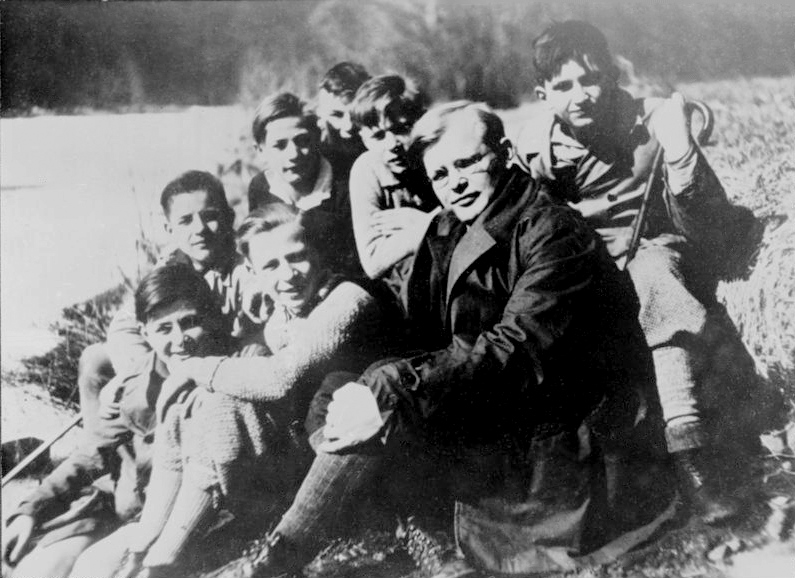
Dietrich Bonhoeffer (1906 – 1945) addressed his Confirmation class (seen in this picture) in a sermon preached after when a minority party and widening fear had put a madman in the saddle.
“You have only one master now…But with this ‘yes’ to God belongs just as clear a ‘no.’ Your ‘yes’ to God requires your ‘no’ to all injustice, to all evil, to all lies, to all oppression and violation of the weak and poor, to all ungodliness, and to all mockery of what is holy. Your ‘yes’ to God requires a ‘no’ to everything that tries to interfere with your serving God alone, even if that is your job, your possessions, your home, or your honour in the world. Belief means decision.”
Dietrich Bonhoeffer, “The Gift of Faith,” sermon to confirmation class, Germany, April 9, 1938.
Our real choice is between holy and unholy madness
Yesterday the American president granted a commutation and pardons to men whose offenses look like his own: abuse of power, betraying public trust, soliciting a quid pro quo, fudging tax returns, and lying to investigators. The timing of that announcement is cunning, coming as it does days following, and in the midst of a storm of protest about the president’s or attorney general’ intervention in sentencing of Mr. Trump’s loyal dirty-trickster friend Roger Stone.
Belief means decision
“Open your eyes and look around you.” Madness is in the saddle anyhow. Only a people seeking a ‘holy madness’ can knock him off our horse.
The president’s spasms of spite at Friday’s post-acquittal White House celebration sent my soul into spasms of its own. Hearing the president claiming that the impeachment trial’s acquittal exonerates him of all wrongdoing, calling out Nancy Pelosi and Adam Schiff as “evil people” on his enemies list, and belittling the conscience and religious conviction of Sen. Mitt Romney — his party’s only senator to break ranks — with the cheering peanut gallery that knows, but will not publicly recognize, the president’s sociopathic character was more than I could take. The party that swallowed a fly gave credence to the lie.
“Telling a big enough lie, and telling it often enough that people will believe it” has a history. So do spite and scapegoating. If in Germany the scapegoats were communists, Jews, gypsies, and “homosexuals”; and if in the McCarthy Era, they were leftist traitors hiding within the federal government, the entertainment industry, and the media, today in the Trump Era the scapegoats are Muslims, Central American migrants, “illegal aliens,” sanctuary cities, climate change believers, Congress, the courts, politicians, previous presidents, “the Deep State,” Democrats and … and traitors like Mitt Romney.
Sen. Joseph McCarthy, Feb. 9, 1950 Lincoln Day speech to the Republican Women’s Club of Wheeling, West Virginia:
“The State Department is infested with communists. I have here in my hand a list of 205—a list of names that were made known to the Secretary of State as being members of the Communist Party and who nevertheless are still working and shaping policy in the State Department.
I couldn’t watch. I was 10 years old watching Joseph McCarthy. We paid good money for that television. I had to walk away.
A FUNDAMENTAL PSYCHOLOGICAL PROBLEM
Donald Trump does have a fundamental psychological problem. He needs to be loved all the time, he needs to have power over everyone all the time. Once you get that idea down, the rest of his behavior and his speech makes sense…

He also doesn’t have any respect for the truth or for honesty. They don’t mean anything to him because he can’t care about them. His focus, again, is always on himself and to be — to care about being honest to people rather than lying to them means you’d have to care about your effect on them. Are you going to harm them? Are you going to mislead them? But since he has no conscience for that kind of thing, he never expresses regret.

He does terrible things to people, the children who are being detained in cages are a good example…The children, of course, really amount to a crime against humanity. If you think about it psychologically, this is what some of us once called soul murder. That’s what he’s doing to these children. His ability to do that fits perfectly with this kind of very deep sickness where other people don’t matter, and he can hurt them to whatever extent he wants.

-- Harvard Professor of Psychiatry,
“We may liken an adult’s temper tantrum to that of a ‘big baby’,” writes Garret Keizer in TheEnigma of Anger, “but even a big baby does not yet know what it truly means to be angry. I say this because I define anger as an emotion of extreme frustration (something a baby knows) poised at the possibility of action (something a baby cannot know, or cannot fully know.). … Might the purpose of anger be to enable us to break loose, to struggle free, and at the most basic level to survive?”
“ZEAL FOR YOUR HOUSE WILL CONSUME ME”
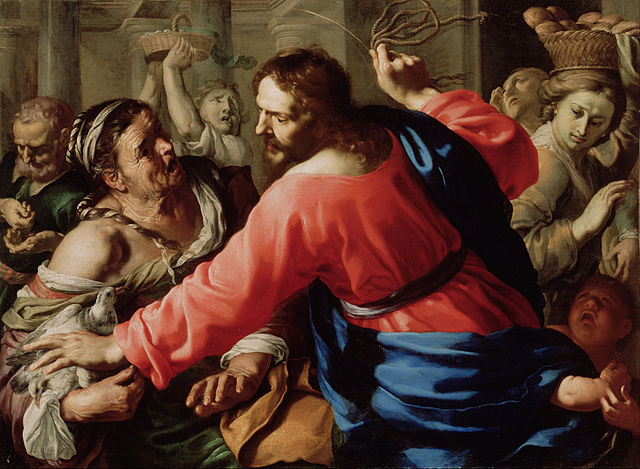
Spasms do not rise to the level of anger. They indicate frustration, but they do not yet qualify as anger as Keizer defines it, or as the Gospel of John points to it in the scene of Jesus’s raid of the money-changers who were scalping the poor in the Temple. The raid in the Temple was not impulsive. It was not a spasm. Jesus first braided a whip of cords before he turned over the money-changers’ tables and drove out their merchandise.
The Passover of the Jews was at hand, and Jesus went up to Jerusalem.In the temple He found those who were selling oxen and sheep and doves, and the moneychangers sitting there. When He had made a whip of cords, He drove them all out of the temple, with the sheep and oxen. He poured out the changers’ money and overturned the tables. He said to those who sold doves, “Take these things away! Do not make my Father’s house a house of merchandise!” His disciples remembered that it was written, “Zeal for Your house will consume Me.
Gospel of John 2:13-17 MEV
It was the monetary system that abuse the poor that Jesus was attacking. “He said to those who sold doves (the only sacrifice the poor could afford) that Jesus addresses his words: “Take these things (the doves) away! Don not make of my Father’s house a house of merchandise!”
The event described by John is not a temper tantrum. Jesus did not throw his shoe at the television. He paused to turn his extreme frustration into anger at the monetary system that turned a profit on the poor who could only afford a bird:–“Take these things away! Do not make my Father’s house a house of merchandise!”
STRIKING AT THE ROOT
“There are a thousand hacking at the branches of evil to one who strikes at the root,” wrote Henry David Thoreau in Walden. There still are, and I’m one of them. How do we strike at the root of evil?
Emotional spasms of extreme frustration (something a baby knows) are not anger until they lead the American people to make the whip to drive out the money-changers. In a constitutional republic the whip is woven from elections, or revolutions, that strike at the roots of an economy of geed, the Big Lie, and soul murder.
In the year 2020, the house desecrated by merchandise is bigger than a temple, church, mosque, or nation. The desecrated house is the planet itself.
Mitt Romney’s speech as a Senator-juror in the impeachment trial came as a surprise because he broke with his party’s ranks, and because he appealed to conscience and religion. No Senator-juror in the history of impeachment had stepped out of line from the party line. Citing the seriousness of the articles of impeachment against President Trump, Mr. Romney explained his reasons for voting to convict the president:
As a Senator-juror, I swore an oath, before God, to exercise “impartial justice.” I am a profoundly religious person. I take an oath before God as enormously consequential. I knew from the outset that being tasked with judging the president, the leader of my own party, would be the most difficult decision I have ever faced. I was not wrong.
“Anger is an emotion arising from a refusal to permit violation…poised at the place where frustration is ready to become action.”
REFUSAL TO PERMIT VIOLATION
One might say the dissenting senator’s vote rose from a refusal to permit violation of the Constitution, a violation the Republican House minority and Senate Majority at first denied without exception. Later, after the House managers presented a compelling case, the Republicans changed their position from complete denial of the allegations to arguing that, though they were wrong, they did not “rise to the standard of high crimes and misdemeanors”. All members of the president’s party held their noses, crossed their fingers, and voted for acquittal on both Articles of Impeachment. Except for one betrayer who is now the target of the man he voted to convict.
“I am a profoundly religious person. I take an oath before God as enormously consequential.”
The oath of office and the subsequent impeachment trial oath to “do impartial justice” places the mantle of conscience on the shoulders of all who “solemnly swear” them. Repeated violations of the oath of office have driven public trust in Congress and the Presidency to a point of despair or anger. Only a public recovery of anger, as Keizer defines it, will lift us from the reign of despair and tyranny.
Views from the Edge called attention to James Madison, John Winthrop, and ethical principles of conscience (“God alone is Lord of the conscience”), and truth (“Truth is in order to goodness. Nothing is more pernicious or absurd than the opinion that truth and falsehood exist upon a level, and that it is of no consequence what a man’s [sic] opinions are”). Conscientious pursuit of truth and courage to speak truth have become the exceptions to the prevailing norms of power and privilege, and the pursuit and maintenance of them.
FRUSTRATION READY TO BECOME ACTION
Mitt Romney’s exceptional vote for what has gone out of style (integrity) is akin to Garret Keizer’s case for what has gone out of style in religion, mischaracterized by the ranting street corner preacher who thunders about the fires of hell: the wrath of God.
“I am unwilling to commit to any messiah who does not knock over tables,” writes Keizer, referencing the scene of Jesus with the money-changers. “The wrath of God is not the wrath of the abusive parent or of power abused. It is the absolute claim of personhood asserting itself in the face of power and chaos alike.”
“There is such a thing as killing someone with kindness. The thoroughly gentle God, the unceasingly kind God, the God of the unalterable smile is also the fairy God, the clown God, the stuffed animal God — perhaps not a great deal more helpful than the threadbare giraffe that a child clutches in his dark room….”
Garret Keizer, The Enigma of Anger
THE WRATH OF GOD AND DELIVERANCE FROM OUR DARK ROOM
For years I have felt the folly of a theology which deletes the first part of the biblical claim that God is “slow to anger and abounding in steadfast love,” leaving the abused woman or child, or nation to swim in empty concrete pools of kindness unfilled without the tears of justice.
Our country has become a dark room. But occasionally, as happened yesterday on the Senate floor, a candle is lit for justice, goodness, and truth. This room need not stay dark if we, the abused, claim again the wrath of God and the place of anger: “the refusal to permit violation…poised at the place where frustration is ready to become action.” To refuse anger will kill us with kindness, leaving us each clutching our stuffed animals in a dark room owned by a tyrant.
Gordon C. Stewart, author of “Be Still! Departure from Collective Madness” (2017 Wipf & Stock) — available in kindle and paperback through the publisher or Amazon — Chaska, MN Feb. 6, 2020
Public trust that you will tell the truth and seek the truth, no matter where it leads, was already dangerously low. Although we know that it is your constitutional right to set the rules for an impeachment trial, the American people know that a “trial” without witnesses and evidence is not a trial. Those still paying attention knew how it would end. Majority Leader McConnell told us. Some of us have stopped watching because we don’t care anymore. Others care but have tuned out to manage their blood pressure and keep their dinners down. We all could use an infusion of wisdom to guide us through this national crisis.
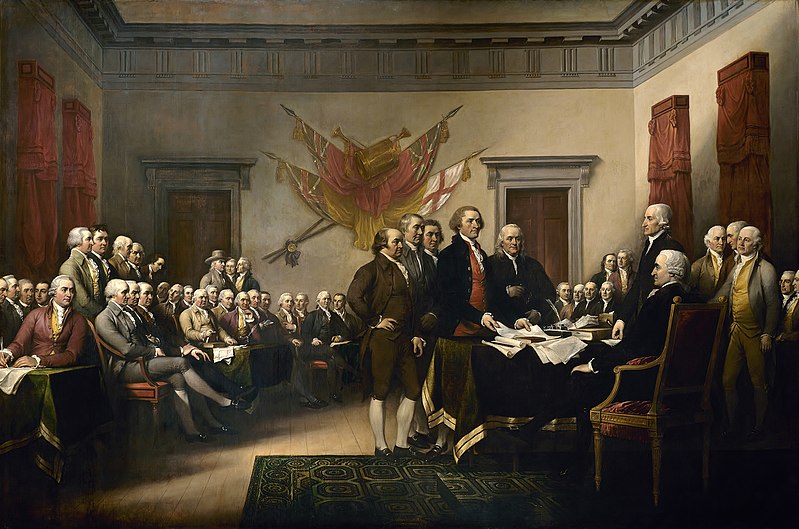
In Declaration of Independence by John Trumbull (1818), John Witherspoon is the second seated figure from the (viewer’s) right among those shown in the background facing the large table.
JOHN WITHERSPOON and JAMES MADISON
I write as a pastor in the tradition of John Witherspoon. Witherspoon was the only religious leader to sign the Declaration of Independence, whose moral philosophy influenced James Madison, the Founding Father of the U.S. Constitution. As President of The College of New Jersey (Princeton), Witherspoon taught moral philosophy. James Madison and other students took Witherspoon’s “Common Sense” philosophy of public morality into the courtrooms of 37 judges (including three Supreme Court justices), and onto the floors of the Continental Congress (12), the U.S. House of Representatives (49), and the United States Senate (28 Senators) where you now serve.
THE CONSTITUTION AND PRELIMINARY PRINCIPLES
In 1787 John Witherspoon participated in two simultaneous national meetings within four blocks from each other in Philadelphia. At Independence Hall the Continental Congress was preparing the U.S. Constitution. Down the street, the first national assembly of the Presbyterian Church in the Unites States of America was adopting the “Preliminary Principles” to guide the church through times of divided opinion and disharmony. There are eight (8) Preliminary Principles. I lift up for your attention the First (conscience) Fourth (truth) , and Fifth (mutual forbearance) Preliminary Principles.
PRINCIPLE: CONSCIENCE
“God alone is Lord of the conscience…” — First Preliminary Principle (1787)
One morning Henry Ward Beecher cut himself shaving. He didn’t like what he saw in the mirror. The public man and the private man were at odds. Public scandal and conscience formed the razor’s edge that cut through his defenses.
Everything hinges on the right and duty of conscience. One need not believe in God to avow the primacy of conscience.
The tight internal discipline and uniformity of the GOP caucus against calling witnesses and admitting evidence in the impeachment trial looks no different from the enforced cohesiveness of the Mafia, the Gangster Disciples, and other street gangs. Step out of line and you’re “going to go through some things.” Courage and conscience are not part of the code. Compliance and scheming have taken their place. We, the people, lose hope watching the gang-banging in the highest places of authority and power.
PRINCIPLE: TRUTH AND GOODNESS
“Truth is in order to goodness….” — Fourth Preliminary Principle (1787)
Truth-telling and truth-seeking are essential building blocks of a good society. The road to goodness is not falsehood, misinformation, disinformation, and concealment. Without truth-telling and truth-seeking we become a society built on quicksand.
“The Fourth Principle continues:
“No opinion can be either more pernicious or absurd, than that which brings truth and falsehood upon a level, and represents it as of no consequence what a man’s (sic) opinions are.” — Fourth Preliminary Principle (1787)
Some opinions are pernicious (highly injurious or destructive: deadly). Others are simply absurd (ridiculous, silly, incredible). Some opinions are both. The exercise of one’s duties by means of falsehood is injurious to goodness. Truth is the plumb line against which an opinion is tested. Truth matters. Falsehood matters. Facts matter. Reality matters. There is no such thing as an alternative facts.
“On the contrary, we are persuaded, that there is an inseparable connection between faith and practice, truth and duty. Otherwise, it would be of no consequence either to discover truth, or to embrace it.” — Fourth Preliminary Principle (1787 –)
There is a direct connection between truth-telling, truth-seeking, and public life. The connection is essential for a civil society. When partisan interests displace truth and conscience, the result is a society with neither a moral code nor a functional Constitution. Watching the Senate impeachment trial tells a different story to the American people: power trumps principle.
PRINCIPLE: MUTUAL FORBEARANCE
“There are truths and forms with respect to which [people] of good characters and principles may differ. And in all these we think it the duty both of private Christians and societies, to exercise mutual forbearance towards each other.” — Fifth Preliminary Principle (1787)
‘Forbearance’ — i.e., patience, tolerance, continuing in relationship — is no longer a household word in 2020. Neither is it frequently practiced. Mutual forbearance is rarer still. Mutual forbearance is essential to achieving E pluribus unum (i.e. “one out of many), which Cicero saw as basic to relational bonds and thriving societies and states.
If God alone is Lord of the conscience, those who differ with respect to those “truths and forms” that are not universally accepted, i.e. political philosophy, owe it to each other and to the body politic to continue in respectful, peaceful relationship.
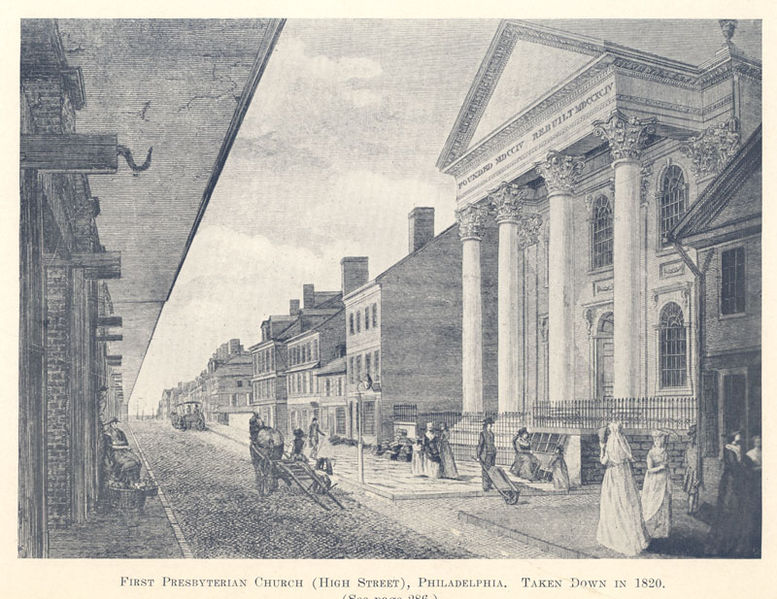
Illustration of the original First Presbyterian Church in Philadelphia located on High Street (now Market Street). First Presbyterian was the meeting place for both the first presbytery and first synod.
WHAT IS AT STAKE IN THE IMPEACHMENT TRIAL?
Mutual forbearance with people of good character and principles is embedded in the history of the Senate. But your good character is on trial. The impeachment trial is a test of the Senate’s conscience, commitment to truth and goodness, character and principles, and mutual forbearance. The great institution in which you are privileged to serve, and a general population that expects a trial to be a trial are at stake in your decisions. The Senate’s good character and principles, as well as Donald Trump’s, is on trial in the court of public opinion. Those who know their history can hear a long shout from James Madison and John Winthrop:
“Sham on you!”
— Gordon C. Stewart, author of Be Still! Departure from Collective Madness (2017 Wipf & Stock), Chaska, MN, February 3, 2020.
The comment left by a reader in reply to yesterday’s post on the impeachment trial (“This Day in History“) expresses a more widely held sentiment.
“I watched most of the Congressional hearings, but watching the Republican Senate pretend that ‘everything is JUST FINE” and there was NOTHING WRONG and NO CRIME is madly depressing. I am not handling this well. I’m trying to believe it will all work out, but I don’t really believe it. It has been a hard, hard, hard few years. Doesn’t it feel so much longer than that?”
Views from the Edge reader’s Comment in reply to “This Day in History” (Jan. 21, 2010)
LOSING OUR FOOTING
The first day of the Senate impeachment trial left me scrambling for sure footing in a world whose foundations are shaking, a condition familiar to the Psalm on which I had focused early yesterday morning. ‘Evil’, ‘the righteous’, and ‘evildoers’ are words of judgment readers of Views from the Edge do not expect to hear here. We do best to steer clear of these words of spiritual pride. Dividing the world into good and evil, sheep and goats, is the opposite of a gospel of reconciliation. But the words of an ancient Psalm gave expression to what I felt watching the Senate’s resistance to “doing impartial justice”.
1 Do not fret because of the evildoers;
    do not be envious of those who do wrong,
2 for they will soon wither like the grass,
    and like the green grass fade away.

7 Be still before the Lord, and wait patiently for him;
    do not fret over those who prosper in their way,
    over those who succeed in evil schemes.
[Psalm 37:1-2,7]
My faith tradition practices the Confession of Sin before the One “to whom all hearts are open, all desires known, and from whom no secrets are hid.” There are sins of omission (“we have left undone the things which we ought to have done”) and there are sins of commission (“and we have done those things which we ought not to have done”).
My father and mother taught us the spiritual practice of confession, repentance, forgiveness, and “the amendment of life.” But it’s often hard to tell when one is committing or omitting. Obsession manages to succeed at both. What dawned on me yesterday was my obsession with evil schemes.
COMPULSIVE OBSESSIONS – IMPEACHMENT AND CAR-SHOPPING
Can I, should I, will I part ways with my beloved 2003 Toyota Avalon? It’s an existential dilemma.
My beloved 2003 Toyota Avalon XLS (171,773 miles)
A person’s relationship with a car isn’t “BREAKING NEWS!” No one cares about my three-week long obsession with a car! Not even when it replaces my obsession with writing for Views from the Edge. Who cares?
Preoccupation with the sirens that call me to sell or trade my faithful Avalon may be Obsessive Compulsive Disorder (OCD), but this car thing feels familiar. It has a history. I’ve been here before.
THE APPLE DOESN’T FALL FAR FROM THE TREE: finding and staying with the Avalon
Maybe it’s in my DNA. “Let’s go out and look at that new Buick,” Dad would say. It didn’t matter that Parkinson’s and the Department of Motor Vehicles had put the car thing in his rear view mirror; Mom and Dad’s Buick Skylark was 21 years old. “Oh, Ken, for heaven’s sake!” We don’t need a new car! You can’t even walk anymore, and, besides, we don’t have the money for a new car.” It didn’t matter. When the car itch took over, he had to scratch it.
Mom and Dad’s 1983 Buick Skylark
Finding the Avalon nine years ago was completely unexpected. I dropped by Total Auto, a mom-and-pop used car dealer, to look at a one-owner Subaru Legacy. I took the Legacy for a test drive, but didn’t like it. But there was another car, covered with snow and ice, a one-owner 2003 Toyota Avalon XLS traded at a Lexus dealer after 115,000 miles. We dug it out of the snow and took it for a spin. It drove like a dream. What’s not to like about a low-miles, loaded top-of-the-line Avalon XLS?
All these years later, after nine good years together, the car itch returned. I’ve been scratching it every day over the last month. But it occurs to me that obsession is a spiritual and mental health thing, and that the return of Dad’s car itch may have been a healthy substitute for the three-year obsession about which I have no control: the rogue president and the political party obsessed with pleasing him and protecting him with evil schemes that prevent a trial.
REGAINING SOLID FOOTING
10 Yet a little while, and the wicked will be no more;
    though you look diligently for their place, they will not be there.
11 But the meek shall inherit the land,
 23 Our steps are made firm by the Lord,
    when he delights in our way;
24 though we stumble, we shall not fall headlong,
    for the Lord holds us by the hand.

27 Depart from evil, and do good;
    so you shall abide forever.
28 For the Lord loves justice;
    he will not forsake his faithful ones.
… and the U.S. Constitution, division of powers, and a faltering Republic may yet survive. You can’t trade the Constitution for a new car.
The dawn of a new year is like turning the page in a bad novel, believing it will get better. No one likes a gloomy Gus! But reality is what it is. Or maybe it’s not. Just when we thought it couldn’t get worse, it did. A toddler playing with matches at his country club threatens to set the world on fire. The toddler and his playmates pretend not to see the bigger fire raging all around them. Only toddlers would believe they can win the game of “Chicken” when their opponent is Nature itself.
THE REAL AND COPIES OF COPIES OF THE REAL
“Faith is the assurance of things hoped for, the conviction of things unseen.” But faith gets harder when what you can see turns your hair white.
“In postmodernity of Late Capitalism,” writes professor David White in “The Contested Status of Truth, “the [facsimile] precedes the original and the distinction between reality and representation vanishes. There is only the simulation . . . Fictional representations — copies of copies of the real — are rapidly replacing the real in our experience.” (Insight: the Faculty Journal of Austin Presbyterian Theological Seminary, Fall 2019.)
Fictional representations repeated repeatedly remove us from what is real. The representation creates its own reality . . . ‘alternative facts’. When comedian Lewis Black tells his audience, “You can’t just make sh-t up,” the auditorium comes alive because the audience knows it’s true.
There are six things that the LORD hates, seven that are an abomination to him: haughty eyes, a lying tongue, and hands that shed innocent blood, a heart that devises wicked plans, feet that hurry to run to evil, a lying witness who testifies falsely, and one who sows discord in a family.
Book of Proverbs 6:16-19 NRSV
IT’S RAINING, IT’S POURING, THE OLD MAN IS SNORING
While global warming accelerates beyond previous expectations — and those earlier scenarios were already ominous and urgent — the party in control of American policy is snoring. Environmental standards that clean air, water, and soil are erased with the stroke of a pen.
It’s not a hoax, Mr. President. Not a hoax, Mr. McConnell, et.al. History will remember you as the climate change deniers intent on partisan control while the planet turned brown.
Likewise, you, Mr. McConnell, will be remembered as the Senate Majority Leader who ended discussion and debate on the Senate floor, and worked hand-in-glove with the impeachment defendant to assure that Mr. Trump is acquitted.
[Blessed are they] who stand by their oath even to their hurt; who do not lend money at interest, and do not take a bribe against the innocent.
Psalm 15: 4b-5a
WHO ARE YOU CALLING CHICKEN?
Had you forgotten, or did you not know, what the people of Iran have never forgotten: the CIA engineered the 1953 coup d’etat that overthrew Iran’s democratically elected president and put the Shah in power for the next 25 years . . . until the Iranian Revolution paid back the insults with American hostage-taking. Iran has a long memory, a proud history, and rich culture that is many centuries old. The new insult — assassinating an Iranian state official — stokes the embers of smoldering fires, leaving our allies scratching their heads once again, wondering what you were thinking, if you were thinking at all. Did you consider that, by assassinating the Iranian General, you also would eliminate a strange but highly effective ally in our common campaign against ISIS?
TOWARD A CULTURE OF GRATITUDE, APPRECIATION, DELIGHT, AND JOY
“Perhaps the resources of our culture — organized around the priority of spectacle and commodity and power — have been exhausted. . . . They cannot deliver the flourishing they claim. They cannot foster a culture of gratitude, appreciation, delight, and joy. They can only foster a culture of hatred, suspicion, and fear.” — David White, Insight.
David Kanigan’s Sunday Morning introduced me to Niall Williams’s words and a photograph of architecture from Berlin. “We are our stories. We tell them to stay alive or keep alive those who only live now in the telling. In Faha, County Clare, everyone is a long story….” — Niall Williams, History of the Rain.
HEARING AND TELLING STORIES
Pondering Williams’ short sentence reminded me of Frederick Buechner’s Telling Secrets. We don’t just have stories. We ARE our stories. And our stories contain secrets.
I’m imagining a scene that will not happen in real time. There is a large room. Folding wooden chairs have been arranged in a huge circle. Members of Congress and their staff members are sitting there. There is no assigned seating. Mitch McConnell and Nancy Pelosi are there.
Adam Schiff and Doug Collins are there. Scattered among the tailored suits and silk ties are members of the Capitol cleaning and custodial staff, the barbers and stylists, the shoe shiners, the cooks, kitchen assistants, table waiters, and dishwashers are all there. The mailroom clerks, the Capitol Guard, and Secret Service are there. No chair is different than another. Shaker-like oak chairs, every one the same. There is no dais. No microphone. No television cameras. All cell phones are off. There are no distractions. The room is quiet.
All eyes are fixed on the Ojibwa dancer sitting alone in the empty space created by the circle formation. All ears are listening to the story the Ojibwa Elder is telling through his flute. Everyone hears the story and his prayers to the Great Spirit offered without words through his drumming. Then he begins to sing toward the four directions. They watch his body turn to the West, and follow his lead, all turning as he turns.
Look towards the West
Your Grandfather is looking this way
Pray to Him, pray to Him!
He is sitting there looking this way!
Look towards the North
Your Grandfather is looking this way
Pray to Him, pray to Him!
He is sitting there looking this way!
Look towards the East
Your Grandfather is looking this way
Pray to Him, pray to Him!
He is sitting there looking this way!
Look towards the South
Your Grandfather is looking this way
Pray to Him, pray to Him!
He is sitting there looking this way!
Look up above (upwards)
God (“Great Spirit”) sits above us
Pray to Him, pray to Him!
He is sitting there looking this way!
Look towards the Earth
Your Grandmother lies beneath us
Pray to Her, pray to Her!
She is laying there listening (to your Prayers).
Everyone is both curious and caught up in the moment. The OIjibwa is on bended knee. He kisses the Earth. He lifts his eyes upwards. With his right hand he cups his left ear, listening for the voice of the ancestors who looked toward the four directions. The people in the circle begin to hear what he is hearing. The Ojibwa, like Moses parting the waters, is creating a path into the center of the circle, as the sounds draw closer. The Ojibwa shaman open to the doors for the Gathering of Nations, dancing and singing because they know what the people in the wood chairs do not: No one owns land. No one can own a Grandmother.
We are our stories. We tell them, including the secrets we’ve dared not tell, to stay alive or keep alive those who only live now in the telling. Humankind is a long story.
“You must unite behind the science. You must take action. You must do the impossible. Because giving up can never ever be an option.”
Greta Thunberg, US Congress, Washington DC, September 17, 2019.
This Christmas we share a chapter from Be Still! Departure from Collective Madness (2017, Wipf and Stock) first aired on MPR’s “All Things Considered” during the Occupy Wall Street Movement. Today there is no Occupy Wall Street. There are no tents. No camps. No protests. But Mary, and the hope she sings in her Magnificat, will never goes away.
Mary of Occupy
He has shown strength with his arm;
 he has scattered the proud
 in the thoughts of their hearts.
 He has brought down the powerful
 from their thrones,and lifted up the lowly;
 he has filled the hungry with good things,
 and sent the rich away empty.
 - Gospel of Luke 1:53-55
in other cultures, and other times, the young woman would be called a peasant. But here and now, she is a protester, one of a dwindling number of ragged young people on the government plaza. She moves among the occupier sleeping bags and protest signs in the cold of winter, singing her song of hope and joy.
She makes no demands, which is confusing to some. Hers is a different way: a bold announcement that the old order, symbolized by Wall Street, is already finished. Her purity and her message are impervious to the game of demand-and-response that serves only to tweak and tinker with the old system of greed and financial violence.
She simply affirms the great new thing that will come to pass. to her it is more real than much of what she sees.
A song like hers is being sung this season in churches through- out the world. The song rejoices in a new world order about to be born. The “same old, same old” world, the one defined by who’s up and who’s down, by social pride and social humiliation, by the overfed and underfed, by extremes of extravagant wealth and pov- erty—that world is over. The mountains of greed are brought down and the pits of desperation are raised up to the plain.
The song celebrated in churches is the Magnificat, the Song of Mary, a composition of the Gospel of luke. it has special meaning to Christians who believe that Mary bore in her womb the savior of us all. But the Luke story also serves as a metaphor for the compassionate character of a new society about to be born.
“My spirit rejoices in God my Savior,” sings this peasant girl living in the time of the Roman empire’s foreign occupation. She is full of the One who “has scattered the proud in the imaginations of their hearts,” who “has brought down the mighty from their thrones, and has lifted up those of low degree,” the leveling God of mercy and justice.
Imagine for a moment an opera house. At one end of the stage stands Mary, the voice of prophetic madness, her tender voice softly rejoicing in the hope growing inside her. At the other end stands a massive chorus, in tuxedos and gowns, thundering its hymn of praise for the market, for its grandeur, for the preservation of the status quo.
“He has filled the hungry with good things,” the girl sings, “and the rich he has sent empty away.” Her voice cannot compete in volume. But in its clarity, it drowns out the mighty chorus.
As Mary’s song is read in churches this Sunday, some anonymous girl will slip unnoticed into the back pew. She will listen to the reading of luke’s Magnificat, and she will hope, like Mary, that the world will hear the message.
We are in the midst a constitutional crisis in the U.S.A. that leads most of us scratching our heads. How did we get here? How will we get out of it? No one knows.
Part 1 of this three-post series suggested kinship with dogs who, by nature, live in packs led by Alpha Dogs. In Part 2, we turn to a time-honored voice from an earlier time.
AN OUTSIDE PERSPECTIVE
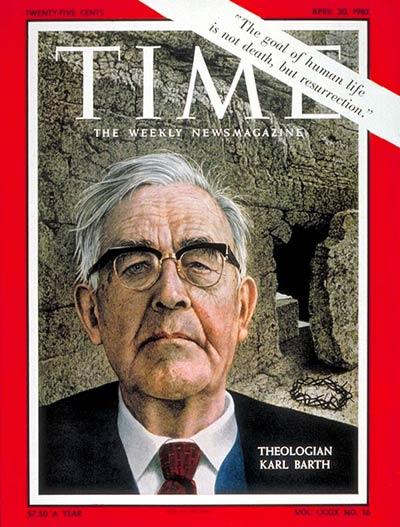
Karl Barth‘s way of seeing and hearing offers one such perspective. Barth was one of great theologians of the 20th Century, known for his brilliance, and for his early opposition to the rise and rule of Adolf Hitler and the nationalist ideology of the Third Reich.
Barth saw what those with “eye disease” did not. Idolatry, not atheism, is the issue for the human creature.
In Adolf Hitler and nationalist party that ended a constitutional republic, Barth saw what he called “the lordless powers” that have no Lord but themselves. They allow for no superiors. They submit to nothing and to no one. They are what Barth’s American friend William Stringfellow called “imposters of God” that prey on our anxiety, powers greater than ours, in effect a ‘lord’ — an Alpha Dog — to protect us and conquer what threatens us.
“DEUTSCHLAND UBER ALLES”
As a Christian theologian, Barth professed faith in Jesus Christ as Lord. This Lord is no victor. For Barth, Jesus Christ was the man for others who stooped to wash others’ feet, a chore assigned to household slaves; unmasked the lordless powers of empire; wept over the city, and rode into it “humble and riding on an ass” in counterpoint to the emperor entering the city on his white stallion; proclaimed a kingdom of infinite compassion not built by ‘the lordless powers’; prayed on his knees to the Lord of lords and King of kings of all the lesser packs; and bent his back to the soldier’s whip and Roman execution, and reached out to the rebel on the cross next to his.
The Jesus of Nazareth who bowed his head to no other power than YHWH — the Ineffable One, the Eternal One, the Lord beyond the lordless that rise and fall and are forgotten — represents humankind in our proper relationship with God.
“The demonism of politics consists in the idea of ’empire’, which is always human as such.“
The Nazi Party and its Alpha Dog were ‘Lordless’ because they were accountable to no one and to nothing. Their authority and power were absolute. Everyone in the pack was ordered to yield to a headstrong man and a “headstrong dream.”
Barth’s theological anthropology offers insight into our vulnerability in an anxious world.
Man’s (sic.) alienation from God at once carries with it his self-alienation: the denaturalizing of the humanity and fellow humanity of is own existence, the contraction of the determination, inalienably given to him as God’s creature, that he should belong to God and have in God his Lord, the beginning of speech, action, and therefore existence, which are headstrong because they have no Lord.
Karl Barth, The Christian Life, 213-14.
Knowing that social control requires consent of the pack, Hitler and the Third Reich systematically transposed the prevailing religious belief system into the key of nationalist supremacy. The religion that proclaimed the elusive Kingdom of God and Jesus Christ as Lord was brought to Heel: Heel! Sit! Down! Off! Leave it it!
The church that prayed “Thy Kingdom come” bowed the knee to the nearer-to-hand kingdom, raising its arm to salute the national messiah. “Heil Hitler!” and Sieg Heil” replaced Handel’s ‘Messiah’.
For unto us a Child is born, unto us a Son is given, and the government shall be upon His shoulder; and his name shall be called Wonderful Counsellor, the Mighty God, the Everlasting Father, the Prince of Peace” (Isaiah 9:5).
Handel’s Messiah
As for the Jews? It’s much harder to bring to heel a people whose faith looks to YHWH, the Holy One, and does not regard any human being as a divine incarnation. They would need to be removed from the fictional Aryan pack. They were stripped of every constitutional protection, herded onto trains, and delivered to concentration camps as people unfit for German society.
“MAKE AMERICA GREAT AGAIN”
Like the Germans in the lead up to 1933, we in America in 2019 are manipulated by well-calibrated propaganda and disinformation campaigns that ‘denaturalize’ and turn neighbors into enemies in the age of cyberspace.
Slogans are simply vents with whose help ideologies surface and in the form of loud whistles call for general applause and acknowledgment. Let us not be deceived: we all listen to the most varied catchwords, we all use them more or less merrily, and in so doing show that we ourselves are people who have been struck and stabbed and snared by systematized ideologies.
Propaganda is putting things in black and white. … What they have to push systematically is their own excellence and usefulness, and by way of background must show how utterly valueless and harmful their rivals and opponents are.
THE TRUMP PHENOMENON
Classical Christian theology is clear about the need for an Alpha Dog. Its understanding of human being is sometimes called theological anthropology. Our mortal human nature is best understood in light of our submission — witting or unwitting — to this, that, or another power. When an Alpha Dog rises to claim the allegiance of a pack, we are thrown back.
Most of us in Roman Catholicism and progressive protestant churches have moved beyond patriarchal metaphors and talk of kings, kingdoms, and lords. We speak instead of ‘kin-doms’ without kings — horizontal societies without authority, what Barth called “the Lordless powers.” The reign of compassion is upended and replaced by an Alpha Dog who reigns absolutely, using propaganda, fear, hate, and cruelty to bring the pack to Heel.
The comforter feels heavy. My body is sore. So is my spirit. I shift from one side to the other and turn on my back, but it doesn’t help.
I look over to the night table at the old digital clock that once told my parents the time of day or night — the inheritance with the BIG red numbers that glow in the dark to help old folks read them.
The red numbers read 3:13.
I throw off the covers, stumble down the 18 steps to the first floor, make a pot of coffee, pour myself a cup, turn on the small table lamp by the fireplace, and sit down for an early morning conversation with the psalmist in the copy of The Book of Common Prayer Sue Kahn put in my hand years ago.
MEDITATION ON PSALM 5 (SELECTED VERSES)
In the morning, Lord, you hear my voice;
  early in the morning I make my appeal and watch for you.[v.3]
I will put my trust in You. I will not surrender to powers that know no higher power.
You, Lord, are the Breath that breathes in all and makes the sun to shine and the rain to fall on the just and unjust — “Lord of lords and King of kings,” the Eternal One from Whom the little kings and usurpers cannot flee.
I make my appeal to You for Whom the darkness is as light. Things are dark here in America. We are divided. The future looks dark. Although my faith tells me You are present everywhere, I do not feel hopeful. It seems as though You have left us to our own devises.
For You are not a God who takes pleasure in wickedness,
   and evil cannot dwell with You. [v.4]
Though it feels as though You are hiding, I have to believe You do not take pleasure in wickedness, and that the partisan evil, as bold and obvious as the big red numbers on my parents’ digital clock at 3:13 A.M, will not prevail. Evil cannot dwell with You.
Braggarts cannot stand in your sight; you hate all those who work wickedness. [v.5]
Does it matter to You?
If braggarts cannot stand in Your sight, come into sight. Show Yourself. Take Your seat on the judgment throne to hold the braggarts accountable for their treason against You and all that breathes. Summon the braggarts to stand before You before it is too late.
Do You hate wickedness? Does Love also hate? Do You shrug and let it go?
But as for me, through the greatness of your mercy I will go into your house;
   I will bow down toward your holy temple in awe of you. (v.7)
I will bow down in awe of You. The good green Earth is Your temple. I will look to the greatness of Your mercy. When it feels as though You are hiding, I will seek You. I will remember the wisdom of the Hasidic grandfather teach his grandson about You, when young Yechiel came home in tears because his friend had stopped looking for him in a game of hide-and-seek.
“Rebbe Barukh caressed Yechiel’s face, and with tears welling up in his eyes, he whispered softly, ‘God too Yechiel, God too is weeping. For, He too has been hidden with no one looking for Him’.” (Martin Buber, Tales of the Hasidim).











 Views from the Edge