Easter Sermon – To Whom the Good News Comes
Video
Reply

Dietrich Bonhoeffer, Kosuke Koyama, and Jay Logan inspired this sermon at Shepherd of the Hill Presbyterian Church in Chaska, MN. It was preached the Sunday the church was welcoming four homeless families as guests for the week. The church members – just 78 loving people – had worked hard for three years to make this happen.
A sermon at Shepherd of the Hill Presbyterian Church in Chaska, MN.
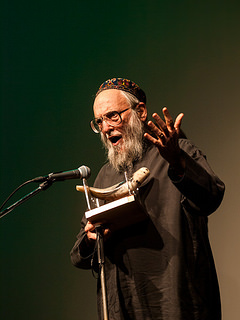
Rabbi Arthur Ocean Waskow
Rabbi Arthur Waskow of the Shalom Center in Philadelphia is one of the more interesting religious leaders of our time. Views from the Edge republishes this week’s “Shalom Report” with permission.
Dead Young Men: 50 Years Ago and Now
Spirals of Violence — or Nonviolence
Dear friends,
I spent several days last week in Mississippi –Mourning the murders of three young men
And then, a few days later, came the news of the murders of three young men just weeks ago –- three Israeli youngsters — their bodies, like those of Mickey Schwerner, Andy Goodman, and James Earl Chaney, hidden while the search went forward for them.
But not only them. The violent deaths of young Palestinian boys/men as well, during the Israeli Army crack-down on the West Bank. Their mothers also mourning. As the New York Times reported the day before the three Israeli bodies were discovered:
“Most Israelis see the missing teenagers as innocent civilians captured on their way home from school, and the Palestinians who were killed as having provoked soldiers. Palestinians, though, see the very act of attending yeshiva in a West Bank settlement as provocation, and complain that the crackdown is collective punishment against a people under illegal occupation.”
Is there a danger of “moral relativism” in mentioning these deaths together? Is the cold-blooded murder of three hitchhiking youngsters morally equivalent to killings carried out by angry, frightened soldiers faced with a protesting mob? At the individual level, No.
But at the level of decision-making and public policy, there is also no moral equivalence between a cold-blooded military occupation and the impotent rage of the occupied.
Above all, there is no “relativism” in the tears of mothers.
Some Israelis and some Palestinians have joined their sorrow over the killings of their own children to work in the Circle of Bereaved Families for a peace that would end the killing. (See http://www.theparentscircle.com/.)
Others –-including some Israeli cabinet ministers in the last day — have defined their deaths as the warrant for more killing.
But Mississippi did not change through threats like that. It changed because an aroused American citizenry from outside Mississippi allied itself with the oppressed community inside Mississippi to demand – through nonviolent direct action and through passing laws — that an oppressed population of black folk be freed to achieve some measure of political power.
As a result of that arousal, the deaths 50 years ago have made a visible difference. Fifty years ago, a scant few black Mississippians had been allowed to register to vote. As the “Freedom Summer + 50” gathering opened last week, thousands of black Mississippians who are devoted to the Democratic Party intervened in a Republican primary to prevent the nomination and for-sure election of a far-right Tea Party candidate.
Important change? Yes. Enough change? No.
In the Israeli-Palestinian conflict, no sufficiently powerful outside energy has made the commitment to bring all its lawful, nonviolent power to bear to achieve a two-state peace. So the violence worsens in a downward spiral of injustice.
What the gathering in Mississippi showed was that even when change is still necessary, even when injustice still continues, there can be an upward spiral, growing from past transformations into future ones.
For the gathering at Tougaloo College addressed the future as much as the past. The memory of youthful deaths so many years ago –- we recited their names, we sang their songs, we welcomed their families — became the celebration of youthful courage that had led to serious change. So not only many veterans of 1964 were there, but also many many young activists, come to learn and be inspired.
So we addressed the injustices that persist, and we took up some levels of injustice that fifty years ago were not on anyone’s agenda. Even Rachel Carson’s Silent Spring, published in 1962, did not envision a massive disruption of the planetary climate system and the web of life it has nurtured for millions of years.
So there was a confluence of issues almost unimaginable in 1964 when Jacqueline Patterson of the NAACP staff brought together two excellent workshops on ”climate justice.” They were the first climate–action settings I have ever seen in which people of color — Black and Hispanic and Asian and Native — were at least half of those present.
Many spoke of two clear cases in their own region when the fossil-fuel Pharaohs had shattered the lives of poor communities of color even worse than they had damaged prosperous whites:
And we learned as well how on a global level the overheating of our planet was hurting and killing the poor even worse than others: How droughts in California, the US corn-belt, central Africa, and Russia had raised the price of staple foods so badly that those who were teetering on the edge in poverty fell into hunger, and those who had been hungry faced starvation. And some who were starving fought civil wars to get their hands on food.
We discussed alternatives for climate activism. Some of us talked about the model of the “Freedom Schools that emerged in 1964, teaching where the impulses to learn and teach were deeply interwoven with the impulse to heal the world. Those Freedom Schools helped give birth to the Teach-Ins against the Vietnam War that flowered in the spring of ’65.
Could we create new Freedom Schools, new Teach-Ins, to fuse the science of climate and the facts of Corporate Carbon domination with the strategies of change? Was our gathering itself a kind of Freedom School, a Teach-In, with the young and the old teaching each other?
And Freedom Summer inspired co-ops, the redirection of our money from feeding bloated corporate power to nourishing the seeds of a grass-roots economic democracy. In that spirit, I shared The Shalom Center’s campaign to Move Our Money/Protect Our Planet (MOM/POP) and handed out copies of our “Action Handbook” on specific steps for how to Move Our Money. See https://theshalomcenter.org/treasury/209.
All of us learned more deeply how important it is to recognize and act on the true linkage of what we might call eco-social justice.
And we learned that what happened fifty years ago in Mississippi sowed the seeds of our ability to recognize and resist new depredations of today. We saw how deeply the nonviolent movement of fifty years before had, even when some of its activists were killed, given continuing birth to nonviolent responses to make more necessary change.
I ended one of those workshops by invoking the spirit of Vincent Harding. If he had not died just a month ago, I said, he would have been deeply pleased by our intergenerational learning, and he would have brought his own deep listening and the quiet with which he surrounded his own wise words.
And most of all, he would have brought his willingness to invest his life in the effort to use nonviolence to expand democracy, to win justice for those who have been oppressed.
And now, in the wake of the news from Palestine and Israel, his ghostly, powerful presence actually reminds me of the Unity of that long effort. For just two summers ago, Brother Vincent took part in a delegation of American Jews and Blacks to visit the occupied West Bank and bring hope to Palestinians committed to nonviolence.
Brother Vincent would have wept over the deaths of the young men of both peoples. As do I.
May the tears we shed become the wellsprings of transformation, not revenge — as they did in Mississippi.
And may we teach the intertwinement of eco-social justice, learning anew from Freedom Summer’s creativity to go beyond our forebears — as they did.
Shalom, salaam, paz, peace! — Arthur
Arab American Christians
Three words not
Usually seen together
Palestinian Christians love
Hearing Acts two
Read on Pentecost
Arabs are listed
Receiving the Spirit
West Bank Bethlehem
Has had Christians
Two thousand years
Lutheran Arabs live
Next to Muslims
In Palestinian towns
The Pope’s prayers
May bring peace
Where three Faiths
Call land Holy
– Steve Shoemaker, Urbana, IL June 10, 2014
EDITOR’S NOTE: Westminster Presbyterian Church in Minneapolis is a partner church with the Lutheran congregation in Bethlehem. The pastor of the Bethlehem church has spoken to the General Assembly of the Presbyterian Church (USA). Once again this year’s General Assembly (national meeting that convenes this Saturday in Detroit) will consider a controversial proposal to divest investments in companies that support the subjugation of the Palestinian people, working against the Church’s commitment to human rights, justice, and peace. Prayers for the General Assembly as its Commissioners deliberate. – GCS
Text of sermon on sanity and madness visa a vis ourselves (homo sapiens) and the rest of nature preached at Shepherd of the Hill Presbyterian Church in Chaska, MN.
We need stories to keep us sane in a culture whose sanity is madness.
In Souls on Fire Elie Wiesel, the Nobel Peace Prize concentration camp survivor, tells the story of “prophetic madness” that challenges the collective madness of a people who ignore the coming calamity of impending crop failure. “Good people…What is at stake,” says the prophetic messenger, “is your life, your survival! The summons falls on deaf ears and the calamity of starvation is not averted.”
Wiesel concludes, “God loves madmen. They’re the only ones he allows near him.”
Late in the year of 1964 a young geography student working toward his doctorate came upon a grove of Bristlecone Pines while doing research searching on Ice Age glaciers.
Wheeler Peak, on Nevada’s eastern border with Utah, reaches an altitude of 13,063 feet with a spectacular glacial cirque on its northeast side. Wheeler Peak cycles through five life zones, from the hot stony desert to alpine tundra, all within a five mile line. Along the edge of this cirque is the home of colossal bristlecone pines. Standing as they have for millennia, in their fields of stone, they overlook the desert far below.
When this student and his associate came upon the bristlecones at the timberline, they began to take core samples from several trees, discovering one to be over 4,000 years old! Needless to say they were excited, and at some point, their only coring tool broke. The end of the field season was nearing. They asked for, and were granted permission, by the U.S. Forest Service to cut the tree down.
They had just cut down one of the oldest living organism on the planet. An earlier group of researchers at Wheeler Peak and given names to the these ancient creatures whose lives reach back to the third century before Christ. They had named some of these trees. Ancient names like Socrates and Buddha. And then there was Prometheus, named after the god in Greek mythology who was punished for stealing fire from the gods and giving it to humankind. Zeus has Prometheus chained to a rock for an eternity of perpetual torment.
It was the tree named after Prometheus that the geology students had killed. They had cut down a tree that was 4,844 year old.
What happened that day on Wheeler Peak is now viewed as a kind of martyrdom by some of the Bristlecone Pine researchers – in inexplicable horror of Prometheus’ death served to save the other Bristlecone Pines from extinction at human hands. You might even say it is to the Bristlecone Pines what the cross of Jesus is to the human species, a death that brings life to the rest of us.
The death of a 4,844 year-old tree and the death of Christ are two sides of a single coin. The death of Prometheus at the tree line on Wheeler Peak is the death of nature at human hands. The death of Jesus on The Hill of Skulls is the death of humankind itself, and out of both deaths, by God’s grace alone, a new human awareness – a new humanity within nature – is awakened.
In the death of that old Bristlecone Pine the other researches came to a new appreciation of nature itself. Not only its magnificence. Not only our dependence upon nature. But our oneness with nature. Homo sapiens do not stand above nature; we stand within it. We are nature; nature is us.
Elie Wiesel reminds us that there are two kinds of madness. There is the societal madness that continues business as usual but is actually insane; the other is what he calls “prophetic” madness that challenges the madness which sees the Earth as a landfill or playground with no value in itself apart from its use to us. Prophetic madmen cry out, “Good people, do not forget! What is at stake is your life, your survival! Do not forget!”
As we remember that story out of which our faith awareness is born around the Lord’s Table, I close with another story from Elie Wiesel.
When the great Rabbi Israel Baal Shem-Tov saw misfortune threatening the Jews it was his custom to go into a certain part of the forest to meditate. There he would light a fire, say a special prayer, and the miracle would be accomplished and the misfortune averted.
Later, when his disciple, the celebrated Magid of Mezritch, had occasion, for the same reason, to intercede with heaven, he would go to the same place in the forest and say, “Master of the Universe, listen! I do not know how to light the fire, but I am still able to say the prayer.” And again the miracle would be accomplished.
Still later, Rabbi Moshe-Leib of Sasov, in order to save his people once more, would go into the forest and say, “I do not know how to light the fire, I do not know the prayer, but I know the place ad this must be sufficient.” It was sufficient and the miracle was accomplished.
Then it fell to Rabbi Israel of Rizhyn to overcome misfortune.
Sitting his his armchair, his head in his hands, he spoke to God: “I am unable to light the fire and I do not know the prayer; I cannot even find the place in the forest. All I can do is to tell the story, and this must be sufficient. And it was sufficient.
God made man because he loves stories.
Remember, Good people. Do not forget. God loves “prophetic madmen” who challenge the madness. Remember Prometheus. Remember the Hill of Skulls. Do not forget. We are not above nature. We are part of nature; nature is us. Thanks be to God.
“It is clear that in this system there can be no Sabbath rest,” writes Walter Bruggemann of Pharaoh’s economic system (Book of Exodus 5:5-19) in which “cheap labor is a footnote.” Into “the grind of endless production” appears the God of the burning bush who opposes the system of weariness and endless toil.
If you’re looking for a book that stands the global economic system on its head, Old Testament scholar Walter Brueggemann’s Sabbath as Resistance: Saying No to the Culture of Now (Westminster John Knox Press, 2014) may be for you.
If you’re looking for something deeper than the mindless slogans about “the free market” and globalization, Sabbath as Resistance will take you to a different place – deep into the economic mandate of the Fourth Commandment (Exodus 20:-8-14).
If you’ve concluded that the Old Testament, i.e, Hebrew Bible, is a barbaric killing field and that “the 10 Commandments” are the pious weapons of the Religious Right, Sabbath as Resistance will blow your mind.
If you think the Fourth Commandment is about Blue Laws, think again. Pick up a copy or download Brueggemann’s masterful treatise on the relation between labor and rest, labor and management, humankind and all of nature, a just and peaceful economy hinted at by the Sabbath Command for everything to stop. To rest.
If you think minimum wage is a latecomer issue, read this book. The exploitation of labor goes directly to the heart of God, the Nameless One (YHWH) whose exodus people set free from economic bondage are summoned to resist all new renditions of the Pharaohic economic system.
Among Biblical scholars, Walter Brueggemann is as good as they come. He reads the Bible with the newspaper in his other hand, and when he’s reading the newspaper, he reads the news through the lens of the central biblical themes that have become his eyes.
Some of us have been waiting for this book for years. We’ve thought some of Brueggemann’s thoughts along the way, but we could not articulate them or argue them so clearly as Brueggemann does in this cogent little masterpiece.
Years ago the late Stirling Professor of Church History at Yale, Jaroslav Pelikan, met a young American seminary student in a rathskeller in Prague. When the discussion turned to the contentious debates about curriculum change at the student’s seminary, Professor Pelikan frowned. Three chapters from the Epistle to the Romans is all Luther needed he said. It’s about how deeply you learn to read a text, not about the curriculum. Anything can be the curriculum if it’s well taught.
Had Professor Pelikan lived to read Sabbath as Resistance, I wonder whether he might add it as the second text for anyone serious about faith and justice, faith and life, faith and nature, faith and global warming, faith and poverty, faith and wealth, faith and violence, and faithful Sabbath resistance in the culture and economy of greed and sorrow.
A Sermon by Rev. Gordon C. Stewart at Shepherd of the Hill Presbyterian Church in Chaska, MN inspired by Jesus serving breakfast, Martin the kitchen manager, and Stanley Gordon West’s novel Blind Your Ponies.
 Views from the Edge