A sermon preached the Sunday before Election Day at Shepherd of the Hill Presbyterian Church in Chaska, Minnesota.
The Sound of the Trumpets in the Morning
Reply

A sermon preached the Sunday before Election Day at Shepherd of the Hill Presbyterian Church in Chaska, Minnesota.
This lovely post from Via Lucis was almost deleted in the avalanche of campaign soliticitations in this morning’s in-box. Scroll down for the post. It lifted my spirits, prompting the following thank you:
Dennis and PJ, Your post gave me a lift this morning. Such grandeur. I am so weary of campaign television ads, phone calls, and internet solicitations that reduce the human spirit to its smallest proportions. I need the height, the soaring arches, the clean lines – and the reminder that sometimes even barbarity recognizes something else worth preserving. Beautiful shots and great commentary.
An English Friend in Norman Coutances (Dennis Aubrey).
Their post took me to the psalms, and psalm paraphrases set to music. One is Christopher L. Webber’s “I will give thanks with my whole heart,” a paraphrase of Psalm 138 set to the music of Cantionale Germanicum (1628) arranged by J.S. Bach (c. 1708).
All kings on earth who hear Your words,
O Lord, will give you thanks and praise
And tell how great Your glory is,
And they will sing of all Your ways.
…
The Lord is high, yet scornes the proud,
Protects the lowly on their path;
Although I walk in trouble, Lord,
You keep me safe from my foe’s wrath.
…
Lord, Your right hand shall save my life
And make Your purpose for me sure;
Do not forsake what You have made;
Your love forever will endure.
– Third, fourth and fifth stanzas
The New York Stock Exchange was closed down. For two full days the trading bell on Wall Street did not ring. But on Main Street the bells that mis-identify American freedom with Wall Street were ringing in our living rooms, flooding the airwaves with campaign ads about freedom and the loss of it.
In front of Westminster Presbyterian Church on the Nicollet Mall at the heart of downtown Minneapolis stands an eye-catching sculpture called “The Birth of Freedom.”. The figures are naked, emerging from primal slime, evolving, reaching toward the heavens.
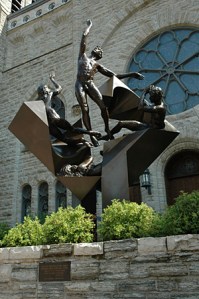
The Birth of Freedom, Paul Granlund
The late Paul Granlund was the sculptor. Westminster commissioned him to give visual expression to the words of the Apostle Paul:
“For freedom Christ has set you free; stand fast therefore, and do not submit again to a yoke of slavery.” (Galatians 5:1)
There is a freedom from and there is a freedom for.
“For your were called to freedom; only do not use your freedom as an opportunity for the flesh, but through love be servants of one another. For the whole law is fulfilled in one word, ‘You shall love your neighbor as yourself.’ But if you bite and devour one another take heed that you are not consumed by one another.” (Letter to the Galatians 5:13-15)
I listen to the campaign speeches. I hear the freedom talk. I see crowds cheering. I hear loud applause. And I wonder…what kind of freedom is being cheered? What kind of slavery is feared?
The advertisers who write the ads for the candidates and the PACs know the answers to these questions. They know that the psyche of American generations that grew up in the Cold War defines freedom as freedom from “Communism” or “Socialism.” They also know that the Christian Right fears submission to the “godless” whom they believe threatens their religious freedom.
But no one can take away my freedom or yours, and it is misleading to paint one’s political opponent as intending to take it way. For me, as a Christian, the freedom for which we are released (set free) is not freedom from but freedom for communion with my neighbors. It applies not only to personal relationships. It applies equally to the political and economic systems.
This morning the bell rang again at the stock exchange. The biting, devouring, and consuming of each other becomes a way of life again, the adored substitute for freedom. To condone it is to submit again to a yoke of slavery, the most widespread violence where, to quote Jacques Ellul,
“in this competition ‘the best man wins’ – and the weaker, more moral, more sensitive people necessarily lose.
“The violence done by the superior may be physical (the most common kind, and it provokes hostile moral reaction), or it may be psychological or spiritual, as when a superior makes use of morality and even of Christianity to inculcate submission and a servile attitude; and this is the most heinous of all forms of violence.”
– Jacques Ellul, Violence: Reflections from a Christian Perspective, Seabury Press, 1969.
Meanwhile Paul Granlund’s “The Birth of Freedom” still stands silently in downtown Minneapolis, calling for the birth of something as yet beyond our imagination. “Stand fast therefore [in the freedom for which Christ has set you free], and do not submit again to a yoke of slavery.” The Apostle Paul often wrote his letters from jail cells, charged with disturbing the Pax Romana.
“The competition that goes with the much-touted system of free enterprise is, in a word, an economic ‘war to the knife,’ an exercise of sheer violence that, so far, the law has not been able to regulate. In this competition ‘the best man wins’ – and the weaker, more moral, more sensitive necessarily lose. The system of free competition is a form of violence that must be absolutely condemned.
“The violence done by the superior may be physical (the most common kind, and it provokes hostile moral reaction), or it may be psychological or spiritual, as when the superior makes use of morality and even of Christianity to inculcate submission and a servile attitude; and this is the most heinous of all forms of violence.”
– Jacques Ellul, Violence: Reflections from a Christian Perspective, Seabury Press, NY, 1969)

Jacques Ellul
Jacques Ellul was active in the French Resistance Movement during World War II, a social critic, lay theologian, sociologist, Professor of Law and Government at the University of Bordeaux, and prolific author. His legacy includes The Technological Society, Propaganda, The Political Illusion, and The Presence of the Kingdom.
Click HERE for information on Jacques Ellul from the International Jacques Ellul Society.
October 14, 2012 at Shepherd of the Hill Presbyterian Church in Chaska
Text: Amos 5: 6-7, 10-15, 18-24
This morning I ask you which of the gods we will bow down and serve: the god of the profits, the organizing principle for those who were at ease in prophet Amos’ time, or the God of the Prophets who thundered against excessive profits in the marketplace?
Some will say that’s too simple.
Amos didn’t think so. Isaiah didn’t think so. Micah didn’t think so. Jeremiah didn’t think so. Jesus didn’t think so. Mohandas Gandhi didn’t think so. We’ve heard from Amos and from Jesus. Here’s what Gandhi called the Seven Deadly Sins of Society. The first sin on Gandhi’s list is
Less than one month before we go to the polls to cast our votes for candidates for public office, I put before you from this pulpit the question of which God you will serve.
Will you commit yourself, or re-commit yourself, to the God of the biblical prophets, or will you line up your life and your values behind the god who thinks there’s no problem with wealth without work, worship without sacrifice?
I have never been more troubled in my life than I am today. It’s not because belong to a political party. It’s not that I want my team to win and the other team to lose. It’s because I believe in the God of the Prophets. I wake up every morning to scripture. And what do the scriptures say?
There were two sets of scripture that informed Jesus’ life. The Torah (also referred to as “The Law”) and the Hebrew prophets. “All the Law and the prophets are summed up in this: You shall love the Lord your God…and your neighbor as yourself.”
Jesus put the Voice of the prophets in the center of Jewish faith and life. Often he sounds like Amos.
We celebrate the Beatitudes of Jesus’ Sermon on the Mount or the Sermon on the Plain. We read in Luke’s Gospel:
“He lifted up his eyes on his disciples and said,
And our hearts rejoice. Because some of us, like Jesus’ first disciples, live in poverty; some of us know what it is to be hungry. Some of us are weeping now, wondering when we will laugh again.
Jesus consoles us. And these words of consolation are lifted up in the churches, as they should be.
But you can’t stop reading there if you want to follow Jesus. For in the very next lines of Jesus’ Sermon to his disciples, he echoes the thundering voice of the prophet Amos and his Woes:
Jesus is calling it like it is. He is describing the revolution of economics, political power, and redistribution of wealth that is the Kingdom of God. The Kingdom of God is an economy – God’s economy. The economy preached by the biblical prophets and Jesus. The world of our best dreams where no stomach is empty, no one goes hungry; no one goes without health care. No one lives on the street under the viaduct, or in a car. No longer will those who have laugh at or pass by those who don’t.
The message of Jesus does console. It comforts the afflicted. But it also afflicts the comfortable. It causes trouble. It makes waves. It speaks the truth. It cuts through the lies that keep the privileged privileged. It calls us to take responsibility in the here and now – to implement in the most practical ways the summary of the Law and Prophets. The over-riding question for the Christian is HOW to love my neighbor as myself? How to live now in the economy of God as the protest of hope and love within the economy of greed, disparity. How to live NOW as those whose worship DOES mean sacrifice.
A businessman notorious for his ruthless pursuit of profits once announced to Mark Twain that before he died, he meant to make a pilgrimage to the Holy Land. “I will climb Mount Sinai,” said the ruthless profiteer, “and I will read the Ten Commandments out loud from the top of Mount Sinai.”
“I have a better idea,” said Twain, with a twinkle in his eye. “You don’t have to go to the Holy Land. You could stay home in Boston and keep the commandments.”
Earlier in his life, Samuel Clemens (who became known as Mark Twin) had been a young reporter in Virginia City. He was walking along the street one day with a cigar box under his arm when a wealthy lady acquaintance said to him scornfully, “You promised me that you would give up smoking.”
“Madam,” he said, “this box does not contain cigars. I’m just moving.
Today we are asked to make a decision of stewardship. In three weeks we will make other decisions in the voting booth. As we consider these decisions, remember Amos yourself which God of the Prophets/Profits your decisions will honor. Will your action bear witness to the economy of greed and extravagance, the world of Gandhi’s Seven Deadly Sins?
Or will your decisions proclaim with Jesus the different Kingdom for which every heart longs to celebrate?
In conclusion, a writer named Ted Kooser invites you to think of yourself as a Daddy Longlegs. You know the Daddy Longlegs, those strange creatures with those tiny little brown bodies like a small brown pill, walking across the floor on those eight long legs.
“Here, on fine long legs springy as steel,
A life rides, sealed in a small brown pill
That skims along over the basement floor
Wrapped up in a single obsession.
Eight legs reach out like the master ribs
Of a web in which some thought is caught
Dead center in its own small world,
A thought so far from the touch of things
That we can only guess at it.
If mine, it would be the secret dream
Of walking alone across the floor of my life
With an easy grace, and love enough
To live on at the center of myself.
You don’t have to go to the Holy Land to read the commandments from Mt. Sinai. Walking on your eight long legs across the floor of your life, you can walk with an easy grace, and with love enough to live on at the center of yourself…You can make love real today right here in Minnesota.
Moral Mormon, yes, at Church and home.
Is there, though, a hint that he objects
To the rules that women have the same
Trouble with the Priesthood that kept blacks
….
Restricted out of the Church for years?
Or that Morman kindness to the poor
Might be a good model for the U. S.
Nation? Can we even up the score?
Everybody knows he’s handsome, smart,
Yes, and rich–but does he have a heart?
– An acrostic verse received this morning from Steve Shoemaker, Urbana, IL.
William Stringfellow observed that the greatest personal challenge is to be the same person… in every time…in every place.
If I’d been able to whisper words into the President’s ear last night, or make him speak like an Edgar Bergen dummy on my lap, he would have asked, “Which of the different people you have been – from which time…and from which place – is the one you asking the American people to vote for?”
But, alas, I only get to grump and moan, holding the President on my lap, like Mortimer Snerd on the lap of Edgar Bergen. Are we really that dumb?
A lot of gas is holding up this balloon.
The Industrial Complex that
doesn’t even need the Military
Corporations have a soul
the Supreme Court decreed.
So it’s better, on the whole,
that they are built on greed,
for the money trickles down
to all of us that way–
CEOs may own the town,
but I still get some pay.
Bailouts go to the big guys,
too big to fail are they.
I have had to lose my house,
Too small to count am I…
I pay my taxes, glad to help!
They hire their big law firms:
here a shelter, there a fudge,
if needed, buy a judge!
– Steve Shoemaker, Urbana, IL, Oct. 23, 2012
I’m exhausted…spiritually exhaused. They’re exhausting me…all the emails…and the voice mails telling me that if I don’t give one more dime one more time…my candidate is going to lose…and the world will come to an end…and it’s going to be… my fault.
Anyone else feeling that way?
I’m also torn up inside. I’m trying to be civil…trying to understand why this election is even close…and trying not to be haughty and naughty.
I’m missing my afternoon nap. I love my afternoon nap with Maggie and Sebastian, my buddies here at home. They still sleep like logs…the way I used to…before the Presidential debates and emails that clog my inbox and the phone calls from chummy best friends I’ve never met who want just one more donation of “just $5” so so-and-so knows s/he can count on me.
It’s an illusion. Anyone else feeling that way?
Meantwhile…between the emails and the phone calls…I visit the dying…in hospice care…who live on the edge of existence itself…who sip comfort from the deeper wells. My spirit is strangely quieted. Strangely calmed. We sit in silence. I read a psalm or two. We…the dying…and I are refreshed. Ready for a nap.
I go home and stumble upon a prayer by Wendell Berry “To the Holy Spirit”:
O Thou, far off and here, whole and broken,
Who in necessity and in bounty wait,
Whose truth is light and dark, mute though spoken,
By Thy wide grace show me Thy narrow gate.”
Wendell Berry, Collected Poems, North Point Press, 1964.
Did anyone else feel the sober tone of the President last Wednesday?
He seemed tired, ill-prepared, scattered, aloof.
It looked to this observer as though he did not want to be there, but for different reasons than the pundits suppose. I saw a President who was tired of the nonsense, the posturing, the game in the Charlie the Tuna ad – “Just because it looks good doesn’t mean it is good.” He knew that the solutions proposed by his opponent were the problem that brought America to its knees on near economic collapse in 2008, and that the Republican Party set its sights on insuring the failure of his presidency instead of working together to solve the nation’s problems.
The President is a kind man. His civility is offensive to his enemies and his friends alike. He doesn’t wear his religion on his sleeve. But his belief in doing to others as he would have them to him is more than a throw-line. At the Democratic National Convention, he had refused to follow the crowd in shouting down Gov. Romney as if he were evil incarnate. Even after Clint Eastwood had put in Obama’s mouth words that he never speaks (“Shut up”), the President chose not to retaliate. He hushed the convention delegates from playing tit-for-tat. He told them not to go there, to rise above it, incurring the anger of a number of party faithful who wanted him to fight with brass knuckles.
Last Wednesday President Obama’s face and demeanor seemed to say, “I want to be somewhere else. I hate this. I hate this charade. There has to be a better way than sound bytes, memorizing one-line shots to fire across each others’ bows, the twisting of fact and the avoidance of the deep philosophical questions that keep a President awake in the night.”
There are no simple solutions to America’s current problems. They’ve been building for decades. There are no magic wands. The problems are moral, spiritual, and structural. This President knows that reality is different from the one we would like to make up. When such a one sees the complexity, it’s hard to step out on a staged, phony debate that squeezes the world into the nut-sized phrases and slogans that ring the bell that makes Pavlov’s dog salivate.
Could the stage on which he stood – on the night of his real wedding anniversary – have struck him as the opposite of reality itself? Maybe that’s why he didn’t ring the bell.
 Views from the Edge