“All Things Considered” (MPR, 91.1 FM) This Afternoon

The Tragedy of Sandy Hook is scheduled to air this afternoon between 5:25 and 5:50 CST, but as one of the producers reminds us, “the time is always subject to change. To be safe, listen to the whole show.”

Thanks to the good folks of Minnesota Public Radio (MPR 91.1 FM) for publishing the piece.

My Grandmother’s Rifle

My 90 year-old Grandmother kept a revolutionary war rifle under her bed in Rockport, Massachusetts. She wanted to be safe. When she showed it to me, I could barely drag it out from under the bed.  How she would have gotten it out and lifted it to point at an intruder was a puzzle, but my Grandmother, like many of us, thought a gun would make her safe.

My Grandmother's revolutionary war rifle.

My Grandmother’s revolutionary war rifle.

Security, weapons, and freedom make strange bed-fellows. Guns will not produce security, and the freedom to buy and use the weapons of war equates pulling a trigger with free speech.

In America the mixing of the right to bear arms, the search for security, and the sanctity of personal freedom without limits are the ingredients of a national security state…and a state of permanent anxiety.

We are not safe in America. The six-year-olds and seven-year-olds of Sandy Hook were not safe. Their teachers were not safe. Their town was not safe. The five-year-old and the two-year-old in Minneapolis who found a pistol under the pillow in their parents’ bedroom were not safe. The two-year old is dead. The five-year-old and his parents will never be the same. Nor will the people of Baghdad, the U.S. Army base at Fort Hood or the folks killed at McDonald’s. We are not safe either at home under Homeland Security or in the places around the world where un-manned drones kill and maim not only those who threaten our safety but innocent children, under that banner of freedom, democracy, and national security.

The U.S. Constitution is a work of genius and wisdom depending on how well it is interpreted by the Courts. The First Amendment the right to free speech. The Second Amendment protects the right to bear arms, a right originally intended to maintain the power of the people, collectively, to overthrow another King George or a government that did not serve the well-being of the American people.

Among the “arms” protected by the Second Amendment there was no assault weapon able to shoot 100 times in 60 seconds and then reload or a pistol capable of 30 shots before reloading. What the framers of the Second Amendment had in mind was muskets.

“Load… aim… fire…..  Load… aim… fire.”

The Second Amendment never imagined the likes of the M-16 or its knock-offs or a semi-automatic pistol concealed in one’s purse or trousers. The weapons used against a mother and elementary school children in Newtown and against customers having a cup of coffee at a McDonald’s were the furthest thing from their time-bound imagination.

There were no McDonald’s when the Second Amendment was adopted and there were no semi-automatic weapons sold at gun shows. Today, ABC News reports that, according to the 2011 statistics of the U.S. Bureau of Alcohol, Tobacco, Firearms and Explosives, there were 4.17 times as many federally-licensed retail gun dealers and pawn shops(58,794) than McDonald’s (14, 098) in the U.S – more death shops than places to eat a Big Mac.

ABC News also reported that “2012 has been a record-setting year for gun sales. As of November, the FBI recorded 16,808,538 instant background checks for gun purchases for 2012. Even without counting December, which has historically been the busiest month, this beats last year’s record by more than 350,000.”
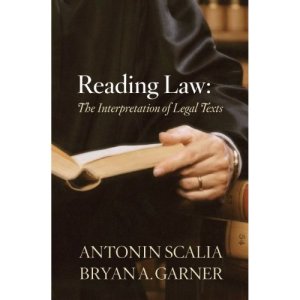
Argument for strict Constitutional interpretation by Justice Scalia

Argument for strict Constitutional interpretation by Justice Scalia

Strict Constitutionalists like U.S. Supreme Court Justice Antonin Scalia know full well that my grandmothers revolutionary war rifle was the “arms” the Second Amendment had in mind. Every citizen in America has the right to have a revolutionary war rifle –  a single shot “load…; aim…; fire… re-load…; aim…; fire…” under the bed… or under the pillow in the parents’ bedroom.

Freedom was never intended to produce a domestic or international killing field. If we Americans have learned anything from 9/11, Iraq, Afghanistan, Columbine, Red Lake, and Sandy Hook, it is that our security is not found in a gun or a drone in every home. Neither was the nation’s security license to monitor the phone calls, emails, texts, bank records, and personal movements of citizens.

I exercise my right to free speech by writing and publishing words as the weapons of persuasion in hopes that they might contribute in some way to a national introspection and action that minimizes the human impulse toward violence and destruction. I have to believe that words are more powerful in the end than the Bushmaster .223 assault rifles and drones that kill at home and abroad – all in the name of keeping us alive and “safe”.

According to strict judicial interpretation of the Second Amendment, everyone in America has a right to own a musket or, perhaps, pull a revolutionary war rifle from under the bed.

Confronting our inclination to violence

A thoughtful reflection from New Zealand:

Confronting our inclination to violence.

The “Tragedy” of Sandy Hook

macbethIf philosophical parsing of the meaning of Sandy Hook was inappropriate just a few days ago, it is mandatory now.

The slaughter of these dear little ones and their teachers was a moment of terrible and terrifying insanity. When Adam put on his body armor and turned his mother’s guns on his own mother and Sandy Hook, insanity broke out to bring grief that chilled the bones of everyone in America.

Today there are calls for gun control and mental health services, and those calls make perfect sense as practical responses, but they will not fix the problem.

There is a more profound collective insanity that pervades our culture and our nation. It’s a tragedy in the sense of the old Greek and Shakespearean theater: a fatal flaw that is doing us in.

Sandy Hook was the latest symptom of the American tragedy: our worship of safety – arming ourselves to the nines – turns out to the death of us.  The idolatry of safety is the worship of death itself.

A five year old boy in Minneapolis is playing with his two-year-old brother in their parents’ bedroom. He finds a loaded pistol under their father’s pillow, points it at his brother as one would point a toy gun. His brother is dead. The surviving five-year-old and his parents will never be the same – because a father sought to keep his family safe with the pistol under his pillow.

A mother in Newtown has guns in the home she shares with the disturbed son she loves and seeks to protect from a cruel world. Like so many others in America, the guns were purchased either for safety or for sport, but the results are the antitheses of safety or fun.

Whether in our bedroom at home or in the nation’s Capitol, when the insurance of safety rises to the top of the pyramid of values, death ascends as the power that destroys, the fatal flaw in a natural human instinct toward safety and security.

Freedom and safety are basic human needs. They are American values. Each is important. But neither freedom nor safety is God. Neither one is worthy of enshrinement by itself, and the two of them mixed together make for a Molotov cocktail thrown back into our own bedrooms, at the Sandy Hook Elementary School, Baghdad, and anywhere else that the concern for safety releases the tragic flaw of the Greek theater, Shakespeare, and the American theatre of the absurd.

Pieta - Michaelangelo

Pieta – Michaelangelo

Sandy Hook: the Day After

    Sometimes as Good as a Dog


Do not say that “It was the will of God.”

  Imagine what automatons are like:

no thought, no will, no emotions.  A good

  dog trained to help the blind can make

the decision not to cross the busy

street even if the master says to heel.

A robot just repeats repeats a task.

  A human can lovingly pat you on

the back, or choose to stab you in the back.

  God seems to prefer life to a machine.

So we are free to love, to choose the good,

and if sometimes we do…we can thank God.

– Steve Shoemaker, Urbana, IL Dec. 15, 2012

The Manger

We are more than animals,

but not as much as we may think

We both must stop to eat and drink:

trough or table, room or stable.

He was placed in a manger.

He would become food for us:

bread and wine, life divine,

grace we can taste, pure salvation,

soul and body–redemption!

All from a baby in a manger.

– Steve Shoemaker, Urbana, IL, December 10, 2012

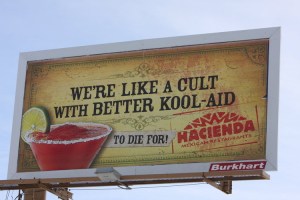
Grover Norquist: High Priest of Purple Kool-Aid

Grover Norquist is quoted in Mallory Simon’s “GOP Resistance to Anti-Tax Pledge Grows” as saying:

“You’ve had some people discussing impure thoughts on national television.”

“Impure”?…  Is The Taxpayer Protection Pledge a religion? With its own “elect”? And its own high priest and Lord High Executioner: Grover Norquist? Thank God for the former cult members who have had “impure” thoughts and are going on national television to either repent or to “weasel out” of their pledges.

No elected representative should take any other pledge than to uphold the Constitution of the United States of America and to faithfully exercise the duties of their office. The Norquist pledge, while it has rallied support for candidates’ election to office, limits their ability to exercise of the duties of office, as many former signers are discovering while standing at the edge of “the fiscal cliff”.

The Taxpayer Protection Pledge (“Anti-Tax Pledge”) was always bad religion. It asked candidates, and the whole country, to follow the example of another religious high priest, Jim Jones, who led this flock into the jungle where they frank the purple Kool-Aid of mass suicide.

We’re not in the jungle of Guyana with Jim Jones. We’re in the United States of America. Time to dump the purple Kool-Aid religion. Time for some fresh orange juice, a bowl of nutritious oatmeal with raisins, and lots of conversation over coffee in the Congress and the White House.

The Sound of the Trumpets in the Morning

A sermon preached the Sunday before Election Day at Shepherd of the Hill Presbyterian Church in Chaska, Minnesota.

An English Friend in Norman Coutances (Dennis Aubrey)

This lovely post from Via Lucis was almost deleted in the avalanche of campaign soliticitations in this morning’s in-box. Scroll down for the post. It lifted my spirits, prompting the following thank you:

Dennis and PJ, Your post gave me a lift this morning. Such grandeur. I am so weary of campaign television ads, phone calls, and internet solicitations that reduce the human spirit to its smallest proportions. I need the height, the soaring arches, the clean lines – and the reminder that sometimes even barbarity recognizes something else worth preserving. Beautiful shots and great commentary.

An English Friend in Norman Coutances (Dennis Aubrey).

Their post took me to the psalms, and psalm paraphrases set to music. One is Christopher L. Webber’s “I will give thanks with my whole heart,” a paraphrase of Psalm 138 set to the music of Cantionale Germanicum (1628) arranged by J.S. Bach (c. 1708).

All kings on earth who hear Your words,

O Lord, will give you thanks and praise

And tell how great Your glory is,

And they will sing of all Your ways.

The Lord is high, yet scornes the proud,

Protects the lowly on their path;

Although I walk in trouble, Lord,

You keep me safe from my foe’s wrath.

Lord, Your right hand shall save my life

And make Your purpose for me sure;

Do not forsake what You have made;

Your love forever will endure.

– Third, fourth and fifth stanzas

“The Birth of Freedom” and the NYSE

The New York Stock Exchange was closed down. For two full days the trading bell on Wall Street did not ring. But on Main Street the bells that mis-identify American freedom with Wall Street were ringing in our living rooms, flooding the airwaves with campaign ads about freedom and the loss of it.

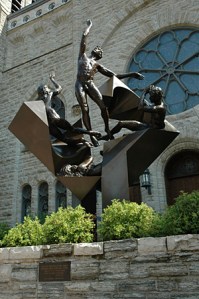
In front of Westminster Presbyterian Church on the Nicollet Mall at the heart of downtown Minneapolis stands an eye-catching sculpture called “The Birth of Freedom.”. The figures are naked, emerging from primal slime, evolving, reaching toward the heavens.

The Birth of Freedom, Paul Granlund

The late Paul Granlund was the sculptor. Westminster commissioned him to give visual expression to the words of the Apostle Paul:

“For freedom Christ has set you free; stand fast therefore, and do not submit again to a yoke of slavery.”  (Galatians 5:1)

There is a freedom from and there is a freedom for.

“For your were called to freedom; only do not use your freedom as an opportunity for the flesh, but through love be servants of one another. For the whole law is fulfilled in one word, ‘You shall love your neighbor as yourself.’ But if you bite and devour one another take heed that you are not consumed by one another.” (Letter to the Galatians 5:13-15)

I listen to the campaign speeches. I hear the freedom talk. I see crowds cheering. I hear loud applause. And I wonder…what kind of freedom is being cheered? What kind of slavery is feared?

The advertisers who write the ads for the candidates and the PACs know the answers to these questions. They know that the psyche of American generations that grew up in the Cold War defines freedom as freedom from “Communism” or “Socialism.” They also know that the Christian Right fears submission to the “godless” whom they believe threatens their religious freedom.

But no one can take away my freedom or yours, and it is misleading to paint one’s political opponent as intending to take it way. For me, as a Christian, the freedom for which we are released (set free) is not freedom from but freedom for communion with my neighbors. It applies not only to personal relationships. It applies equally to the political and economic systems.

This morning the bell rang again at the stock exchange. The biting, devouring, and consuming of each other becomes a way of life again, the adored substitute for freedom. To condone it is to submit again to a yoke of slavery, the most widespread violence where, to quote Jacques Ellul,

“in this competition ‘the best man wins’ – and the weaker, more moral, more sensitive people necessarily lose.

The violence done by the superior may be physical (the most common kind, and it provokes hostile moral reaction), or it may be psychological or spiritual, as when a superior makes use of morality and even of Christianity to inculcate submission and a servile attitude; and this is the most heinous of all forms of violence.”

– Jacques Ellul, Violence: Reflections from a Christian Perspective, Seabury Press, 1969.

Meanwhile Paul Granlund’s “The Birth of Freedom” still stands silently in downtown Minneapolis, calling for the birth of something as yet beyond our imagination.  “Stand fast therefore [in the freedom for which Christ has set you free], and do not submit again to a yoke of slavery.” The Apostle Paul often wrote his letters from jail cells, charged with disturbing the Pax Romana.