
Martin Luther King, Jr. 50 years ago

2013 MLK: “What happened?”

Glock owner at State Capitol hearing. Photo by David Joles, StarTribune.

Martin Luther King, Jr. 50 years ago
2013 MLK: “What happened?”
Glock owner at State Capitol hearing. Photo by David Joles, StarTribune.
This article is long but so important. Noam Chomsky speaks about reality and democracy.

Deepwater Horizon fire
The date is TUESDAY, SEPTEMBER 10. Time: 7:00 p.m. Shepherd of the Hill Presbyterian Church, 145 Engler Blvd. in Chaska, MN. The Topic: Beyond Environmental and Human Extraction: Deepwater Horizon Three Years Later.
Here’s why this is worth your time (a quote from the MinnPost commentary):
“They call the oil rigs “rigs” for a reason. The whole thing is rigged.
“If we see a stranger on what used to be Isle de Jean Charles; if we see canals still crisscrossing through the marsh; if we’ve seen the fires of Deepwater Horizon light up the Gulf of Mexico and slick the waters and estuaries with black gold; if we’ve seen the evidence of breaking-and-entering in the house of the Gulf Coast waters, if we see empty oyster shells where once there were oysters; if we’ve heard about the oil companies hiding without anyone playing seek, we can ignore the game or we can seek and find for the sake of survival.”
Yesterday’s New York Times published Gulf Spill Sampling Questioned. Click THIS LINK to read the story. Researchers found a higher level of contamination than federal agencies did in water, sediment and seafood samples taken in 2010 after the Deepwater Horizon drilling rig explosion in the Gulf of Mexico.
Our speakers for this Dialogues event, Kris Peterson and Richard Krajeski, are there in the field. They split their time as researchers and disaster recovery professionals with the University of New Orleans’ Center for Hazards Assessment, Response, and Technology (CHART) and serving as pastors to the Bayou Blue Presbyterian Church of Gray, Louisiana. Kris and Dick work most closely with the subsistence communities of the Louisiana Delta, including the Isle de Jean Charles Biloxi-Chitimacha-Choctaw, whose traditional homeland is disappearing.
Hope to see you there.
A Sermon at Shepherd of the Hill Presbyterian Church in Chaska, MN, August 11, 2013.
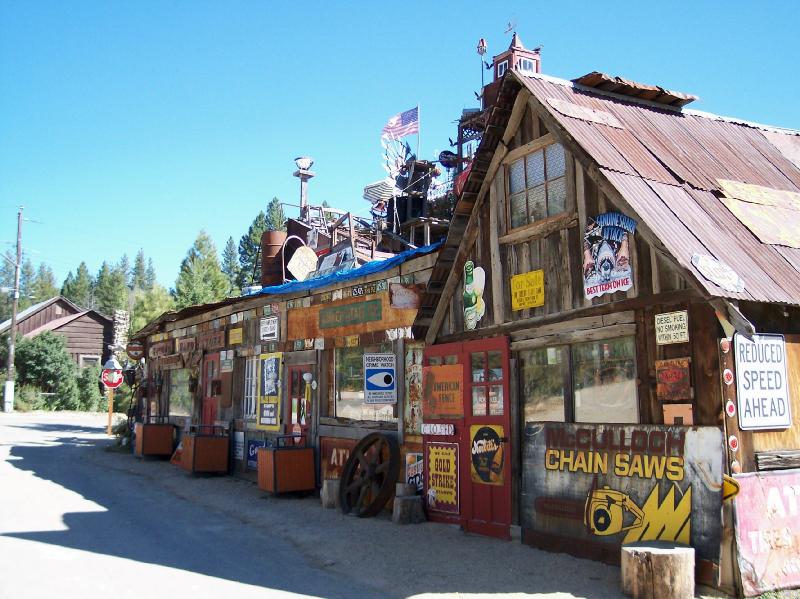
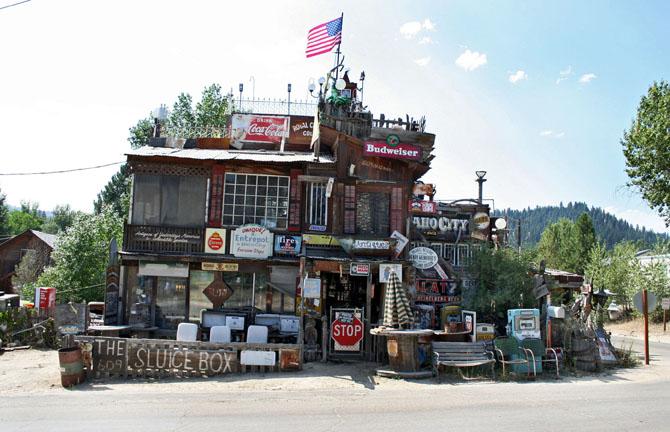
For sale in Idaho City
According to the woman who strolled up the street while Kay was taking photographs, it belonged to a fella who was “a little eccentric” whose surviving relatives didn’t want to continue “the business” so it has sat vacant for a couple of years waiting for a new owner. She said it could be ours for $350,000 – and not just the property, but ALL the valuables inside. It’s been vandalized several times, she said, but with a little attention, if the right person came along and “restored” the place, it could become a thriving operation. People would come from miles around.
Wouldn’t you like to meet the man who owned and operated The Sluice Box? Elsewhere on Views from the Edge we’ve noted famous people who were a little eccentric – people like Bishop James Pike – and suggested the world would be a better place if we were all a bit more eccentric. Whoever the man was who (sort of) maintained this old 1800s structure while collecting everyone else’s junk, he wasn’t into a throw-away culture.
A web search uncovered the current asking price: $249,900. Click HERE for the real estate listing. Turns out the house next door comes with it.
Click HERE and then click the audio link on the Minnesota Public Radio website to hear yesterday’s commentary on the classical spiritual-philosophical-ethical premise we need to remember. This piece was written two days BEFORE the President delivered his speech yesterday at Knox College.
The English word “economy” comes from the Greek work “oikos” – the Greek word for house. The word “economics” derives from the Greek word “oikonomia”- -the management of a household.
Before it is anything else, economics is a perspective, a frame of reference. Before it decides anything about household management, it knows that there is only one house. Good household management – good economics – pays attention to the wellbeing of the entire house and all its residents.
Aired earlier today on All Things Considered (MPR, KNOW, 91.1 FM).
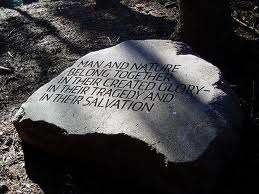
Paul Tillich quote in Tillich Park, New Harmony, IN.
Economics is about a household and how to manage it. The household is a family, a state, a nation, a planet.
The English word “economy” comes from the Greek work oikos – the Greek word for house. The word “economics” derives from the Greek word oikonomia–the management of a household.
Before it is anything else, economics is a perspective, a frame of reference. Before it decides anything about household management, it knows that there is only one house. Good household management – good economics – pays attention to the wellbeing of the entire house and all its residents.
In America and elsewhere across the world, we are coming to realize that the planet itself is one house. What happens in one room of the house – one family, one city, one nation – affects what happens everywhere in the house. Paul Tillich caught the clear sense of it when he wrote that “Man and nature belong together in their created glory – in their tragedy and in their salvation.” That is to say, there is only one house.
The essential question of economics is not about systems – capitalism, communism, socialism, or something else. The essential question is spiritual, philosophical, and ethical. It’s whether we believe that there is only one oikos, one house; the subsequent question is about how best to manage it for the wellbeing of all its residents and the fragile web of nature without which the house of the living would not exist.
Very often what we call ‘economics’ is not economics. It’s not oikonomia. It’s something else. It assumes something else, and when we forget what an economy and economics really are, we enshrine greed as the essential virtue, ignoring and imperiling everyone else and everthing in the one house in which we all live.
I dream that the President will preach the old Greek common sense: that in his own way, he will reclaim the essential premise of an economy and the ethical task of economics. By bringing the Greek origins to our television sets, headsets, and iPads, he can call us to move forward out of the partisan houses of nonsense.
There is only one house.
Thrice happy he, who by some shady grove,
Far from the clamorous world, doth live his own;
Though solitary, who is not alone,
But doth converse with that eternal love.– William Drummond, Urania
Next to the big barn attached to the big house on the big hill in South Paris, Maine was my favorite place: the pine grove.
It was a quiet place. The pine trees reached up to the sky, so tall that I wondered whether their tops could touch the blue sky and the white clouds I would watch floating over them through the filtered light of the trees, lying on the pine needles of the pine grove floor.
Sometimes Annie went with me to the pine grove. She lived just behind Grandpa’s and Grandma’s big house on the hill.
Annie liked my grandmother’s sugar cookies almost as much as I did…and the gingerbread cookies and the toll-house cookies, but mostly the big white sugar cookies my grandmother made every day because she knew we liked them best. We would settle on the granite steps outside the pantry with big glasses of fresh milk from real returnable glass milk bottles brought that morning by the milk man, and eat the cookies and drink our milk. Then a cookie or two would go with us into the pine grove.
We would lie there and look up…without talking…smelling the aroma of the pines. It was a sacred place of solitude and quiet – God’s greatest gift – where I could forget that my father was somewhere far away on the other side of some great big ocean in a great big war against a great big monster. I would retreat to the pine grove to get away from the radio broadcasts we listened to that might tell us whether my father was alive or dead.
There was no war in the pine grove. There were no people there. Just the great big pine trees that didn’t seem to care about the war. They just kept reaching up to the sky.
After we moved far away to Pennsylvania following my father’s return from the war, we returned to South Paris annually for vacation. Every year those pine trees were there waiting for my return.
During the 10 hour drive to South Paris, I looked forward to lying on the floor of the pine grove with a fresh-baked sugar cookie. As we drove up the road from Gray and rounded the bend by the Fair Grounds, the anticipation grew. I could almost smell the scent of the pines of the pine grove.
Until the year I looked up to see a franchise submarine sandwich shop standing where the pine grove had stood. The pine grove was gone. Clear cut. All the trees. All the pine needles. And the hill had been leveled to street level.
Someone had declared war on the pine grove, and the trees couldn’t fight back. Trees don’t fight. I sobbed like a baby.
 Views from the Edge