The First Supper

Steve Shoemaker, 4/18/12

Front gate, Ganghwa Anglican Church

With traitors, cowards, doubters he sat down,

he took the bread, gave thanks, passed it around…

With Adam, Eve, and Sarah, Abraham,

with David and Bathsheba:  sinners all.

With you and me, with the whole human family,

he shared the holy cup of salvation.

The water, flour and heat (bread):

his body broken.  Then his blood was shared:

the fruit of the vine, pressed down, runs over

the land–ocean, flood, eternal river…


Give thanks for grace, for love, for mystery.

(Jesus):  This do in remembrance of me.

Barabbas

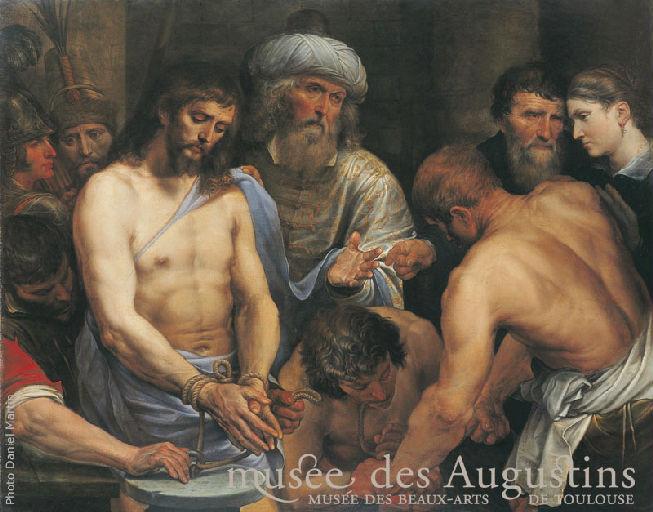
Release of Barabbas - artwork by Wenceslas Coehergher

Another acrostic poem by Steve Shoemaker, April 16, 2012, a reflection from the standpoint of Jesus Barabbas, the man released by Pilate. He is variously described as “among the rebels,” “a notorious prisoner, ” and a bandit/terrorist. Jesus of Nazareth is crucified. Jesus Barabbas is set free.

BARABBAS

Because my father was a Rabbi, when

Assassinations became part of our

Rebellion against Rome, my friends were then

Amazed that I would kill.  But victory

Belongs to us:  power yields only to power.

Being arrested, jailed, soon a martyr,

All will help the cause! Peaceful ways never

Save a soul.  Blood alone will set us free…

The desire for the society that is beyond up-and-down, oppressing-oppressed, haves-and-have-nots takes many forms.  Steve’s “Barabbas” is the son of a peaceful rabbi, a man of peace. Unlike his rabbi father, Barabbas knows that “Peaceful ways never save a soul. Blood alone will set us free.”

What do you think?

Ist Barabbas right that “Power only yields to power!”

Is violence – the taking of blood – necessary “to the cause”?

There are two Jesus figures in the story. One takes life; the other gives it.

How do you understand Steve’s last line?

Pontius Pilate

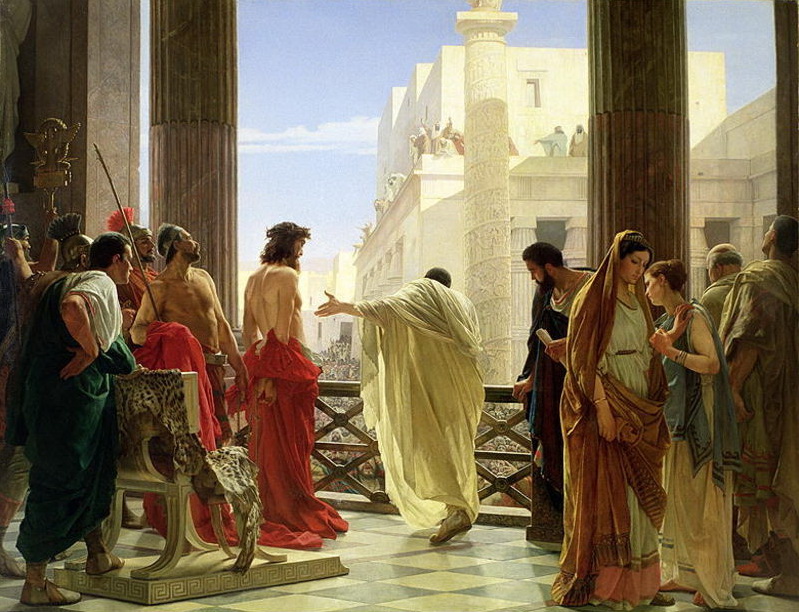
Pontius Pilate with his Prisoner - Antonio Ciseri

Ecce homo - "Here is the man"

“PONTIUS PILATE” – (acrostic) – Steve Shoemaker – April 14, 2012

Position is the most important thing,

Of course…   You say your reign is not in this

Nasty world, but here you are suffering…

Total power is mine.  If this grim choice

I make (and ignore my wife’s dream), nothing

Untoward will come back to haunt me!  I wash

Sand and dirt from my hands as I wash you…


Prefects are not required to be perfect.

If I send tax money to Rome, a few

Lies told against me soon will die.

A sect or uprising I stamp out now will do

The most to make my name remembered. Fact:

Even if I call you “King,” you die a Jew….

If you like Steve’s poem, you might also be interested in “You don’t get to have a non-Jewish Jesus” (CLICK HERE), posted earlier on Views from the Edge on Christian anti-Semitism.

Art work Ciseri, Antonio, 1821-1891. Ecce Homo – “Here is the Man”, from Art in the Christian Tradition, a project of the Vanderbilt Divinity Library, Nashville, TN.  http://diglib.library.vanderbilt.edu/act-imagelink.pl?RC=55115 [retrieved April 14, 2012].

A Lightness of Being

Dew Drops on a Spider's Web

Dew Drops on a Spider’s Web – Kay Stewart Photography

This spider’s web, covered with early morning dew – a natural miracle nearly invisible to the naked eye – was in the corner of a flower box on our deck. Kay, whose camera is always nosing around for the things we do not see, took this photograph. The poem was inspired by the smallness I felt – the beauty of smallness – seen in the magnificence if a spider’s web in morning light and in e. e. cummings’ poem “who are you, little i”.

“A Lightness of Being” – Gordon C. Stewart

who are you, little i, sitting above

the world so high (e. e. cummins)

on the high perch home

hammers and saws have made

on land filled and leveled by

bulldozers and gas-guzzling graders?

then i see it in the morning sun

the all-but-imperceptible home

spun from inside a spider self,

wet with drops strung like beads

so small, so delicate, so light

they leave the spider’s home intact,

a natural grace respecting strength

and weakness – a lightness of being

that does not crush or break

this hidden part – this most amazing part –

of a larger Web of life we barely see

Say “Yes!”

Here’s an uplift for your day.

It comes fresh from a blogger named David from New Zealand. I came across “Say ‘Yes!'” this morning following up on a comment left yesterday in response to Steve Shoemaker’s poem “Denial”  on Views from the Edge. I’m glad I did.

Click Say “Yes!” and embrace your life.

What do you think? Are you having a Yes, No, or Maybe kind of day? Remember, it’s the only one you have and no one else gets to live it. Thanks for dropping by.

DENIAL

Peter's denial

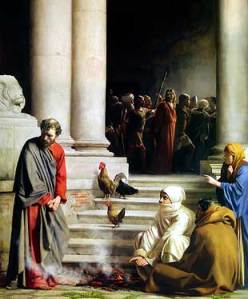
Peter's Denial by Carl Heinrich Bloch

Any faith worth its salt recognizes our capacity for denial, betrayal, and flight, as well as our capacity for truth, love, and courage. Steve Shoemaker’s poem about the Apostle Peter, “the Rock” who crumbled, takes us into the heart of the matter. It;s a reflection on Peter denying that he knew Jesus (represented by Carl Bloch’s painting where he looks away from the woman who claims he knows him) and the post-resurrection appearance where the resurrected Christ offers forgiveness.

“DENIAL” – Steve Shoemaker, 2012


The future Bishop began badly.  He

was “rude, crude and lewd,” as they say.

His fist would shake, would hit,

his mouth could often be a sneer, or leer…

but Jesus chose him first.


The fisherman was big and brash, yes,

bold as well at times.  But after the arrest

a servant girl confronted him and

told those listening that Peter was with Christ.

He swore and then denied it, then again

and still again–she would not stop.


The cry then came of rooster telling of the dawn,

and he wept because he had told a lie.

But Peter felt forgiveness full and deep

when Jesus three times told him,

“Feed my sheep.”

Peter “the Rock” was no rock. Nor are we. He was sinking sand. So are we.

Like “the future Bishop,” we slip badly and yet we are raised up. Betrayal, denial, flight are part of every human story. But grace… even more….so much more, abounds! And to the likes of Peter and of us, there comes to our three-fold denial the Voice of forgiveness with a gentle but bold command: “Re-gain your courage. Live in love!”

In the Strife of Truth with Falsehood

Get ready for the verbal assaults.The PAC ads. The disinformation and misinformation media campaigns funded by big money with big interests that know how powerful words are.

Words are POWERFUL! Sometimes those of us who stand in pulpits doubt that our words matter. But reading this paragraph in Timothy Egan’s NYT,Deconstructing a Demagogue,”reminds me of just how powerful words are:

Back in 1994, while plotting his takeover of the House, Gingrich circulated a memo on how to use words as a weapon. It was called “Language: A Key Mechanism of Control.” Republicans were advised to use certain words in describing opponents — sick, pathetic, lie, decay, failure, destroy. That was the year, of course, when Gingrich showed there was no floor to his descent into a dignity-free zone, equating Democratic Party values with the drowning of two young children by their mother, Susan Smith, in South Carolina.

Today, if you listen carefully to any Gingrich takedown, you’ll usually hear words from the control memo.

And that’s just the beginning of the story of how language is used and abused for purposes of social manipulation. Gingrich knew that language is “A Key Mechanism of Control.”  Those who are well-schooled in theology and politics know that language is the primary mechanism of mind control: truth becomes falsehood and falsehood becomes truth; beauty becomes ugliness and ugliness becomes beauty; goodness becomes evil and evil becomes goodness, twisted by the language of innuendo and word association.

The cynicism that pervades the American electorate is due, in part, to this demagogic use of language. Words are precious things. Holy things. Sacred things. When they get twisted, they become vulgar and profane, one might even say ‘demonic’ in the sense in which Paul Tillich defined ‘demonic’: the twisting of the good. “The claim of something finite to infinity or to divine greatness is the characteristic of the demonic” (Paul Tillich, “Life and It’s Ambiguities,” Systematic Theology, Vol. 1, p. 102).

Paul Tillich, “The Courage to Be”

Paul Tillich was one of the first university professors fired during the Third Reich in 1933. At the invitation of Reinhold Niebuhr, he came to America where he taught at Union Theological Seminary in the City of New York, Harvard Divinity School, and the University of Chicago. Tillich and his academic colleagues in theology, philosophy, and ethics (Willem Zuurdeeg, Martin Niemoller, Karl Barth, Dietrich Bonhoeffer, and Elie Wiesel) left us a rich legacy of linguistic analysis of the language of demagogic use of language.They speak with authority because they each paid a price for their opposition to it.

There are those who say that Hitler won his war after all. His ingenious use of language and rhetoric is the substance of Language: a Key Mechanism of Control. Newt Gingrich is not Adolf Hitler. And we are all well-advised to be very careful with contemporary references to him, the Third Reich, or the Holocaust. Yet the language that once led a nation regarded as “the most sophisticated culture” to swallow the toxin of twisted truth is with us still. The demonic poison how rules the day in America, peddled as cure and candy by candidates bought and sold by the private corporate powers whose PAC ads control the airwaves.

Words are sacred. And those who abuse them enter into the darkness of the demonic twistings that led James Russell Lowell to write the hymn lyrics I sang as a child:

Once to every man and nation Comes the moment to decide, In the strife of truth with falsehood…. Though the cause of evil prosper, Yet t’is truth alone is strong; Though her portion be the scaffold, And upon the throne be wrong;, Yet that scaffold sways the future, And, behind the dim

unknown, Standeth God within the shadows, Keeping watch above His own. – James Russell Lowell, 1945, “Once to Every Man and Nation”

The PAC ads are coming. Plug your ears…or…better yet, listen carefully, listen critically. Then speak out “in the strife of truth with falsehood.”


The Charcoal Fire — 10 Years Ago

As the sun rose this [Easter] morning, a few of us warmed ourselves around a fire outside the church. Two charcoal fires were recalled, involving Peter, “the Rock” who crumbled like a piece of shale, and the risen Christ, who would re-create the scene to change the story from denial to welcome, forgiveness, and a commissioning to love.

Steve Shoemaker Verse, “The Charcoal Fire”

THE CHARCOAL FIRE

Charcoal Fire
Three times
Denial:

I do not know the man

Charcoal Fire
Three times
Forgiveness:

Do you love me?
Do you love me?
Do you love me?

Charcoal Fire
Three Times
Commission:

Feed my sheep
Feed my sheep
Feed my sheep

Steve Shoemaker
Urbana, IL
April 8, 2012

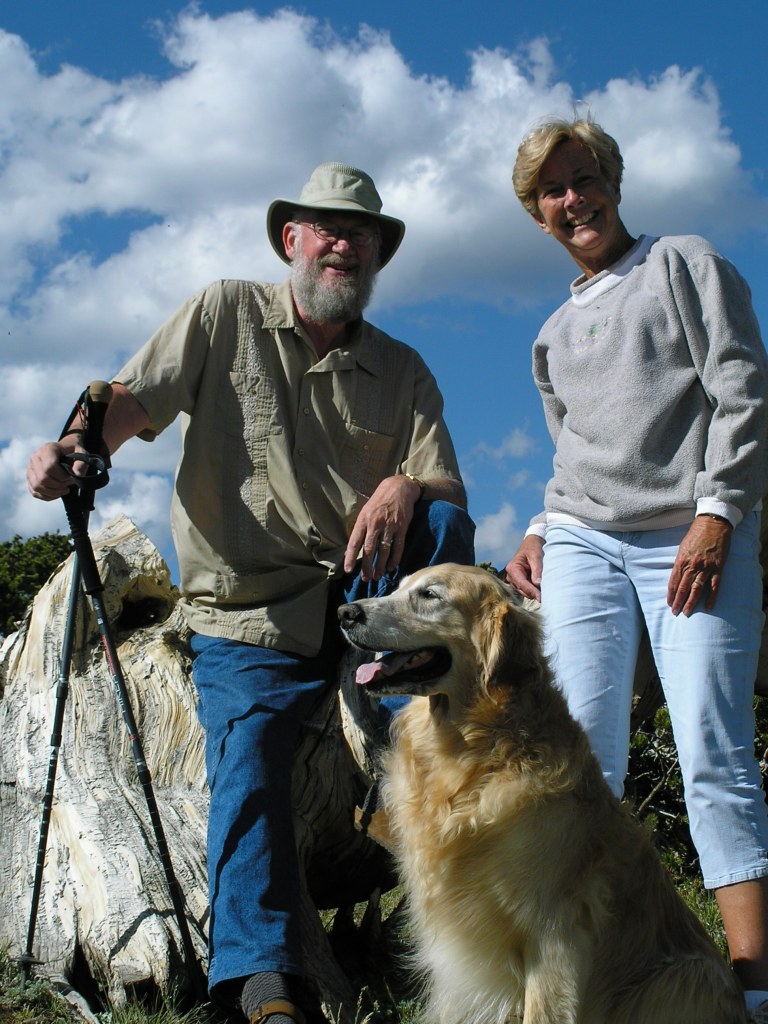
Gordon C. Stewart, author of Be Still! Departure from Collective Madness (2017 Wipf and Stock), edited and republished in memory of Steve Shoemaker. Steve is sitting on a Bristlecone Pine stump above the tree line in Colorado during a gathering of seminary friends. Mutual friend Anna Strong and canine companion stand by him.

A Poem for Easter Morning

EASTER MORNING

(double acrostic)


Either Jesus really did rise or

All his followers made up the worst

Series of lies in history…  Poor

Thomas certainly was right to doubt

Even after hearing tales: what four

Reached the tomb (or five?)  Who saw him first?


Matthew says two women, Mark says three;

Or was it just one, as said by John?

Reports of what eye-witnesses can see

Never can be trusted.  Luke said one

In the road joined two who could not see–

Not until he broke the bread…  No one

Got the story straight! Conspiracy?


Even grade school kids could do as well.

And Luke throws in Peter saw him too–

Somewhere unreported…  Who could tell

That this jumble of accounts could do

Enough to give faith and hope to all.

Resurrection?  Who could think it true?


Maybe just the simple:  those whose eyes

Open to the light through grief, through tears…

Reminded of love, of truth, of grace…

Needing to be fed, hands out for bread…

Inspired by the scriptures, in whose head

Grow visions:  life can come from the dead.


-Steve Shoemaker, 2012

“Good” Friday?

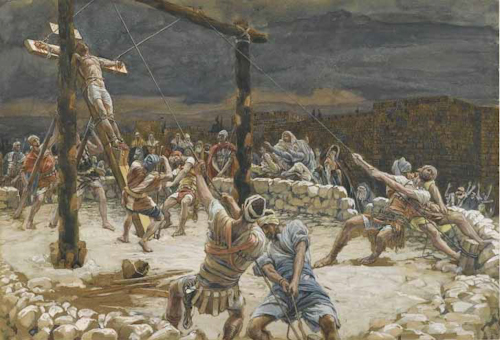
It’s Good Friday. Why would anyone call it “GOOD”? Today the Roman Empire executed Jesus. Beat him, stripped him, mocked him, jeered at him, hoisted him intot he air on cross, threw dice for the purple royal robe in which they had clothed him, pierced his side with a soldier’s spear, heard him cry from the cross, “Eloi, Eloi, lema sabachtani!” “My God, my God, why have you forsaken me!” Why would anyone in their right mind call this horror “GOOD”?

The raising of the cross - James Tissot

Sebastian Moore, O.B, speaks to this in The Crucified Jesus Is No Stranger (Seabury Press, 1977).

The meaning of the Christ-event is that in it the wrestle of man with his God-intended self is dramatized and led through the phases of rejection, hatred, crucifixion, destruction, surrender, new life. Oscar Wilde said, “each man kills the thing he loves.” Those who stop short of evil in themselves will never know what love is about. They will never receive the crucified. – p. 37

The human race thinks it can go on with all its Narcissistic human normalities, of war, of politics, of religion, and that somehow the vast other side of the picture will look after itself. So in opting for “himself as conscious”, man is opting for an ultimate solitude.

And ultimate solitude is death. It is to be cut off from the tree of life, and to wither. – pp. 69-70

For your further reflection, this poem received today from Steve Shoemaker.

Good Friday?

What makes this Friday Good is not what Rome

did to Jesus: torture, false witnesses,

and finally capital punishment.

In all regimes these standard practices

preserve the powerful, but then foment

disgust, infamy,  abroad– shame at home.

The dying one, the empty tomb was good

only if we are justified by trust,

mysteriously by God’s grace made whole.

The goodness cannot stay with us, it must

be passed on to the world–this is our role.

The Good is recalled in the feast:  soul food.

In a few moments I will host the Good Friday meditation – readings from the Gospels, long silences, the movements of Garbriel Faure’s Requiem…silence…reading… until it all soaks in.

I can’t get to Easter by by-passing the cross. Click  to hear the music.