The Angel Gabriel and Mary

A sermonic reflection for the Fourth Sunday of Advent, Dec. 21, 2014, Gordon C. Stewart.

Text: Luke 1:26-38

The Annunciation {El Greco]

The Annunciation {El Greco]

Mary has every reason to fear the appearance of Gabriel. Every demure depiction to the contrary, the Angel Gabriel’s “annunciation” to Mary is no private affair. It’s a public matter of the first order. Gabriel  is the archangel commissioned to destroy the offspring of the rebellious angels and human women. (see below). Mary shrinks back.

“Do not be afraid,” says Gabriel.

Why should she not be afraid? This is not just any angel.

This is the Angel Gabriel, whose trumpet will summon the people, sweep away the occupation forces that substitute their rule for the Kingdom of love and delight. This is an angel of revolution. The Archangel of conflict who inspires both hope and fear.

”Do not be afraid!”

El Greco’s painting of the Annunciation illustrates the problem of textual interpretation.
Gabriel’s appearance is not frightening. It’s very…how shall we say? Feminine. Even to the point of appearing perhaps pregnant himself. The great masters did not paint an angel messenger as male, even when his name is Gabriel or Michael, the only two angels named in Holy Scripture.

Gabriel in Hebrew means “God is my Warrior”. Gabriel is a warrior angel, announcing to Mary that she too is to become a warrior, a mother whose birth-giving will lead to conflict with the Empire and the religious authorities who collaborate with it.

As described by New Testament scholar Carol Newsom, any annunciation by Gabriel inspires fear.

In the Book of Daniel, Gabriel is preeminently an angel of eschatological revelation. He is sent to Daniel to explain a vision of ‘the time appointed for the end’ (Dan. 8:15-26)…. Gabriel’s functions are more varied in I Enoch. In the Book of the Watchers (I Enoch 1- 36) he is listed as ‘the one of the holy angels who is in charge of paradise and the dragons and the cherubim (20:2). He is commissioned to destroy the offspring of the rebellious angels and human women (10:9-10)….

In the War Scrolls from Qumran (IQM) the names of 4 archangels, Michael, Gabriel, Sariel, and Raphael, are written on the shields of the 4 towers of the army. The positioning of the 4 archangels around the throne of God or other sacred space has a long subsequent history in both Jewish and Christian tradition…. [Carol Newsom, “Gabriel.” The Anchor Bible Dictionary, Vol. 2]

So why does Gabriel look the way he does in the art museums and literature of Christian interpretation? Why does the original Gabriel look so benign? And why does Mary look so calm, perhaps even demure, as in El Greco’s Annunciation?

The Jesus story has been neutered. The End Time has been re-interpreted by the Constantinian Church as a paradise beyond time, a state of afterlife, not this life. In no way political. In no way economic. In no way conflictual. Peaceful. Serene. Calm. Quiet Passive. “Let it be to me according to your word.” Never disquieting. Never disrupting. Never revolutionary.

Gabriel has been transformed, neutered, emasculated, rendered harmless by the Constantine religion whose adherents can no longer see the conflict between Christ, or his mother, Mary, and his father, Joseph, with the systems of unbridled greed and poverty under which they live. The Gabriel spoken of in most pulpits is not the Angel Gabriel that came to Mary.

We’ve turned Gabriel into our own image. But though we may tame him in our hearts and minds, our paintings and our sermons, we can erase neither the need to be afraid nor his invitation to fear not. Gabriel’s finger points at us, asking whether we will rally to the trumpet sound, the sound of his coming. We can repaint the young girl Mary as an icon of passive obedience and tranquility. But it will be a different Mary than the courageous one painted by the Gospel of Luke.

Luke and his Mary know that “Do not be afraid!” makes no sense unless there really is something to fear, and that we cannot overcome fear unless we hear Gabriel’s word of favor, “Hail, O favored one! The LORD is with you. Blessed are you among women…You shall conceive….”Do not be afraid…. For with God nothing will be impossible.”

“Then Mary said, ‘Here am I, the servant of the Lord; let it be to me according to your word.’

“Then the angel departed from her” for parts unknown to make his visits down through the ages, making the impossible possible.  Word has it he appeared last week in Washington, D.C. and Havana, Cuba to turn the impossible into the possible, a new Order being born from the old.

If you listen with faith, you might hear him. If you look, you will see him.
 

Verse – An Old Man and His Dog

He limps as the other clicks
along the sidewalk beside him.
Slowly, they walk together,
And loneliness falls behind a few paces.
They partake of one spirit.
They know the mystery of
growing old together.

Ah yes, there’s a world beyond them,
But now they know more
Of a priceless world between them.
One glance, and a thousand worlds
spring form the depths
Knowing a direction far beyond
the concrete way beneath them.

– Dale Hartwig (1940-2012) from the window of a care center, Grand Rapids, MI.

Two Verses – Different Moods

Two good friends write verse and poetry. Yesterday Steve Shoemaker’s “Anticipation” arrived. Having just re-discovered the verses of our mutual friend Dale Hartwig (1940-2012), it seemed right and good to place the two  voices together as part of a greater whole.

Anticipation: a Pagan Poem by Steve Shoemaker

(Virgil, b 70 BC, wrote farmers
should breed oxen while
the ox’s “lusty youth lasts.”
This reminded him that for
humans our “best days
go quickly,” then on “creep
diseases and gloomy age.”)

When injured, or sick,
animals may well know
something is wrong,
without knowing
they are dying.
We humans often know
even at a young age,
even when healthy,
that we will die.

When old, we breathe
death daily, wondering
if the next shuffled step,
the next irregular heartbeat
will be our last.

Will our last word
be remembered
or even heard?

Sudden Death by Dale Hartwig (1941-2012), written on the occasion of the untimely death of George Spriggs.

So sudden death comes
With raptor claws
To pilfer our world
Break our laws.

Abruptly breath stops
To quiet the stay.
So silent the night,
So numb the day.

The heavens are rent
But little is heard
Save soft moot whispers
Of Life’s absurd.

But wait! I hear
A tiny Babe’s cries
Of Life anew
And death that dies.

And Christ is come
To walk our way,
A Man who knows
With heart, our stay.

NOTE: Some days are like the one Steve was having. Others like the one Dale was having when a voice cries “Wait!” Dale and Steve were and are painfully familiar with “stays” in the Absurd, but also with the courage and joy of “a Man who knows With heart, our stay.”

Dale served only one church in his life, a small church in Concord, Michigan where he also became the chaplain to the village over coffee.  He was one of seven seminary classmates who gather each year for renewal of friendship and for theological reflection. He died in the long-term care center in Grand Rapids where his advanced Parkinson’s had taken him several years earlier.

At the last gathering he attended in Chicago, he left copies of his poetry with us. I thought I had lost them until they suddenly reappeared when my colleague at Shepherd of the Hill Presbyterian Church, Kathy, presented me with a bag of “stuff” she’d found while cleaning out my office before my retirement.

Look for more of Dale, as well as Steve, on Views from the Edge today and in the days to come.

– Gordon C. Stewart, December 16, 2014


The Lonely Blogger and Steve Martin

It’s been lonely. Traffic is down on Views from the Edge. I ask myself why. But I suspect I know the answer. I’ve broken blogging rule #1. Blogs are mostly about entertainment, not serious stuff . People go to blogs to get away from serious stuff. Not that this one is all that serious, but it’s hardly a rendition of Steve Martin’s happy feet.

Then two comments arrive. The first is from Gary who shares the experience of being influenced early on by Ernest Becker’s seminal work, The Denial of Death.  The second comes from Jim, a former classmate. Both Gary and Jim went on to become teachers.

Gary wrote:

The book title Amusing Ourselves To Death by educator Neil Postman comes to mind. Postman believes we have reduced most values to equate with entertainment. Education he says has to be entertaining. We demand constant amusement through sports, films, travel etc. There is a constant search for entertaining experiences to make us feel alive. It is as though our existence is so fraught with escaping death that the only antidote to dying is amusement. Just as everyone uses humor to take the edge off of awkward social encounters, humor has become the background context of existence. Humor is used as a cover for what human nature really is about and that is “Real Politic” or the feeling that what needs to be done is whatever is practical to survive.

Two other books by Peter Gay and Karl Marx come to mind: Gay’s The Enlightenment: The New Paganism and Marx’s The Communist Manifesto. Gay suggests the Enlightenment led to a loss of traditional religious metaphors to live by, resulting in new forms of paganism arising to supplant the old worldviews. These include everything from “consumerism” to “new age” religions like Scientology. Karl Marx says in his “Manifesto” that “capitalism will destroy all that is permanent”. I think we can say Groucho Marxism seems to be the preferred way to analyze our culture’s ills. Everything has to be couched in humor or it is considered boring. At best we can say humor functions as the sigh of the oppressed as we try to take the edge off of everyday existence that seems to be all about a belief in human society as a survival of the fittest existence. We all want something better but science has been hijacked by capitalism for its own need to constantly revolutionize production to keep novel products arriving to allow us to feel alive when we no longer can see loving people as the real antidote to a preoccupation with fending off death. That was Christ’s reason for sacrificing himself in the face of a pagan Roman Empire. We have come full circle. Hopefully the Coliseum isn’t next as we escalate the need to amuse ourselves to death.

Jim wrote:

Folks get twisted in knots over things which they have neither read nor understood. Back in the days of teaching I had students read a writer who argued that under pure capitalism if profits are to be maximised there are several alternatives: Raise prices; Lower Wages. Then you have a product your workers cannot afford to buy. Because there are more workers than capitalists they will soon suffer. They liked the argument until they learned its author was Lenin.

Thanks, Steve Martin. Thanks, Gary. Thanks, Jim. I feel better.

Poem #5 – Dale Hartwig (1940-2012)

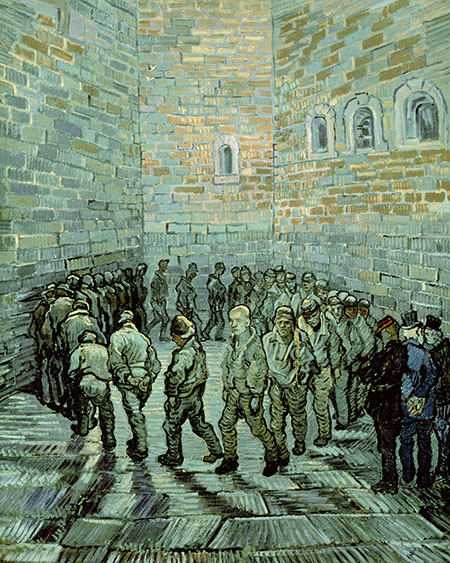
Prisoners Exercising, Vincent Van Gogh, 1890  with Van Gogh looking out and beyond.

Prisoners Exercising, Vincent Van Gogh, 1890 with Van Gogh looking out and beyond.

Dale Hartwig stood out from the crowd. He wrote for himself. His was a rich inner world, a necessity for survival as Parkinson’s shrank his world to the size of his room at the care center. His writings, shared with a group of six close friends, deserve a larger audience.

Dale’s verses and poetry often echo the Hebrew psalmists. They are visceral, sometimes crying out  like Vincent Van Gogh exercising in his asylum at Saint-Remy, and at other times delighting at the sight of a fluttering leaf or falling snowflake outside his care center window. None of Dale’s pieces have titles.

Like prisoners, they only have numbers – the order in which he wrote them, as best we can tell.

Poem #5

Behind and before, Thou goest, O Lord.
Like the wind I cannot see.
But why so silent in ways of my need?
To let you but walk to trust in me.
O my steps are oft frozen from fear,
And my thoughts locked to the darkness around.
O God, only You can move me beyond
The prison that seems to abound.
Come, Lord, and move me, just one small step
Toward the One who would give me so much.
I am who I am, so little sometimes
But, with You, so much, so much.

The last time Dale joined the annual Gathering of classmates in Chicago, he surprised us. He wasn’t supposed to leave “home” – but he did. He somehow managed to get himself to the train station in Grand Rapids, Michigan, board a train for Chicago, and make his way from Union Station to Hyde Park by public transportation carrying a suitcase on the stiffening legs he still exercised daily.

When it came his time to share what had been happening in his life, he handed me a sheaf of papers and pointed to the number 5 on one of the pages he had typed. I read it aloud for him. Every face was wet. “I am who I am, so little sometimes But, with You, so much, so much.”


Four-letter Words

Two four letter words are clean as a whistle until placed side by side.

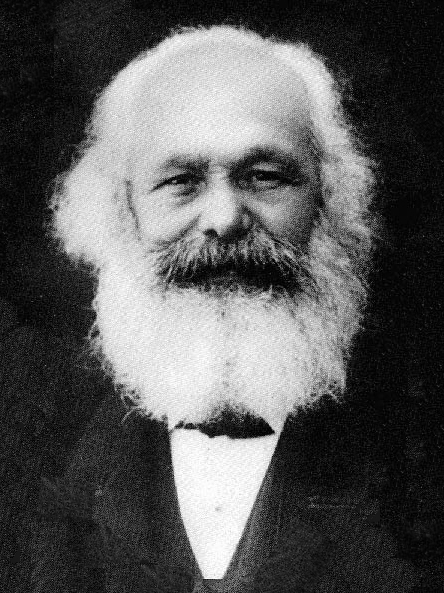
‘Karl’ could be just another guy, like George Karl, the NBA coach, Karl Malden…or maybe Karl Rove.

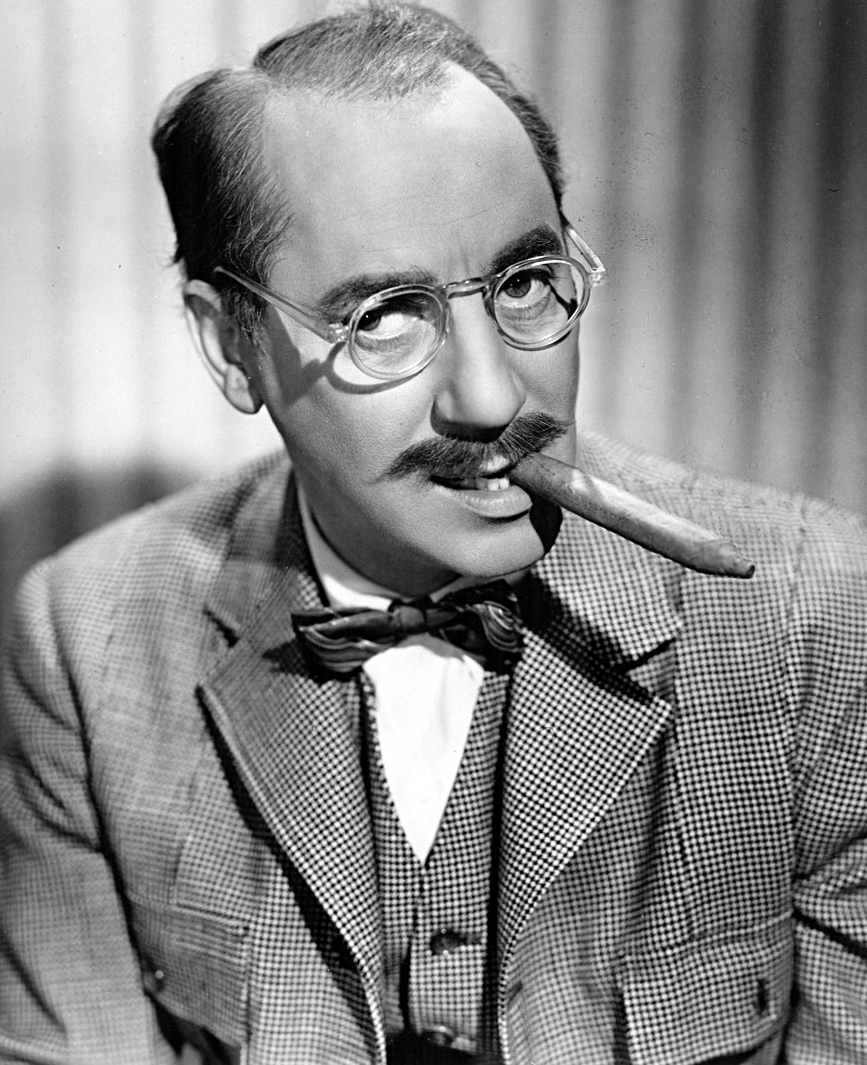
‘Marx’ could be Groucho, Harpo, Chico, or maybe Richard. Or it could be mistaken for the word ‘marks’ as in grades in school. Or for targets, as in ‘marksmanship’.

Each name by itself has four letters but is not yet a four-letter word. Either can be spoken out loud. But speak the two together, as in ‘Karl Marx’, and heads will turn, fingers will wag, charges will be brought, electronic ears will be listening.

It’s popular to be a Groucho, Harpo, Chico, or Richard. It’s not so safe if your name is Karl, unless your last name happens to be Rove.

The older Karl grew up in a white house in Trier, Germany, but he never occupied the White House

Karl Marx Haus in Trier

Karl Marx Haus in Trier

The White House

The White House

Blogging RULE #1:

Karl Marx

Karl Marx

Never, ever, ever mention the name Marx! Americans hate that. Especially in a sermon. [See yesterdays’ “In the Footsteps of Mary“].

Unless it’s Groucho.

“All people are born alike – except Republicans and Democrats.” – Groucho Marx

Groucho Marx

Groucho Marx

In the Footsteps of Mary

A sermonic reflection on America today, Dec. 14, 2014.

Today’s texts speak indirectly to the national outrage over the deaths in Ferguson, Cleveland, and Staten Island and to the larger context of the economic Law – Capitalism – under which they’ve taken place.

The Spirit falls upon Isaiah

…to provide for those who mourn in Zion– to give them a garland instead of ashes, the oil of gladness instead of mourning, the mantle of praise instead of a faint spirit….They shall build up the ancient ruins, they shall raise up the former devastations; they shall repair the ruined cities, the devastations of many generations. (Is. 61:2-4)

I am in mourning. Even in the midst of Zion. Though I already taste the fruit of the Kingdom of God which is yet to come in fullness, I am in mourning. In ashes. Faint in spirit. Living among the ancient ruins, the former devastations, the ruined cities, the devastations brought on by many generations including my own.

There is anger out there. Lots of it. There are calls for justice out there. There are “die-ins” on Interstate Highways blocking traffic, interrupting business as usual. And it’s good. It’s right. It’s an American thing to do.

But, like most movements, this one will pass in a few weeks or maybe months. It will go the way of Occupy Wall Street.

For while protesters were were being hand-cuffed for “die-ins”, Congress was taking the hand-cuffs off Wall Street and the “too-big-to-fail” banks. The Dodd-Frank restrictions enacted following the 2008 meltdown were being quietly removed by hidden-away paragraphs in the down-to-the-wire spending bill. There will be no more hand-cuffs. No more probation. No more accountability to the American people. The legal limits on dealing in the “derivatives” market were being deleted on Capitol Hill, and, perhaps worse, the Dodd-Frank provision prohibiting a second government bailout was replaced by a commitment to bail them out again.

While on Capitol Hill the Law was being re-written to deliver automatic bail to Wall Street, individuals protesting law enforcement tyranny on the streets were hauled off to jail hoping a friend would bail them out.

Only within the larger economic puzzle do the various pieces begin to make sense.

For all of America’s national wealth, we are among the poorest of nations. We are a classist society bordering on a caste society. Class has always been the issue in America. Race and class have always gone hand-in-hand, but classism has other hands as well.

The wider context surrounding the law enforcement racial divide is the classism embedded in a global capitalist economic structure.

We are living still amid the “ancient” devastations brought on by rich white slave traders who captured Africans like animals for a zoo to work their plantations for profit. Racism is a class issue, an ownership issue, an issue of economic privilege, before it is anything else. The coupling of race and class is as clear now as it ever was, despite the Civil Rights Movement and the election of America’s first African American president.

Capitalism is the issue. The accumulation of wealth. The increasing concentration of wealth. The hoarding of wealth. Wealth disparity, power disparity, racial disparity, electoral disparity, legal disparity; what’s enforced and what’s not; who’s in handcuffs and who’s not; who’s bailed out and who’s not; who’s charged and who isn’t; who’s in prison for what and who’s not; who’s on probation or parole and who’s not; who’s elected to Congress and who’s not; who owns what and who doesn’t; who can pay for an election and who can’t – are all about class, the control of the means of production and capital and the expropriation of cheap labor and natural resources that can’t talk back.

Enter now into this world the psalmist of today’s readings who dared to dream of a great reversal of fortunes:

When the LORD restored the fortunes of Zion, we were like those who dream.

Then our mouth was filled with laughter, and our tongue with shouts of joy; then it was said among the nations, “The LORD has done great things for them.”

“The LORD has done great things for us, and we rejoiced.

Restore our fortunes, O LORD, like the watercourses in the Negeb.

May those who sow in tears reap with shouts of joy.

Those who go out weeping, bearing the seed for sowing, shall come home with shouts of joy, carrying their sheaves.”[Psalm 126:1-6]

The tears of weeping bear the seeds for sowing and reaping of the sheaves of the new economic order. It is no accident that the psalmist mixes the metaphors of weeping, seeds, sowing, and shouts of joy, and sheaves. It is, as it were, a vision for the Earth itself. Honest weeping is the beginning – the sowing – that leads to earthly transformation and shouts of joy.

Mary, the newly pregnant peasant girl, becomes the representative, singing her song amid the ancient devastations, announcing the hope that will engage the powers of class “to provide for those who mourn” [Is.61:1]:

My soul magnifies the Lord, and my spirit rejoices in God my Savior, for he has looked with favor on the lowliness of his servant. Surely, from now on all generations will call me blessed; for the Mighty One has done great things for me, and holy is his name. His mercy is for those who fear him from generation to generation. He has shown strength with his arm; he has scattered the proud in the thoughts of their hearts. He has brought down the powerful from their thrones, and lifted up the lowly; he has filled the hungry with good things, and sent the rich away empty. He has helped his servant Israel, in remembrance of his mercy, according to the promise he made to our ancestors, to Abraham and to his descendants forever.” [Luke 1:46b-55]

Put differently by Philip Clayton, Ingraham Professor of Theology at Claremont School of Theology, we are living

“…at the dawn of a new form of human civilization. Individuals, societies, and nations are now deciding whether to keep fighting to preserve the dying order, or whether to take leadership in building the new. It’s not a matter of waiting for more data; we already know what the old practices are doing to our planet, and we know what it takes to build a global society that is socially, economically, and environmentally sustainable. The ones who make the greatest difference are those who work and live with wisdom, with diplomacy, and with restraint, placing the good of the whole planet first.” [Philip Clayton and Justin Heinzekehr, Organic Marxism: An Alternative to Capitalism and Ecological Catastrophe, Process Century Press, 2014]

I’m still mourning. But I feel better. I know that the mourning is a holy thing, the hint of a coming “garland instead of ashes, the oil of gladness instead of mourning, the mantle of praise instead of a faint spirit” and so, I write. I pray. I sing. I mourn to the tune of Isaiah. I march to the dream of the Psalmist. I walk in the footsteps of Mary.

– Rev. Gordon C. Stewart, Honorably Retired, Views from the Edge, Third Sunday of Advent, Dec. 14, 2014.

The Funeral at the Megachurch

“Jesus, you’re the best…” he said.
His open collar showed his chest
was tan even in December.
“We just want to thank you, Lord,
for taking Joe to be with you.
We’ll miss him, but we know it’s best
for him to be in heaven.”

We sang Amazing Grace, but Joe,
it seemed, had clawed his way up high
through generous gifts to the church,
by staying married, raising kids,
and praying often. He would reach
the Golden Gates, receive the pie
in the sky. Not so, you and I.

– Steve Shoemaker, Urbana, IL, Dec. 10, 2014

What salesmen do for a living

This story is told by my cousin Dennis, originally from South Paris, Maine. Our grandmother was a tea-totaler, a member of the Women’s Christian Temperance Union (WCTU) that struck fear in every drinking man! Here’s the story in his own words.

Every Christmas our family would have our tree in the morning, go to church and then go to grandma’s house on Main St. All the Titus uncles and aunts would be there with their children. We would nosh on pastries baked by Aunt Muriel and then do the tree.

The aunts and uncles plus us children would get two or three gifts from each family and be done with opening our gifts in 15 minutes. Then our grand parents would methodically open each gift from all of us there and all their far flung friends and relatives. There would be mounds of gifts for them. Grandma was very precise, she would cut off all the bows and have a box to put them in for next year. Likewise all the wrapping paper. Then she would write in a book who gave the present and what it was. This process meant that everybody sat for hours watching them open all their gifts. You would see everybody nodding off or going to the dining room to get pastries and coffee.

After about an hour of this gift opening by Grandma, I noticed one of more of my uncles would get up and disappear for a half hour or so. Being the curious person that I am, I followed my Uncle Roy. I noticed that he went through the kitchen out into the barn. [Note to the reader: the barn was attached to the house through a pantry by the kitchen].

So I waited a few minutes and went out into the barn too. They were all gathered in a separate room with the door shut.

I opened the door and surprised them. They were drinking beer and smoking. They quickly tried to hide the beer cans and butt their cigarettes hoping I didn’t notice. I just stood there frozen in my tracks. Finally Uncle Roy said this was not place for me and I should return to living room.  As I turned to leave, Uncle Alva said “Wait a minute.” He came over to me and asked what had I seen. I told them I saw that they had been smoking and drinking, in a smug sort of way.

Uncle Alva was building a boat at that time, so he asked if I would like to go fishing with him and Bill [i.e. Alva’s son; Dennis’ cousin] next spring? Of course I said I sure would. Being the salesman he is, he proposed a deal to me. If I go back to the living room and keep my mouth shut, he would take me on the maiden voyage of his boat on Thompson Lake and we would go fishing for Lake Trout. I looked at him with wide eyes and a big smile and said “Uncle Alva you got a deal!” My other uncles pulled their beer out and took a big swallow and laughed. I shook hands with all of them and left with a grin that didn’t come off until I went home that night (laughing to myself all the next day).

When my mother asked where I had been as I returned to the living room, I told her in front of everybody I had to go to the bathroom real bad. No one was ever the wiser…. I went fishing with Bill and Uncle Alva on their maiden voyage laughing all the way. That’s when I learned what salesmen do for a living!

Dennis Smith, Whitewater, WI, December 10, 2014