
The Day the School Burned Down

“Where were you on April 9, 1956?” The answers are pouring in from the Class of 1960.
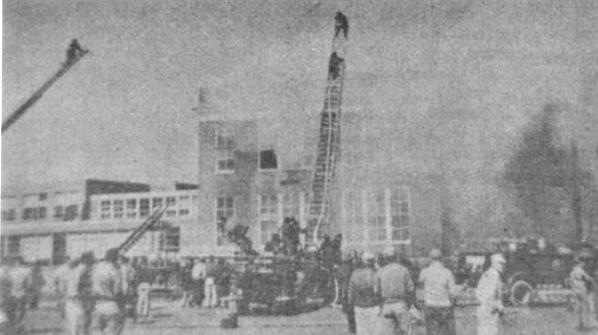
Marple-Newtown Junior High-Senior High School Fire, April 9, 1956

Marple-Newtown Junior High-Senior High School Fire, April 9, 1956

We were in the 8th grade of Marple-Newtown Junior-Senior High School. On that day we were eating lunch, getting ready for our next class when the fire alarm sounded. Must be a fire drill. We knew the drill. So did the teachers. The teachers led us outside, hand-in-hand in the continuous line processional we’d learned in those ridiculous fire drills. The school was going up in flames.

One of my classmates, Dave, remembers it this way:

The Boys’ Room was crowded with guys smoking cigarettes before class, the air was filled with a cloud of tobacco smoke and smells, so we didn’t have any indication that a fire was building below the first floor. Hearing the fire alarm, we stepped out into the hallway to see a trickle of smoke rising from each plank of the hardwood flooring. Seeing that smoke, we knew that the school and the students were facing a serious fire emergency. An orderly evacuation began and although it was a cold day, no one was permitted to go back to their homerooms for their coats.

To a chorus of cheers, we all stood outside shivering for what seemed to be a long time and watched the fire fully consume the building. To a chorus of boos, the fire trucks finally arrived and the volunteer firemen had trouble hooking up the hoses and getting water on the destructive blaze.

The school building was obviously a total loss and since I was cold, I decided to hitchhike home. It was about lunchtime, when I arrived home. My mother immediately descended on me, “…why are you home, are you playing hooky and where is your leather jacket?” “No,” I said. “It wasn’t my fault,” I blurted out, before feeling the back of her hand across my face. “Tell me the truth,” she demanded. I said,”the school burned down,” just before getting a fresh one on the other cheek.

One of the memories we share is the picture of Mr. Harvey, still inside the building, handing the typewriters out the upstairs window from his typing class to Seniors who were ascending and descending a firetruck ladder to save the typewriters until he had to come down himself to loud gasps and cheers.

Fred, remembers being “in typing class a year later using one of those ‘saved’ machines with melted keys.”

Ellie, who wasn’t in the building when the first started, adds something else:

I was approaching the school entrance after lunch at the pizza shop and was met by students rushing out to safety. Still remember that once we were all assembled by homerooms Mr. Rathey went tearfully from group to group checking whether we were all accounted for.

What a surreal day!

Mr. Rathey pointing

Mr. Rathey pointing

The miracle is that we all made it out safely. Before Mr. Rathey, shown here pointing to the school, could see his charges walk across the stage at graduation, he was diagnosed with cancer. The Class of 1960 presented him with a gold watch at his early retirement. Ellie reminded us today of Mr. Rathey’s tearful care on the day the school burned down and in the years that followed.

– Gordon C. Stewart, Chaska, MN, April 9, 2015.

When it rains…

… it sometimes pours.

News came today of the death of John, followed hours later by news of the death of Jerry, and the impending demise of two more friends. Life is like that, or so I tell myself. But it doesn’t help much, if at all, because grief has its own way. Grief wends its course through the soul the way a river eventually ignores the man-made routes and dams imposed to keep it in its place. Nature always wins.

Loss is always hard, even for those who believe, as the Creed does, “in the life everlasting.” I look to the presence of the Eternal in this life, this side of death, this side of my mortal end, as the heart of things, knowing that love continues, no matter how many deaths and sorrows it suffers.

On days like today when it pours, a familiar hymn often sings itself in me, and I am strangely comforted.

“Time, like an ever-rolling stream, soon bears us all away, we fly forgotten as a dream dies at the opening day.

“O God, our help in ages past, our hope for years to come; be Thou our Guide while life shall last, and our eternal Home.”

I pray the same comfort for John’s and Jerry’s spouses, relatives and friends, and for the readers of Views from the Edge, in whatever circumstance you find yourself tonight.

– Gordon C. Stewart, Chaska, MN, April 8, 2015.


Verse – My Familiar Voice

Her voice is low and very resonant,
but now, with age, I often cannot hear
each word. She rightly takes offense at that
and thinks me inattentive. If my ear
is turned away, or if I do not see
her moving lips, the sounds are often lost.
For other women there is jealousy
since I can hear them fine. It is not lust
for at the string trio tonight, the sound
of violin was clear, cello was round,
but viola was lost in the background…

– Steve Shoemaker, Urbana, IL April 8, 2015

The Choir – emblem of hope in a world at odds with itself

Listen in on John Rutter, one of the world’s great composers, discuss the choir as “a kind of emblem for what we need in this world, when so much of the world is at odds with itself….”

The Tree of Life and the Other Tree

Something happened in church yesterday on Easter. Call it an “aha” moment.

Hidden away in the first reading of Easter is a curious reference that draws no attention: “They put him to death by hanging him on a tree; but God raised him…” [Acts of the Apostles 2:5]. Yesterday the “tree” shined like a diamond attracting full attention.

The reference to “a tree” seemed strange. This wasn’t a lynching in Mississippi – they hadn’t hanged him from a tree. It was a crucifixion. The Roman cross was made of wood, but why would Peter call it a tree? Unless, perhaps, the tree calls something else to mind, a reference point within Hebraic scripture and theology that puts the cross in the greater light of a tree. Like the stories of creation and fall in Genesis 1 and 2.

There are three references to a tree in the Genesis narrative.

The first is from the third day of creation:

“And the earth brought forth grass, and herb yielding seed after his kind, and the tree yielding fruit, whose seed was in itself, after his kind: and God saw that it was good. And the evening and the morning were the third day.” [Gen. 1:11-12]

The second reference juxtaposes two trees. One gives life. The other is the tree of death.

“And the Lord God planted a garden in Eden, in the east; and there he put the man whom he had formed. Out of the ground the Lord God made to grow every tree that is pleasant to the sight and good for food, the tree of life also in the midst of the garden, and the tree of the knowledge of good and evil.” [Gen. 2:8-9]

The third reference describes the tree of the knowledge of good and evil as the one tree that is forbidden in the garden:

“The Lord God took the man and put him in the garden of Eden to till it and keep it. And the Lord God commanded the man, “You may freely eat of every tree of the garden; but of the tree of the knowledge of good and evil you shall not eat, for in the day that you eat of it you shall die.” (Gen. 2:15)

It is always the fruit of the tree of the knowledge of good and evil that gets us into trouble. It is the tree of divine presumption. Hubris. The tree that produces not life but death. It destroys, almost always in the name of goodness, and what goodness seeks to kill is evil. The knowledge of good and evil is beyond human capacity.

The Jesus who is hanged from this killing tree exposes the folly of the tree on which he hangs. As foe to the global imperial claims of the Roman Empire, his killing tree becomes for one and all the tree of life.  On the forbidden tree of the knowledge of good and evil, the crucified-risen One becomes the tree of life, “yielding fruit, whose seed was in itself, after his kind; and God saw that it was good. And the evening and the morning were the third day.”

Perhaps that’s the rich history, the diamond, that shines like a diamond in the Easter text from The Book of Acts. No one would know the juxtaposition better than Peter, the only disciple to deny knowing Jesus, and the only disciple specifically named in the instructions to the three women at the empty tomb: “Go and tell the disciples and Peter that he is going before you to Galilee; there you will see him… [Gospel of Mark 16:7]

Christ “suffered under Pontius Pilate, was crucified, dead, and buried; he descended into hell; The third day he was raised again from the dead” [Apostles’ Creed]. And by this fruit of creation restored is all creation blessed.

– Gordon C. Stewart, Chaska, MN, April 6, 2015

A Verse for Easter

Readers unfamiliar with Christian scripture will find it helpful to learn that the original Gospel of Mark ended abruptly and curiously, not the way one would expect good news to end. Upon discovering the stone rolled away from the tomb and the tomb empty, Mark ends not with triumphal joy but with fear. “So they went out and fled from the tomb, for fear and amazement had seized them, and they said nothing to anyone, for they were afraid.” Here’s Steve’s verse for Easter:

The Short Ending of Mark

Most scholars think that first came Mark,
then Matthew, or perhaps St. Luke,
but Mark is shortest of the three
and it takes work for brevity.

The empty tomb is found in Mark,
but in the first draft of the book
no resurrected Christ appears–
his followers are left in fear.

The Gospels four all tell the tale
of thousands fed by miracle,
but only Mark will tell it twice–
this Jesus is the Bread of Life.

Young Mark assumes from Chapter One
that Jesus is the Son of God
the Christ-Messiah, Holy One.
His faith was fed by wine and bread.

Mark must believe that doubts and fears
can turn to trust when he appears.

[Mark 16:1-8]

– Steve Shoemaker, Urbana, IL, April 5, 2015

Mom’s Handkerchief – Good Friday

As a child, I wondered why they called Good Friday ‘good’. It wasn’t. It was awful.

At the annual Good Friday service my mother’s cheeks were wet. She’d hold her handkerchief in one hand and, without drawing attention to herself — Mom was shy and shunned attention — she would dab the tears, hoping no one would notice.

A soloist would sing:

Were you there when they crucified my Lord?
Were you there when the crucified my Lord? Oh……
Sometimes it causes me to tremble, tremble, tremble.
Were you there when they crucified my Lord?

Mom would dab her cheeks and eyes.

As I grew older I began to understand why they called the Friday of the crucifixion ‘good’. It wasn’t good because they nailed him to the tree, or because they took him down and laid him in a borrowed tomb. It was good because, in that deep darkness, tears fall in grief and in hopes of something else. Tears that recognize both the betrayal, denial, flight — our  own and others’ – and the steadfast love, courage, and magnanimity of the man on the cross.

Both sides of the human condition are front and center on Good Friday. So is the sense of god-forsakenness – the wrenching cry from the cross, “Eloi, Eloi, lama sabachthani?” (“My God, my God, why have you forsaken me?”) — the gnawing feeling of senselessness, meaninglessness, and helplessness, hanging alone, tortured and mocked, over the abyss of nothingness.

Over the years, I’ve learned that a healthy sense of denial is sometimes a good thing. So is truth-telling. Good Friday brings me face-to-face with myself at my worst and my best. And at the heart of it all is a man with arms spread wide, looking out at us who still crucify him — ours is a Good Friday world — with eyes that reach my soul. “Father, forgive them, for they know not what they do. Into Your hands I commit my spirit.”

On Easter Mom would dab her eyes for joy because she’d brought her handkerchief with her from Good Friday.

— Gordon C. Stewart. Chaska. MN, April 3, 2015.

Even our best intentions…

As Sesame Street’s Kermit the Frog croaks that it’s not easy being green, today reminds me that it’s not easy being right, whatever “right” is.

The Presbyterian Church (USA) recently amended the Church’s constitutional definition of marriage as a commitment between two people. It was a good day for those of us who have discussed, debated, and advocated for full inclusion over the last 40 years.

It represents something akin to the civil rights movement – institutionalization of the same ethic that refused any longer to deny equal rights to African-Americans in the Civil Rights Act of 1964. It was the right thing to do.

But nothing ever happens in a vacuum. Collateral consequences accompany every controversial decision, and sometimes those collateral consequences place us in conflict between two highly prized commitments.

No sooner did the Presbyterian Church (USA)’s constitutional change make the news than the National Black Church Initiative (NBCI) announced its decision to break fellowship with the Presbyterian Church (USA). Click HERE for the story. The NBCI claim that the PC(USA) has abandoned or “manipulated” sacred text is not a new charge, but it’s a mistaken one. Said NBCI’s President, the Rev. Anthony Evans:

“No church has the right to change the Word of God. By voting to redefine marriage PCUSA automatically forfeits Christ’s saving grace. There is always redemption in the body of Christ through confession of faith and adhering to Holy Scripture.

“In this case, PCUSA deliberately voted to change the Word of God and the interpretation of holy marriage between one man and one woman. This is why we must break fellowship with them and urge the entire Christendom to do so as well.”

But the PC(USA) did not alter Scripture. It amended its understanding of the Word of God, as we did when we repented of the biblically acceptable practice of slavery. Scripture and tradition without the guidance of the Holy Spirit are not the sine qua non of the Christian faith. It was and is through the guidance of the Spirit of the Living God that we are called to read the Bible through the eyes of Christ, the eyes of love and human dignity, to bring the church and society into a greater light.

It seems, as best I can tell, that there are two grounds on which opposition to the PC(USA)’s full embrace of GLBT members is based. One is psychological (fear). Whenever fear appears, we are called to be compassionate. To understand and walk in the fearful one’s shoes. The second ground is intellectual, as in arguing against biblical interpretation. To argue that one’s biblical literalism is the only faithful reading of the Bible is intellectually dishonest. It’s buried in denial, but it no less intellectually dishonest if it were spoken from unfettered consciousness.

Life is messy. Theology, ethics, and morality are messy. Every decision is contextual, and in that complex set of competing claims and valued, we stand responsible for our decisions of interpretation, faith, and action.

The “breaking of fellowship” by the National Black Church Initiative and its 36,000 African American congregations cuts to the bone of a church for whom racial justice and reconciliation has long been a mandate of the gospel of Jesus. Racism is America’s great sin. Its forms are personal and institutional.

The PC(USA) Confession of 1967 declared the ending of discrimination as of first important to the church’s mission of reconciliation, a confession of faith we now apply to discrimination against the GLBT community.  Section 4 on Reconciliation in Society, begins as follows:

In each time and place there are particular problems and crises through which God calls the church to act. The church, guided by the Spirit, humbled by its own complicity and instructed by all attainable knowledge, seeks to discern the will of God and learn how to obey in these concrete situations. The following are particularly urgent at the present time.

a. God has created the peoples of the earth to be one universal family. In his reconciling love he overcomes the barriers between brothers and breaks down every form of discrimination based on racial or ethnic difference, real or imaginary. The church is called to bring all men to receive and uphold one another as persons in all relationships of life: in employment, housing, education, leisure, marriage, family, church, and the exercise of political rights. Therefore the church labors for the abolition of all racial discrimination and ministers to those injured by it. Congregations, individuals, or groups of Christians who exclude, dominate, or patronize their fellowmen, however subtly, resist the Spirit of God and bring contempt on the faith which they profess.

It was in that same spirit of God’s reconciling love in Jesus Christ that the Presbyterian Church (USA) slowly moved over the last 40 years to the position of full inclusion of GLBT members, culminating in the marriage amendment.

It’s not easy being green. It’s not easy being right, whatever right means, especially when one right creates another wrong, or is perceived as sin.

This Wednesday  of Holy Week, we once again move with Jesus toward the cross. Green, black, white, yellow, red, and brown, straight and gay; the certain and the confused. Sin is everywhere, even in our best intentions, and often it hides in the corners of our own claims of righteousness. Only a vast love and mercy can overcome the gulfs of estrangement that divide us. Some sins are plain to us, some escape us, some we cannot face. Even our best intentions…. Johan Hermann’s text “Ah Holy Jesus, How Hast Thou Offended” (1630) set to music by Johann Cruger’s “Herzliebster Jesu” (1640) is a heartfelt prayer for the whole Church and for the world itself as we move through confession on Maundy Thursday and Good Friday toward Easter this Holy Week.


Disciples of Christ opposed Indiana RFRA

Before the national hubbub about Indiana’s Religious Freedom Restoration Act Christian Church (Disciples of Christ) leaders sent this letter to Indiana Governor Mike Pence urging him to veto the the bill.

March 25, 2015

The Honorable Michael R. Pence
Governor of the State of Indiana
200 W. Washington Street, Room 206
Indianapolis, Indiana 46204

Dear Governor Pence,

We write with respect to the Religious Freedom Restoration Act (RFRA). We urge you to veto the bill.

The Christian Church (Disciples of Christ) has been headquartered in Indianapolis for nearly 100 years. Although Butler University is no longer affiliated with the Christian Church (Disciples of Christ), its founder, Ovid Butler, was a Disciple and a noted abolitionist. The college, in keeping with our values, admitted women in a time when that was rare. We are the church that founded Christian Theological Seminary. Our offices are located on North Meridian. Our Indiana regional offices are located in Indianapolis as well.

Every two years our general assembly, a gathering of over 6000 people from across the United States and Canada, is held in a US city. In 2017 it is scheduled to be in Indianapolis as it was in 2009 and 1989. Like so many other host cities, we find Indianapolis to be a hospitable and enjoyable location for our people. Many of our leaders are citizens of this city, and we take particular pride when our selection process makes it possible to bring the assembly to our home town.

However, the recent passage in the state legislature of the RFRA bill is distressing to us. It is causing us to reconsider our decision to hold our 2017 gathering in Indianapolis.

Purportedly a matter of religious freedom, we find RFRA contrary to the values of our faith – as well as to our national and Hoosier values. Our nation and state are strong when we welcome people of many backgrounds and points of view. The free and robust exchange of ideas is part of what makes our democracy great.

As a Christian church, we are particularly sensitive to the values of the One we follow – one who sat at table with people from all walks of life, and loved them all. Our church is diverse in point of view, but we share a value for an open Lord’s Table. Our members and assembly-goers are of different races and ethnicities, ages, genders and sexual orientations. They have in common that they love Jesus and seek to follow him.

We are particularly distressed at the thought that, should RFRA be signed into law, some of our members and friends might not be welcome in Indiana businesses – might experience legally sanctioned bias and rejection once so common on the basis of race.

We are following closely the progress of this legislation. It will be a factor in whether we continue with our plans to hold an assembly in Indianapolis in 2017. We urge you to veto the bill.

Respectfully,

Sharon E. Watkins  Julia Brown Karimu, President    Ronald J. Degges, Pres. Gen.Minister & Pres.     Div. of Overseas Ministries    Disciples Home Mission

After Governor Pence signed the bill, the Christian Church (Disciples of Christ) took further action reported by The Huffington Post. Click “Disciples of Christ Church Threatens a Boycott Over New Law … that Allows GLBT Discrimination” to read the story.

Sometimes disciples of Jesus stand up for the rule of love. Do I hear hands clapping for the Disciples of Christ?

Confession is good for the soul

Tears welled up last Sunday listening to the Gospel reading for Passion Sunday: Palm Sunday. The reading was LONG, but it didn’t matter. It pierces the heart, step by step –  the human psyche revealed under an electron microscope, humanity on parade. All in one long reading. The tears that welled up Sunday didn’t fall, but they will later this week during Tenebrae, the service of Light and Shadow by the end of which the church is left in darkness, every worshiper’s candle extinguished by recognition of our participation in betrayal, sleeplessness, flight, and denial. One by one, the individual candles get blown out. All of them.

Holy Week for liturgical Christians is a solemn time of confession. There is no escaping our participation in the passion: our readiness to betray, doze off when asked to “watch with me one hour”, flee in fear for security, throw the switch, consciously or unconsciously, into psychological and public denial. Yet there is, at the same time over it all, the faithfulness, the wakefulness, the courage, the embrace of reality in its horror for the sake of love’s transforming power, the light of Christ himself.

Christians live in the dynamic paradox of faithlessness and faithfulness, sin and grace. We include a Prayer of Confession in the Sunday liturgy. Last Sunday at Trinity Episcopal Church in Excelsior, Minnesota, the Prayer of Confession, which came following a dramatic reading of the Passion Narrative, expressed the conscious and unconscious nature of sin and grace.

God of all mercy, we confess that we have sinned against you, in thought, word, and deed, by what we have done and by what we have left undone. Some sins are plain to us, some sins escape us, some we cannot face. We repent of the sin that enslaves us, the evil we have done, and the evil don on our behalf. Forgive, restore, and strengthen us through our Savior Jesus Christ, that we may not turn from your love, but serve only your will. Amen.

We barely know ourselves. Some sins are plain to us. Some escape us. Others are too painful to face. Holy Week is time to wade into the waters of self-reflection, confident that these waters are the healing waters of the deeper Self, the crucified-risen One who cannot finally be betrayed, fled, denied, or killed.

Sunday’s liturgy ended with the singing of the hymn “My Song Is Love Unknown,” lyrics by Samuel Crossman, 1664, music composed by John Ireland.