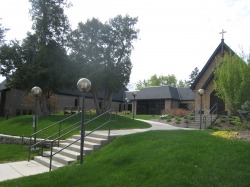
Talking about death and dying

Talking openly about death is a rare thing. We don’t like talking about it. We prefer it go away and stay away, like rain: “Rain, rain, go away. Come again some other day.”

When someone dies, it’s often said they’ve passed, passed away, or passed on, a sentiment dating back to a Greek idea of the immortality of the soul. It was/is assumed the soul at death is set free from its mortal cage to live forevermore.

The likes of Barbara Brown Taylor, of whom I consider myself one, have different idea. “Matter matters,” she says. Flesh and blood matter. Flesh, blood, and matter matter. Christians, following the older view of the Hebrew Bible, do not share the belief in a part of us – a soul – that survives our mortal frame. Instead, we profess a curious hope that affirms the essential goodness of corporal existence. Belief or hope in the resurrection of the body may seem even stranger than the immortality of the soul.

I have no more reason to believe in the resurrection of the body than I do to believe in an immortal soul. Watching the life go out of my dogs, I did not imagine some invulnerable part of them leaving their bodies to pass on to some other state of being. They were dead. I cried. I grieved. I mourned their loss. I never thought I would see them again. If they, or we, had a future, it seems more natural, so to speak, to think of them in their bodies all over again.

But which body would it be? Would Maggie, our West Highland White Terrier-Bichon Frise, be the playful pup or the one with the tumor on her hip? Would I be the 73 year-old me, the new-born me, or the teenager with the raging hormones?

Passing away has always made more sense to me than passing or passing on. “You are dust and to dust you shall return” makes better sense to me. The Earth will go on, as will those I love … for a time … but not forever, so far as any of us really knows. I say the Nicene creed on Sundays and ponder what it means to say “I look for the resurrection of the body and the life of the world to come.” The world to come, so far as I can tell, is the Earth where Cecil the lion doesn’t get killed by a dentist, and the lion and the lamb…and the dentist…lie down together in peace and hurt one other no more.

My friend Steve talks openly about death and dying. “I’m dying,” he says, not with a morose or maudlin sensibility but as a fact. It’s not a great surprise to him. Would he and we prefer the rain to go way and come back some later day? You bet. But it won’t, and even it if would, it would be back some other day. There’s great grace in the acceptance of death and the maturity to speak of it aloud, enjoy old friends when one can, laugh and cry and hug and kiss those one loves.

That we would want something more or fear death as the end is part of being human. The time of death is not time to debate philosophy or theology. It’s time for compassion, and for grace and courage to recognize our creatureliness – the distinction between every creature and the Creator, mortal life and the Immortality, the finite and the Eternal.

– Gordon C. Stewart, Chaska, MN, Dec. 29, 2015

Verse – The Exchange

INTRO: This piece uses the Hebrew terms for man (atham) and woman (athama), descriptions that remind Hebrew readers that human beings are of the dust, of the earth.

The Exchange 

“Did God really say you will die if you
eat the fruit of the tree in the middle
of the garden, the tree of the knowledge
of good and evil?” asked the snake
of the woman beside the Elysian tree.

So she did eat and so did he – Atham
and Athama, the earthlings – wishing to
be like God, mocking death by dividing
evil from the good down below where
a snake exchanged a hiss for a kiss.

“Cursed are you among all animals,”
said God. “On your belly you shall go,
eating dust along your way. Atham
and Athama will bruise your head,
and you shall bruise their heel.”

Then the two-legged creatures knowing
good and evil, dividing the Garden between
sheep and goats, stumbled at a nip on
the heel and heard a hiss: “You, too,
are dust, and to dust you shall return.”

Of the forbidden fruit of that one tree all
earthlings still do eat despite the voice
from the tree that tamed the snake,
exchanging a kiss for the hiss: “Forgive
them, for they know not what they do.”

  • Gordon C. Stewart, Chaska, MN, Dec. 28, 2015

Verse – Christmas: a Donkey’s Tale

Hee Haw

Burro's ears

Burro’s ears

“Just put the burro here,” he said,
“She’ll calm the horses of the folks
inside the inn.”  And so they tied
me to the pole above the trough.

I was surprised he later led
a man and girl into the stall
and pointing to the straw, he said,
“Sleep here,  this simple space is all
that’s left tonight, and if the child
is born the cries won’t wake the guests.”

He grimaced, but she somehow smiled
and sank down to the ground.  Their rests
did not last long.  Her labor soon
began and then the baby, wrapped
and warm, was laid under the moon
light bright where we, the stock, were trapped
and fed.  I brayed when shepherds dumb
barged in and said a king had come…

– Steve Shoemaker, Urbana, IL, Dec. 11, 2012

Verse – Christmas Re-Imagined

INTRO: How strangely idyllic Jesus’s birth appears in Matthew. No mention of the absence of a midwife, stench, or unsanitary conditions. The animals were the only neighbors, including the goats and sheep of Matthew’s parable of the Last Judgment, and as I have re-imagined it, the serpent who would bruise humanity’s heel in Genesis 3:8-15.

All the midwives were busy that night
when goats and sheep butted and
bleated for a taste of the after-birth
while a hapless not-quiet-husband
knelt beside his not-yet-wife Mary,
confused by having to birth this
child of another he’d never met,
a lamb she said was meant to be
for reasons he could not feel or see.

No Star Wars star shone above
a forgotten place the three of them
shared with none but bulls and
cows, hens and roosters, a snake
slithering through the straw toward
the donkey’s heel, the goats on
his right, the sheep on his left,
before the angels said the baby’d
come to bruise the serpent’s head.

  • Gordon C. Stewart, Chaska, MN, Dec. 27, 2015

Verse – December Rain and Reign

Trinity Episcopal Church ExcelsiorSome Sundays, like last Sunday, I just don’t feel like going to church. The weather was depressing. I was feeling kind of down. But we went, Kay and I.

After going to church, I wrote this piece. A poet I am not. Steve’s the poet of Views from the Edge. But, hey, he’s a very forgiving guy. Hope you are, too.

Advent Rain – Christmas Reign

harvest-being-2014-051In drizzling rain under
sullen gray-chilled skies
we trudge to church as
through a Scottish moor –
neither fall nor winter,
a gloomy in between
when spring’s bright
hope seems dead as
days are dark and short –
on the way toward
a reign in Bethlehem.

  • Gordon C. Stewart, Chaska, MN, Dec, 15, 2015

An NRA Christmas

But Mary was much perplexed by his words and pondered what sort of greeting this might be. The angel said to her, “Do not be afraid, Mary, for you have found favor with God. Conceal and carry!

Luke 1: 26-28  NRAV [National Rifle Association Version]

  • Gordon C. Stewart, Chaska, MN, Dec. 22, 2015

“Do not be afraid”

A sermonic reflection for the Fourth Sunday of Advent, Dec. 21, 2014, Gordon C. Stewart.

Text: Luke 1:26-38

El_Greco_044-medium-3

The Annunciation {El Greco]

Mary has every reason to fear the appearance of Gabriel. Every demure depiction to the contrary, the Angel Gabriel’s “annunciation” to Mary is no private affair. It’s a public matter of the first order. According to tradition’s lore, Gabriel is the archangel commissioned to destroy the offspring of the rebellious angels and human women. (see below). Mary shrinks back.

“Do not be afraid,” says Gabriel.

Why should she not be afraid? This is not just any angel.

This is the Angel Gabriel, whose trumpet will summon the people, sweep away the occupation forces that substitute their rule for the Kingdom of love and delight. This is an angel of revolution. The Archangel of conflict who inspires both hope and fear.

”Do not be afraid!”

El Greco’s painting of the Annunciation illustrates the problem of textual interpretation. Gabriel’s appearance is not frightening. It’s feminine. Even to the point of appearing perhaps pregnant himself. The great masters did not paint an angel messenger as male, even when his name is Gabriel or Michael, the only two angels named in Holy Scripture.

Gabriel in Hebrew means “God is my Warrior”. Gabriel is a warrior angel, announcing to Mary that she too is to become a warrior, a mother whose birth-giving will lead to conflict with the Empire and the religious authorities who collaborate with it.

As described by New Testament scholar Carol Newsom, any annunciation by Gabriel inspires fear.

In the Book of Daniel, Gabriel is preeminently an angel of eschatological revelation. He is sent to Daniel to explain a vision of ‘the time appointed for the end’ (Dan. 8:15-26)…. Gabriel’s functions are more varied in I Enoch. In the Book of the Watchers (I Enoch 1- 36) he is listed as ‘the one of the holy angels who is in charge of paradise and the dragons and the cherubim (20:2). He is commissioned to destroy the offspring of the rebellious angels and human women (10:9-10)….

In the War Scrolls from Qumran (IQM) the names of 4 archangels, Michael, Gabriel, Sariel, and Raphael, are written on the shields of the 4 towers of the army. The positioning of the 4 archangels around the throne of God or other sacred space has a long subsequent history in both Jewish and Christian tradition…. [Carol Newsom, “Gabriel.” The Anchor Bible Dictionary, Vol. 2]

So why does Gabriel look the way he does in the art museums and literature of Christian interpretation? Why does Gabriel look so benign? And why does Mary look so calm, perhaps even demure, as in El Greco’s Annunciation?

The Jesus story has been neutered. The End Time has been re-interpreted by the Constantinian Church as a paradise beyond time, a state of afterlife, not this life. In no way political. In no way economic. In no way conflictual. Peaceful. Serene. Calm. Quiet. Passive. “Let it be to me according to your word.” Never disquieting. Never disrupting. Never revolutionary.

Gabriel has been transformed, neutered, rendered harmless by the Constantine religion whose adherents can no longer see the conflict between Christ, or his mother, Mary, and his father, Joseph, with the systems of unbridled greed and poverty under which they live. The Gabriel spoken of in most pulpits is not the Angel Gabriel that came to Mary.

We’ve re-created Gabriel in our own image. But though we may tame him in our hearts, our paintings and our sermons, we can erase neither the need to be afraid nor his invitation to fear not. Gabriel’s finger points at us, asking whether we will rally to the trumpet sound, the sound of his coming. We can repaint the young girl Mary as an icon of passive obedience and tranquility. But it will be a different Mary than the courageous one painted by the Gospel of Luke, the one who sings the Magnificat.

Luke and his Mary know that “Do not be afraid!” makes no sense unless there really is something to fear, and that we cannot overcome fear unless we hear Gabriel’s word of favor, “Hail, O favored one! The LORD is with you. Blessed are you among women…You shall conceive….”Do not be afraid…. For with God nothing will be impossible.”

“Then Mary said, ‘Here am I, the servant of the Lord; let it be to me according to your word.’

“Then the angel departed from her” for parts unknown to make his visits down through the ages, making the impossible possible. Word has it he appeared last week in Washington, D.C. and Havana, Cuba to turn the impossible into the possible, a new Order being born from the old.

If you listen with faith, you might hear him. If you look, you will see him.

  • Gordon C. Stewart, Chaska, MN, Dec. 22, 2015

Joseph and Mary living in our pantry

La Posada Festival poster

La Posada Festival poster

It’s almost Christmas. Joseph and Mary stayed at our house last night as part of La Posada, a Mexican tradition re-enacting Mary and Joseph’s search for lodging in Bethlehem.

We welcomed them to our home for safe lodging, food, and a warm place.

When they arrived we sat them on the floor.

Barclay welcoming Joseph and Mary to our home.

Barclay welcoming Joseph and Mary to our home.

Unfortunately, Barclay  quickly took a liking to Joseph’s left ear, so we moved Joseph and Mary into the pantry where they’d feel safe from a domestic terrorist attack.

Last night, after Barclay had gone to bed, I invited Joseph and Mary to join me  watching the presidential candidate debate.  Last night’s debate topic was terrorism. Refugees fleeing persecution and immigration policy were also discussed.

Our guests stayed very still. They were very quiet. They watched the faces on the TV screen. They listened to every word. As I went to the kitchen for a drink, Mary cuddled up to Joseph needing reassurance. She whispered, “Joseph, we have to get out of here before one of them gets elected -these people don’t like us! They’re mean. They sound just like Herod!”

I took them back to the safety of the pantry, put them back on the shelf, said goodnight, and closed the door so they’d feel more secure. Today they came out of the closet when another family came to protect them from Herod on their way to Bethlehem. But before they left, Joseph told Mary, “Don’t worry, honey, as soon as you give birth and are strong enough for the journey, we’re leaving for Egypt.”

  • Gordon C. Stewart, Chaska, MN, December 17, 2015.
The Holy Family traveling to Egypt

The Holy Family traveling to Egypt

An angel of the Lord appeared to Joseph in a dream and said, “Get up, take the child and his mother, and flee to Egypt, and remain there until I tell you; for Herod is about to search for the child, to destroy him.”  Then Joseph got up, took the child and his mother by night, and went to Egypt, and remained there until the death of Herod. This was to fulfill what had been spoken by the Lord through the prophet, “Out of Egypt I have called my son.” – Matthew 2:13-15


Verse – Am I Dying?

Well, certainly sometime…
but I mean, am I dying soon?
like before my next birthday…
or even before I get to make love again…
(and these days, at my advanced age,
that might well be AFTER my next b- day),
and is that a good sign, or a bad sign?

Energy is low, even after I stopped my statins,
(which one of my five M.D.s says increases
an elderly male’s risk of a heart attack)
–btw, having 5 Docs is certainly a sign
of one’s impending demise.

All of my doctors are younger than I am.
Two of my doctors are younger
than my youngest child.
The ages given of the newly dead
in my local paper’s obits are half
older, half younger than I am, usually.

I am writing more verses than ever,
but fewer sonnets–am I preferring
free verse because it is faster?
Am I desperate to say what I have to say
before I can no longer think or speak?

There are times now I can no longer
see the grid of streets (as if from above)
in my home town. I make more wrong turns.
My dreams are more memorable than
many conversations. Nightmares
are more frequent–nightSTALLIONS
chase me till the dawn.

If death is like sleep, will I ever
really rest in peace?

  • Steve Shoemaker, Urbana, IL, written May, 2014, Published on Views from the Edge Dec. 15, 2015.

NOTE TO READERS: Steve has been diagnosed with a painful terminal cancer. They say people die the way they’ve lived. Steve is typically forthright about his condition. “I’m dying,” he says, as a simple matter of fact. As readers saw in his post about making sure the chair was there before you sit and the window open before your spit, his sense of humor is strong as ever. The size and length of his spirit exceeds his height of 6’8″ and his sleeve length. Would that we might all learn to die with dignity, grace, and humor.


Annals of Aging, # 487

A chair should be there BEFORE I sit,
I should roll down the window BEFORE I spit,
But because I am old,
I am frequently told:
“You know we all think you’re just a HALF-WIT!

  • Steve Shoemaker, Urbana, IL, Dec. 14, 2015