My son once asked me, “Dad, what is time?” After a long pause, I responded, “I don’t know. It’s a perennial question of philosophers, theologians, and other thoughtful people. But, so far as I can tell, time is what we have.”
Some people think that time isn’t real, that it’s a human construct and only eternity is real. They think of time as the prison of the soul, the prelude to eternal life.
That always seemed a bit strange to me. Like the imaginary friends that children make up when they’re afraid of being alone in the dark. I could never understand. The animals know what time is. They also experience eternity. They wake and sleep to the rhythm of sunrise and sunset that marks what we call time. They know nothing about clock time or the names of days, months, seasons or years, but they live in the reality of time.
Time is what we have between birth and death. Eternity is the depth of time, the Mystery beneath, within, and beyond the limits of time. We participate in the eternal, but we are not eternal.
The illusion of superiority to the web of nature — the idea that the human species is nature’s singular exception – is a fabrication peculiar to the species that considers itself conscious. The imaginary friend of eternal life may help us sleep better at night, but it leads to slaughter and, eventually, to species suicide.
Ernest Becker (The Denial of Death) saw the denial of death as bedrock to American culture. The denial of death — the refusal to acknowledge death as real; the flight from the gnawing sense of our mortality – not only deprecates life here and now; it takes into its hands the life and death of those different from ourselves. It builds towers to itself that reach toward the heavens while it plunders an earth it considers too lowly for its lofty aspirations.
Time is our friend and time is our limit. We are meant for this. “Grace and pride never lived in the same place,” says an old Scottish proverb, for pride always seeks to exceed what is given (grace).
Time is what we have. Time is mortal participation in the glory of God. If there’s more, it will only by grace.
Gordon C. Stewart, public theologian “Be Still! Departure from Collective Madness” (2017 Wipf and Stock, Brooklyn Park, MN, January 1, 2024
It’s stranger than strange, yet, perhaps, not strange at all, for a human being to describe himself as legitimate. “I don’t do things wrong. I do things right. I’m a legitimate person,” said former president DJT on June 27 in self-defense when his integrity had been called into question following release of a self-incriminating audio tape.
What is a legitimate person? What makes a person illegitimate? What might it mean to call oneself a legitimate person? The synonyms for “legitimate” are interesting, but they are less helpful than some of the antonyms: counterfeit, deceptive, dishonest, false, illegal, invalid, unfitting, unreal, unreliable, unsuitable, untrustworthy, unlawful.
Who will rescue me from myself?
There are neither legitimate nor illegitimate persons, according to my faith tradition. Even the best of us lives in the throes of tragic estrangement. No one is exempt. The Apostle Paul — Saul of Tarsus who’d been knocked off his horse and blinded on his way to Damascus to commit domestic terrorism — expressed in his Epistle to the Romans the horrifying truth he had come to see in himself.
Though the will to do what is good is in me, the power to do it is not: the good thing I want to do, I never do; the evil thing which I do not want — that is what I do…. In my inmost self I dearly love God’s law, but I see that acting on my body there is a different law which battles against the law in my mind. So I am brought to be a prisoner of that law of sin which lives inside my body.What a wretched man I am! Who will rescue me from this body of death?
Epistle to the Romans 7:19-24 New Jerusalem Bible
Breaking the paradigm of reward and punishment
While studying Paul’s Epistle to the Romans, Martin Luther saw that the genitive in Justitia Dei (“the justice of God”) was not passive but active, his heart and mind set aside the mistaken view of God as the Judge waiting to reward or punish us according to our own righteousness and embraced the Judge who is gracious toward the defendant who throws himself on the mercy of the court, and, as in the parable of the prodigal son, is met by the grieving parent who has waited patiently for the beloved child’s return and reunion.
“The trouble with our times is not the multiplication of sinners, it is the disappearance of sin.”
“Philosophy always buries its undertakers.”
Étienne Gilson (1884 – 1978).
“I’m a legitimate person” is not a declaration of innocence. It’s a cry for rescue from the horror within one’s own self — the terrifying sense of illegitimacy — the threat that leaves one weeping in a solitary confinement of his own making.
“Life moves against itself through aggression, hate, and despair.”
– Erich Fromm (1900 –1980)
Law and Grace
In my less frequent pastoral moments I hear in the former president’s declaration of legitimacy the stammering cry of a wounded child who put his hand in the cookie jar but was never called to account. When the protest — “I didn’t put my hand in the cookie jar!”— is declared, and the lie is believed, or the truth swept aside with a shrug, the child is split between the instinct of self-preservation and the instinct of self-destruction. There remains a life-long denial, oozing from the cracks between truth and falsehood, a protest of legitimacy —“I don’t do things wrong. I do things right. I’m a legitimate person.” The adult child has yet to learn that none of us is legitimate or illegitimate and that there is a floor of mercy and acceptance waiting to save us from ourselves.
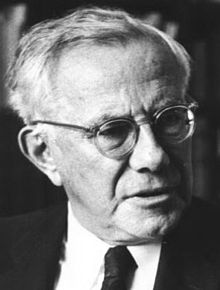
A return to Paul Tillich
In this moment I return to the wisdom of Paul Tillich that broke through the darkness of a despondent college student who had all but concluded that the faith tradition in which I had been raised was a hoax. I
I pray now for a similar wave of light for other sinners like me.
Grace strikes us when we are in great pain and restlessness. It strikes us when we walk through the dark valley of a meaningless and empty life. It strikes us when we feel that our separation is deeper than usual, because we have violated another life, a life which we loved, or from which we were estranged. It strikes us when our disgust for our own being, our indifference, our weakness, our hostility, and our lack of direction and composure have become intolerable to us. It strikes us when, year after year, the longed-for perfection of life does not appear, when the old compulsions reign within us as they have for decades, when despair destroys all joy and courage.
Sometimes at that moment a wave of light breaks into our darkness, and it is as though a voice were saying: “You are accepted, accepted by that which is greater than you, and the name of which you do not know.”
— Paul Tillich, “You Are Accepted,” The Shaking of the Foundations” (New York, Charles Scribner’s Sons, 1948).
No one can claim to be legitimate. None of us can claim we don’t do things that are wrong. No one does only right. The division of life into right and wrong is an early stage of childhood development in which the judge either rewards good behavior or punishes when you’ve put your hand in the cookie jar.
Blessed are they who live long enough to get knocked off their horses, and trust that there is more mercy in God than there is sin in us.
Gordon C. Stewart, public theologian, author of Be Still! Departure from Collective Madness, Brooklyn Park, MN, July 15, 2023
This post comes in two parts. The first was written Holy Saturday (the day between Good Friday and Easter); the second was written yesterday, the second Sunday of Easter.
The Silence of Holy Saturday
Everything falls into silence today. Jesus is crucified, dead, and buried behind the heavy rock of a borrowed tomb. Armed guards stand on either side of the stone that secures the tomb; the governor’s seal — the occupying empire’s official seal —warns against tampering with this tomb. The seal is unbroken; everything else is broken.
Holy Saturday is the day after the victory of death on the Hill of Skulls. There is no Easter. No reason to trust that the clouds will blow over, the sun shine through, the shivering stop. Life is frozen stiff. Only the loneliness within my frozen self remains.
To protect themselves against the fear of death, two bullies twist truth into lies, and station their guards to keep the rock in place and the seal unbroken. The piercing of his side; thorns cutting into his skull; the ridicule of vision; the soldiers’ taunts to come down to prove he is the king he never claimed to be; the cynic-sneer that takes the place of innocence; the barren blindness to what was once my sense of beauty; the indictment of hope and trust; the gnarling of beauty, truth, and goodness into tangled knots that are neither truthful nor social, hammer in my head from Moscow, Mar-a-Lago, and now from the state house of Tennessee.
My soul is not still today. The stone has not been moved. The seal stays put. Only Pilate’s questions and sneer remain:”So you’re a king!” “What is truth?”
Thomas and his Twin
I’m a lot like Thomas. Neither of us was there to verify what others told us. We were not in the room when the others reported that the crucified Jesus had come through their locked door. Thomas wasn’t into ghosts. Neither am I. Although my grandmother claimed the old house on Church Lane was haunted by a previous resident named ‘Gus’, and although I often heard the creaking steps outside my bedroom, I’ve always been like Thomas. I’ve never believed in Gus or the Jesus-ghost other apostles say they’d seen and heard.
My Holy Saturday experience this year was just my latest recurring argument with my grandmother and with the surviving apostles who made up fairytales to keep us from doing what Judas did when despair and guilt overwhelmed him.
I like fairytales. I love Wendy, Peter Pan, and Tinker Bell, but I don’t confuse them with the way things are. Neither Wendy’s wand or Jiminy Cricket could wish upon a star and make the Pied Piper drop by Gus’s house to rid the rats that scampered through the walls at night. This year reminded me of that; it’s the year of the rats, another year of the plague with no Pied Piper to lead the rats out of town. In 2023, there is no longer anywhere that is out of town.
Thomas is called ‘The Twin’ with no further explanation or elaboration. People of my ilk carry Thomas’ DNA! We’re Thomas’ identical twin. When Thomas arrives at the upper room to join the other surviving apostles, a week has passed. The difference between Thomas and Judas is that despair has not yet severed Thomas’ sense of connection. Loneliness, not belief, drives him back to what remains of his circle of friends. All hope is gone for Thomas. There is only the grieving: the sounds of nails being driven into Jesus’ hands, the horror of a soldier thrusting a spear into his side, the shouts of mockery and insult, his final declaration that it was over. His Lord is dead and buried, never to return. His friends have told him that things are not as they seem. The rock, they said, had been rolled back, the imperial seal broken, the guards lay on the ground like dead men, an encounter with Mary as a gardener, instruction to meet him in Galilee. All of it a fairytale!
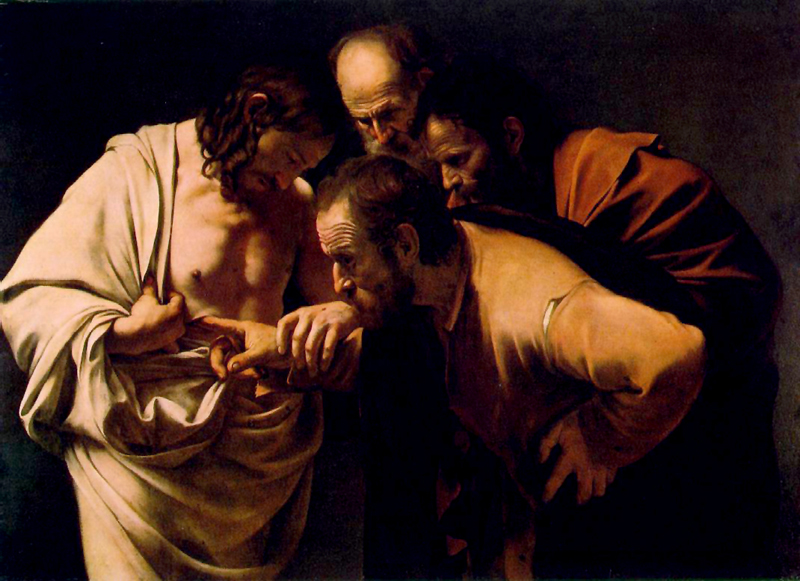
The Incredulity of Thomas – Carravagio
“Put your finger here; reach out your hand”
What happens to Thomas and others like him is more tangible than magic wands and pixie dust. “Put your finger here and see my hands. Reach out your hand and throw it into my side” is not an ethereal invitation. To be a disciple of Jesus means not only to see and hear, but to touch his physical wounds. The new community is born of his wounds and their transformation, commanded to throw ourselves into the sufferings and open wounds from which blood and water still flow. Resurrection is not pixie dust.
In the world it is called Tolerance, but in hell it is called Despair…the sin that believes in nothing, cares for nothing, seeks to know nothing, interferes with nothing, enjoys nothing, hates nothing, finds purpose in nothing, lives for nothing, and remains alive because there is nothing for which it will die.
Dorothy Sayers
Gordon C. Stewart, Be Still! Departure from Collective Madness (2017, Wipf and Stock), 49 short meditations on faith and the news; Brooklyn Park, MN, Second Sunday of Easter, April 16, 2023
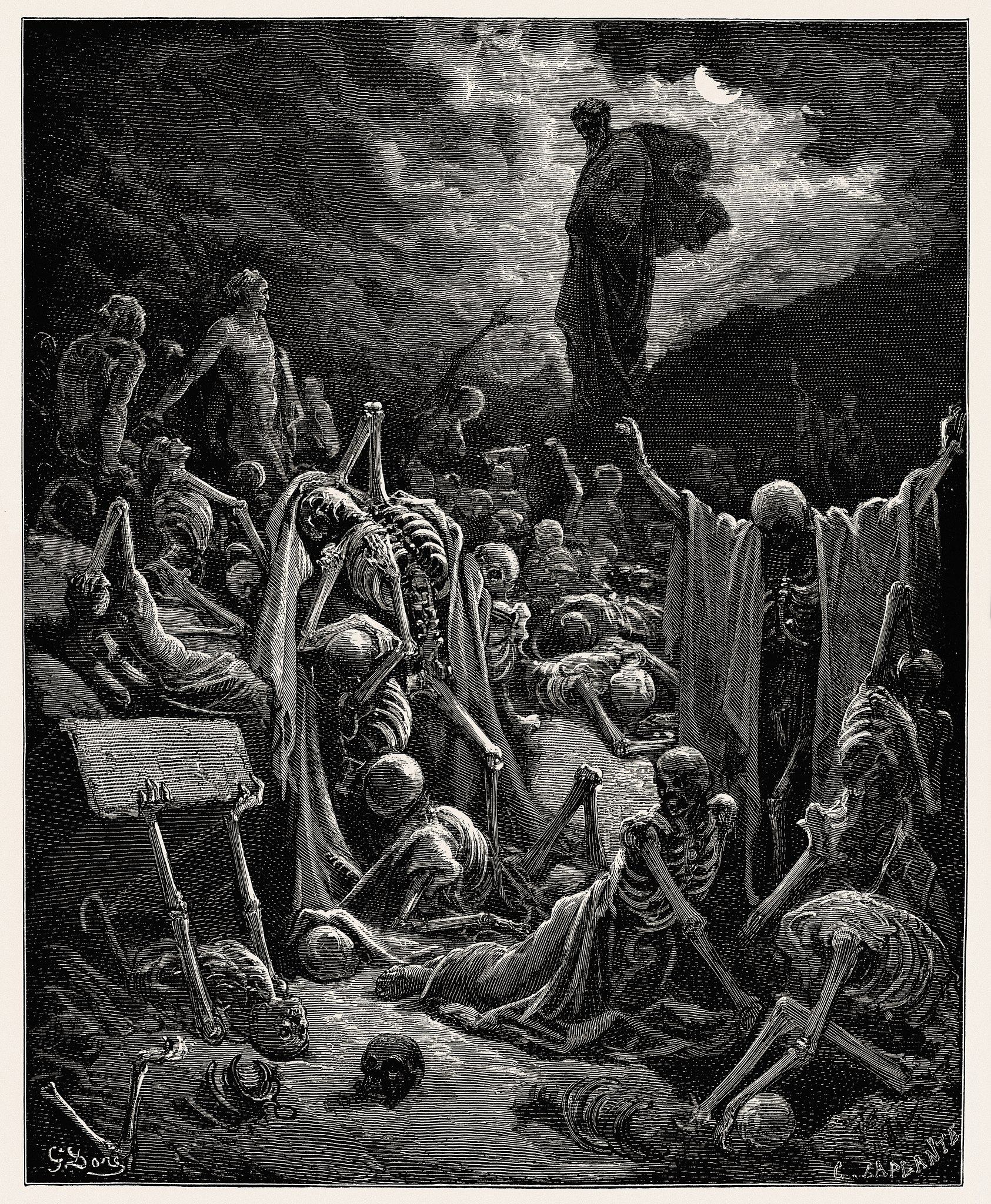
In these times, Ezekiel’s valley of the bones comes to mind. The valley is full of bones. The bones are everywhere, and they are very dry. There is no hope. A Voice speaks from the midst of the valley: “Mortal, can these bones live?” I answer, “No. They’re dead. They’re all dead!’’ To which the Voice responds, “Of course they are. They’re dead, but don’t you see? They are you. You and your people are the bones in the valley” (Ezekiel 37).
Gustave Doré, Vision of the Valley of the Bones (1866)
Like Ezekiel, I look in despair at my country and kindred. Ezekiel’s dry bones were his people in exile, far from their homeland. I’m a stranger in my own country, the valley of the bones, with little reason to no hope for a transformation.
Fresh bones are thrown into the valley every day. The remains of three nine-year-old children and three of their teachers in Nashville are the latest to hold our attention, until tomorrow another man, woman, or child repeats the horror somewhere else, while our children and grandchildren go through drills to protect themselves in the event the next gunman comes to their schools.
The land of the fearful
The assault weapons carried by American soldiers in Afghanistan and Iraq, and the culture of war — “kill-or-be-killed” — have come home to roost, turning schools, shopping malls, synagogues, churches and mosques into valleys of death and destruction in Ukraine and places like Nashville. The “land of the free” has become the land of the fearful; the home of hucksters and cowards. not the home of the brave. The assault weapons that killed nine-year-old Evelyn Dicephalus, Hallie Scruggs, and William Kinney and their teachers were not stolen; they were bought and sold legally.
Asking questions — speak what is real
Evelyn, Hallie, and Billy won’t blow out 10 candles on their next birthdays. They cannot ask the man who has failed to represent them in Congress whether he might now think twice before sending another Christmas card picturing his smiling family, each brandishing an AK-15, or why, moments after they were shot and killed, he said nothing can be done to “fix it,” noting that he homeschools his children. Evelyn, Hallie, and Billy can’t ask him what goes haywire in his brain that allows him to sport an AK-15 on his lapel on the floor of Congress, and shed tears and express surprise and horror at what happened at the school in the district he represents.
Understanding ourselves
Answers to how America arrived at the valley of the bones in 2023 are as many as the disciplines that study such matters: psychology, sociology, history, biology, genetics, economics, philosophy, anthropology, and, yes, religious studies and theology. I look through the lens of theological anthropology — mortals and mortality (death) understood in light of that which does not die—the Immortal, the Eternal, the Encompassing within which every mortal lives and dies.
Guns don’t kill?
“Guns don’t kill; people do.” Seriously? Guns don’t kill? AK-15s don’t kill? A firearm in the hands of “God-fearing, law-abiding citizens” won’t kill? Guns do kill; assault weapons slaughter, massacre, and tear bodies into body parts.
I’d like to say I don’t get it, but I think I do. The bones in Ukraine are added to the valley every hour by a mortal’s worship of himself and his nation. The idolatry of self and nation is no different in America. What’s the difference between “Make America Great Again” and “Make Russia Great Again?” How did the party of Lincoln (“Honest Abe”) become the party of John Wilkes Booth? Why do elected Representatives and Senators wear AK-15s on their lapels and take the floor to block legislation that would put legal boundaries around the freedom to bear arms under the Second Amendment? Guns don’t kill; elected officials do. Guns don’t kill; liars and cowards do. Guns don’t kill; bullies do. Guns don’t kill; ideologues do. Guns don’t kill; those who mistake themselves as more than mortal do.
From folly to wisdom
For people like me there is no better explanation for such horror than the violation of the First Commandment that Moses brought down from Mount Sinai. The sense of it is this: “You are not the center of the universe. You are mortal. You are born and you will die. You are not infinite. You are finite. To worship yourself is folly.
I scratch my head and wonder why the obvious isn’t obvious. The valley of the bones makes me weep. Nothing I do will turn us from this madness. The dry bones in Ukraine will not rattle, come together, and stand again, as in Ezekiel’s vision. But my faith tradition insists, against all evidence to the contrary, that the Word is more powerful than an AK-15, and the Immortal greater than a mortal.
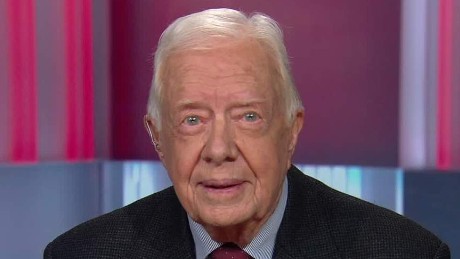
Former President Jimmy Carter has entered hospice care at home. The love of his life, Rosalind, asked that their privacy be respected. They have had their fill of limelights and cameras. When Ronald Regan defeated his bid for a second term, President Carter graciously conceded, and returned to their home in Plains, GA. He spent the rest of his life with hammer and saw in hand, building homes for Habitat for Humanity.
On Presidents Day, President Joe Biden risked a visit to Kiev for a face-to-face meeting with Vladimir Zelensky to assure him that the USA would keep its commitment to Ukraine for as long as it takes to put down Vladimir Putin’s siege. Joe Biden was in the limelight yesterday, but the limelight was not about him. It was about Ukraine and the defense of democracy against autocracy and oligarchy.
Former President Donald Trump was at home alone with a golf club in one hand and a scorecard in the other. The cameras and microphones were missing. His soul, buried in a sand trap, was his only company, if he could find it. No one is holding their breath waiting for Mr. Trump to find the conscience he had sliced into the rough years ago, long before he pressured Vladimir Zelensky to investigate — and announce to the world — Ukraine’s investigation of Hunter Biden as the quid pro quo for releasing the US budgeted dollars he was withholding from the Zelensky administration.
Living in the Metaverse
In the latest issue of The Atlantic (March 23), Megan Garber’s “We’re Already Living in the Metaverse” draws on the insights of George Orwell, Aldous Huxley, Neil Postman, Neal Garber, Hanna Arendt, and others to trace how we came to live in the dystopian “post-truth” era when “the news is entertainment, and entertainment is the news.
In the metaverse, the ideal subjects of authoritarian rule are not the true believers in the cause. They are instead people who come to believe in everything and nothing at all: people for whom the distinction between fact and fiction no longer exists.
To live in the metaverse is to expect life should play out as it does on our screens. And the stakes are anything but trivial. In the metaverse, it is not shocking but entirely fitting that a game-show host and Twitter personality would become president of the United States.
Megan garber, “we’re already living in the metaverse,” The Atlantic, March 2023
Character counts for little in the world of the metaverse. Glitz and entertainment are everything. But flesh and blood reality doesn’t disappear. Within a matter of weeks, Jimmy Carter will breathe his last in Plains, GA. Rosalind and the Carter family will decide how best to celebrate the exemplary character of the former president whose real hammers and saws remind us that character is everything.
Gordon C. Stewart, public theologian, author of Be Still! Departure from Collective Madness (2017 Wipf and Stock), Brooklyn Park, Minnesota, February 21, 2023.
ELIJAH (5 yrs. old): Bumpa, now that Santa Claus is in Congress, will he still come next Christmas?
BUMPA: Santa Claus isn’t in Congress.
Uh-hu! He’s all over the news. He’s very conventional. Don’t you watch the News Hour or listen to NPR?
I do. Grandma and I watch the News Hour every night. I think maybe you meant ‘controversial’.
Then you saw him with your own two eyes. He looks different ‘cause he shaved his beard and his hair’s not white, but it’s definitely Santa. You forgot to put your ears in again, didn’t ya.
You mean my hearing aids.
Yeah. your ears. Maybe you need to change the batteries.
Elijah, there must be a misunderstanding. Santa isn’t real.
Whoah! You don’t believe in Santa and Rudolph? I’m going to tell Mommy! You’re an atheist!
I think you’re confusing religion and politics. I have a lot in common with Atheists and a lot of differences. I go to church. They don’t. I worship God. They don’t. But we both believe Santa is a fantasy. He’s an illusion. Congress is different. Congress is no illusion. Congress is real.
You went to school, right, Bumpa?
Yes.
Mommy says you used to say the Pledge of Illusion every morning.
We did, Elijah. But it’s the Pledge of Allegiance, not the pledge of illusion. It’s important to get that straight.
What’s a pledge?
Well, it’s pretty simple, Elijah. A pledge is a promise.
Like when I promise Santa every Christmas that I’ll be good next year.
Right. Now you’re getting the hang of it. If you’re bad, Santa won’t bring any presents. You’ll get coal in your stocking. The Pledge of Allegiance is sort of like that. It’s a promise to do the right thing for your country.
Yeah, and it’s not an illusion, right?
Right.
What’s an illusion?
It’s something that isn’t real. Like Santa Claus. An illusion is something that isn’t there. You can’t make a promise to an illusion ‘cause it’s not real.
Our country’s real, right, Bumpa?
Right.
And so is Congress, right?
Right.
But Santa isn’t?
Right.
He is too, Bumbpa! Santa’s real! He’s a member of Congress who pledges allegiance. He was just put on two committees.
Okay, it’s taken me a long time to get what you’re talking about. The new Congressman isn’t Santa. His name is Santos.
And Santos is real, right?
Well, yes and no, Elijah. Yes, Santos really is in Congress, and, No, he lied to get there. None of what he said about himself is true. It was all an illusion, and everyone knows it.
So, Santos will get coal in his stocking next Christmas?
Gordon C. Stewart, Public Theologian, Author of Be Still! Departure from Collective Madness (2017, Wipf and Stock), Brooklyn Park, MN, January 19, 2023.
Some memories blur over time. Others, like the hospital visit with Nee-gon-we-way-we-dun (Clyde Bellecourt, Jr), still ring the fire alarm.
I had come to visit Clyde — Nee-gon-we-way-we-dun (“Thunder Before the Storm”) — in the cardiac care unit after he had suffered a minor heart attack. It had been Clyde and the Legal Rights Center (LRC) Board who invited me to step in as LRC’s interim executive director. LRC and I were in the same boat: our boats were sinking. I stayed at LRC for the next seven years.
LRC is the creation of Black and American Indian community civil right leaders as an “outside the system” community-based public defense corporation belonging to, managed by, and serving low-income African-American and American Indian defendants in the courts of Hennepin County.
I had been in Clyde’s room in the cardiac care unit no more than 10 minutes when an Anishinabe Midew arrived to offer prayers for healing to Gitche Manitou (the Great Spirit). She brought sage and sweetgrass, the herbs for ‘smudging’ in preparation for prayer. Smudging serves the purposes of cleansing, keeping evil away, and providing a spirit of calm and peacefulness.
The Midew had, of course, come with matches to bring the herbs to a smolder to create the smoke for smudging. She lit the match, and the smoke triggered the hospital fire alarm throughout Hennepin County Medical Center. The alarm stopped a few minutes later when an attending nurse smelled the sweet smell of smudging, and sent the word that stopped the alarms. We never did get to the prayers.
If we had gotten beyond the preparation for prayer, the Midew would have offered something like this Ojibwe prayer for the healing of each other and the healing of the planet:
Grandfather,
 look at our brokenness.
 We know that in all creation
 only the human family
 has strayed from the Sacred Way.
 We know that we are the ones
 who are divided
 and we are the ones
 who must come back together
 to walk the Sacred Way.
 Grandfather,
 Sacred One,
 teach us love, compassion, and honor
 that we may heal the earth
 and heal each other.
 (Ojibwe prayer)
The Legacy of Thunder Before the Storm
Clyde is gone now (RIP), but his legacy will live on. Though he could not end the racism or heal America of the trail of broken promises, he did what a human being is called to do. Because he did, his thunder is still heard. Professional sports teams no longer bear the names or wear the logos that dehumanize America’s first peoples. Although fans of the Cleveland ‘Guardians’ (MLB) and the Washington ‘Commanders’ (NFL) may not know or care why, when, and how their teams took their names, those who know will not forget the persistence that blew away the insults. Soon no one will remember, with a chuckle, the day preparation for prayer set off the fire alarms. No one will know that security systems can’t be smudged.
Gordon C. Stewart, public theologian, host of Views from the Edge, Author of Be Still! Departure from Collective Madness (2017 Wipf and Stock), writing from Brooklyn Park, Minnesota, December 19, 2022.
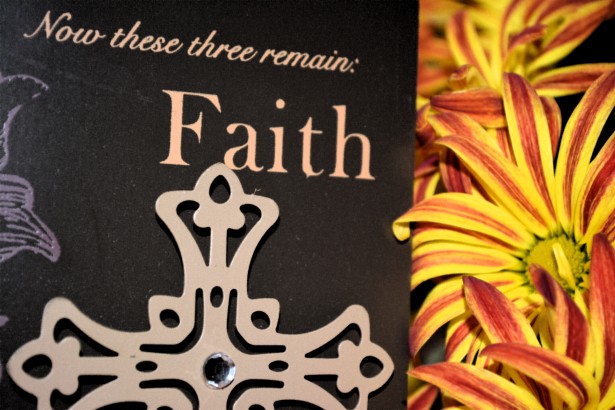
Christmas felt different this year. I did not feel the Light shining in darkness. It feels as though the darkness has overcome the light. I feel the heaviness of bombed out, homeless Ukrainians more than Zelenkov’s resistance lightens my spirit. “Faith, hope, and love abide, but the greatest of these is love.” Love overflows the banks of hope, and no hope that ignores reasons for despair is worth a damn.
So I stayed home on Christmas Eve. In the morning, the NPR annual broadcast of the Festival of Lessons and Carols that lifted my soul in years past, was silent. I didn’t turn it on. Everything was off. Fairy tales can be true, or they can be delusive. Ludwig Feuerbach, Karl Marx, and Sigmund Freud’s critiques of religion as illusion crashed the place where sugar plumbs once danced in my head.
Faith is a Leap — Reality is Existential
So much of what passes for Christian faith is nonsense. It doesn’t take a Ludwig, a Karl, or a Sigmund to ask what is real; it’s not a head trip. The difference between illusion and reality is existential — a disturbance of the stomach, a migraine, or a numbness that won’t go away.
Eight years into retirement, I have stopped looking for a church home. Nowhere is the darkness darker than in the churches that profess Jesus Christ as Lord and Savior while following a stand-in savior who fabricates and perpetuates the lie that he has been robbed of his legitimate authority. The embrace of QAnon conspiracy theory — the latest iteration of the division of the world between the saved Bible-believing patriots, and the damn pedophiles, child kidnappers, and sex traffickers of the Deep State — fits like a glove, but it is a betrayal the churches profess.
I was never big on Satan. Over the years, the division of the human species between good (heaven-bound) and evil (hell-bound) made less and less sense until it made no sense at all. Belief in life after death, or, as William Stringfellow called it, “after-death life,” struck me as a comforting delusion, the fanciful escape from death, the limit of every mortal creature.
Who we are, and what we’re not
The Book of Genesis parable of humankind’s tragedy in the Garden of Eden goes straight to the heart of the matter. The temptation is to know what only God knows, namely, the difference between good and evil that would make them like God, i.e., the illusion that they, the human creatures, would never die. The great sin is refusing to be what we are — trying to be what we are not.
The Day after Christmas in Minnesota
December 26, 2022, marked the 160th anniversary of the Mankato Massacre when 38 Dakota were hanged on a platform built for public shaming. The white European settlers gathered to observe the largest execution ever to take place on American soil.
They came to watch the ultimate shaming, but, before the execution, they heard what they did not expect. The heard voices from the gallows, chanting a prayer to the Great Spirit:
Wakantanka taku nitawa tankaya qaota; mahpiya kin eyahnake ca, makakin he duowanca. Mniowanca sbeya wanke cin, hena ovakihi.
Dakota hymn
Many and great, O God, are Thy works, Maker of earth and sky; Thy hands have set the heavens with stars, Thy fingers spread the mountains and plains. Lo, at Thy word the waters were formed; Deep seas obey Thy voice. Grant unto us communion with Thee, Thou star-abiding One; Come unto us and dwell with us: With Thee are found the gifts of life. Bless us with life that has no end, Eternal life with Thee.
Mankato was not calm the day after Christmas in 1862. No bright star shone down on the gallows. No angels sang. No babe in swaddling cloths. No shepherds knelt. No cattle were lowing. No ‘kings’ brought gifts. No carols rang out from the churches.
The day after Christmas was a time for crucifixion (a state execution) by White Christian Nationalists. Even so–or perhaps because it was a crucifixion — a Dakota hymn of faith, hope, and love still echoes from a gallows in Mankato. Love overflows the banks of hope, and no hope that ignores reasons for despair is worth a damn.
Gordon C. Stewart, public theologian and social commentator, author of Be Still! Departure from Collective Madness (2017 Wipf and Stock), Brooklyn, MN, December 26, 2022.
It’s a new year according the calendar, but it’s the same world we had hoped to leave behind on New Year’s Eve. It’s still Pinocchio’s world. Pinocchio’s nose has grown longer each year. Those who have mistaken insurrection for patriotism, and party loyalty for fidelity to the Constitution have all but forgotten Jiminy Cricket. The voice of conscience is missing. All that’s left is the song meant to encourage children:
When you wish upon a star
Makes no difference who you are
Anything your heart desires
Will come to you
If your heart is in your dream
No request is too extreme
When you wish upon a star
As dreamers do
Like a bolt out of the blue
Fate steps in and sees you through
When you wish upon a star
Your dreams come true
Optimism and the hand grenade
Before taking the oath of office, a prerequisite for the new Congress to convene, is sworn in, the new majority pulled the pin on the hand grenade before throwing it, leaving the House a mess without a Speaker.
THE REALITY OF CLIMATE CHANGE
The worst of it is the failure to face and act upon the reality of climate change. Whether by willful ignorance, misinformation, blind optimism, despair, or humankind’s Achilles’ Heel — our mortal propensity toward illusion — there is a deafening silence, louder than the calamity of war, that will not go away in 2023 and the years that follow.
Jiminy’s optimism has faded and the voice of conscience is weaker now. If Pinocchio’s nose had grown longer in private, it would be less consequential. No one would follow him. But Pinocchio cannot stand living without a stage and applause. The audience has come to the theater wanting Pinocchio to be more than someone’s puppet. Whoever is managing the strings, one thing is certain. It is not Gipetto. Pinocchio never goes on stage without Jiminy Cricket.
My father’s absence, return, and absence again
What child does not find hope in Jiminy Cricket’s calm invitation to wish upon a star, no matter who you are? But what adult can believe it “makes no difference who you are/ Anything your heart desires/Will come to you/If your heart is in your dream”? Does it? Does fate step in? Will fate see us through 2023? Fanciful thinking won’t get us through.
Questions of reality and illusion have been part of me since the day my father stepped from the B-29 Bomber at Logan International Airport. My mother and grandparents had assured me that I did have a daddy, but they had also prayed for his safety, and listen to the radio, hoping there would be no bad news about American troops in the South Pacific.
When my father stepped from the B-29 at Logan Airport and scooped me up in his arms, I pulled back. “Are you really my Daddy?” “I am,” he said. “And I’m never going away again!” The next morning, he was gone. What child knows the difference between “I’m never going away again!” and leaving the next day to be honorably discharged from the Army Air Corps?
Skepticism in Pinocchio’s world never left me. What is, and is not, trustworthy; what is real and what is illusion; what are faith, hope, and love in a Pinocchio world? In the adult world of 2023, Jiminy Cricket has changed his tune, but his call to conscience remains. Fate and destiny are not the same. Optimism is not the same as hope. Faith is a leap of faith, hope, and love that plunges into a sea of not-knowing and not-yet for the sake of a destiny greater than fate.
Gordon C. Stewart, public theologian and social commentator, Brooklyn Park, MN, January 5, 2023
The Nihilism of which Cornel West wrote in Race Matters describes American culture across all lines of division.
Nihilism is to be understood here not as a philosophic doctrine that there are no rational ground for legitimate standards of authority; it is, far more, a lived experience of coping with a life of horrifying meaninglessness, hopelessness, and [most important of all) lovelessness. The frightening result is a numbing detachment from others and a self-destructive disposition toward the world. Life without meaning, hope, and love breeds a cold-hearted, mean-spirited outlook that destroys both the individual and others.
Cornel West, Race Matters, p. 22-23
A Lived Experience
Years before meeting Cornel West, Professor Paul Lehmann, spoke of him as a brilliant rising star, and advised me to keep my eyes open for him as a source of wisdom worthy of attention.
A decade later, Cornel was the guest speaker of the Westminster Town Hall Forum at Westminster Presbyterian Church in downtown Minneapolis.
Shunning the Limelight
Of all the Forum speakers, Cornel West made the most lasting impression. It wasn’t what he said. It’s what he did. He wanted to meet the rest of the church staff, and he did. He eagerly greeted each and every one as if that person were the apple of God’s eye. With Al in the basement boiler room office, members of Al Cooper’s custodial staff, administrative support staff, associate pastors, he greeted them eagerly, as though they, not he, were the honored guest.
That was then. This is now. Some things are different; other things have not changed. For both good and ill, the present moment springs from our roots. To turn a blind eye to the past is to become blind to the present.
American history is a tinderbox of unresolved contradictions. We inherit a legacy of both neighborliness and violence, compassion and cruelty, wisdom and folly, love and hate, aspirations toward a more equitable society and persistence of the pecking order. Underneath every contradiction lies the fear of our mortality, the denial of death that spills the blood of Abel. Abel’s blood still cries out from the ground where kidnapped Africans lived and died as property of White slave owners deluded by the same presumption of racial, religious, and cultural superiority that committed mass murder of America’s indigenous peoples after coming here to practice religious freedom and build the biblical “city set upon a hill.”
The Politics of the Limelight
No nation is exceptional. Every nation that imagines itself to be the city set upon a hill rises by, and falls on, its own sword. The rise and fall of the myth of national exceptionalism has turned Ukraine into a killing field. Once the strongmen had been Stalin and Hitler. Now, their protégé continues the propaganda of lies and fears to establish himself and Russia as exceptions to the tides of history.
We cannot point to Vladimir Putin as unusual. He’s not. While Putin seeks to rescue Russia from the ashes of history, the defeated president who gathered the wood and lit the match on January 6, 2022, continues his campaign of arson that will Make America Great Again, free of criminal indictment and prosecution to stop him. In the meantime, the people he has seduced into conflating America and himself feed the “rule of law” and the Constitution through the paper shredder.
The Politics of Cultural Conversion
People like Al in the boiler room, and administrative assistants like Eloise, Mary, and Sharon quietly stand guard over the boiler and the paper shredder, remembering the moment when Cornel West shined a light on them. With no need for recognition, they practice “the politics of [cultural] ]conversion that shuns the limelight — a limelight that solicits status seekers and ingratiates egomaniacs.” (West, p. 31)
Gordon C. Stewart, public theologian, Author of Be Still! Departure from Collective Madness (2017, Wipf and Stock), Brooklyn Park, MN, December 14, 2022.










 Views from the Edge