She Could Give a Kiss

Morning reflections composed today by my friend Steve Shoemaker

She Could  Give a Kiss

She could give a kiss

and not have less to share.

He could take a kiss

and still have more to give.

She could have a child

and still have time for him.

He could be a child

and run away from her.

–  Steve Shoemaker, 03.21.12

Your Dear Eyes

 Your dear eyes…

Macular Degeneration,

what a multi-syllabic curse.

Hazel:   sometimes blue,

sometimes green, birthing

children’s eyes of blue and gold…

Flashing with indignation,

pensive, wise, creative, wary–

yes, windows to a good soul.

Let us see all that we can see

while we can.  Travel, taste, hear,

feel and, yes, smell what is good

around the world.  All of us

are fading into dust:  some of us

receive a warning–fair or unfair.

– Steve Shoemaker 03.21.12


“And the Word became flesh….” and words.

Little Steve at Sheldon Jackson Church, Colorado

Sometimes it comes in a poet’s words. The flesh it comes in is all shapes and sizes. Here’s a photo of Steve (6’8” and shrinking) standing behind a historic pulpit at Sheldon Jackson Church in Colorado. Sheldon was a bit shorter. Who says ministers don’t have a sense of humor!LEAVE A COMMENT on Steve’s poems. He, I, and others would love to know what you think. Or, in today’s butchered English, “Me and him” look forward to seeing/hearing the words YOU share.

The List

“You have ca… You have can.. cancer. But we think it’s treatable.”

I read The List early this morning, the day after hearing a doctor tell a wonderful older couple the news. The full bone scan tells a different story. It can be treated with radiation, but at what price for an old man already writhing in unbearable pain? My friend has been on “the list” once before 20 years ago. Now he’s back on it, this time for good. He’s a strong man, but not that strong, not immortal, not invulnerable. The treatment will not stop it this time. Morphine and lots of love will see him through until he’s off the list for good.

My step-daughter, Katherine, was placed on “the list” at age 30. She was exited the list at 34. Her ashes are on the mantel now. Her courage, her buoyancy, her steadfast refusal to let being on “the list” define her, her compassion for the doctors and nurses who “treated” her with surgery, chemo, more surgery, radiation, lasers, and morphine, and for us, the members of the family to whom she brought so much delight, have left us with so much more than what’s left on the mantel.

I’ll post a piece written during the third year of Katherine being on “the list” later today. Look for “It’s raining; it’s pouring.”

For now, share your stories with a comment here, or go to Courteney Bluebird’s blog and comment there. All of her work is remarkable and worth the visit.

Sometimes I feel blue

Purple-yellow iris (Kay Stewart photography). Poem by you know who.

Purple-Yellow Iris

Sometimes I feel all blue

Sad      Sorry      Down

Like the Blues

A Rhapsody in Blue


Sometimes

When the Blues

Begin to play in me,

It happens –


Blue bursts into purple

Leaping into joy

And a burst of sun-burst yellow

Comes crashing through the blues

I feel all clean

All wet    All  up

Like a hymn

An ode to purple-yellow joy

A Sermon on Suffering

The post of my friend Steve Shoemaker’s poem “Murillo’s Christ after the Flagellation” and the comments that you posted prompted the sermon I delivered this morning at Shepherd of the Hill Presbterian Churchin Chaska, MN. The sermon never would have happened without your thoughtful, penetrating comments on the earlier post. THANK YOU. Here’s the sermon.

THE FLAGELLATION

“Now the men who were holding Jesus mocked him and beat him; they also blindfolded him and asked him ‘Prophesy! Who was it that struck you?’ And they spoke many other words against him and reviled him.”  Gospel of Luke 22:63

Two months ago I created a blog. One of my seminary classmates, Steve Shoemaker, wrote the other day to say that he was impressed by how prolific I was. I thought maybe he meant “wordy” until he said that my productivity embarrassed his laziness as a poet. So, he said, “Here’s the deal I’ve made with myself. For every piece you put up on your blog, I’ll write a poem.” Steve is 6’8 and a basketball player in college. Clearly, he hasn‘t lost his competitive spirit.

A poem arrived last Friday. It’s a reflection on a painting by sixteenth century Spanish artist Bartolomé Esteban Murillo. In the painting, Jesus is bent over on all fours after he being mocked and beaten.
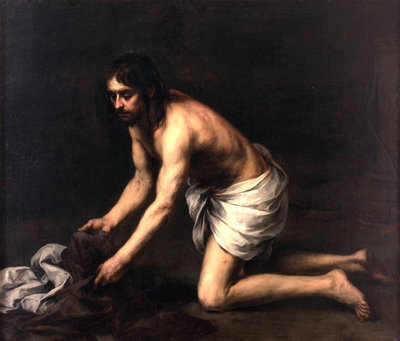
Christ after the Flagellation

Steve’s poem, “Murillo’s Christ after the Flagellation” changed the direction of the sermon this morning.  Here’s the poem.

The human had been tied to the whipping

post, a pillar that had been used many

times before by the Romans (and ages

earlier by the Greeks–but for a much

different purpose). Now, his pale skin looks

translucent (should it not have been darker,

with more blood?) His mother recalled his bris.

They had both cried then, too.

A strong young man, broad back, thick arms, now on

hands and knees, but head raised with eyes open:

seeing a cross that’s even worse ahead…

Still, unflinching, resigned–no, determined

to go on, face more pain, indignities,

shame, even death (there is no sign of God.)

Shortly there arrived a brief comment from a blogger who blogs about the daily struggle with mental illness.

“This poem brought tears to my eyes.”

Score one for my friend Steve.

Later in the day another comment arrived on the blog in response to Steve’s poetry. Like the first comment, this one also comes from someone with a history of some kind of long-term suffering. It reads as follows.

I have a response to the stories of Christ’s beating that often leaves others aghast. So brace yourselves:

He was beaten for several hours, or a day or two? Big deal. Those of us who have suffered years of abuse and terror know what real suffering is.

I don’t find focusing on Jesus’ suffering, or any of that 12 stages of the cross crap, to be helpful at all. I find it to be insulting. As if there is something noble and glorious about suffering. Nope, not a damn thing to recommend it. I know that Jesus voluntarily placed himself in the position for that to happen. So? Doesn’t help.

Please, fellow readers, don’t think that I am an isolated one, or few. There are lots and lots of us feeling this way.

The world is full – FULL – of people who have suffered much worse for decades or lifetimes. Think of people who live in North Korea. Or poor girls growing up in India. Or young girls in Fundamentalist Church of the Latter Day Saints settlements who get married off to much older men and are then raped daily for the rest of their lives. Jesus’ few days of humiliation are nothing in comparison.

The Lenten/Easter season is my favorite church season because I am reminded of how deeply I am loved and how quickly I am forgiven. Jesus’ brief beating plays no role in that….

The writer is hardly alone in his thinking about this. What do we say about those whose tenures of torture and suffering far exceed the relatively short period of Jesus’ suffering?  Is focusing on Jesus’s suffering and the stations of the cross insulting to those who have suffered, and continue to suffer, for decades or for a lifetime?

How would you reply to the writer?

Here’s how I responded:

Your thoughtful response calls for an equally thoughtful reply. So I’ll try.

The cross, in my theology, in no way minimizes or disrespects the suffering of others. Nor does it say, as it is too often understood by sacrificial atonement theology, that suffering itself is noble or glorious. The cross was an instrument of Roman torture and execution. The Jesus who was tortured and executed, as were thousands of his Jewish contemporaries, is not somehow God masquerading in human flesh. That being said, moving the cross to the sidelines of Christian faith and reflection is, in my view, a mistake. Well meaning because it reacts against the twisted theology that understood it to be separate from, and above, all other human suffering, but mistaken nonetheless.

When I look at the cross, I see all these people. And I see myself there as both the crucified and the crucifier. What I see in the crucifix is total abandonment. “My God, my God, why have you forsaken me!” And in some way I hear not only the cry of Jesus but the cry of the God Dietrich Bonhoeffer described as the Divine Center we push to the edge of the world.  I see in the Christ-event the tragedy and the hope of the divine-human encounter.

Sebastian Moore (The Crucified Jesus Is No Stranger and The Inner Loneliness) and Joseph Campbell awakened me to this richer Christology. Moore: “We have to think of God as closer to our evil than we ever dare to be. We have to think of God not as standing at the end of the way we take when we run away from our evil in the search for good, but as taking hold of us IN our evil, as the sore point which the whole idealistic thrust of man is concerned to avoid

“Redemption through the blood of Christ is (wrongly!) interpreted as the bending of Reality itself to man’s great dream of himself. And it is exactly the reverse. It is the ending of the dream. It is the beautiful collapse of the whole enterprise. It is the invasion of man by himself, with God at the center as love.” (Bolding added  for emphasis.)

Closer to home, another great theologian, my wife, Kay, reflected on the cross the other night at a Lenten series on “The Place of the Cross”:

“The Apostle Paul used to talk about all of his theology in terms of transformation at the foot of the cross. If a theological insight couldn’t go to the foot of the cross and be transformed there, then it wasn’t of God. This darkness is not for lightweight faith statements or testimonies. The annihilation of all goodness and all love which takes place in the action of one human being in violence to another human being—it cannot be redeemed by any other force but God’s pure love. That is a faith statement that lives inside a vacuum until manifested. There is no meeting of love and abandonment, they are mutually exclusive realities. We are lost. Period. And if God is to find us, then it is all about God’s initiative.”

From today’s perspective, Moore’s language is too gender- specific, not inclusive. But the substance of his Christology is totally inclusive. We’re all there. Anything short of that either drifts off into a new utopian project or into some new rendition  of the power of positive thinking. The power of Christian theology is its gravitas: it doesn’t turn away.

I told the blogger, “Love to hear more…. Hope we can keep the conversation alive.”

Hours later, an email arrived from the second blogger who had watched “The Leper” on the blog saying s/he was moved and grateful for the sermon.

If I could sit down in a coffee shop or in a living room by the fire to continue the conversation, this is what I would say.

The cross of Jesus does not minimize other suffering. It casts a light backward and forward into all darkness for all time. From inside the light we see the darkness of all human violence and abuse, and at the foot of the cross, we look up to realize that the protest against the suffering we impose on others and our own self-imposed suffering – our own reviling of others and our reviling or ourselves — is not just our protest. It is God’s. It is the suffering of God at the hands of a godless world. And the word for “they reviled him” is the same as the word “blasphemed” him.  Whenever we treat others cruelly, or treat ourselves cruelly, we blaspheme God. We are reviling and whipping the back of God.

From Jesus’s cry to God – “My God, my God, why have you abandoned me?” – there comes an echo from the heavens: “My children, my children, why have you abandoned me? My children, how could you forsake Me?”

The cross calls for an end to the reviling of others and our own sorry self-flagellation, as though those we revile, or we ourselves, would be or should be beyond love’s reach.

Who is the “the human tied to the whipping post”? Who puts her there?

Will you join the suffering of the God who wants it all to stop? Will you rejoice in the inevitable, eternal reach of God’s love and redeeming grace?

Footnote: Here is Steve, the poet, among the Bristle Cone Pines at 11,000 feet in Colorado:
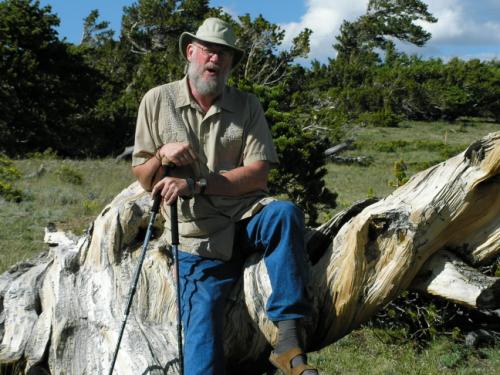
Steve Shoemaker

..

A fellow student at McCormick Theological Seminary in Chicago, we’ve continued the friendship for 47 years. A published poet, Steve was the Senior Minister of the McKinley Presbyterian Church and Director of the McKinley Foundation (campus ministry) at the University of Illinois for many years. He hosts “Keepin’ the Faith” on WILL, Illinois Public Radio,. He and his wife, Nadja, a research biologist, live in a geo-thermally-heated house on the prairie outside Urbana, IL where his neighbors often spot Steve’s kites riding the winds of the prairie skies.

The Leper

Ever been a leper? I have. I still am.

Lepers are people separated from the mainstream society. Isolated. Beaten. Pushed to the side. Shamed. Ashamed. I have met the leper many times. I meet him every morning shaving. I meet her as the abused woman, the taunted gay teenager, the child who has trouble in school, the sentenced murderer,  the hooker, the heroin addict, the young person and the tenured professor who took their own lives, the depressed, oppressed, repressed, and suppressed souls who live in quiet despair. Sometimes we break the chains of the psychic and social code. Sometimes we move out of the leper colony, push our way through the crowd and cry out.

That’s what this sermon is about.  Shepherd of the Hill Presbyterian Church in Chaska, MN.

Let me know what you think. Better yet, let me know what you feel. Peace.


Silence and Cell Phones

This piece originally aired on “All Things Considered” (Minnesota Public Radio). Click here for an audio connection on the MPR site, or just read the piece.

Driving to work this morning, I suddenly started to pay attention to the drivers in my rear view mirror.  It all started when a large SUV nearly hit me from behind.  The driver was jabbering away on a cell phone.  I’m sure the conversation was important.  Why else would he jeopardize our safety?

For the next fifteen minutes on I35W I conducted my own scientific survey.  All of the drivers had cell phones glued to their ears.

Makes me wonder.  Are we that uncomfortable being alone?  Or do we think we’re so important that the rest of the world can’t get along without us?  Or perhaps we are afraid that the rest of the world WILL get along very well without us – so we need to keep reminding others that we exist because we’re not sure we really do unless someone else is filling the speechless void?  I wonder.

As concerned as we should be about the terrorism of distracted drivers on the highway, I’m more concerned about what our use of cell phones says about us as a people.  We are addicted to outside stimuli. Less and less comfortable with silence. Less and less attuned to wonder. More and more filled with chatter. More wordy – less thoughtful.

Sociologist Eugen Rosenstock-Huessey once observed – before the advent of the cell phone – that for many folks the drive to and from work was the only true “free zone” during their day.  It was time for solitude and reflection, a transitional pause to get your bearings, time to make the transition from home to work and from work to home. These were trips to be celebrated for what they were – opportunities to stand free from the herd – the herd mentality of religion, nationalism and ideology.  They were times to think.

Maybe I’m just getting older.  I am.  And that’s a good thing.  Because I’m getting tired of looking in my rear view mirror at someone with a cell phone stuck in his ear because he can’t stand the silence…or the sound of her own heartbeat.  Someday that beat will stop and there will only be the silence.  Maybe we ought to put down the phone and listen before there’s nothing to hear.

My Father’s Portrait

We’re all cut from our parents’ cloth. It falls to each of us to finish their unfinished business.

Following my mother’s death, it fell to the three sons and our spouses to clean out the apartment and arrange for distribution or disposal of the belongings.

My father had died two years earlier.

Don, Bob and I spent an afternoon alone in the apartment using a rotation method to divide the belongings.  By order of birth, we would each choose what we wanted. Round one: Gordon, Don, Bob; round two: Gordon, Don, Bob – I-2-3; 1-2-3 – until everything  any of us wanted was chosen.  The rest would go to auction or to Goodwill.

Among my parents’ personal art was an oil painting of my father. In my early years, I loved that painting.  Handsome man. Robed in his clergy robe, dignified, smiling, tender eyes, a man of stature, our Dad. The painting had been in the family for as long as I can remember and, as best I can recall, had hung in Dad’s pastor’s office at Marple Church when I was a teenager. Now it hung in the narrow hallway just inside the entrance to my parents’ apartment. It was the first thing a visitor saw – a reminder to all who entered that Dad had once been someone special, a man of the cloth.

One-two-three, we chose our favorite pieces.  We agreed that monetary value made no difference to our selection process. All that mattered the value each of us placed on an item.  The grandfather clock was clearly worth the most in dollars, but the clock had been purchased late in our parents’ marriage; it bore only the most recent memories, not the memories of home.  It could not compare with the knicknacks – one of our mother’s Hummel figurines, a Baltimore Oriole paper weight, my father’s dog tags from World War II, a dish, a lamp, a photo, or the original painting given by a parishioner that reminded me of Robert Frost’s “Stopping by the Woods on a Snowy Evening” – artifacts of precious times now gone except for memory.

But there was another painting, a portrait of Dad in his ministerial robe.

As we went around the room, the painting didn’t move. Nobody picked it. Finally, Don asked with a smile, “Who wants Dad’s painting?” Deferring to me, Bob chimed in. “You’re the oldest! You should have it. It’s okay with me. I don’t want it!” “Sure,” said Don, “I don’t want it. Go ahead, Gord, you should have it. You’re the oldest!”

We all looked at each other and began to laugh about the elephant that had been sitting for years in the living room.

I looked at the picture. There was Dad, clear as day, a keepsake that had meant so much to  our father and mother, and we didn’t want his picture?  “I don’t want it,” I said, and  started to say more but couldn’t get the words out. Grief had overcome me. I couldn’t speak. I shuddered with sobbing. My brothers watched and waited in silence. When finally I composed myself enough to complete the thought through the tears, the words came out slowly . . . in staggered gulps. “I hate that thing! I always wanted to rip that robe off him! He never took it off!  He was always the minister. I just wanted him to be his own naked self. I just wanted him to be Dad.”

Reflecting on it years later, that moment was one of many breakthrough moments of taking off my own robe. I hadn’t worn mine for five years and hadn’t missed it. I began to find my own naked self bereft of the robe while working for a poverty criminal defense law firm founded by African American civil rights activists and founders of the American Indian Movement. Unconditional love was not a creedal statement; it was a daily fact of life, the treasure of grace held by many kinds of vessels. “We hold this treasure in earthen vessels….”

I took the painting of Dad and took him with me on the long flight home to the Legal Rights Center.  When I got there, I put the painting in storage, as a reminder that the work isn’t finished for me or my offspring. Who knows, someday one of the great-grandchildren may bring Dad’s painting out of the closet.

Dew Drops on a Spider’s Web

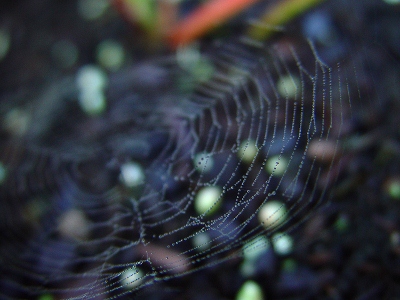
This small spider’s web, tucked away in the corner of a flower box on our deck, was noticed by Kay and preserved with her camera.

When Kay showed me what she’d found with her camera, I was blown away.  Very grateful.  And very wonderfully small. Breathless.

Here’s what I wrote:

who are you, little i, sitting above the world so high? (e. e. cummins)

from the high perch home hammers and saws have made

on land leveled by bulldozers and gas-guzzling insect graders?


Then I see it…in the early morning sun:


the all-but-imperceptible home spun from inside a spider’s womb, wet with drops

strung like beads so small… so delicate… so light

they leave the spider’s home intact, a natural grace respecting  strength and weakness – a lightness of being that does not crush or break this hidden part –

this most amazing part – of the larger Web of Life we barely see.


“To the Sea” re-blog

Woke up this morning to this photograph by Portuguese photographer Paolo Flop, posted on PhotoBotos.com. PhotoBotos introduced the piece this way:

I keep wondering what this woman is doing here?  Why does she have a lantern in the water?  Paulo’s photography doesn’t answer a lot of questions, but it sure does inspire them.  We have a lot of people who visit our website mention that they get inspiration to write a poem, story, or paint a picture from the photographs we post.  I think this one has story written all over it.  Feel free to add your poem or link to your artwork in the comment section.

Let the photograph speak for itself. Contemplate it. Drink it in. What “story” does it write for you? Then share your comment here. You can also add your comment on PhotoBotos.com. My comment is posted on Photobotos.com.

A Higher Species of Life

If and when we find more highly developed life somewhere in the universes beyond our universe, might this be what we find? Click HERE to see a higher species.

Thanks to Photobotos for photo. Gotta love ’em, yes?  And we think we’re so smart.