The Bus Tour

See the Windy City!

Learn About America!

Two Hours by Bus–Hop On & Off!

The Tour Bus

….

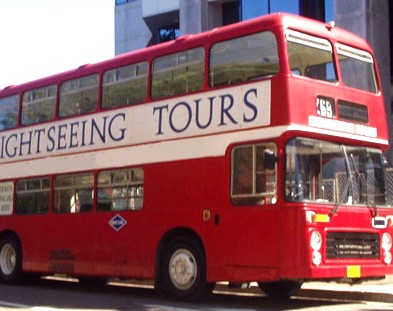
The tour guide obsequiously spoke

into his mike to the polyglot group

aboard  the double-decker bus that took

them slowly winding through Chicago’s Loop

He thanked each one who put a buck into

the duct-taped peanut jar on their way out,

but few responded generously to/ his hints.

He had a tendency to pout.

He kept repeating “Stay in your seats when

the bus is moving!”  But the kids would run

the aisles and up and down the stairs.  He then

would yell, “Sit down!” –but did not spoil their fun:

He was forceful in his use of language,

but few foreign visitors spoke English…

– Steve Shoemaker, host of “Keepin’ the Faith.” Archive programs, including two with Gordon C. Stewart, can be heard anytimee @ www.will.illinois.edu/keepinthefaith.

Noah’s Ark: Only TWO Worms – “NO FISHING!”

A Grandfather’s Concern: Literacy, Literalism – and the Measure of Truth” – a social commentary published several years ago on MinnPost.com – came to mind today as I read the humorous comments “Owning a Canadian” about the Bible and homosexuality. I post it here with a name that better reflects the tongue-in-cheek spirit in which it was written.

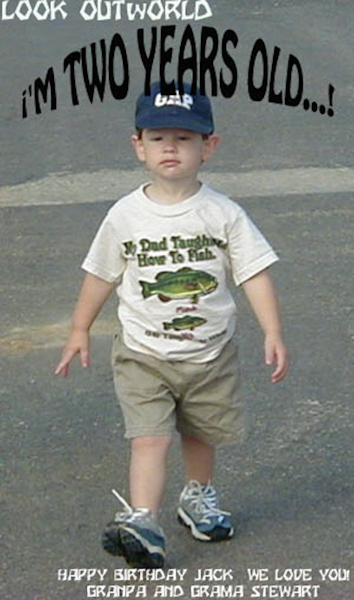
Jack at age two

I’m worried about my grandchildren. They live in Kentucky.

A New York Times story by Laurie Goodstein re-published by the Star Tribune (12.12.10) as “Creationism meets the Constitution” triggered the concern.  Its focus  was the separation of church and state, occasioned by a proposed Christian theme park.  But my concern was for my grandchildren.

Kentucky ‘s Governor and the Kentucky Tourism, Arts and Heritage Cabinet seem enthralled with a new Christian theme park  called “Ark Encounter. “ Ark Encounter will be developed by “Answers in Genesis,” developers of The Creation Museum in Petersburg, Kentucky that shows humans and dinosaurs living together on a planet that is 6,000 years old, a kind of Disneyworld for the illiterate.

Ark at “Ark Encounter”

My concern is for Jack and Mimi’s survival.  I’m proud of Jack.  He’s 10 years old now.  He’s a thinker. His emails to me are flawlessly literate. According to his dad, he doesn’t need Spell-Check.  He knows how to spell.  In addition to being literate, his emails are sometimes literary.

“The developers of Ark Encounter, who have incorporated as a profit-making company, say they expect to spend $150 million, employ 900 people and attract 1.6 million visitors from around the world in the first year. With the Creation Museum only 45 miles away, they envision a Christian tourism corridor that would draw busloads from churches and Christian schools for two- and three-day visits.” (NYT article)

If he goes the literalist route, Jack might find himself like the little boy who, when asked whether Noah did a lot of fishing on the ark, answered no…because he only had two worms.  Eventually, his native curiosity and literary bent would free him for the less obvious symbolic  riches of sacred text.

But the issue is not only in Kentucky.  It’s everywhere that people refuse to read the Bible literately as literature.  It may be sacred literature, but it is literature.  The folks from “Answers from Genesis” who are building the Ark Encounter insist that the Bible must be read literally.  According to my dictionary, “literal” means “restricted to the exact stated meaning; not figurative.” Genesis is factual but not figurative.

My hope for Jack and Mimi is that they’ll board a different ark – the ark of literacy that will rescue them from the sea of literalism that misses nine-tenths of what is sacred – the poetry, the metaphors, the similes, the parables, the literary allusions of The Song of Solomon, the Psalms, or the prophet Habakkuk who climbed up, figuratively, on “the watch tower” to see what God would say to him about the world in which he lived.

The more I think about it, the less concerned I become…unless, of course, Jack and Mimi, succumbing to peer-pressure, conclude that to be a person of faith means you have to swallow a camel.  While some of their friends are trooping off to see the young giraffes in Noah’s ark – “We think that God would probably have sent healthy juvenile-sized animals that weren’t fully grown yet,” said the head the project, ”so there would be plenty of room” – I hope Jack and Mimi stay off the buses to Ark Encounter. More than one person’s faith has been killed by encounters that pitted faith against reason.

I hope Jack and Mimi stay home to read their Bible not as a collection of “literal” facts but as sacred literature that will lead them into the deepest sacred recesses of the soul and into the heart of the world itself.  When someone asks whether they take the Bible literally, I hope they’ll be able to answer that they don’t read it literally; they read it literately.  Otherwise, there would be no worms.

– Gordon C. Stewart, originally published as “Literacy and Literalism” on www.minnpost.com.

Swallows

tree sallows

My brother tried to plant 2,000 trees

each spring.  Eventually there were 13

cut-your-own Christmas tree varieties.

While helping mow the grass, swallows were seen

around my noisy tractor darting, diving,

staying close wherever I would go.

I claimed the swallows felt the same strong love

I felt for trees, the sky, the clouds (although

in secret I thought they felt love for me.)

The tree farm had so many birds that experts

came out from the university.

I asked if the swallows had become pets?

The ornithologists said that the birds

were chasing bugs thrown by the mower’s blades…

– Steve Shoemaker, Urbana, IL May 22, 2012

Owning a Canadian

Talk radio host Dr. Laura Schlessinger

Sometimes we just need a good laugh. A little perspective. A time to step back and think.

Ever wondered why you can’t own a Canadian?

On her radio show, Dr. Laura Schlesinger said that homosexuality is an abomination according to Leviticus 18:22, and cannot be condoned under any circumstance.

Read the open letter to Dr. Laura that circulated on the internet for a good laugh:

Dear Dr. Laura:

Thank you for doing so much to educate people regarding God’s Law. I have learned a great deal from your show, and try to share that knowledge with as many people as I can. When someone tries to defend the homosexual lifestyle, for example, I simply remind them that Leviticus 18:22 clearly states it to be an abomination. End of debate.

I do need some advice from you, however, regarding some other elements of God’s Laws and how to follow them.

1. Leviticus 25:44 states that I may possess slaves, both male and female, provided they are from neighboring nations. A friend of mine claims that this applies to Mexicans, but not Canadians. Can you clarify? Why can’t I own Canadians?

2. I would like to sell my daughter into slavery, as sanctioned in Exodus 21:7. In this day and age, what do you think would be a fair price for her?

3. I know that I am allowed no contact with a woman while she is in her period of Menstrual uncleanliness – Lev.15: 19-24. The problem is how do I tell? I have tried asking, but most women take offense.

4. When I burn a bull on the altar as a sacrifice, I know it creates a pleasing odor for the Lord – Lev.1:9. The problem is my neighbors. They claim the odor is not pleasing to them. Should I smite them?

5. I have a neighbor who insists on working on the Sabbath. Exodus 35:2 clearly states he should be put to death. Am I morally obligated to kill him myself, or should I ask the police to do it?

6. A friend of mine feels that even though eating shellfish is an abomination, Lev. 11:10, it is a lesser abomination than homosexuality. I don’t agree. Can you settle this? Are there ‘degrees’ of abomination?

7. Lev. 21:20 states that I may not approach the altar of God if I have a defect in my sight. I have to admit that I wear reading glasses. Does my vision have to be 20/20, or is there some wiggle-room here?

8. Most of my male friends get their hair trimmed, including the hair around their temples, even though this is expressly forbidden by Lev. 19:27. How should they die?

9. I know from Lev. 11:6-8 that touching the skin of a dead pig makes me unclean, but may I still play football if I wear gloves?

10. My uncle has a farm. He violates Lev.19:19 by planting two different crops in the same field, as does his wife by wearing garments made of two different kinds of thread (cotton/polyester blend). He also tends to curse and blaspheme a lot. Is it really necessary that we go to all the trouble of getting the whole town together to stone them? Lev.24:10-16.

Couldn’t we just burn them to death at a private family affair, like we do with people who sleep with their in-laws? (Lev. 20:14)

I know you have studied these things extensively and thus enjoy considerable expertise in such matters, so I’m confident you can help.

Thank you again for reminding us that God’s word is eternal and unchanging.

Your adoring fan,

James M. Kauffman, Ed.D. Professor Emeritus, Dept. of Curriculum, Instruction, and Special Education, University of Virginia

P.S. It would be a damn shame if we couldn’t own a Canadian.

Cause of death: Stubborness

Ever read an obituary that raised your eyebrows? Ever left a funeral thinking it was  case of mistaken identity?

This week my old friend Bob Young shared this obituary with the annual gathering of seminary classmate. Bob has a wry sense of humor. We knew something was coming by the twinkle in Bob’s eye.

This obituary is the exception to phony. It appeared in the Ponca City News:

Joshua Micheal (nope, not a typo it’s really spelled that way) McMahan left this world April 18, 2012. He was loved, hated, praised, and cursed by relatives and friends alike. He ultimately passed as a result of being stubborn, refusing to follow doctors’ (or anyone else for that matters) orders, and raising hell for a little more than three decades. He lived life on his own terms.

Josh was born on Sept. 16, 1978, to Linda Burgert Waller. Josh was a beautiful, unique, kind, and loving spirit man. Joshie endured around ten mind-numbing years of public schooling. He had worked as a pizza delivery boy and call center representative before shockingly becoming independently “wealthy.”

He loved music, beer, movies, vodka, television, and women, but not necessarily in that order. He was also an awesome drummer!/vocalist? and was in several bands over the years. He lived in Ponca City his entire life except for the past year where he was forced to put up with his sister and brother-in-law out in the middle of nowhere — a little piece of terra firma aptly called Haskell.

He is survived by Rosie, his long-time canine companion; a sister, Melanie Waller Ochoa; a brother-in-law, DJ Ochoa; a best friend/brother, Cliff Crull; three nieces, Miranda, Emma, and Camille; and one nephew, Maxx. Josh had no children of his own (at least none that we know of). He was preceded in death by Mom Linda, Grandma Nina Burgert, and Grandpa Joe Burgert.

A remembrance service will be held at 2 p.m. April 25 in the chapel of Trout Funeral Home where you may re-tell the stories he can no longer share. Anyone dressed in a suit or Sunday’s best will be promptly escorted back to their vehicle. Just kidding … we’ll accept you as you are — just as Josh would have in life. Please be wary for any children’s sake, there may be profanity and/or alcohol involved. If you have a special memory or maybe just want to irritate Josh for all eternity, please bring a magnet or sticker to attach to his casket for evermore.

In lieu of flowers or memorial gifts, please give generously, in Joshs’ honor, to rockstarmusiceducation.org.

JRock will be placed to rest in the St. Mary’s section of Odd Fellows (the irony) Cemetery in Ponca City and I’m sure he would invite you to come by later and have a laugh on him — literally.

As Bob read aloud Josh’s  obituary in his droll manner, we had a great laugh, just as Josh would have wanted, and we felt accepted as we really are. Lord knows we’re all likely “to pass as a result of being stubborn.”

We had another round in Josh’s honor and prayed (not really) that, if someone decides to tell the truth in our obituaries, the writer will have a lively sense of humor…and a whole lot of grace.

The Missing Shoes

Gordon C. Stewart – copyright – a memoir

Five years before my father’s death in July of 1999, the first of many false alarms had called me home to Pennsylvania.  I had brought some reading material for the flight from Minneapolis to Harrisburg – James Carse’s Breakfast at the Victory, an autobiographical reflection on the mysticism of ordinary experience.

I sat down for the flight, strapped myself in for take-off, opened to the Preface, and soon found my eyes flooded with tears.  Dad had developed Parkinson’s and had been hospitalized following a fall and several transient ischemic attacks, i.e., small strokes that had left my mother in a constant state of worry.  I could see him wasting away, yet his spirit was strong and he continued to insist that my brother Bob sneak him over to the golf course for nine holes.  “Dad, I’d love to, but you can barely stand up without a walker.  How you gonna play golf?”  “I can do it!  I can still swing a golf club.  Come on, just drive me over.”  “I think Mom might have some thoughts about that!”  “Come on.  Just you and me – Mom doesn’t ever have to know.”

So there I sat, strapped in, reading the Preface, the story of James Carse’s visit to this friend Charles who was dying of cancer.  Carse had gone to visit Charles before walking an old pilgrimage route in Spain that leads from the French border to Santiago de Compostela in northwest Spain.

“Maybe you’ll find my boots in Spain,” said Charles.  “They just gave out.  So I put them on a stone wall by the road and limped on my bare feet.”

As Carse made his solitary pilgrimage across Spain, slogging through the mud and cow dung produced by heavy rain and snow, he came upon “the outline of a familiar object crushed in the mire.”  He tugged at the old boot until it came loose from its moorings in the mud to find the sole gone but its essential structure in tact.  Could it be Charles’s boot?  He took a picture which he presented to Charles when he next visited him.

My face was flooded with tears.  I choked back the sobs.

Charles’s boots had been the essential equipment of a pilgrim, yet in the end they had not served him well.  He had had to make the journey in his bare feet.  So would Dad.  My father’s boots were the role of ordained Minister of Word and Sacrament.  One is ordained for life, he would remind me, not just for a particular job.  Yet I always wanted him to take off his boots, expose his naked self, experience the squish between his toes in the primordial muck that is more real than social roles and expectations, the more ordinary sacred ground that required Moses to take off his shoes.

Thirty-thousand feet in the air, I took out a pen and scribbled in the margin of Breakfast at the Victory:

“Dad and his boots – his soles worn out, only his bare feet for the rest of the journey.  At some point your boots wear out and it’s just you and your bare feet and the mud – the self shorn of the ego.”

I sobbed for Dad.  I sobbed for myself, fearing that he and I would both die with our boots on.  I cried for losing him.  I cried for him to be free.  I cried for barefoot authenticity.

Five years later – it was July – I again flew to Harrisburg.  Expecting my father’s death, I had worn a suit and my black Johnston & Murphy shoes, highly polished by the best shine man in the Minneapolis-St Paul International Airport, as a tribute to Dad – his shoes were always polished – but also because I have inherited Dad’s appreciation of good grooming, especially a pair of good shoes, shined to the max as a sign of dignity and self-respect.

When I arrived at my folks’ apartment at the retirement complex, I took off my shoes and placed them carefully next to the grandfather clock in the living room.  My mother had continued to live in the independent living apartment they had shared until seven months earlier  when Dad’s deteriorating health had required moving him to the dreaded “Care Center.”  The Parkinson’s had left my father weak and wobbly to the point where my mother could no longer manage his needs, and, with great distress, the move had been made that separated them after 62 years of marriage.

My trip to Cornwall Manor, however, had been planned three months before.  I had promised to drive my mother to a Titus family reunion in South Paris, Maine, our version of “A Trip to Bountiful,” a return to my mother’s roots.  When we had laid those plans in April, the doctor had told us that my father had two weeks at most to live.  Believing the end was near and knowing that my mother’s health had declined under the stress of watching Dad slowly fade away, I had made the plane and car reservations in the expectation that the July Titus family reunion would be several months after Dad’s death.

To everyone’s surprise, when it came time for the Maine reunion, my father continued to survive against all odds.  He had broken the doctor’s crystal ball.  Although he appeared to be near the end – his ability to swallow was all but gone – it had been so for some time, and both Dad’s doctor and my parents’  pastor urged us to make the trip for the sake of my mother’s health.  I explained to Dad that I was taking Mom home to South Paris for a few days for the family reunion.  He smiled and nodded his consent, giving approval to meeting her need, knowing, perhaps, that it was the best thing for them both that he slip away without her having to watch and knowing that both he and she would be surrounded by family when he went.

The call came three days later at two-thirty in the morning.  “Mr. Stewart, I’m sorry to tell you….”  “My father’s dead,” I said, less perhaps to make her job easier than to get a grip on death myself.  “We’re so sorry,” she said.  “The girls went to turn him at one-thirty.  He seemed fine.  He was comfortable.  When we went back in at two o’clock, he was gone.  Although we’ve been expecting it for a long time, we were surprised.  I’m very sorry.”

I was two years old again. My mother and I were back on the train following my father’s departure for the South Pacific in World War II.  Only this time he wasn’t coming back.  We wept.  We talked.  We engaged the guilt of having left him alone at the end.  Yet I also believed that it was as it was supposed to be.  My father had gone quietly into the night, knowing that he could go without taking care of my mother or my mother having to take care of him.  It was for her that he had stayed alive; he had received permission to go.  He knew she would not be alone when he went.

While my mother and I prepared to return to Harrisburg, it fell to my brother Bob and sister-in-law Janice, who lived nearby, to gather the belongings from the room at the Care Center and deliver to the funeral director the clothes my mother had carefully laid out on the bed for Dad’s burial – his favorite blue suit, a silk tie, and my father’s favorite blue shirt.

The morning of the funeral, I showered and pulled from the closet the white shirt and tie I had worn on the plane for just this occasion.  All was well.  With the sole exception of Bob and Janice who were to meet us at the funeral home, the family had gathered in the living room and was ready to go.  We were running on schedule when I returned to the grandfather clock to put on my shoes.  No shoes!  My shoes were missing.  I scoured the apartment without success, rifling through the closets of stuff Bob and Janice had brought home from the Care Center..  I was grumping about, cursing my brother for packing up my only good shoes, and in a terrible state of mind when I found the black cap-toed Johnston & Murphy’s.  I breathed a sigh of relief and put them on.  My feet were swimming in them – then it dawned on me: “These are Dad’s!  My shoes are on Dad!!!”

Johnston and Murphy shoes

Johnston and Murphy shoes

Dad was wearing my shoes.  I was wearing his.  Laughter shook the rafters of that living room, relieving the tension of whatever dread was there.  My cousin Gina and her husband Norman from Massachusetts; my brother Don and sister-in-law Bonnie from Kentucky; my son Douglas, who had come in from New York City; Kay, and my mother – all were convulsed with laugher and a lightness of being.  “They’re on Dad.  Dad’s wearing my shoes!”A jovial, somewhat irreverent debate such as only families can have followed.  “I love it,” I said.  “Dad always loved shined shoes and he’s wearing the very best.  He’d like this.”  “No, why don’t you call the funeral director,” Mom said, “You should have your own shoes.  Those shoes may feel okay now, but they’re going to kill your feet by the end of the day.  You need your own shoes.  Besides, I don’t think they bury them with their shoes on.”

“Well, I wonder,” I said.  “How in the world would they be able to get those on him – they’re two sizes too small.  His feet must be killing him!”

At the funeral home we made the switch, giving the director Dad’s shoes, just in case those who major in illusions are right and shoes are part of the pilgrimage to the other side.  Which, of course, they aren’t.  We all go out with bare feet.

Over the five years between the first summons to Harrisburg and my father’s final breath, Dad and I had each discovered his bare feet.  Each of us had begun to learn not to try to fill shoes that aren’t ours.  For Dad it was the shoes of Harold, his older brother and a family icon.  For me, it meant exchanging my father’s and my uncle’s imagos for their humanity.  Physical weakness has a way of compelling onlookers to see reality.  Any illusions about enduring greatness are dashed by the ticking of time in the human body.

Yet if I had made some progress toward releasing myself from the icon of my father’s goodness, I have also learned that the recovery is never quite complete.  Expectations lurk in the night, waiting to cast their shadows.

Sometimes a shadow crosses over us and we don’t even know it.  One crossed over me during the funeral service, although I did not recognize it until two weeks later, when the presiding pastor, Richard Cassel, a wonderful friend to my parents who had urged the trip to Maine, started his homily with the question “Should I eulogize Ken, or preach the gospel?”

He went on to say that everyone there would want him to say something personal about what a gift from God Ken Stewart’s life was for us all.  He extolled his selfless, joyful giving of himself for others.  He did not say, nor perhaps did he know, that it was hard to tell how much of my father’s generosity and “selflessness” arose from his need to win others’ approval, how much of it arose from the stolen self-esteem that lived in Harold’s lengthy shadow, how much of it arose from the unconscious suppression of his own needs, and how much arose from the call to follow his Lord.

Yet for all of that, the pastor’s words rang true: “He had all the dignity of his calling without one bit of the pomposity that sometimes afflicts lesser clergy-folk; all the confidence in the truth of the gospel without one  wit of judgment or condemnation for those who believe differently.  Ken was a proud man – proud of his family first of all – his beloved wife, Muriel, who was his devoted, loving, caring partner in all the ups and downs of life – proud of his three sons, all of them giving their lives to helping, healing, encouraging others, and of their families – proud of his Scottish ancestry (even his golf game!) – of his profession – proud, but without one molecule of arrogance.  He was a compassionate pastor and friend whose life was given away to be sure you were certain that you mattered – to him, to God, and that he would do whatever he could to make your life better, happier, more whole.”

All of that was true.  Memory took me back to age 13 when I had brought home a seventh grade report card filled with Fs.  My mother had wept and responded the only way she knew how: “Wait ‘til your father comes home!”  I went upstairs to my room to await his arrival.  The wood stairs in that 125-year old manse creaked with every ascending footstep, but the steps were slow and soft, not fast and hard.  What Dad saw when he entered the room was an ashamed first-born son sitting on the edge of the bed with his head down.  Without a word, he sat down next to me, put his arm around my shoulder and said, “Hi Skip.  It must be pretty bad.  Tell me how it is.”  Compassion was his middle name.  It all rang true.

The preacher returned to his original question, “Should I eulogize Ken or preach the gospel?” and proceeded to bring my father’s answer into that chapel loud and clear.  “Richard, a funeral is an occasion for the praise of God, not the deceased – and I certainly want God, not me, to be praised at my memorial service.  So…preach the gospel, Richard.”

At those words, my body convulsed.  My hand involuntarily squeezed Kay’s and my Mom’s, a vein of grief tapped deep in my soul.  It was as though my father were saying to me, “Gordon, preach the gospel” – the same charge he had delivered to me at my ordination 32 years before, a charge which I had failed.

Again, the preacher’s voice: “I can hear Ken say that to me.  But then it occurred to me,” he said, “that I must not choose between eulogizing and preaching the gospel.  Ken’s life among us was the gospel.”

I wanted to scream:“No! My father’s life was not the gospel.  It bore witness to the gospel, but his life was not the gospel.   My father was not Jesus Christ.  He was just another child of God who struggled to get it.  He was a child of God and of John Thomas and Sophia Campbell Stewart of Prince Edward Island and east Boston, brother of Mary, Harold and Olive, husband of Muriel, father of Gordon, Donald and Robert, who, for a time, bore the privilege of ordained pastoral ministry, his humanity as broken and scarred, as imperfect and flawed and complicated and messy as the worst rogue that ever occupied a pew.”  The preacher had elevated my father to sainthood, to an icon, an image that bears little resemblance to the human reality.

In his best moments my father understood that the gospel is not about our achievements.  In his worst moments of living in the shadow of Harold’s image, he believed it was.  His whole life was a fight against that perversion, that belittlement.  He preached because he needed to be convinced again day by day that there was a greater light than Harold’s shadow.  He preached it, as in an anthem he had written, sung by the Choir of St. Andrews Presbyterian Church at his funeral, “from mountaintops filled with promise” but also “from valleys of deep despair”.  He was a stranger to neither.

Two weeks after the funeral service grief had overtaken me.  I couldn’t sleep.  After several days of waking at three in the morning, I went to a friend to talk it out.  When I told him about the funeral, I became momentarily speechless when I recalled the preacher’s line, “Preach the gospel, Richard.”

I was back in the pew convulsing with unspeakable guilt and sorrow. I could never make it right.

Then I remembered the shoes and recalled my father’s unconditional support during the most traumatic time of my life that had led me to ministry outside the church at the Legal Rights Center. It was right that I have a pair of shoes that fit my own feet.

Dad no longer needed to fill Harold’s shoes.  I no longer needed to fill my father’s shoes.  When the end comes, it is altogether clear.  Our boots wear out.  Bare feet are all we have – just us, our bare feet, and mud, the self shorn of all ego.

“Barak Obama” (an acrostic) the day after

Rush Limbaugh STOP Obamaism

Rush Limbaugh STOP Obamaism

Get a Rush out of this tongue-in-cheek acrostic by my friend Steve.

“Barak Obama” (acrostic)

Barak Obama was not born here in

America.  He is not qualified,

Really, to be the President.  Fear in

All the conservative radioland:

Knowing he will take away each one’s gun.

—–

ObamaCare says all must be  insured,

But who wants health care for everyone?

Arrest Saddam Hussein?  Don’t say a word…

Marriage should only be between a man

And woman. Gay folks equal?  That’s absurd!

President Barak Obama at National Prayer Breakfast

President Barak Obama at National Prayer Breakfast

Steve Shoemaker, host “Keepin’ the Faith” @www.will.illinois.edu/keepinthefaith. Steve knew the President when he was an Illiinois State Senator. He told me then, “This is one very unique human being. He’s special.”

The O.D.D. Waiter

The following is a dialogue from dinner last night with the oppositional waiter.

Can I get you something to drink?

Yes, two Mojitos, please.

A Mojito for the gentleman?

Yes. Two Mojitos, please.

You both want a Mojito.

Yes.

We have a very nice strawberry drink…a strawberry basil lemonade – very nice for the lady.

Well… (Kay is hesitant…)

Or maybe the Hibiscus…very nice: Absolut Pear, St. Germain, and Lunetta sparkling wine with a sugared hibiscus flower. I think you’ll really like it. It’s very nice…

No… I don’t think so. I’ll have the Mojito.

(Waiter stares and frowns at “the Lady”)

And we’d like the spicy shrimp appetizer and the calamari.

Sure. One spicy-shrimp. Good choice. Do you like Sushi?

Yes.

May I suggest the crunchy crab roll? I think you’ll really like it. It’s one of my favorites.

Hmmm… Is it soft-shell crab?

Yes. It’s really good. Very nice.

Okay.  Okay with you, honey?

Sure.

One spicy shrimp and the crunchy crab roll.

Very good, and I’ll leave you with the menus.

(Waiter departs.  Kay and I – each incredulous –  turn to each other with wide-eyed smiles.)

What just happened? Who is this guy?

He’s oppositional defiant (Kay works in the mental health field, she knows about Oppositional Defiant Disorder [ODD] where I say it’s green, he says it’s red.). Can you believe that? Everything we said we wanted, he opposed. It was weird. Have you ever seen anything like that?

What was even weirder is that we did what he said! How crazy is that! Reminds me of the old Steve Martin waiter routine, except that this guy’s on top of it. He got us to change our order!

Why did we do that? At least I got my Mojito. I didn’t want something with strawberries.

(Waiter returns)

And what can I get you for an entrée?

We’ll have the Macadamia chicken to share.

(Waiter makes a face.)

And we’d like the garlic mashed potatoes.

The best thing on the menu – my favorite – is the sea bass. Really special.

(Kay and I hesitate … look at each other)

I don’t know.  Is it Chilean Sea Bass? There’s a lot of bad press about Chilean sea bass and mercury.

Hmmm. I don’t know. I can find out if you really want to know. But there are 13 different kinds of sea bass. (Kay, who’s not hard of hearing, tells me later that he had told us that this is a very rare endangered sea bass! If I’d have know that…)

What’s it come with?

A very nice rice pilaf. But if you like, I can substitute the garlic mashed potatoes. This is very special. My favorite.

Okay. We’ll go with the sea bass.

Very good choice. You’ll really like it.

(ODD Waiter leaves. We’re alone again.)

Did you really want the sea bass?

No, I wanted the Macadamia Chicken.

(Laughter again.)

Why did we do that?

I don’t know. He’s a terrorist!

I can’t believe it.  We did whatever he said. What’s wrong with us?

It’s like he’s the ODD Waiter – the ODD junior-high waiter. And we were the parents who buckled ‘cause we didn’t want to make him mad. We’re afraid of the junior high terrorist.

(The sea bass arrives….. With rice pilaf. No garlic mashed potatoes. The rice pilaf is fabulous. So was the sea bass.)

We say nothing.

Watch Dynamic speech on “My Energy Plan”

President Gerald Ford addressing the nation

President Gerald Ford addressing the nation on energy policy

Click HERE to be blissfully inspired by dynamic speaker President Gerald Ford’s speech on energy policy and Congress “doing nothing to end energy dependence,” including a call for “a windfall profits tax on oil companies,” complete with equally dynamic props. “Nothing has been done since January!” “We must get on with the job RIGHT NOW. Thank you, and good night.” – 1975

He Always Taught Her to Respect Herself

“He Always Taught Her to Respect Herself”

Steve Shoemaker, Urbana, IL – April 24, 2012

A college-age daughter does not enjoy

hearing that her dad was quite the

when her age.

She can see him in a boy

that she is with:  so tall and gaunt, a grin,

a joke, a casual touch roué. But now a man

quite married to her mom–could he have been

a thong-collector?  (No, back then they called

them “panties…”)

Now a lawyer, then he studied

seduction,  Casanova, de Sade?

Now he’s a Deacon in the Church– absurd!

Steve Shoemaker standing at historic pulpit of Sheldon Jackson Church, Colorado

“Views from the Edge” note: Steve is not a Deacon and he’s not a lawyer. He’s a retired Presbyterian minister, poet, and activist living on the prairie near the University of Illinois. Steve was Pastor and Director of the McKinley Presbyterian Church and  Foundation at the University of Illinois. He concluded his ministry as Executive Director of the University YMCA  at the University of Illinois, a vigorous campus student center as big in heart and mind as Steve. His voice is heard every Sunday evening as host of “Keepin’ the Faith” an interview show on the University of Illinois’s radio station, WILL AM – Illinois Public Radio.