The Prenuptial Dinner

Prologue

Describing  the prenuptial dinner in Bend, Oregon calls to mind my niece’s twinkle-in-the-eye declaration after her first experience with Japanese Sushi (raw fish): “It was,” you might say, “an experience!” The memorable “experience” was the company more than the food.

Scene 1

The room in the back of the Middle Eastern restaurant in cosmopolitan downtown Bend, Oregon was hard to find, but well-prepared for the 16 family members.

We introduce ourselves to Bonnie, the bride’s mother, and Mike, the bride’s second step-father. The next 25 minutes is a tag-team Bonnie and Mike monologue. We learn all the places they have lived, why they are now moving from Maryland – on the Chesapeake Bay – to Texas, Bonnie’s ancestral home. They have put their house on the market…and their boat with a listing price higher than the market value of our house in Minnesota. Third marriage for both Mike and Bonnie. No interest in knowing anything about us. Monologue. Texas monologue. The first taste of what is to come.

Scene 2 

The bride’s 65 year-old gregarious Uncle Billy Bob (“Uncle Bill”) – married to the bride’s Aunt Frances – makes his grand entrance. Uncle Bill is very large – 6’4” 280 lbs. of massive  proportions wearing a khaki work shirt tucked into suspendered khaki work pants hiked up high above his waistline and a tractor hat.

Uncle Bill’s voice is as loud as his body is big. He is a commanding presence. We’d met the night before when the families were gathering from Oregon, New York, Texas, and Minnesota. He’s been told I’m a minister.

“Have s seat,” he says, glad to see me, pulling a chair from the long table and slapping it with his hand like a command from a drill sergeant. “So you’re a minister. What kind?”
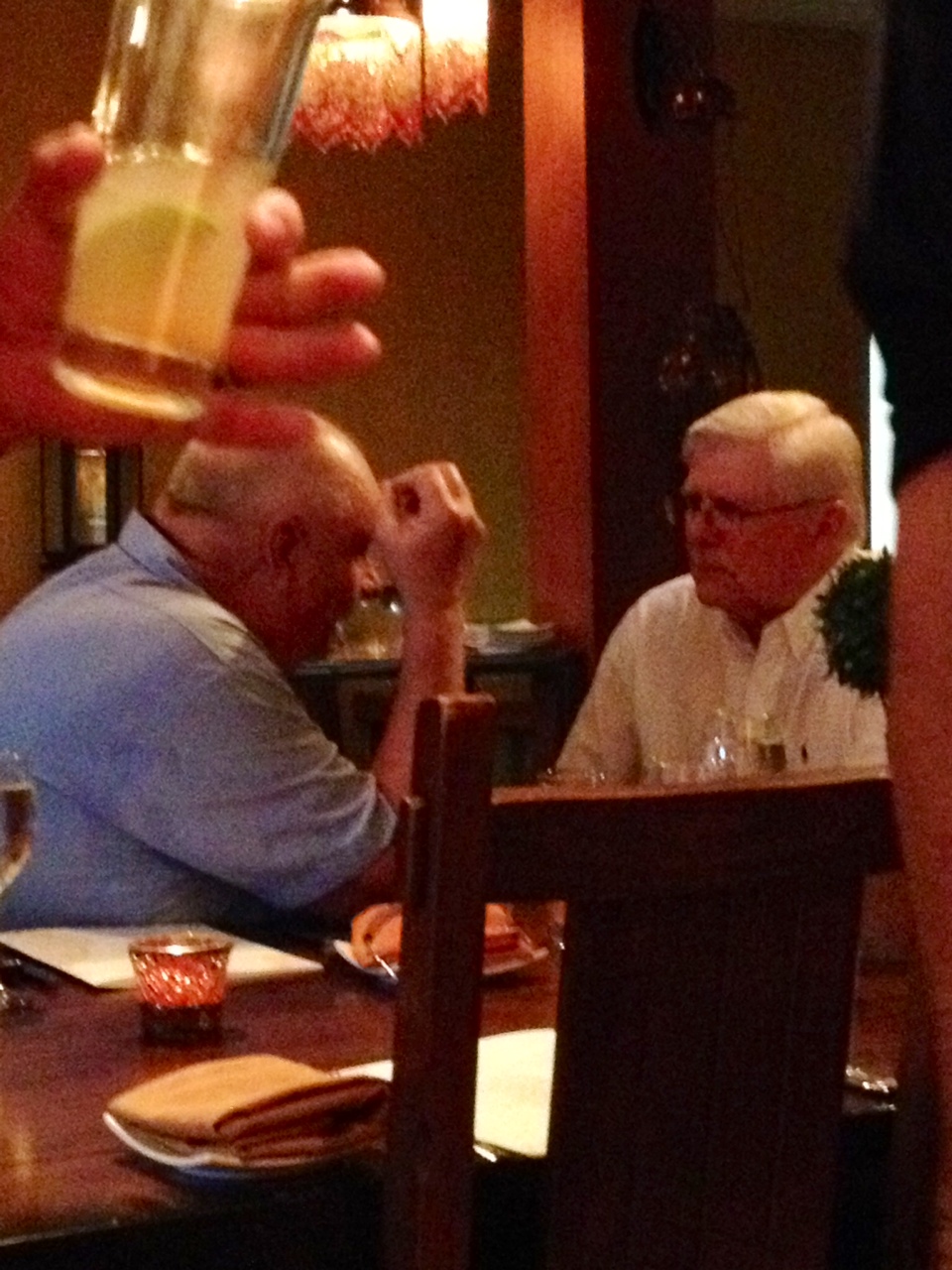
Uncle Bill and Gordon

“Yes sir. Presbyterian,” I say, wondering where this is leading.

“Well, lemme tell ya a story,” says Uncle Bill. “Ma Granddaddy was a Hah Babtist. He married my Grandmomma who was a Hah Church of Chrast.”

“What’s ‘high’ mean?” I ask.

Uncle Bill’s face tells me he’s astonished by my ignorance, a man of the cloth and all that. “Well, sir, there are Hah Babtists and Low Babtists; Hah Church of Chrast and Low Church of Chrast. ‘Hah’ means ‘mine is the only way.’ So my Grandaddy and Grandmomma’s son, ma Daddy, was a heathen. He married a Hah Babtist.

“I was raised Hah Baptist, like ma Momma. Now here’s where the story begins…….”

The waiter interrupts by putting a large platter of hummus and Lebanese pita bread in the middle of the wide table. Billy Bob looks at it. He’s hungry. He’s never seen anything like this. He’s wondering what it is and what to do with it. “Frances!” he calls out to the other side of the room. Frances, who’s recovering from hip surgery, walks to where we’re sitting. “What’s this?” “I don’t know,” says Frances, “I’ll ask Bonnie, maybe she’ll know,” and walks across the room to Bonnie and Mike.

“Now, as I was startin’ to say…you take Frances and me. I was a Hah Babtist; Frances was a Hah Church o’ Chrast.  Now I’m a Low Babtist and she’s a Low Church o’ Chrast.”

Frances returns from the other side of the room.  “It’s chick peas,” says Frances. “Well, I’ll be,” says Uncle Bill, pulling the whole platter in front of him from the middle of the table where others could share it. “Now, what do I do with it?” Before Frances can answer, the large serving spoon is filled with hummus in Uncle Bill’s mouth. “You take the bread and dip it in the chick peas,” says Frances. “Where’s the bread?” “It’s right there,” says Francis, “it’s Middle Eastern.”

“Now the story gets really interesting,” he says. “This is where it begins.”

I’m thinking to myself it’s been 20 minutes and all I’ve said was “What’s high mean?” Uncle Bill doesn’t seem to notice or care. He’s reeled in a minister. Ministers are supposed to be nice people who listen. They just smile, nod, and show interest. This is a monologue by a Texas story-teller with a captive audience.

“I go to my Babtist church and Frances goes to her Church o’ Chrast church. Been doing it for 35 years. Now my minister went off to the Holy Land, I guess they call it and went to the seminar. And you know what the other students told him about why they was at the seminar? Money! They was there for the money. What kinda minister’d you say you was?”

“Presbyterian,” I repeat, “and we’re required to go to seminary in order to be ordained. For us it’s not about money. No one gets more money by going to seminary. Every candidate for ministry goes to seminary because we want our ministers to learn the original biblical languages – Hebrew and Greek – and spend three years in graduate school before serving a congregation.”

“How big was your church?” asks Bill. What was the biggest?”

“3,000.”

“See that’s what I mean? Now we’re just a little church o’ 35 people. We pay our minister $1500 a month which seems pretty dang good to me.”

Apparently Bill has concluded that his audience is a money-grubber, although he never says so. He’s Low Babtist; I’m Presbyterian. I’m sipping a vodka martini; he’s drinking lemonade-iced-tea. He’s livin’ the low life; I’m living the hah life.

Scene 3

I’m thinking to myself,

“Funny how Hah (the only way OR the superior way, religion, culture, accent) manages to find an open door even when we think we’ve locked it behind us. High just re-defines itself according to whatever ways my life seems superior to Billy Bob’s or Billy Bob’s seems to him to be superior to mine.”

I poke fun at Billy Bob’sTexas drawl and monologue and laugh at his call across the room to Frances to rescue him in a Middle Eastern restaurant which is stranger to him than the money-grubbing Presbyterian “seminar” graduate from Minnesota. Each of us has managed to place himself on the perch of Hah looking down at the Low.

But there’s something about the two of us sitting there sipping our different drinks, eating the hummus and pita bread, that unifies us. We kind of like each other…maybe the way opposites are attracted to each other, if for no other reason than that they’re interesting.

“Now lemme tell ya another story… As I was startin’ to say…”

“Bill, I’m sorry, I need to catch up with my wife. It’s been a pleasure.”

“You bet. We got a w h o l e evening to get acquainted. We’ve got plenty o’ time.”

Scene 4

As we sit down for the meal, I sit at one end of the long table of 16 people with Kay on the left and Frances to my right. Uncle Bill sits to France’s right.

At the opposite end of the table sits my son Doug with his partner and two of the bride’s relatives, all now living in New York City. They’re on their second bottle of wine, having a great time, as the waiter brings the entrees to our end of the table. Doug flashes a wave to his Dad.

Uncle Bill turns to the head of our table and asks the money-grubbing Presbyterian minister from the seminar, “Would you say the blessing’ for our end of the table?” I offer the blessing on behalf of all the hah and low Baptists, Church of Christ, and Presbyterian people at our end of the table – thankful for new food and friends, for family, and for grace bigger than any of our highs – thankful, you might say, for “the experience.”

Verse – “Of the Dead”

Steve hits a home run with this piece. OUCH – and a good laugh.

Verse – “Of the Dead”

De mortuis nihil nisi bonum.

Of the dead speak nothing but good.

As the family gathered

after my mother’s death,

of course we told stories.

My three younger brothers

did not seem to recall

what most disgusted me

about Mom in our youth.

On the phone, she would smile

and say in a sweet voice,

“Good-bye then…see you in church,”

hang-up, and then yell at me,

“Shut-up, when I’m on the phone!

Stop fighting!  You boys drive me crazy!”

Then, RING, and “Hello, there…”

in the sweetest low voice/ imaginable.

…..     …     …     …     …

I had been wanting to play

a CD of clever church songs

for my two unchurched grand-kids,

and as I dropped their father off

to  get his repaired car,

I hit the PLAY button, stepped around

to the driver’s seat, heard them yelling

at each other, smashed the OFF button,

and heard myself out-yell them,

“Shut up!  Stop fighting!

You kids are driving me crazy!”

– Steve Shoemaker, Urbana, Illinois, July 7, 2012

When the heart is awash in memory, it’s easy to get lost

Click HERE for the link to “When the heart is awash in memory, it’s easy to forget,” the humorous walk-down-memory-lane commentary published today by Minnesota Public Radio. Thank you, MPR

Here’s a photograph of the Andrews Casket Company mill and “trout stream” in Woodstock, ME, the homestead of the Andrews family where Pete was the last Andrews to make his home.

The Andrews Mill in Woodstock, Maine

Father Hardon

Things seem to have quieted down recently regarding the objection of the U.S. Conference of Catholic Bishops (USCCB) to a federal mandate to include contraception in health care coverage.

Back in February Catholic News Service (“Obama’s revised HHS mandate won’t solve problems, USCCB president says”) reported on the story. Cardinal-designate Timothy Dolan, President of the USCCB, “said the bishops are ’very, very enthusiastic’ about the Respect for Rights of Conscience Act, introduced by Rep. Jeff Fortenberry, R-Neb. The cardinal said the legislation would produce an ‘ironclad law simply saying that no administrative decrees of the federal government can ever violate the conscience of a religious believer individually or religious institutions.”

A few days later, my son-law’s neighbor left something on Chris’s doorstep. It was an article from The Catholic Servant about someone named Father Hardon, S. J.  I’d never heard of Father Hardon.

I love the Jesuits. A small group of Presbyterian and Jesuit students met together for beer and theology the last Friday of the month in 1966 in Chicago. The Jesuits are brilliant.

My first impression reading the piece Chris handed me on Fr. Hardon was that it was a spoof, that John Hardon was a fictional priest, or, if the article was serious, I thought it must be misspelling. Surely it was Harden. Or Hardin. Not Hard-on.

I went home and looked him up. There he was…Father John Hard-on.

Hardon seal – Father John Hardon

I found him him on a website dedicated to his memory, including a famous speech of his entitled “Contraception, fatal to the faith?”

“What do we mean by the title,” asks Fr. Hardon, “and what is the thesis of this presentation? We mean that professed Catholics who practice contraception either give up the practice of contraception or they give up their Catholic faith.

“The grave sinfulness of contraception is taught infallibly by the Church’s ordinary universal teaching authority. Therefore, those who defend contraception forfeit their claim to being professed Catholics. Consequently, those who persist in their defense of contraception, deprive themselves of the divine graces which are reserved to bona fide members of the Roman Catholic Church.”

Every one of my priest friends is horrified by Father Hardon. Like him, they are celibate and know how difficult it is to stay morally erect, but, unlike Father Hardon,  they don’t walk around calling men and women who use condoms, diaphragms, or the pill “mortal sinners” who have placed themselves beyond the graces if the Church or its God.

My old buddies from the Bellarmine School of Theology welcomed the Second Vatican Council as a breath of fresh air, as did my Protestant classmates. They are now holding their breath because old Father Hardon is back with a vengeance.

None of my Catholic friends – priests or laity – has lived by what Father Hardon believed was an infallible teaching on contraception. Even if, like Father Hardon, they’ve  never worn a condom, they’re no longer entitled to the graces of the Church or the grace of God.

The elevation of Fr. Hardon (he’s been nominated for sainthood) causes me to grieve the loss of something very, very precious. I grieve it for all my catholic friends. I grieve for my own loss…. And I wonder…

I wonder if my religious conscientious objection to militarism and war might exempt me from paying my federal income taxes. I think I’ll write Rep. Fortenberry for inclusion in the Respect for Rights of Conscience Act.

Grammar quiz

Can you find the split infinitive in “The Only Animal Dumb Enough…”

Valois Cafeteria, Chicago

I just received this email from my friend Steve:”…sitting in Valois Cafeteria in Hyde Park (They have a list on the wall near the menus, ‘President Obama’s Favorites’).

“I was where I was till you interrupted me & pulled me into your hair-styling shop — I hate you guys with Good Hair.

“Would your great insight (and I mean that sincerely, although the Existentialists never quite persuaded me to join their ranks fully) be better or worse if there was not a split infinitive?

“Now back to my Rice Pudding.”

The only animal dumb enough…

Kay, Maggie, Sebastian

“We are the only animal dumb enough to not be where we are.”

The words popped out in the barber chair at Great Clips when Dee, the barber (I still call them barbers), told me that the person who had sat in the chair before me had spent her whole time playing on her iPhone. Never said a word. Never looked up. It sure seemed to Dee that her client was there…in the barber’s chair…but she was somewhere else, while the barber with the real scissors that were cutting her real hair in the real chair at the real Great Clips in the real Chaska Commons was…well…not there. How dumb is that!  “We humans are the only animal dumb enough to not be where we are.”

I spend my days alone with my dogs. Maggie and Sebastian live where they are. They don’t miss a trick – no pun intended; they’re not very well-trained – but they pay attention to every little thing. Every movement I make, every bird that flies across the window, every word spoken, every sound that might hint that Mom’s home, or that Dad is leaving…or taking them for a walk…or a ride in the car. They live where they are.

Sometimes they have to bark to jerk me away from my desk when I pretend I’m not there, checking my emails, surfing the web,  or writing a story. They know I don’t know how to be where I really am. They know that I’m not as smart as they are, but they’re  forgiving of my chronic weakness. They never look down on me.

We human animals think we’re so smart. We are. But what have we lost in ADHD heaven? If it hadn’t been for Maggie and Sebastian, I might not know; the words would never have popped out of my mouth in Dee’s barber’s chair.

When I got home, I shared with my furry companions the conversation with Dad’s groomer and what I had said: “We are the only animal dumb enough to not be where we are.” They were proud of Dad. I returned to my computer and ADHD heaven. They came along side the desk, gave me their paws, and said in unison, “We’re always here for you, Dad.” Then they asked if it was time to go for a ride in the car.

The Man at the Bar

“Damn” is not his last name,”

Said Herb

To the man on the stool

With the beer at the bar.

….

“What?” said the man with the beer

To Herb,

Drinking his vodka and milk

On the stool at the bar.

….

I said, “God damn!”

Said the man with the beer.

…..

“And I said ‘Damn is not His last name!’”

Cried Herb with his vodka and milk.

…..

“Pow!” came the fist

From the man with the beer.

…..

“What’d you do that for?”

Asked Herb from the floor

To the man with the beer

On the stool at the bar.

– Gordon C. Stewart, June 6, 2012, Chaska, MN

Waist

A narrow female waist and wider hip

is found to be attractive by the male

across all cultural boundaries.  To slip

a hand around a waist will never fail

to thrill a guy past puberty.  The waist

Need not be small:  the ratio is what counts

according to the anthropologist

as a sign of fertility.  An ounce

of thought, however, makes one think (if this

is what is going on in a male brain)

that pregnancy is not high on his list

of preferred outcomes…  It may be a strain

on his imagination to perceive

what happens to that waist if she conceive.

– Steve Shoemaker, Urbana, IL. Steve’s Sunday evening program “Keepin’ the Faith” can be heard anytime @ www.will.illinois.edu/keepinthefaith, including archive programs, “two of  which,” says Steve, “feature Gordon C. Stewart, my ‘publisher’.”

Josh, Alfred, and You

This “mind-numbing” sermon was inspired by the obituary of a young man named Josh who suffered “10 years of mind-numbing public schooling.” It was preached at Shepherd of the Hill Presbyterian Church in Chaska, Minnesota, “sharing the message of God’s unconditional love for everyone.”

Ever read an obituary that raised your eyebrows? Ever left a funeral thinking it was case of mistaken identity?

This week my old friend Bob Young shared this obituary with the annual gathering of seminary classmate. Bob has a wry sense of humor. We knew something was coming by the twinkle in Bob’s eye.

This obituary is the exception to phony. It appeared in the Ponca City News:

Joshua Micheal (nope, not a typo it’s really spelled that way) McMahan left this world April 18, 2012. He was loved, hated, praised, and cursed by relatives and friends alike. He ultimately passed as a result of being stubborn, refusing to follow doctors’ (or anyone else for that matters) orders, and raising hell for a little more than three decades. He lived life on his own terms.

Josh was born on Sept. 16, 1978, to Linda Burgert Waller. Josh was a beautiful, unique, kind, and loving spirit man. Joshie endured around ten mind-numbing years of public schooling. He had worked as a pizza delivery boy and call center representative before shockingly becoming independently “wealthy.”

He loved music, beer, movies, vodka, television, and women, but not necessarily in that order. He was also an awesome drummer!/vocalist? and was in several bands over the years. He lived in Ponca City his entire life except for the past year where he was forced to put up with his sister and brother-in-law out in the middle of nowhere — a little piece of terra firma aptly called Haskell.

He is survived by Rosie, his long-time canine companion; a sister, Melanie Waller Ochoa; a brother-in-law, DJ Ochoa; a best friend/brother, Cliff Crull; three nieces, Miranda, Emma, and Camille; and one nephew, Maxx. Josh had no children of his own (at least none that we know of). He was preceded in death by Mom Linda, Grandma Nina Burgert, and Grandpa Joe Burgert.

A remembrance service will be held at 2 p.m. April 25 in the chapel of Trout Funeral Home where you may re-tell the stories he can no longer share. Anyone dressed in a suit or Sunday’s best will be promptly escorted back to their vehicle. Just kidding … we’ll accept you as you are — just as Josh would have in life. Please be wary for any children’s sake, there may be profanity and/or alcohol involved. If you have a special memory or maybe just want to irritate Josh for all eternity, please bring a magnet or sticker to attach to his casket for evermore.

In lieu of flowers or memorial gifts, please give generously, in Josh’s honor, to rockstarmusiceducation.org.

JRock will be placed to rest in the St. Mary’s section of Odd Fellows (the irony) Cemetery in Ponca City and I’m sure he would invite you to come by later and have a laugh on him — literally.

As Bob read aloud Josh’s obituary in his droll manner, we had a great laugh, just as Josh would have wanted, and we felt accepted as we really are. Lord knows we’re all likely “to pass as a result of being stubborn.”

We had a round in Josh’s honor and prayed (not really) that, if someone decides to tell the truth in our obituaries, the writer will have a lively sense of humor…and a whole lot of grace.

Harry followed the obituary with the laughter with the story of a man named Alfred.

Alfred left Russia at the age of 18. After spending a year in Paris studying chemistry, he moved to the United States. After five years, he returned to Russia and began working in his father’s factory making military equipment for the Crimean War. In 1859, at the war’s end, the company went bankrupt. The family moved back to Sweden, and Alfred soon began experimenting with explosives. In 1864, when Alfred was 29, a huge explosion in the family’s Swedish factory killed five people, including Alfred’s younger brother Emil. Dramatically affected by the event, Alfred set out to develop a safer explosive. In 1867, he patented a mixture of nitroglycerin and an absorbent substance, producing what he named “Dynamite.”

In 1888, Alfred’s brother Ludvig died while in France. A French newspaper erroneously published Alfred’s obituary instead of Ludvig’s, noted that Alfred had died a very wealthy man as a result of inventing dynamite. Alfred was irked that the wrong obituary had been published. But he was more disturbed – deeply embarrassed, in fact – by a true obituary about his life. Disappointed with how he would be remembered, he decided to do something different with his life.

Alfred died of a stroke on December 10, 1896, in San Remo, Italy. After taxes and bequests to individuals, he left the majority of his estate to fund the Nobel Prizes. His name was Alfred Nobel.

—————————————–

Somewhere between Josh and Alfred there is you. Somewhere between the two there is I.

If you could write your own obituary, what would it say?

In her book Bird by Bird, Anne Lamott lays her life bare in print. Anne herself is a rare bird. She found her way to a church like Shepherd – small, humble, a bit odd, very loving and very joyful – in Marin City, California whose people accepted her as she was: depressed, addicted to alcohol and drugs, promiscuous, seriously depressed and feeling lost.

In Bird by Bird’s Acknowledgements, she wrote  “I want to mention once again that I do not think I’d even be alive today if not for the people of St. Andrews Presbyterian Church, Marin City, California.

But this is the paragraph I want you to remember as you think about the rest of your life and how you will pull together the pieces. The words were written for aspiring writers.  But, for our purposes this morning, I ask you to think of life as a kind of writing.  It’s a paragraph in a chapter on Perfectionism.

“Your day’s work might turn out to have been a mess. So what? [Kurt] Vonnegut said, ‘When I write, I feel like an armless legless man with a crayon in his mouth.’ So go ahead and make big sprawls and mistakes. Use up lot of paper. Perfectionism is a mean, frozen form of idealism, while messes are the artist’s true friend. What people somehow…forgot to mention when we were children was that we need to make messes in order to find out who we are and why we are here – and, by extension, what we’re supposed to be writing.”

How would you want your obituary to read?

I’d be pleased if mine read something like the following, a mixture of Josh’s and Alfred’s, although it won’t be up to me. It will be written by Kay and family. I won’t get to read it or censor it.

Gordon Campbell Stewart died of a stroke. Actually he didn’t. He died because he wouldn’t listen to his wife, his friends or his doctors and because he had chosen to believe his dogs who thought his nightly bowls of ice cream and cashews would last forever, just like him.

He was a lot like his dog Maggie. Stubborn, occasionally amusing, playful, and very annoying when he didn’t get what he wanted.  He was a preacher man, or so he thought, although those who slept through years of his mind-numbing sermons often brought pillows and blankets, and sometimes a flask to church. Fortunately for him, Gordon never noticed.

After many years of self-absorption, he discovered the joy of being mortal. He stopped worrying about tomorrow.  He learned to appreciate the fullness of the moment. He learned to listen to the birds…well, actually…since he could no longer hear them, he learned to watch the birds and to imagine their songs after his hearing had gone. He watched the clouds and felt the wind, the snow, and the rain. He found solace in rainbows and rabbits, in squirrels, chip-monks, purple martins and woodpeckers.

He stopped trying to be perfect. He gave thanks for the messes as much as for the cleaning up. Because it was out of the messiness of his life that God shaped him into something more real. It was out of the death of pretense that the truth looked back at him in the mirror until he came to love himself. He gave up suits and expensive shoes. He wore the same pair of pants four days in a row…relaxed fit jeans…and extra large shirts to cover the paunch that eventually killed him.

In the silence of his shrinking world, he turned increasingly inward, sitting at the window at his computer, blogging hour by hour, and going deeper into the once bottomless pit of himself where he found not emptiness but fullness.

Out of the fullness, he has asked that the few people who gather around his ashes sing the strong traditional hymns that meant the world – literally “the world” to him – in hopes that the words and the music would lift you up.  “O God our help in ages past, our hope for years to come, our shelter from the stormy blast, and our Eternal Home.”  “All creatures of our God and King, Lift up your voice and with us sing, Alleluia! Alleluia! Thou burning sun with golden beam, Thou silver moon with softer beam, Alleluia! Alleluia! Alleluia! Alleluia! Alleluia!”

“Wait ’til Mom gets home!”

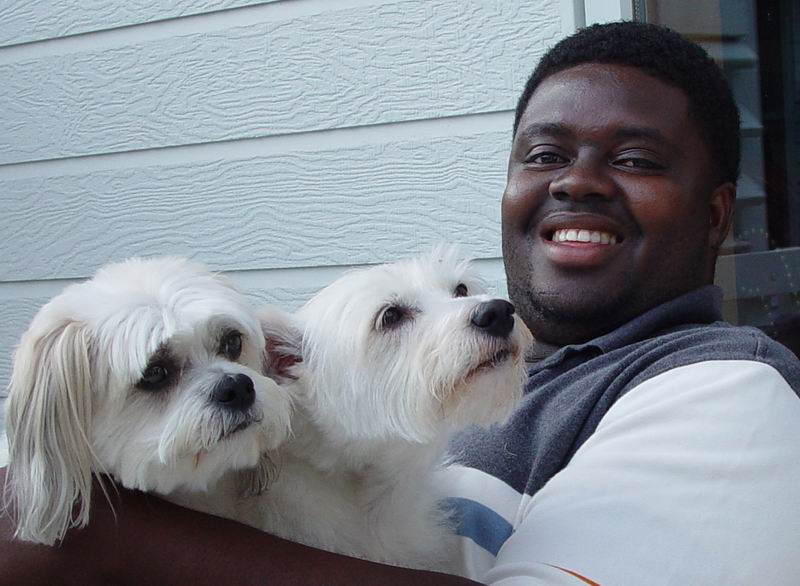
Over the Memorial Day Weekend, my only conversations are with Sebastian (Shih Tzu-Bichon Frise), and Maggie (Three quarters West Highland White Terrier and one-quarter Bichon Frise).

Maggie and Sebastian romping in the snow

Sebastian keeps asking, “Where’s Mom?”

“She’s gone to the cemetery.”

“NO!”

“Yes. She’s gone to TWO cemeteries!”

“NO!!!!”  “Not TWO.”

“Yes, two cemeteries.”

“No! Mom’s dead?”

“No… she’s gone to the cemeteries.”

“No. You’re pullin’ our tails…she can’t be buried in TWO cemeteries. Only ONE. We’re not stupid.”

“Okay,” I say. “You’re not stupid. You’re both very bright. Mom’s not been taken to the cemetery like you guys will be if you keep peeing on the rugs and on the corner of the new kitchen island …she’s not buried. She’s DRIVING to the cemeteries in the car.”

“DRIVING? In the CAR?”

“Yes…in DAD’S CAR.”

“We’re going for a ride In DAD’s car?”

“No,” I say. “Mom has Dad’s car. She’s gone to the cemeteries…in Lincoln, Nebraska. It’s Memorial Day. Besides, no rides in Dad’s car until you stop peeing in the house.”

“Aw! That’s not fair. We want to go for a ride in the car…right NOW. Like you always say!  ‘Where the ____ is Mom?'”

“Bad dog, you’re not supposed to talk like that. Where’d you learn to talk like that?”

“Mom taught us. We love Mom more than you.”

“I don’t care. She’s not here!  I’m all you’ve got until Mom gets home.”

“Mom’s home?” They run to the door.

“Oh boy, oh boy, Mom’s home! Mom’s home!”

“No. She’s coming home tomorrow. Maybe, when she brings Dad’s car….”

“Dad’s car? Ride in the car?”

“No. You have to listen. When she gets back from the cemeteries, Dad will take you for a ride in the car…OR…if you keep peeing in the house, Mom will take you both for a ride… to the cemetery.

“No, no…not the cemetery!” shouts Maggie.

Sebastian saunters over to the island.

“You’re pullin’ our tails,” he says. “Mom wouldn’t take us to the cemetery.”

He looks right at me and lifts his leg: “You’re mean. Wait ’til Mom gets home!”

Sebastian and Maggie with Momoh Freeman