The Way We Eat

A prompt on Modern Families got me to thinking. 

“If one of your late ancestors were to come back from the dead and join you for dinner, what things about your family would this person find the most shocking?” 

How would you answer? Here’s my shot at the question. 

Well…for starters, most folks don’t join each other for dinner anymore.

My grandparents and parents honored a long-standing family tradition.  They ate dinner around the dining room table. ALL of them. At the same time. In the same place.

But we didn’t just eat together. We lingered together. We served each other. We passed the food in large bowls – mashed potatoes, green beans, peas, stuffing, salad – family style. No one ate until all had been served.

In their generations, the roles were clearly defined. Mom wore and apron and cooked the meal. She sat at one end of the table. Dad, sitting  at the opposite end (the head of the table) with the carving knife served the entree on plates to the other members of the family. If it was a turkey, for instance, he carved the bird in front of us at the table.

“Skip, you like dark meat.” He’d carve from the thigh or the leg. “Don, you like both white and dark.” “Bob, you like the leg and a wing.” And so it went, until we all had been served according to our liking, and we all had served each other.

Mom and Dad lived long enough to see the change in their children’s family eating habits and graciously, if sadly, accepted the fact that there was no longer a set time for dinner, there were soccer games, Little League games, concerts, and the demands of this, that, and the other that tore apart the cherished hour when the kids and parents all checked in on the day and discussed the big issues of the news.

My grandparents would be shocked by the fraying of common life, the loss of careful attentiveness to each member of the family’s preferences, likes and dislikes, the substitution of the automat for the dining room table.

If they came back from the dead, they would wonder how and why sharing and serving around the table and nightly dinner conversations have vanished, replaced by family members staring at their iPhones, texting people who aren’t in the room. They might re-frame Shakespeare’s question in Hamlet, “To be, or not to be?” They might say:

“To eat alone, quickly, or to eat at the dinner table with others, slowly?” – that is the question.

I think I’ll turn on the TV, go to the fridge to see what’s there, send a text or two, and enjoy the ballgame.

  • Gordon C. Stewart, Chaska, MN, January 18, 2016
 

Link

Last Monday I learned of a student’s tragic death in Saint Paul. This morning I read this remarkable reflection. The writer and blog are new to me. I’ve chose to “follow” this site.

How the doubting father’s son became a shouter

A BIBLICAL FATHER-SON STORY: ZECHARIAH & JOHN THE BAPTIST

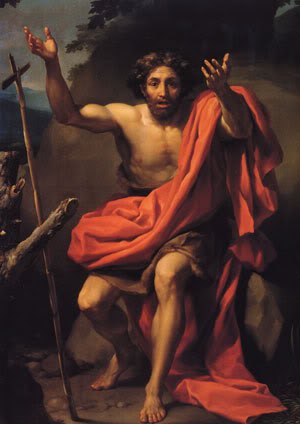
John the Baptist
John the Baptist

Ever wondered why John comes out of nowhere with a fiery message?

He has a bone to pick. Why? With whom? What’s his story?

The Eastern Orthodox Christian tradition preserves a story about John’s father, Zechariah, a Temple priest, sending his wife, Elizabeth, and their son, John, into hiding. Zechariah hides his son to protect him from Herod’s “Slaughter of the Innocents” by which all males below the age of two were to be killed following rumors of a newly-born king, a threat to Herod’s rule.

According to the story told by The Infancy Gospel of James [the mid-Second Century C.E.], John and Elizabeth remain in hiding – far away from their husband and father, Zechariah – until John is five or six years old when Zechariah risks visiting their hiding place. The result is the brutal murder of Zechariah by Herod’s soldiers.

As the son of a Temple priest, John descended from the priestly lineage of Aaron. John was destined to be a Temple priest. Father-son dynamics become more difficult when the father is a public religious figure. Zechariah’s son sounds like an angry preacher’s kid.

When [John] saw the Pharisees and Sadducees coming to be baptized, he said to them, "You brood of vipers, who warned you to flee from the wrath to come? Bear fruit that befits repentance, and do not presume to say to yourselves 'We have Abraham as our father ....'" (Mt. 3:7-9a).

The Pharisees were lay people with a more liberal religious bent than the Sadducees. The Sadducees were Temple authorities and Temple supporters, the folks who aligned themselves with John’s father Zechariah and a conservative reading of the Torah. The Pharisees and the Sadducees were in conflict during the time of John and Jesus. Only the Pharisees survived the later destruction of Jerusalem and the Temple in the Roman-Jewish War of 70 C.E.

By the time the Gospels are written, the Temple had been destroyed. So we have the Temple priests and their supporters, the Sadducees, and John the Baptist in the Gospel of Matthew scolding both the Pharisees, who will carry on their tradition without accepting one of their likely members, Jesus of Nazareth, as the awaited Anointed One (Messiah), and the Sadducees who have disappeared into history.

Whether the Orthodox tradition and The Infancy Gospel of James are taken as historical fact or mythic truth, John’s real fight was with his father and the Sadducees who had compromised Jewish identity and integrity by their accommodations to Rome.

John is certain, bold, and in-your-face. His father, Zechariah, according to Matthew’s Gospel, had doubted the news of John’s conception. As a result of his doubt, Zechariah was struck dumb. He remained unable to speak until Elizabeth had named their son ‘John’, at which point his mouth was opened. “Yes,” said Zecahariah, “his name is John.”

Zechariah had been a doubter; John was no doubter. Zechariah sent John into hiding. The John who returned from safety was no hider. John became a shouter who minced no words. Far from Jerusalem and the Temple, out in untamed space by the Jordan River, he took his stand for the return of his people from the false choice of the pious laity (the Pharisees) and his father’s priestly class (the Sadducees): “You brood of vipers!”

Baby vipers were said to eat their mother’s stomachs. Israel was the Mother whom the Pharisees and Sadducees were eating from the inside out.

John wanted nothing to do with the killing of his Mother or with those who had killed his father. In the interest of protecting his Mother from the vipers, he had run from the Temple into the wilderness, returning to the place where his Mother, Israel, had been born after the Exodus. He did not go into the wilderness to hide. He went out to rescue his Mother from being eaten by her children. When the vipers arrived, he shouted in ways his mute father never did. Yet, in the end he died by the same hands as his father when Herod delivered his head to Salome on a platter.

Like father, like son. His younger cousin Jesus carried on.

  • Gordon C. Stewart, Chaska, MN, January 7, 2015

Grandpa’s letter to Ruby

Dear Ruby,

Barclay and I loved playing with you yesterday. I think you enjoyed it too!

You and Barclay aren’t old enough to understand all the things I know. Both of you are only two-and-a-half years old. But, from the looks of yesterday’s play time, you both enjoy life more than Grandpa. Watching you and Barclay do his tricks was such fun!  “Barclay, sit!” “Barclay, down.” “Leave it.” “Roll over.”

You were the alpha dog, the commander-in-chief, Chairwoman of the Joint Chiefs of Staff. To this day, no woman has ever held any of those positions.

But I’m getting ahead of myself. You don’t know all that stuff. You don’t know what an alpha dog is, or a Commander-in-Chief, or Chairwoman of the Joint Chiefs of Staff or President. You’ll learn all that stuff soon enough, and, if this were the world I would like for you, there wouldn’t be any Commanders-in-Chiefs, or Joint Chiefs of Staff. There would be grandchildren like you and Cavalier King Charles Spaniels like Barclay who play together with moms and dads, grandmas and grandpas without worrying about the reasons we have Commanders-in-Chief and Chairwomen of the Joint Chiefs of Staff.

Watching the two of you yesterday made me think about how much of what I know I wish I could un-learn. My head and heart are crammed full of things that don’t belong there, like the time your Great Uncle Bob drank the Drano and had to be rushed to the hospital to have his stomach pumped.

Drano container - POISON

Drano container – POISON

Older people your Uncle Bob and me have drunk the poison of thinking we’re smarter and better than dogs and cats, and trees and birds and blue skies and clouds and rivers and ponds and oceans. We drank the poison. I hope you’ll grow up remembering your play time with Barclay whenever the can of Drano sits on the back of the toilet.

I go to the toilet a lot more these days. You’re still wearing diapers. If you’re lucky you’ll learn from Barclay what my generation never learned: never poop in your own kennel. The world, the planet, is your kennel, Ruby! This whole wide world. We need to take care of it. Enjoy it. Not be mean to it or hurt it.

As you get older, remember how you and Barclay looked right in each other’s eyes and smiled. Remember the love. If you do, the world will be a better place than the one I’m passing on to you. And, when I pass on, remember that our big wonderful kennel doesn’t go anywhere. It just keeps going long after we’ve been here. Be nice to it. Be nice to yourself. Keep playing, and, please, don’t swallow the Drano!

Love you,

Grandpa Stewart

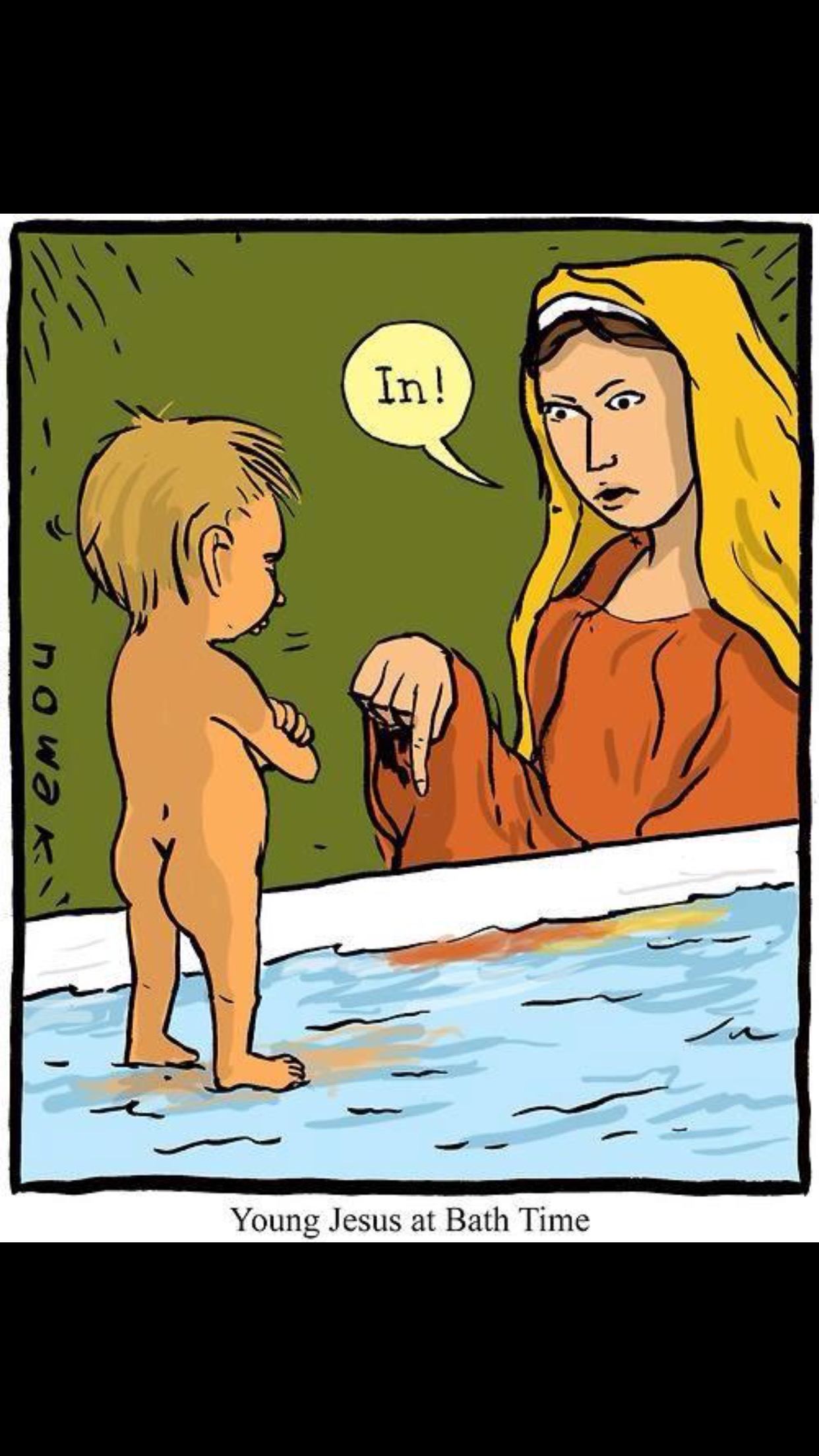
Young Jesus at Bath Time

Image

Young Jesus at Bath Time

Young Jesus at Bath Time

Birthday Tribute to Steve

Kate Shoemaker, MD, and her Uncle Steve Shoemaker share the same birthday – today, December 19. Kate sent this to Steve today. Kate, from St. Louis, MO, is spending the day with Steve and Nadja in Urbana, IL.

Happy Birthday poem from Kate Shoemaker to Uncle Steve.

Happy Birthday poem from Kate Shoemaker to Uncle Steve.

Joseph and Mary living in our pantry

La Posada Festival poster

La Posada Festival poster

It’s almost Christmas. Joseph and Mary stayed at our house last night as part of La Posada, a Mexican tradition re-enacting Mary and Joseph’s search for lodging in Bethlehem.

We welcomed them to our home for safe lodging, food, and a warm place.

When they arrived we sat them on the floor.

Barclay welcoming Joseph and Mary to our home.

Barclay welcoming Joseph and Mary to our home.

Unfortunately, Barclay  quickly took a liking to Joseph’s left ear, so we moved Joseph and Mary into the pantry where they’d feel safe from a domestic terrorist attack.

Last night, after Barclay had gone to bed, I invited Joseph and Mary to join me  watching the presidential candidate debate.  Last night’s debate topic was terrorism. Refugees fleeing persecution and immigration policy were also discussed.

Our guests stayed very still. They were very quiet. They watched the faces on the TV screen. They listened to every word. As I went to the kitchen for a drink, Mary cuddled up to Joseph needing reassurance. She whispered, “Joseph, we have to get out of here before one of them gets elected -these people don’t like us! They’re mean. They sound just like Herod!”

I took them back to the safety of the pantry, put them back on the shelf, said goodnight, and closed the door so they’d feel more secure. Today they came out of the closet when another family came to protect them from Herod on their way to Bethlehem. But before they left, Joseph told Mary, “Don’t worry, honey, as soon as you give birth and are strong enough for the journey, we’re leaving for Egypt.”

  • Gordon C. Stewart, Chaska, MN, December 17, 2015.

The Holy Family traveling to Egypt

The Holy Family traveling to Egypt

An angel of the Lord appeared to Joseph in a dream and said, “Get up, take the child and his mother, and flee to Egypt, and remain there until I tell you; for Herod is about to search for the child, to destroy him.”  Then Joseph got up, took the child and his mother by night, and went to Egypt, and remained there until the death of Herod. This was to fulfill what had been spoken by the Lord through the prophet, “Out of Egypt I have called my son.” – Matthew 2:13-15


My Father’s Portrait

We’re all cut from our parents’ cloth. It falls to each of us to finish their unfinished business.

Following my mother’s death, it fell to the three sons and our spouses to clean out the apartment and arrange for distribution or disposal of the belongings.

My father had died two years earlier.

Don, Bob and I spent an afternoon alone in the apartment using a rotation method to divide the belongings.  By order of birth, we would each choose what we wanted. Round one: Gordon, Don, Bob; round two: Gordon, Don, Bob – I-2-3; 1-2-3 – until everything  any of us wanted was chosen.  The rest would go to auction or to Goodwill.

Among my parents’ personal art was an oil painting of my father. In my early years, I loved that painting.  Handsome man. Robed in his clergy robe, dignified, smiling, tender eyes, a man of stature, our Dad. The painting had been in the family for as long as I can remember and, as best I can recall, had hung in Dad’s pastor’s office at Marple Church when I was a teenager. Now it hung in the narrow hallway just inside the entrance to my parents’ apartment. It was the first thing a visitor saw – a reminder to all who entered that Dad had once been someone special, a man of the cloth.

One-two-three, we chose our favorite pieces.  We agreed that monetary value made no difference to our selection process. All that mattered the value each of us placed on an item.  The grandfather clock was clearly worth the most in dollars, but the clock had been purchased late in our parents’ marriage; it bore only the most recent memories, not the memories of home.  It could not compare with the knicknacks – one of our mother’s Hummel figurines, a Baltimore Oriole paper weight, my father’s dog tags from World War II, a dish, a lamp, a photo, or the original painting given by a parishioner that reminded me of Robert Frost’s “Stopping by the Woods on a Snowy Evening” – artifacts of precious times now gone except for memory.

But there was another painting, a portrait of Dad in his ministerial robe.

As we went around the room, the painting didn’t move. Nobody picked it. Finally, Don asked with a smile, “Who wants Dad’s painting?” Deferring to me, Bob chimed in. “You’re the oldest! You should have it. It’s okay with me. I don’t want it!” “Sure,” said Don, “I don’t want it. Go ahead, Gord, you should have it. You’re the oldest!”

We all looked at each other and began to laugh about the elephant that had been sitting for years in the living room.

I looked at the picture. There was Dad, clear as day, a keepsake that had meant so much to  our father and mother, and we didn’t want his picture?  “I don’t want it,” I said, and  started to say more but couldn’t get the words out. Grief had overcome me. I couldn’t speak. I shuddered with sobbing. My brothers watched and waited in silence. When finally I composed myself enough to complete the thought through the tears, the words came out slowly . . . in staggered gulps. “I hate that thing! I always wanted to rip that robe off him! He never took it off!  He was always the minister. I just wanted him to be his own naked self. I just wanted him to be Dad.”

Reflecting on it years later, that moment was one of many breakthrough moments of taking off my own robe. I hadn’t worn mine for five years and hadn’t missed it. I began to find my own naked self bereft of the robe while working for a poverty criminal defense law firm founded by African American civil rights activists and founders of the American Indian Movement. Unconditional love was not a creedal statement; it was a daily fact of life, the treasure of grace held by many kinds of vessels. “We hold this treasure in earthen vessels….”

I took the painting of Dad and took him with me on the long flight home to the Legal Rights Center.  When I got there, I put the painting in storage, as a reminder that the work isn’t finished for me or my offspring. Who knows, someday one of the great-grandchildren may bring Dad’s painting out of the closet.