Elizabeth and the Pipeline Patriot

Imagine your name is Elizabeth. You’re 64 years old. Your grandparents have left you and your sister an inheritance – farm land – in Storm Lake, Iowa. You and your sister grew up next door to Iowa in Nebraska and, though you now live in another state, you’ve looked on with pride as Nebraska put the screws to the Keystone XL pipeline.

You’re sitting at home. The phone rings. You answer. The voice on the other end represents an oil company from North Dakota.

After you finish talking with the man on the phone, you email your Nebraska high school girlfriends describing the conversation. It reads like this:

Another oil company – Dakota Access, LLC – is planning to run a pipeline from North Dakota through South Dakota, Iowa, and Illinois. They wanted to pay us $16,000 plus three years of crop damage for easement on our Iowa land.

I had a rather funny conversation with the young representative from Texas who was sitting in Storm Lake, Iowa contacting land owners and farmers. When I asked him if it was voluntary, he said, “We are told not to discuss that.” What? (I already knew it was, just wanted to see what he would say.)

So they are telling people that a pipeline is coming and not that they don’t have to do it. I asked him why landowners would want to do this and he said, “Well, for the compensation involved and…for the nation.” I laughed out loud.

Then we talked about the environment and Nebraska and the recent pipeline spill in western North Dakota, and how I thought our leaders better get it together or we were going to destroy the planet. At which time he said, “Maybe we should have a woman president.” He had me for a moment until he said, “21 days a month, my wife is the nicest person on earth.” Seriously. He is from Texas.

We ended the conversation with me suggesting a nice young man like himself should get into the windmill business and then give me a call back. He said he would take me OFF the list, with a note – don’t bother trying to talk to this lady again. Amen brother. (until it turns into eminent domain 😦

Happy Valentine’s day to all you women who used to be nice 21 days a month but now….skies the limit.

The conversation is real. It happened to Elizabeth while sitting at home in Princeton, New Jersey. Do I hear a vote for another Elizabeth for President?

– Gordon C. Stewart, Chaska, MN, March 12, 2015. Elizabeth’s email, sent originally to her dear friend Kay Stewart, is reprinted here with Elizabeth’s permission. The coloration of the text and the links have been added to the original.

Shall the meek inherit the earth?

The meek shall inherit the earth, according to the fourth Beatitude of Jesus’ Sermon on the Mount: “Blessed are the meek; for they shall inherit the earth” [ Gospel of Matthew 5:5].

Will they?

And, if they will, what kind of earth will they inherit? Will it be worth inheriting?

Will there be….

As in the rest of Jesus’ teachings, the contrary value system of the powerful, the rapacious, and the vested interests is turned on its head. The prevailing fourth beatitude then and now is different, the beatitude that parades under the cover of freedom from government interference:

“Blessed are the indomitable, for they will have title to the planet.”

This morning’s story “Dayton, safety rules get blasted” [StarTribune, p. 1], is a local illustration of the two sets of beatitudes playing themselves out in American public life.

The Minnesota Legislature is muscling in on the power of state agencies in a broad effort to assume more influence on everything from from water quality to health and safety regulations.

A  coalition of Republicans and DFLers from the Iron Range and rural districts say regulators are socking businesses and cities with burdensome, expensive rules in order to keep Minnesota’s water clean of sulfates, phosphorus and other contaminants.

What will be left of the Earth by the indomitable may not be worth inheriting. The StarTribune article goes on to quote a South Saint Paul legislator at a recent hearing, which makes the connection between the need environmental protection and the need for campaign finance reform. “The pollution in the system is money.”

However that may be, one thing is clear. No one owns a planet.

Only the meek deserve the inheritance we’re now wasting — the Earth to which no one owns title.

– Gordon C. Stewart, Chaska, Minnesota, March 11, 2015


One Animal Family

One Human Family  bumper sticker, Key West

One Human Family bumper sticker, Key West

“One Human Family” is Key West’s motto. Key Westers take pride in their LGBTQ, racial, and cultural diversity. Whoever you are, you’re celebrated here, the quirkier and the boring. “We’re one human family.”

Key West Rooster on car hood

Key West Rooster on car hood

Recently an amended version has become popular. “We are one animal family.”

The roosters and chickens that roam the island, walking through the restaurants and grounds, ignoring the pedestrian crosswalks on the street are protected by law. Choke a rooster or a chicken here in Key West and you’re in big trouble!

The open air restaurants welcome the roosters and chickens and the penny-less cats and dogs as naturally as they do the cruise ship shoppers with their American Express cards. The spirit of Ernest Hemingway (Papa) is alive all these years later.

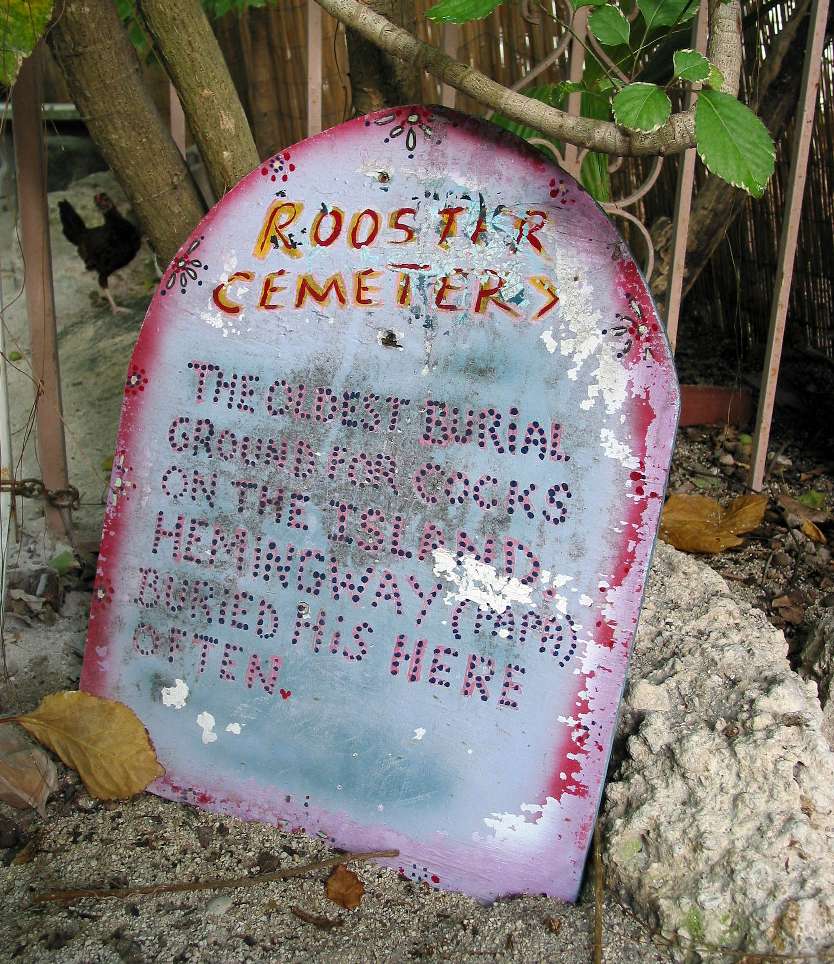
Key West rooster cemetery Ernest Hemingway

Key West rooster cemetery
Ernest Hemingway

Every creature is protected here. After the cruise ships take the 3,000 shoppers out to sea in the late afternoon, the island belongs to all the Key Westers, human and otherwise.

We are one animal family.

– Gordon C. Stewart writing from Key West, FL after visiting the Ernest Hemingway House, Key West, FL, Feb. 17, 2015.

Look what the ocean coughed up

What the ocean coughed upLook what washed up on Palm Beach this morning.

Like the whale that coughed up Jonah into the sea, the ocean is coughing up Halls cough drops along with a Portuguese Man-o’-War on the beach.

But there’s a difference. The sun and time will disintegrate the dead Man-o’-War in a few days time; the cough drop package, still zip-locked with three plastic wrapped fresh lemon menthol cough drops, will be around until who knows when.

The Halls cough drops and other plastics manufactured by a Pomethean species at war with Nature were found a few feet from the decaying Man-o’-War. Click Plastic Pollution for more information about the effects of plastics on the ocean, sea mammals, and the land. The ocean is coughing. But Nature always wins; it always has the last cough.

Coughed up on the beach

Coughed up on the beach

– Gordon C. Stewart, beautiful Palm Beach, FL, Feb. 11, 2015

Keystone XL Pipeline and Prairie Roots

The Keystone XL pipeline is more than a pipeline. It’s a rich man’s pipe dream that calls to mind an alternate view of reality itself: the psalmist’s tree with deep roots planted by the rivers of waters. Poets speak truth.

Blessed is the man
who walks not in the counsel of the wicked,
nor stands in the way of sinners,
nor sits in the seat of scoffers;
but his delight is in the law of the Lord,
and on his law he meditates day and night.
He is like ia tree
planted by streams of water
that yields its fruit in its season,
and its leaf does not wither.
In all that he does, he prospers.
The wicked are not so,
but are like chaff that the wind drives away.

– Psalm 1, ESV Bible

Say no to Keystone! Say it for the prairie. Say it for water. Say it for yourself. It’s good for big oil. Good for Congressional Representatives and Senators funded by big oil and and big money. Bad for the environment. Bad for national and global policy shift to renewable sources of energy. The Keystone XL lobby is, in the long run, like chaff which the wind drives away. Let the people say, “Amen!”


Water is NOT a Commodity

Video

Nine (9) year-old Luke Sekera-Flanders of Fryeburg in Maine’s poorest county, Oxford County, took on the Nestle company, one of the world’s largest bottled water-for-profit producers, which was seeking a 45 year contract with the Public Utilities Commission. Nestle’s CEO has declared there is no human right to water and that the way to preserve water is to put a price on it. Nestle sees water as a commodity.

“I get my water from the Fryeburg Water Company,” said Luke. “In school we learn about being a good neighbor….”

Sometimes we live on different planets, one public and poor; the other private and getting richer. Or different sides of an aisle as at last night’s State of the Union Address. Score one for the Psalmist: “Out of the mouths of babes and suckling…” (Ps. 8:2)  Click the link below to hear Fryeburg’s little David, Luke Sekera-Flanders.

Boy testifying against Nestle contract in Fryeburg, Maine

This video won a special place in my heart. Oxford County is my maternal ancestral home. My mother and the rest of the Titus and Andrews family would be so proud of Luke.

Good News and Hard News – Nature and Capitalism

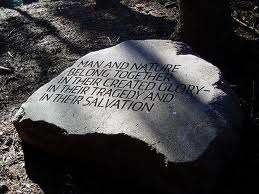
Paul Tillich quote in Tillich Park, New Harmony, IN: "Man and nature belong together in their created glory - in their tragedy and in their salvation."

Paul Tillich quote in Tillich Park, New Harmony, IN: “Man and nature belong together in their created glory – in their tragedy and in their salvation.”

A spiritual reflection for the Second Sunday of Advent, December 7, 2014.

The beginning of the GOOD news is HARD news, according to John the Baptist, calling people out into the wilderness. “We must change,” he said.  “Repent” by which the Judeo-Christian tradition means a 180 degree turn. “About face!” Only by turning will we be delivered from the consequences of the actions that have led us here.

For John the Baptist and the writer of the Gospel of Mark’s opening paragraph (Mark 1:1-8) the system at issue was Roman imperialism, an economic system centered in Rome, expanding out, and enforced by, military invasions, subjugation, religious tolerance (so long as the religious practice did not interfere with Roman prerogatives) and occupation.

One could repeat the sentence in 2014 with little change: “the system at issue [is [American] imperialism, an economic system centered in [Washington] expanding out, and enforced by, military invasions, subjugation, religious tolerance (so long as the local religious practice [does] not interfere with [American] prerogatives) and occupation.”

It is our spiritual, moral, economic, cultural and political captivity to a global system that cannot satisfy our real needs or the world’s that produces a longing in our hearts, a readiness to make the lonely trip to the wilderness.

We’re a weary people in 2014. Wearied and still disheartened 11 years after the “Shock and Awe” that took down Saddam Hussein on the pretense that he had weapons of mass destruction (WMDs) that threatened us, the Administration’s manufactured association of Saddam Hussein as the cause of 9/11. We’re wearied of lies and misrepresentations. Weary from budget fights that barely reference 10 years of un-budgeted military expenses, the loss of thousands of American soldiers’ lives and as many as 100,000 Iraqi civilians, a military venture undertaken on the assumption that the Iraqi people would welcome our presence as the beginning of democracy and a “free market” economy that would lift them all up.

That belief in the goodness of American intentions hit the rocks as quickly as Saddam’s statue hit the pavement in Baghdad. All the while we were wearied by the earlier invasion of Afghanistan, whose original justification was a quick elimination Osama bin Ladin and Al-Qaida untempered by realistic knowledge of the long history of the military interventions that mired the invaders in quagmires such as the Soviet Union found itself before leaving in defeat. To the Afghans it didn’t matter whether the troops were Soviet or American. They were the same. They were the occupation forces of an imperial power destined to fail.

In the midst of the weariness about what was happening abroad, the financial system at home took the American economy to the brink of disaster in 2008. Occupy Wall Street rose to the top of the news cycles. Although the movement fizzled over time, as such movements inevitably do, it caught the attention of television viewers, internet surfers, and newspaper and magazine readers. Occupy Wall Street and the spot light it placed on “crony capitalism” became a hot topic around water coolers at work and the table in the coffee shops.

For the first time in recent memory, capitalism was no longer sacred, no longer off limits. Time’s front cover asked the question whether Capitalism was dead. But, as with Occupy, public attention is short-lived. Amnesia sets in when people are weary. How soon we forget…until some new John the Baptist issues the cry for a 180 degree turn for the sake of something better.

Maybe Naomi Klein is edition of John the Baptist. This Changes Everything: Capitalism vs. the Climate, reviewed by the New York Times – places the over-riding systemic issue squarely before the general public again. Senator Bernie Sanders, America’s only socialist Senator who names climate action as among his four top priorities, is gaining attention as a possible presidential candidate. Elizabeth Warren, the Senate’s bulldog on holding Wall Street accountable is creating a wave of populist momentum. Put them with Bill McKibbon and 350.org and you begin to hear the echo of John’s all to the hard truth that is the beginning of the good news.

The hard truth that precedes good news is the discovery of the myth that has coupled democracy with capitalism in the American psyche, while demonizing socialism as democracy’s opposite. Ideological blinders are to nations and peoples what blinders are to horses on a race track: they limit vision to the straight-ahead narrow limits of the track. Ideological blinders prevent the owners’ horses from thoughts of anything but the track on which they’ve been placed to race each other.

But when the climate is changing our track in ways that compel our attention, and when we ask how we will make it through the changes together, the bigger question of the economic system – the race track itself – comes into view by virtue of necessity. It calls us off the track into the wilderness of Nature.

The words ‘economy’ and ‘economics’ derive from the Greek words for ‘house’ and ‘the management of the household’.  Economics not about markets, free or otherwise, or about the technicians and pundits who monitor investments and predict quarterly outcomes. It is not an academic discipline, the exclusive province of experts on Wall Street or in university Economics departments who understand how the free market works.

Economics is a spiritual perspective like the one on Paul Tillich’s marker in Tillich Park in New Harmony, Indiana. “Man and nature,” he said, “belong together in their created glory – in their tragedy and in their salvation.” There is no humanity with nature; the human calling of our time is to reshape our lives for the wellbeing of the one house in which all life lives.

During this Advent season of longing expectation, John the Baptist with his axe aimed at the root of the tree reminds us that economics is the spiritual issue of the first order. The good news is what the Hebrew Bible calls “the Day of the Lord” and John the Baptist and Jesus of Nazareth called “The Kingdom [i.e. Society] of God”. The hard news is we’ve been running on the wrong track, or, you might say, barking up the wrong tree.

The planet – this home we call “nature”, without which no person, society or form of life exists – is an economy that requires different management. The economy for which our hearts long is the one house imagined by the psalmist and announced by John in the wilderness beyond the Pax Romana: the good news awaiting our longing hearts to embrace it, a planetary home where “righteousness and peace will kiss each other” (Psalm 85:10) and wars will be no more.

The beginning of the GOOD news is HARD news. “Repent, for the kingdom of heaven is at hand.”

– Gordon C. Stewart, Chaska, MN, December 7, 2014

Capitalism, Socialism, and the Earth

The online Oxford Dictionary defines democracy as “a system of government by the whole population or all the eligible members of a state, typically through elected representatives….”

But it immediately biases the discussion with the following sentence to illustrate the word democracy: “capitalism and democracy are ascendant in the third world.” That is, capitalism and democracy go together. Wherever capitalism goes, democracy goes. The ascend together as was imagined to be the case in the Arab Spring.

To the contrary, the online Oxford Dictionary defines capitalism as “an economic and political system in which a country’s trade and industry are controlled by private owners for profit, rather than by the state.”

The Oxford Dictionary identifies what we are coming to realize in America. We do not live in a democracy. We live under “the economic and political system in which a country’s trade and industry are controlled by private owners for profit rather than by the state.” Neither are they controlled by the people of the state, the body politic.

The presumed ideological kinship between capitalism and democracy has existed in America culture as long as most of us can remember. It wasn’t always so in the 1920s and ‘30s, but, as we are beginning to understand again by virtue of circumstance, democracy does not depend upon a capitalist economy. In fact, democracy and capitalism are contradictions in terms. They are philosophically incompatible.

The more natural kin of democracy is socialism, as defined by the online Oxford Dictionary: “A political and economic theory of social organization that advocates that the means of production, distribution, and exchange should be owned or regulated by the community as a whole.”

Democracy is the rule of the people, “a system of government by the whole population….” or, “the community as a whole.”

Finally in America an intelligent discussion is afoot about democratic rule and economics. Naomi Klein’s This Changes Everything: Capitalism vs. the Climate takes the discussion to a new level that views global capitalism as “the most profound threat humanity has ever faced: the war our economic model is waging against life on earth.”

The Dancing Dog Eatery and Juicery

An Acrostic Tribute

The vegetarians love it!
How do omnivores love it too,
Even though all is vegan food?

Delicious, each bite of the pies!
Animal friends happy outside!
Nice, the waiters are always nice!
Chips and fish, the menu says,
Inside is plant-based tasty food,
Never cooked from any other!
Good! And never had a mother!

Delicious, I use the word twice!
Orange, apple, grape, amazing juice!
Good wine and beer, let’s give a cheer!

– Steve Shoemaker, Urbana, IL, Dec. 4, 2014. The Dancing Dog is in Urbana, IL. Here’s a link to the restaurant.

The Dancing Dog Eatery and Juicery

The Dancing Dog Eatery and Juicery

The Politics of Vision

Voter turnout in the November election was the lowest since 1942. Many folks have given up on the political establishment. The know that Citizens United baptized the privilege and power of the billionaire class.

Very few candidates stood up against the pejorative, demagogic ad campaigns that painted progressive candidates with a red brush. Most campaign ads focused on what the candidate opposed. Very few put forward what they stood for, as well as against.

But what if…. What if a candidate answered the question “What do you stand for?” very clearly? Something like this:

YES to raising the minimum wage.

YES to a massive jobs program rebuilding our crumbling infrastructure.

YES to transforming our energy system away from fossil fuels.

YES to pay equity for women workers. YES to overturning Citizens United.

NO to cuts in Social Security.

NO to cuts in Medicaid.

NO to converting Medicare into a voucher program.

NO to new trade legislation that sends our jobs overseas and hammers our middle-class workers.

NO to cuts to nutrition programs, education, or environmental protection.”

Someone did say this. Senator Bernie Sanders, (I), Vermont. How does America’s only socialist Senator from the small state of Vermont manage to get elected? How does it happen that conservative Vermont farmers and small business owners support him?

His “Yes” means “YES” and his “No” means “NO”. He is honest. He has a message. He doesn’t fudge the way Mitch McConnell’s Democratic opponent did in Kentucky when she re-made herself to sound tougher than Sen. McConnell on immigration enforcement.

Clarity of message is everything. So is honesty. Boldness. “Where there is no vision the people perish” [Proverbs 29:18]. Where there is (a good) vision, the people follow and thrive.

Traditional American values were not up for debate in 2014. Disgust was the issue. Anger was the issue. Distrust was the issue. Cynicism took over. Between now and 2016 we can expect more of the same. But there is also a national debate brewing about the vision.

“Write the vision and make it plain, so he may run who reads it.” [Habakkuk 2:2]

Thanks you, Bernie Sanders, for writing yours so clearly. I look forward to hearing others’ plain Yeses and No’s, such that might inspire us to run to the polls next time.

Go back

Your message has been sent

Warning
Warning
Warning
Warning

Warning.