Things too hard for me

Momentary access to the world-wide-web leads away from many words toward reflection on an ancient text.

O Lord, I am not proud;

I have no haughty looks.

I do not occupy myself with great matters

or with things that are too hard for me.

But I still my soul and make it quiet,

like a child on its mother’s breast;

my soul is quieted within me.

O Israel, wait for the Lord,

from this time forth and for evermore. 

[Psalm 33, Book of Common Prayer psalm for the morning]

sunrise-over-lake-superior

I wake before dawn to see the sun rise over the far horizon beyond Lake Superior, shining its rays across the waves, a beauty beyond compare. I do not occupy myself with “great things” that matter less and things too hard for me. I am not proud.

— Gordon C. Stewart, Encampment Forest, Two Harbors, MN, October 5, 2017.

Dear Brother Donald

Letter to President Donald J. Trump

September 30, 2017

Dear Don,

I hope you don’t mind me calling you Don. You can call me Gordy; only those close to me in grade school called me that, but, so did the kids in my confirmation class. Since we were both confirmed in Presbyterian churches, I think it makes sense to call each other Don and Gordy.

brown-psr-3-300-394After writing you yesterday, I wondered whether your confirmation class read the same book mine did. Did you read Robert McAffee Brown‘s The Bible Speaks to You? I have to confess I didn’t read much of it at the time. I faked it. Maybe you did, too. I think we were probably a lot alike that way, don’t you think?

Anyway, this morning I went online and found The Bible Speaks to You in Google Books — Google, like Twitter, is amazing, don’t you think? — to see what we were supposed to be reading and to get a sense again of what we were being taught. Even way back when we were in confirmation class, we were being taught that Jesus was killed by the coalescence of two mistakes that seem to be the opposite of each other: nationalism, on the one hand, and imperial rule, on the other. They went hand-in-hand in deciding Jesus has to go.

Do you remember that?

Jesus wasn’t big on either nationalism or or empire; he saw both as substitutes for God, idols manufactured by the human heart to provide a false sense of security and importance. I suspect you may have skipped those chapters of the New Testament, but this wouldn’t be the first time the crucifixion was erased from consciousness. It happened in the German Church in the 1930s when the majority Christian population blamed the Jews, the Gypsies, the communists, and homosexuals for Germany’s fall from greatness. Make Germany great again was the agenda back then and Jesus was weeping all the way through it — in the concentration camps and in the cattle cars of the trains that removed from the nation everyone who wasn’t of the Aryan race, an idol of exceptionalism that, like all idols, had no foothold in reality itself.

Do you remember how we hated Hitler and all that stuff in confirmation class, how we thought of ourselves as Christians who would never do that because we were disciples of Jesus, and as Americans who would never do that because … well, we were Americans? We were better than that!

Funny how things change sometimes if we don’t pay attention, don’t you think? Maybe we paid too much attention to that period of world history and not enough attention to Robert McAfee Brown and the Bible. Long after we finished confirmation class to become disciples of Jesus, Robert McAfee Brown said something I’m remembering now:

Who we listen to determines what we hear. Where we stand determines what we see. What we do determines who we are.

I wonder who you’re listening to, where you stand on all of this, and write you now because, as your brother in Christ, I went on to listen to Dietrich Bonhoeffer and his American friends,Paul Louis Lehmann, William Sloane Coffin, and, yes, our old confirmation class author Robert McAfee Brown, who all claimed that what we do determines who we are.

The Bible speaks to you

Original cover of The Bible Speaks to You used in Presbyterian church confirmation classes in the 1950s and ’60s.

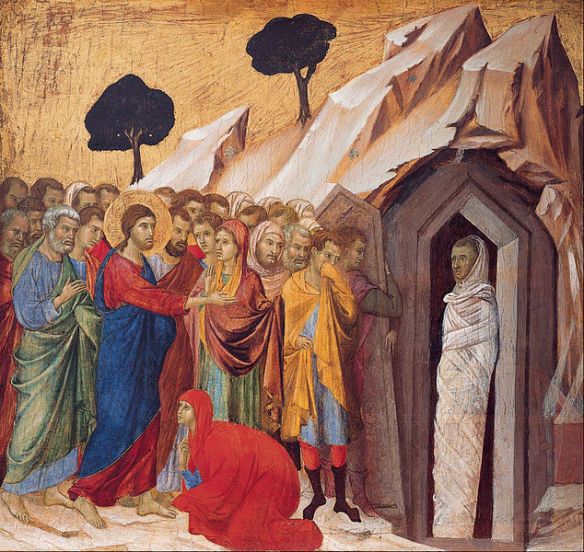
Don, if you can find a moment this morning, you can click this  Amazon LINK to The Bible Speaks to You, click “Look Inside” and scroll down to what neither of us can remembers now that we’re over 70 years old and forgetting much of what we learned. Take a look at pages 11 and 12 about the Marine Corporal following Robert McAfee Brown, the Marine Chaplain, back to his quarters after a Bible study on the Gospel of John story of Lazarus:

“Chaplain,” he said, “I felt as thought everything we read this morning was pointed right at me. I’ve been living in hell for the last six months, and for the first time I feel as though I’ve gotten free.”

You’ve been in the White House for nine months now, and I suspect it may feel like a hell you’ve never experienced. Maybe the same thing can happen with you as happened with the Marine.

634px-Duccio_di_Buoninsegna_-_The_Raising_of_Lazarus_-_Google_Art_Project

“The Raising of Lazarus” — Duccio di Buoninsegna (c. 1318-1319)

Remember, Don, every one of us has had at least a taste of hell these last nine months, but I’m looking to you for something different to rise from the ashes of our confirmations: a refutation of nationalism and empire. As Robert McAfee Brown said when he was much older, “What you do determines not only who you are but who we are. ” Take a close look at the picture of Robert McAfee Brown and at . It feels as though he’s looking at us to see whether we’re with Jesus and Lazarus.

Grace and Peace,

Gordon C. Stewart (“Gordy”), Your Brother in Christ

Chaska, Minnesota

In stillness I wait

fd102fe612128b9da9857f58e5286d30I see things in the wilderness I do not notice at home.

Last night the sky was lit by lightning on every side —north and south, east and west— but the lightning was flashing from far away. There was no sound. There was no thunderstorm within miles of the A-frame under the stars.

The cabin by the wetland is like that — a place apart for a news-weary soul. A humble shelter of rough-cut pine without electronic devices among the crows, owls, white-tailed deer, skunks, and swans. Yes, the skunks are here, digging for grubs at night, but the skunks here don’t stink up the place like humans do back home, and, like the crows, owls, deer, and swans, they know nothing of the world I’m trying to leave behind.

1928_bcpThis morning’s Psalm from the Daily Office of The Book of Common Prayer brings its own kind of light from afar.

We give you thank, O God, we give you thanks,
calling upon your Name and declaring your wonderful deeds.

“I will appoint a time,” says God,
“I will judge with equity.

“Though the earth and all its inhabitants are quaking,
I will make its pillars fast.

“I will say to the boasters, ‘Boast no more,’
and to the wicked, ‘Do not toss your horns;

“‘Do not toss your horns so high,
nor speak with a proud neck.’”

[Psalm 75:1-5, Book of Common Prayer]

The lightning flashes from ages ago, calling me to hope for such a time.

In the morning stillness of the wilderness, I wait.

  • Gordon C. Stewart, uploading at the truck stop 12 miles away, September 23, 2017.


The owl in the wilderness

An owl greeted Kay this morning from a tree outside the door of the wilderness cabin next to the wetland with the swans’ nest before we turned to the wisdom of the Psalm assigned for today by The Book of Common Prayer.

But as for me, my feet had nearly slipped;
I had almost tripped and fallen;

Because I envied the proud
and saw the prosperity of the wicked:

For they suffer no pain,
and their bodies are sleek and sound;

In the misfortunes of others they have no share;
they are not afflicted as others are;

Therefore, they wear their pride like a necklace
and wrapt their violence about them like a cloak.

Their iniquity comes from gross minds,
and their thoughts overflow with wicked thoughts.

They scoff and speak maliciously;
out of their haughtiness they plan oppression.

They set their mouths against the heavens,
and their evil speech runs through the world.

And so the people turn to them
and find in them no fault.

They say, “How should God know?
Is there knowledge in the Most High?”

So then, these are the wicked;
always at ease, they increase their wealth.
….

Like a dream when one awakens, O Lord,
when you arise you will make their image vanish.

[Psalm 73:2-12, 20]

Having almost tripped and fallen into despair, I hear in the psalmist’s voice the hoot of the owl in the wilderness and pray that the evil speech that ran through the world from the podium of the United Nations and the mage of the violent and the haughty will vanish.

Respite off the map

Sanity demands solitude.

thoreau quoteHenry David Thoreau withdrew to Walden Pond to come to his senses. His time was much simpler than mine. He never got out of bed to check his emails or search the internet. But even in that less over-stimulated time he felt the need to leave everything that distracts the human spirit from the deeper truth about itself.

Solitude loves silence.

The wilderness cabin in northern Minnesota feels a bit like Henry’s place on Walden Pond. The wetland separates it from the small pond that has no name on a map. There are no sounds here other than the loons’ calls, Barclay’s bark, and the occasional mooing from a mile or two away when the wind is right.

Solitude puts me in touch with nature.

Not all the sounds are calming. In the night darkness, the howls of a nearby coyote and the scratching sounds of skunks digging for grubs remind me that nature is not as altogether sweet as romantics sometimes make it out to be. The cabin provides a respite from the human howls and odors that startle me in the world beyond these woods.

I ponder with the psalmist the societal ills that drove Henry to Walden Pond and have driven me here.

Their idols are silver and gold,
the work of human hands.

They have mouths, but they cannot speak;
eyes have they, but they cannot see;

They have ears, but they cannot hear;
noses, but they cannot smell;

They have hands, but they cannot feel;
feet, but they cannot walk;
they make no sound with their throat.

Those who make them are like them,
and so are all who put their trust in them.
[Psalm 115:4-8, The Book of Common Prayer]

fd102fe612128b9da9857f58e5286d30I become aware of the light dancing on the aspen leaves in a gentle breeze, the yellow oak leaf signaling the turn of summer toward fall, the sudden gust of wind from across the nameless pond, the osprey circling overhead on currents I cannot see, the ice-cold water hand-pumped from the well, the warmth of the fire in the wood stove, the feel of dirt from the flower beds—the living silence of a dead stop.

  • Gordon C. Stewart, Walden Pond, MN, September 2, 2017.

The Shadow of Fred Trump

150202142706-new-york-times-profit-780x439To a degree greater than his Oval Office predecessors, President Trump is waging perpetual war with the press, especially the New York Times.

Why?

Like Father, Like Son

Sons who reflect deeply on what makes them tick eventually wade in the muddy waters of their relationships with their fathers.

Although psychotherapists warn against armchair diagnosis, especially by those not trained in the DSM and diagnostic practice, some things have always been in the public domain of human wisdom. Among them is the existential relationship of a father and a son.

It’s taken 75 years of self-reflection to reach the little clarity I have about my father and me. Along the way I have listened to men, young and old, wrestling with — or refusing to wrestle with —their fathers.

Sometimes the fathers are alive. Sometimes they’re dead. But a father never dies. He lives on in the son who looks to him for approval, for legitimacy, for love.

The Story of Jacob

Although we are not trained in clinical diagnosis like our psychology counterparts, rabbis, priests, ministers, and imams, rabbis, priests, ministers, and imams are privileged to wade in these sacred waters with other waders and wrestlers.

We are schooled in a companion tradition to the DSM, the ancient wisdom passed on from generation to generation by the Torah like the story of Jacob wrestling with the night visitor by the ford of the Jabbok.

The back story of Jacob’s night of wrestling is Jacob’s tricking his blind father Isaac into giving him the father’s blessing meant for Esau and Jacob’s crafty theft of Esau’s birthright.

“After that Esau hated Jacob because of the blessing from Isaac. He thought to himself, ‘My father will soon die, and I will be sad for him. Then I will kill Jacob.’” [Genesis 27:41.]

Esau’s fury has sent Jacob into flight fearing for his life. Now, after years of running for his life, Jacob is about to meet the brother he assumes intends to kill him.

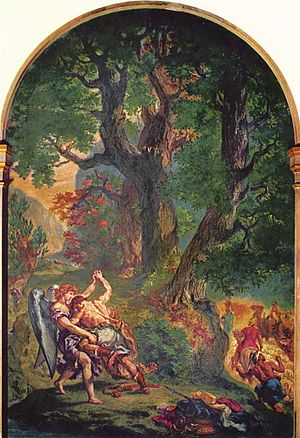
300px-Eugène_Ferdinand_Victor_Delacroix_061

Jacob wrestling with the angel – Eugene Delacroix 

It is the night before Jacob’s encounter with Esau.

“Jacob was left alone; and a man wrestled with him until daybreak.  When the man saw that he did not prevail against Jacob, he struck him on the hip socket; and Jacob’s hip was put out of joint as he wrestled with him. Then he said, ‘Let me go, for the day is breaking.’ But Jacob said, ‘I will not let you go, unless you bless me.’

So he said to him, ‘What is your name?’ And he said, ‘Jacob.’ Then the man said, ‘You shall no longer be called Jacob, but Israel, for you have striven with God and with humans, and have prevailed.’ Then Jacob asked him, ‘Please tell me your name.’ But he said, ‘Why is it that you ask my name?’ And there he blessed him. So Jacob called the place Peniel, saying, ‘For I have seen God face to face, and yet my life is preserved.’ The sun rose upon him as he passed Penuel, limping because of his hip.” [Genesis 32:24-31 NRSV.]

Jacob’s dark night of the soul appears at first to be his unresolved sin against his brother Esau. But beneath the obvious, what the Genesis narrator sets up as a life-and-death moment between the two estranged brothers is a night-dream resolution of Jacob’s very being — his grounding in God . . . and his father.

Jacob is not the only one who has wrestled alone in the night. No night is bleaker than the absence of love, and the darkest of them come when the absence comes from one’s mother or father.

The memory of a father like Isaac casts a long shadow over a man like Jacob. No matter how far Jacob runs from his brother, he cannot walk outside the shadow of Isaac’s disapproval. So long as we run, we miss the holy limp that results from the wrestling.

Perhaps in the light of a son’s relationship with his father we see something much deeper than politics in the behavior and speech of Donald j. Trump.

Walking with a Limp

Jacob’s night of wrestling leaves him permanently injured. Forever after he walks with a limp. After his night by the ford of the Jabbok and the next day when Esau embraces him against every expectation, Jacob and Esau join together to bury their dead father.

For Donald Trump’s sake and for all the brothers and sisters the president has managed to estrange across the world in 2017, one can pray, and hope against hope, that Fred Tump’s heir would finally bury his father’s fight with the New York Times.

FredTrumpArrest

  • Gordon C. Stewart, Chaska, MN, August 21, 2017.


Getting smart with sick people

https---blueprint-api-production.s3.amazonaws.com-uploads-card-image-567195-92342710-0d5c-4235-a14a-8c7f1b862648

Pictures like this from Charlottesville, Virginia send chills down the spine. White supremacy, white nationalism, the KKK, and the Neo-Nazis sometimes evoke a reptilian response in me. I hate the haters.

I am like the psalmist in the psalm I learned as a child.

Surely thou wilt slay the wicked, O God: depart from me therefore, ye bloody men.

For they speak against thee wickedly, and thine enemies take thy name in vain.

Do not I hate them, O Lord, that hate thee? and am not I grieved with those that rise up against thee?

I hate them with perfect hatred: I count them mine enemies. [Psalm 139:19-22 KJV].

They are evil, pure and simple! I hate them with a perfect hatred.

Then I remember the conclusion of the psalmist’s reflection immediately that strangely comes on the heels of hating God’s enemies with a perfect hatred. These last lines of Psalm 139 come only after the psalmist takes a very deep breath — a more contemplative introspective pause.

Search me, O God, and know my heart: try me, and know my thoughts:

And see if there be any wicked way in me, and lead me in the way everlasting. [Psalm 139:23-24 KJV]

Evil is not only out there. It’s also in here. In me. It’s like an infection. It’s pandemic. Comparing myself with the most egregious white supremacists leaves me among the righteous, but, as an old professor observed, comparison is the Devil’s work.

andrew-young

Andrew Young and Martin Luther King, Jr.

“I grew up in New Orleans, La., 50 yards from the headquarters of the Nazi party. Before I went to kindergarten, I was having to look in the window on Saturdays, and watch all these folks [shout] “Heil, Hitler!”

“In 1936.

“And my daddy said, those are sick people. They’re white supremacists, and white supremacy is a sickness. You don’t get mad, you get smart. You never get angry with sick people, because you’ll catch their sickness. That’s what I worry about with our young people. Anger and this emotional militancy will give you ulcers, give you heart attacks.

“Don’t get mad, get smart. Your brain is the most important thing you have.”

Andrew Young, August 16, 2017.

reptilian brain

The reptilian brain uploaded from http://www.collectiveevolution.com

Click How to By-Pass Your Reptilian Brain and Restore Your Creative Powers, or Controlling Anger Before It Controls You on the American Psychological Association web site, and remember Andrew young. “Don’t get mad, get smart. Your brain is the most important thing you have.”

Or just remember the psalmist in light of the snake’s deception in the biblical myth of the Garden of Eden: “You will be like God, knowing good and evil!”

  • Gordon C. Stewart, Chaska, MN, August 17, 2017.

“Every round goes higher, higher”

Part 2 of “Jacob’s Ladder at Almost 75”

As a child and youth, Jacob’s Ladder touched something deep within me. I couldn’t have described what it was or why at the time.

Looking back, it was a happy song. We were all climbing. Getting older meant climbing higher, getting taller, becoming mature, successful adult “soldiers of the cross.”

“Every round goes higher, higher.”

It expressed a joyful innocence and confidence. I had no knowledge of the economic-political origins of the ‘spiritual’ until much later.

The connection between the slaves’ faith, or their understanding of what it meant to be a “soldier of the cross” — the struggle for economic-political liberation, climbing “higher” to freedom in the North — was as far from consciousness as white is from black.

As a 13 year-old, Jacob’s Ladder expressed an innocent childhood hope during those hormone-challenging years when ascending the ladder toward adult self-sufficiency felt like a fireman trying to save  an 800-pound gorilla in a raging fire. All I could do was stay on the ladder, hoping that human equivalents of angels might be there to catch me when I fell.  The closest thing to angels were people like Mr. and Mrs. Kidder and friends who encouraged my upward progress from childhood to adulthood. Surely some progress must be made.

Faith still meant climbing higher on a ladder that was going someplace, as the Genesis story (Genesis 28:10-19a) of the ladder between heaven and earth seemed to say. We were on the upward ladder.

Then, something happened.

  • Gordon C. Stewart, Chaska, MN, August 6, 2017.


Boundary-breaking God

Kosuke Koyama - RIP

Kosuke Koyama (1929-2009) R.I.P.

INTRODUCTION: The Japanese theologian to whom Be Still! Departure from Collective Madness is dedicated delivered these words a decade ago from the pulpit of House of Hope Presbyterian Church in St Paul, Minnesota. Contrary to popular misconception, the biblical prophets did not fore-tell the future; they rather forth-told a word greater than their own. Kosuke Koyama‘s experience led him to hear something quite clearly – a word he could not have known would be more important in 2017 than the day he spoke it.

THE SERMON, June 6, 2006. Texts: Leviticus 19:33, Psalm 139: 7-10, and Luke 14: 1-6. [Bold type added by Views from the Edge.]

Dear Sisters and Brothers in Jesus Christ,

When an alien resides with you in your land, you shall not oppress the alien. The alien who resides with you shall be to you as the citizen among you; you shall love the alien as yourself, for you were aliens in the land of Egypt: I am the Lord your God. – Lev. 19:33.

This is a challenging suggestion for the immigration and naturalization policy of any nation. God does not discriminate between citizens and aliens. The God of the Bible is more concerned about the welfare of the aliens, the weak, than of citizens, the strong.

Remember your own experience in Egypt! “Love the alien as yourself!” Jesus is even more emphatic when he says, “Love your enemies!” We think of aliens and enemies as potential threats to our community. They must be kept outside of our boundaries.

“Something there is that doesn’t love a wall,” observes the New England poet, with sharp insight. Something there is in the gospel of Christ that dismantles walls. Jesus “has broken down the dividing walls,” we read in the Epistle to the Ephesians. (2:14)
+++
“In the beginning was the Word” (John 1:1) – This Word, the truthful Word, “breaks down the dividing walls” by making honest dialogue possible. When communication breaks down peace breaks down. It takes a great deal of dialogue to come to mutual understanding between peoples of different language, religions, racial and cultural practice. Often the choice is between dialogue and mutual destruction, between diplomacy and war. The alternative to dialogue is taking the sword. Jesus says; “all who take the sword will perish by the sword” (Mt.26:52). Our “sword” today is incredibly destructive! Our fear, today, is of nuclear proliferation. We fear it because we started it! “Choose life so that you and your descendants may live”! (Dt.30:19)
+++
The brief gospel text for this morning is a record of a profound dialogue. The story is honest and transparent. We can understand it very well. The dumfounded lawyers and Pharisees only reveal the sincere quality of the story. In conversation with Jesus, the man of total honesty, human hypocrisy is exposed and expelled.

On one occasion when Jesus was going to the house of a leader of the Pharisees to eat a meal on the Sabbath, they were watching him closely. Just then, in front of him, there was a man who had dropsy. Jesus asked the lawyers and Pharisees, “Is it lawful to cure people on the sabbath, or not?” but they were silent. So Jesus took him and healed him, and sent him away. Then he said to them, “If one of you has a child or an ox that has fallen into a well, will you not immediately pull it out on a Sabbath day?” And they could not reply to this (Luke 14:1-6).

How boldly Jesus simplifies and zeroes-in on the central issue! “Is it lawful to cure people on the Sabbath, or not?” This is the question that distinguishes the gospel from religion. This story is only one of a number of “Sabbath controversies” told in the gospels. The gospel breaks boundaries. Religion often insists on boundaries. The gospel opens windows in hope. Religion may shut windows in fear. The gospel is “scandalously” inclusive. Religion often is piously exclusive. “You shall love the alien as yourself” expresses the spirit of the gospel. Religion tends to question whether everyone deserves to be loved.

The Sabbath is a holy institution commemorating the holy rest God has taken after creating “heaven and earth.” Sabbath is mentioned as one of the Ten Commandments:

“Remember the sabbath day, and keep it holy. Six days you shall labor and do all your work. But the seventh day is a Sabbath to the Lord your God; you shall not do any work – you, your son or your daughter, your male or female slave, your livestock, or the alien resident in your towns. For in six days the Lord made heaven and earth, the sea, all that is in them, but rested the seventh day; therefore the Lord blessed the Sabbath day and consecrated it” (Ex.20: 8-11).

“On another Sabbath he entered the synagogue and taught, and there was a man there whose right hand was withered” (Lk. 6:6) “Now he was teaching in one of the synagogues on the Sabbath. And just then there appeared a woman with a spirit that had crippled her for eighteen years. She was bent over and was quite unable to stand up straight” (13:10,11).

“On one occasion when Jesus was going to the house of a leader of the Pharisees to eat a meal on the Sabbath, … Just then, in front of him, there was a man who had dropsy” (the disease of the swelling from abnormal fluid retention ). A man of withered hand, a woman who is bent over, and a man with dropsy appear “on the Sabbath in front of him.”

Jesus cures them. Jesus “works” on the Sabbath! Some for whom it is important to “keep” the sabbath complain, “There are six days on which work ought to be done; come on those days and be cured, and not on the sabbath day”(Lk.13:14). Jesus, for whom the persons with need are more important than the rule, responds, “If one of you has a child or an ox that has fallen into a well, will you not immediately pull it out on a Sabbath day?”

Jesus comes to heal the broken human community. He is the embodiment of direct love-action and action-love. He cures sick people publicly on the Sabbath with unassailable authority and freedom. The people are amazed – ecstatic – and praise God. Representing the God of compassion, Jesus breaks the boundary attached to the sacred Sabbath tradition. In his “boundary breaking” he restores the authentic purpose of the sabbath – that is, to bring health to human community. The Sabbath is for healing. “The Sabbath was made for humankind, and not humankind for the Sabbath,” says Jesus (Mk.2:27). What a freedom he exhibits!

+++

The gospel of Jesus Christ is “scandalous,” says the apostle Paul in his letter to the Corinthians (1 Cor. 1: 18-25) for he is “the man who fits no formula” (Eduard Schweizer, (Jesus, chap. 2). Creeds, doctrine, theology, or tradition cannot domesticate Jesus. No one can confine Jesus within walls. Let me quote from a Swiss New Testament scholar:

“…teaching in itself does not convey the living God. It may even hinder his coming, though it (the teaching) may be totally correct. It is exactly the most correct and orthodox teaching that would suggest that we had got hold of God. Then he can no longer come in his surprising ways” (Eduard Schweizer, Luke: A Challenge to Present Theology p.58)

We feel uneasy when Jesus breaks the boundaries we make, because boundaries are a part of our accepted culture. “Good fences make good neighbors.” Yet, fences can never be the final word. Tragically in our real lives fences work more in the direction of mutual alienation than mutual embrace. “Before I build a wall I’d ask to know what I was walling in or walling out” – says the poet. That is a good question!

When I was in my early teens, Japan followed her gods who were rather poorly educated in international relations. They were parochial. They spoke only Japanese. They did not criticize Japanese militarism. They endorsed the inflated idea that Japan is a righteous empire. Trusting these parochial gods, the people recited, to paraphrase: “If I take the wings of the morning and settle at the farthest limits of the sea, behold the glory of the divine emperor of Japan is there!” Japan broke international boundaries in pursuit of self-glorification and aggrandizement. Without any threat from her Asian neighbors, Japan attacked and invaded them. The Japanese gods approved and Japan ruined herself. Blessed are nations that have a God who criticize what they do! The God of Israel said to God’s own people: “You are a stiff-necked people!”

+++

The infant Jesus “was placed in a manger – “for there was no place for them in the inn” (Luke 2:7). Being thus edged out even from a human birth place, Jesus breaks a boundary. When he “eats with sinners and tax collectors” (Mk.2:16) he breaks a boundary. Crucified, nailed to the cross, – completely immobilized – he breaks a boundary. Dying between two criminals, becoming a member of this community of three crosses, he breaks a boundary. Being “numbered with the transgressors”, to quote from the Book of Isaiah (53:12), he breaks boundaries. This is an amazing story. The one who is totally vulnerable, disarmed, non-violent, and immobilized and humiliated has broken all the boundaries, which threaten the health of human community.

With our geopolitical realities, we may think that the way of Christ is romantic and not realistic. Then we must know that the alternative is the historical fact of 5000 years of human civilization replete with constant warfare. Should we continue this state of endless destruction for another 5000 years? Gandhi’s practice of non-violence has done more to increase the welfare of humanity upon the earth than many wars put together. Martin Luther King Jr. says: “Far from being the pious injunction of a Utopian dreamer, the command to love one’s enemy is an absolute necessity for our survival”! (Strength to Love, p.47) “For God’s foolishness is wiser than human wisdom, and God‘s weakness is stronger than human strength” cries the apostle Paul (1 Cor.1:25).

+++

“Look at the birds of the air,” Jesus says. “They neither sow nor reap nor gather into barns, and yet your heavenly Father feeds them. Are you not of more value than they?” (Matt. 6:26). The birds of the air and the Father who feeds them are free from all boundaries. Climate change – global warming – has no boundaries. The light of the sun and the air that sustain all living beings know no boundaries. The Berlin Wall of 96 miles was there for 28 years up to 1989. The racial wall of the South African Apartheid existed for 46 years and ended in 1994. In their limited existence, these walls have done immeasurable damage to humanity on the both sides of the wall. The Orthodox Church of the East and the Catholic Church of the West did not speak to each other for 911 years from 1054 to 1965. The Great Wall of China and Check Point Charlie in Berlin are tourist spots today. “One cannot dehumanize others without dehumanizing oneself” says James Baldwin. “Forgive us our debts as we forgive our debtors,” we pray. It is this prayer that breaks the boundaries in a way that is pleasing to God.


 

Elijah’s face

Elijah calm

Five day old Elijah

Looking at the contentment on Elijah’s face, do you suppose he’s already read grandpa’s Be Still! Departure from Collective Madness or has memorized grandpa’s favorite psalm, Psalm 46? I wish I could be this calm, this cool, this collected, this still.

God is our refuge and strength,
    a very present help in trouble.
 Therefore we will not fear, though the earth should change,
    though the mountains shake in the heart of the sea;
    though its waters roar and foam,
    though the mountains tremble with its tumult.Selah

There is a river whose streams make glad the city of God,
    the holy habitation of the Most High.
God is in the midst of the city; it shall not be moved;
    God will help it when the morning dawns.
The nations are in an uproar, the kingdoms totter;
    he utters his voice, the earth melts.
The Lord of hosts is with us;
    the God of Jacob is our refuge.

Come, behold the works of the Lord;
    see what desolations he has brought on the earth.
He makes wars cease to the end of the earth;
    he breaks the bow, and shatters the spear;
    he burns the shields with fire.
“Be still, and know that I am God!
    I am exalted among the nations,
    I am exalted in the earth.”
 The Lord of hosts is with us;
    the God of Jacob is our refuge.

[Psalm 46, NRSV]

  • Gordon C. Stewart, Chaska, MN, May 26, 2017