Cherubic smile

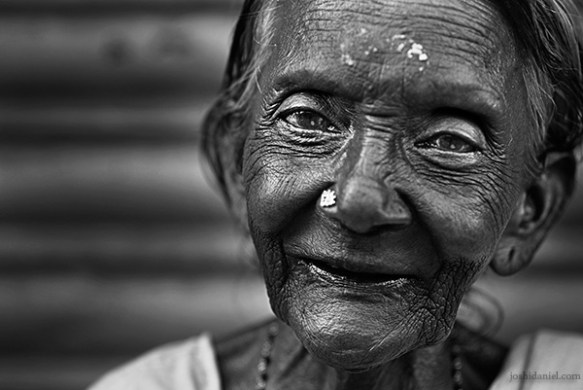
Joshi Daniel’s photograph reminds viewers of the power of inner joy. Thank you, Joshi, for using your extraordinary gift in a way that makes the world a better place.

joshi daniel's avatarJoshi Daniel Photography

Black and white portrait of an old woman with an angelic smile from Trivandrum, Kerala Old woman with a cherubic smile | Trivandrum, Kerala, India

This charming old lady kept on speaking to me while I took this photo of hers.

View original post

Looking and Seeing – Thoreau


What you see, not what you look at, is what you get. Or is it?

Is something there you don’t see? Is what you see there because you put it there?

The relation between subject and object is an ancient philosophical question that’s not about to go away.

When I saw the Thoreau poster, I saw the darkness behind the words. Then it drew me to the light – the sunrise or sunset. But, which is it: a sunset preceding darkness, or sunrise bringing the light? Or are we seeing cars, pavement, poles, and signs? What would Thoreau see?


Non-verbal Communication: Cain looking at us

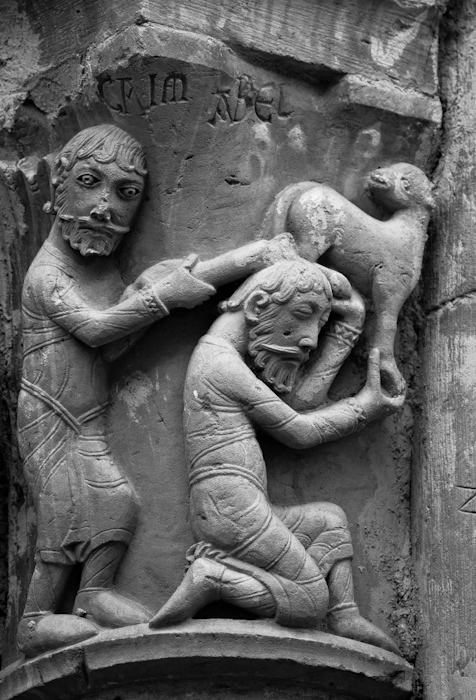
Cain and Abel – the mythical story of the first two children of humanity – in the Book of Genesis (Genesis 4:1-16) is about something that never happened way back when but about what is always happening with us: the inexplicable violence to which humankind turns against itself. It’s about the yawning abyss of violence into which we plunge when we can’t make sense out of life or when things don’t go our way.

Yesterday’s brief post on Via Lucis Photography of Religious Architecture focuses on a capital of Cain and Abel in a Romanesque church.

Photograph by Dennis Aubrey of Via Lucis Photography of Religious Architecture

Photograph by Dennis Aubrey of Via Lucis Photography of Religious Architecture

Like the Genesis writer, the Medieval artist whose hand crafted the story in stone many centuries later was doing theology and anthropology. The biblical author told the story with words; the Medieval sculptor told it with non-verbal communication.

The face of Cain on Via Lucis held my attention long after I’d gone on with the day. It kept returning to mind.

Cain’s head isn’t turned toward Abel whom he is pummeling to death with his stave. He’s looking away from Cain at someone or something else, as if to say the viewer, “So, you think I’m cruel. You think I’m different. You’re looking in the mirror.”

In the biblical story God tells Cain, “sin is crouching at the door; its desire is for you, but you must master it.” The Medieval sculptor’s art seems to be saying it in stone. Cain’s head is cocked, his eyes looking at us. At you. At me.  And, perhaps, at God, to whose failure to rescue Abel he shifts responsibility: “Am I my brother’s keeper?”  The capital seems to say Cain knows he owns us and the endless history of violence in which the blood of the silent victims cries out from the ground, unless and until we – persons, groups, religions, races, cultures, nations, a species – master the sin that’s forever crouching at our door.

  • Gordon C. Stewart, Chaska, MN, October 16, 2015


The Mason of God (Dennis Aubrey)

Dennis Aubrey's avatar

In a world where what passes for news are articles about the megalomaniac Donald Trump, the Kardashians, and the Jenners, we occasionally find something worth consideration.

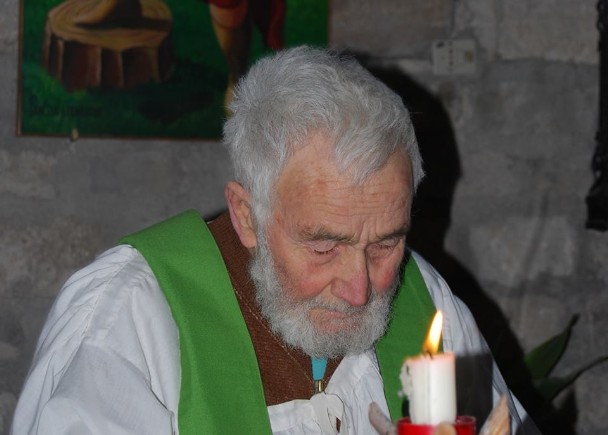
On August 25 a funeral mass was celebrated in the Italian town of Montefortino at the chiesa della Madonna dell’Ambro. The recipient of the mass was a Capuchin friar, Padre Pietro Lavini who lived as a hermit in the Sibylline Mountains near Rubbiano Montefortino and along the Gola dell’Infernaccio, the Gorge of Hell. A thousand people attended the service of the man who died two weeks prior, on August 9, 2015.

Why did they come to this mass? What did Padre Pietro accomplish with his life as a hermit?

Padre Pietro Lavini, photo from Santuario Madonna dell'Ambro Padre Pietro Lavini, photo from Santuario Madonna dell’Ambro

In 1971, Padre Pietro discovered the ruins of the Eremo di Santo Leonardo, an abandoned 12th century Benedictine monastery in the wilds of the Sibyllines. All…

View original post 251 more words

Verse – Last Request

Last request from an Illinois boy

I was born in Urbana on Orchard Street,
The hospital, Carle, was then quite small:
A three-story building of yellow brick,
The first of four brothers, and that was all.

My Mother was Char, my Dad was Bob
away at war, though a Pacifist he.
In ’42, to avoid the Draft,
He joined the SeaBees, the Navy

Guys who built the docks, airfields–
Alaska, even Hawaii.
After the war they lived in town
From house to house, till number three

Was 1306 South Orchard Street.
My happy high school years were there,
My first fast car, my first slow girl…
My friends were from the band or choir,

Although I grew to six foot eight
And stumbled playing basketball.
I started writing poems then:
Love yelps, or sonnets for the school

Assignments Mrs. Hewett gave.
Now decades past, I still will write
My last request in doggerel.
V-mails from Dad to Mom would cite

His love for us in poetry.
So if the cost is not too great,
Send me to die on Orchard Street.
Carle Hospital has grown to eight

Or ten or 12 facilities.
Perhaps they’ll have a room for me
To breathe my last in my home town.
Like poetry, it’s symmetry.

– Steve Shoemaker, Urbana, IL, June 29, 2015

The Punishment and Rescue of the Talkative

You’re reading a blog post. Blogging is talking. Sometimes it’s downright t-a-l-k-a-t-i-v-e. Chatty. Pointless. Silence is to be preferred to word pollution.

Two photographs in The Wood of Our Lady, Dennis Aubrey’s Via Lucis post, give reason to talk about talkativeness. Open the link and scroll down near the bottom to see two capitals: 1) two figures with their heads in their hands, weeping, and 2) what Dennis calls “The Punishment of the Talkative”.

The weeping figures of 12th century Église Notre-Dame-de-la-Nativité strike a chord of familiarity.  How many times a day does the news cause us to put our head in our hands in despair? But “the punishment of the talkative” capital evokes no such sympathy. It strikes us moderns as barbaric, the art of a Christian first-cousin of ISIL with grotesque figures excising the tongue of the talkative. Yet it served to remind the worshipers in the 12th century, as it still does in its startling way, that talkativeness is no virtue. Words are sacred. Dennis Aubrey puts it this way:

Perhaps the most famous capital represents the punishment of the talkative, presumably by excising the tongue with tongs. I don’t know if this condemns lying, calumny, or verbal abuse, or if it is a more generalized censure of chattiness or language in general. While this punishment somehow seems fitting for the slanderers who fill our public lives, I would prefer these thoughts of Voltaire, … les anges m’ont tué par leur silence. Le silence est le just chatiment des bavard. Je meurs, je suis mort. “The angels have killed me with their silence. Silence is the just punishment for the talkative. I’m dying. I’m dead.”

It was poet Kahlil Gibran, author of The Prophet, whose first published book (1918) was titled The Madman, who used words to say, “I have learned silence from the talkative, tolerative from the intolerant, and kindness from the unkind; yet strange, I am ungrateful to those teachers.”

Thank you, Dennis Aubrey and P.J. McKey for bringing the teachers to light.

– Gordon C. Stewart, Chaska, MN, April 20, 2015.

Our Lady of the Crusades Redux


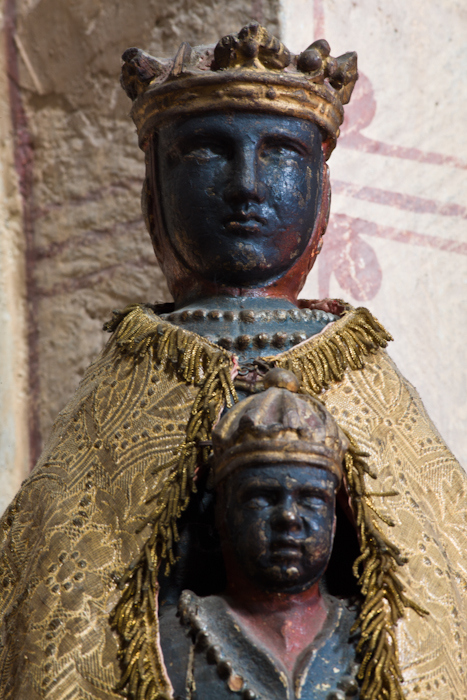
Crusader Madonna and Child courtesy of Via Lucis Photography (Dennis Aubrey and P.J. McKey)

Crusader Madonna and Child courtesy of Via Lucis Photography (Dennis Aubrey and P.J. McKey)How differently people of different times view life is masterfully illustrated by Dennis Aubrey’s post . .Dennis Aubrey’s post .

Dennis Aubrey’s post The Throne of Wisdom demonstrates how peoples’ views of life are shaped by their times in history.

During the Crusades, Mary and the Jesus of the Gospels become the authorization for killing Muslims. The executed Jesus of Nazareth becomes the Knight Templar, angrily taking up the sword against the unbelievers. Mary, the iconic “Mother of God” of Catholic and Orthodox Christian veneration, is turned into the Mother of Christian Jihad.

Pictured below is an altogether different Madonna  (12th Century from Notre Dame de Vauclair, Église de Molompize, Molompize [Cantal] Photo by Dennis Aubrey) who seems to be looking with horror at what is happening.

Notre Dame de Vauclair, Église de Molompize, Molompize (Cantal) Photo by Dennis Aubrey

Notre Dame de Vauclair, Église de Molompize, Molompize (Cantal) Photo by Dennis Aubrey

There is a great struggle today over which Madonna to enthrone.  Our Lady of the Crusades is back. For example, click HERE for Sen. Tom Cotton, author of the letter to Iran signed by 47 U.S. Senators, interviewed by CBS host Bob Schieffer on Face the Nation.

Thanks to Dennis and P.J. for prompting this post. When we look carefully at where we come from, we sometimes see the darkness today in the clearer light.


Visual Poetry

Image

Steve flies kites all night when the weather is just right. Last night the kite was poetry in motion over the Illinois prairie. Photo by Steve Shoemaker, Urbana, IL, March 16, 2015.

Visual poetry

Visual poetry


Their Blood Runs in Mine

Our friend Dennis Aubrey posted “The Destruction of History” today on Via Lucis, lamenting the latest in the sordid history of religion destroying history and art.

Dennis Aubrey and P.J. McKey love beauty, history, and the religious architecture of Gothic and Romanesque churches they photograph in Europe. Sometimes, like today, they express a profound despair over the destruction done in the name of religion.

“Now we have word that ISIS has defaced and destroyed artifacts in Mosul, including Assyrian statues of winged bulls from the Mesopotamian cities of Ninevah and Nimrud. Video released by the newest barbarians to assault the cultural history of humanity shows a man using a power drill to deface the works.

“As so often throughout history, the excuse was religion. ‘The Prophet ordered us to get rid of statues and relics, and his companions did the same when they conquered countries after him.’  How many times in our work at Via Lucis have we read variations of these words from Catholics, Huguenots, Calvinists, revolutionaries, counter-revolutionaries, and military leaders?”

Years ago during a sabbatical in St. Andrews, Scotland, the destruction wrought there by my Scottish reformation forebear John Knox and his followers chilled my soul. The people who bred and raised me – Presbyterians of Scottish descent and religious sentiment – did this. They took the commandment to have no other gods as license to destroy, maim, and burn church art and heretics. Their blood runs in mine. Their DNA is mine. And, if confession has any meaning or merit whatsoever, the children of such crimes must say we’re sorry. Really sorry. Repentant. No more destruction. No more following the orders of bully prophets, no matter whose name they claim to honor.

Thank you, Dennis, for your post. On behalf of my ancestors and in the spirit of spirituality of beauty, love, and peace on the other side of destruction, thank you for your artist’s eyes. Thank you for your courage. Thank you for the hope in something better in a barbaric time.

– Rev. Gordon C. Stewart, Presbyterian minister Honorably Retired, Chaska, MN, March 4, 2015.

Église Abbatiale Saint-Jouin-de-Marnes (Dennis Aubrey)

Via Lucis Photography of Religious Architecture is a Views from the Edge favorite because of its ability to synthesize art, history, theology, and social commentary centering on the deeper things of the human spirit and the awe of Gothic and Romanesque architecture. In the midst of this post, Dennis Aubrey draws attention to the lion which appears to be spewing foliage. I proposed to Dennis that perhaps the lion is “eating straw like the ox” in Isaiah 11 and 65, Isaiah’s vision of the peaceable kingdom, an interpretation that seems to go well with the church’s sculptural rendering Jesus’ Parable of the Last Judgment in Matthew 25.

Église Abbatiale Saint-Jouin-de-Marnes’s Last Judgment scene suggests an artistic interpretation that eliminates the divide between sheep (saved) and goats (damned), a pictorial witness to the final judgment as universal forgiveness and salvation. To enjoy the original, complete with photographs, scroll down and click on “View the Original”.

Dennis Aubrey's avatar

The church of Saint Jouin de Marnes is known as the Vézelay Poitevin, a tribute to its importance and beauty. It was named after a 4th century hermit named Jovinus from Mouterre-Silly near Loudun. Desiring a retired, contemplative life, he settled on a site of a Roman camp near the road from Poitiers to Angers, ten miles southwest of Mouterre-Silly. The site was called Ension and was in the swamps of the river Dives which flows two miles to the east. In 342 he founded an oratory church which attracted a modest religious community. By the time he died in 370, Jovinus had achieved a great reputation for sanctity and miracles. Over the years, his small community grew in importance, but eventually there was another decline.

In 843, however, the monks of Saint-Martin-de-Vertou in Brittany were forced to abandon their monastery by depredations of the Vikings. With the help…

View original post 968 more words