Non-verbal Communication: Cain looking at us

Cain and Abel – the mythical story of the first two children of humanity – in the Book of Genesis (Genesis 4:1-16) is about something that never happened way back when but about what is always happening with us: the inexplicable violence to which humankind turns against itself. It’s about the yawning abyss of violence into which we plunge when we can’t make sense out of life or when things don’t go our way.

Yesterday’s brief post on Via Lucis Photography of Religious Architecture focuses on a capital of Cain and Abel in a Romanesque church.
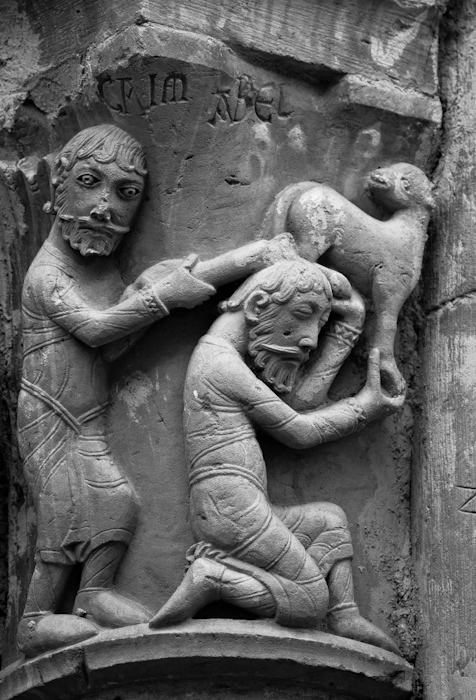
Photograph by Dennis Aubrey of Via Lucis Photography of Religious Architecture

Photograph by Dennis Aubrey of Via Lucis Photography of Religious Architecture

Like the Genesis writer, the Medieval artist whose hand crafted the story in stone many centuries later was doing theology and anthropology. The biblical author told the story with words; the Medieval sculptor told it with non-verbal communication.

The face of Cain on Via Lucis held my attention long after I’d gone on with the day. It kept returning to mind.

Cain’s head isn’t turned toward Abel whom he is pummeling to death with his stave. He’s looking away from Cain at someone or something else, as if to say the viewer, “So, you think I’m cruel. You think I’m different. You’re looking in the mirror.”

In the biblical story God tells Cain, “sin is crouching at the door; its desire is for you, but you must master it.” The Medieval sculptor’s art seems to be saying it in stone. Cain’s head is cocked, his eyes looking at us. At you. At me.  And, perhaps, at God, to whose failure to rescue Abel he shifts responsibility: “Am I my brother’s keeper?”  The capital seems to say Cain knows he owns us and the endless history of violence in which the blood of the silent victims cries out from the ground, unless and until we – persons, groups, religions, races, cultures, nations, a species – master the sin that’s forever crouching at our door.

  • Gordon C. Stewart, Chaska, MN, October 16, 2015


The Mason of God (Dennis Aubrey)

Dennis Aubrey's avatar

In a world where what passes for news are articles about the megalomaniac Donald Trump, the Kardashians, and the Jenners, we occasionally find something worth consideration.

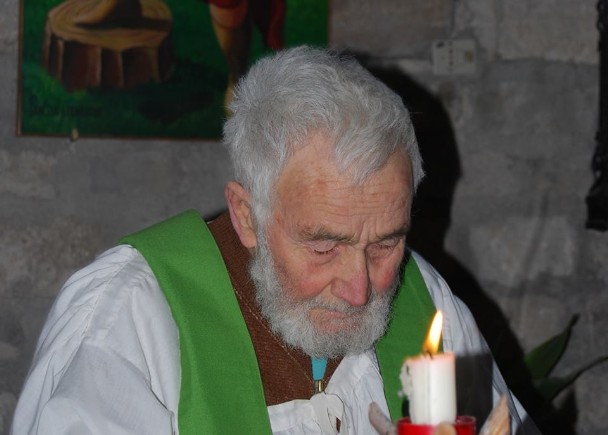
On August 25 a funeral mass was celebrated in the Italian town of Montefortino at the chiesa della Madonna dell’Ambro. The recipient of the mass was a Capuchin friar, Padre Pietro Lavini who lived as a hermit in the Sibylline Mountains near Rubbiano Montefortino and along the Gola dell’Infernaccio, the Gorge of Hell. A thousand people attended the service of the man who died two weeks prior, on August 9, 2015.

Why did they come to this mass? What did Padre Pietro accomplish with his life as a hermit?

Padre Pietro Lavini, photo from Santuario Madonna dell'Ambro Padre Pietro Lavini, photo from Santuario Madonna dell’Ambro

In 1971, Padre Pietro discovered the ruins of the Eremo di Santo Leonardo, an abandoned 12th century Benedictine monastery in the wilds of the Sibyllines. All…

View original post 251 more words

Simplicity

Leonard Bernstein’s “Simple Song” from the Bernstein Mass describes the kind of purity of heart of which Jesus speaks in the Sermon on the Mount. It is a simplicity in accord with Views from the Edge‘s earlier post “America – In Search of Wisdom“: a singleness of heart that refuses double-minded or dualistic thinking and practice. “God is the simplest of all.”

A tenor soloist from the Knox Choir sang it at the 1983 worship service that officially installed me to the office of Senior Minister of Knox Presbyterian Church in Cincinnati, which blessed me with its music for 11 years. The song, the soloist, and Knox Church will remain with me always.

  • Gordon C. Stewart, Chaska, MN, August 16, 2015.


Verse on Burning Man

Verse — Remembering Burning Man
After a Year at age 72

Experience it, don’t observe it.
Participate, give gifts to others–
nothing is for sale. An empty desert
is the frame, the canvas, the gallery–
see art appear out of the blowing
Nevada playa dust. Huge temporary
sculptures, many that will blaze with flames
to the skies, paid for by previous fees
to attend, and gifts of time, and effort.

70,000 people last year brought costumes,
creativity, music, dancing, humor (yes,
alcohol & other drugs), but although
there were over 900 bars giving away
free shots and cocktails & wine & beer,
I saw no fights, no violence, no sexual
harassment. Art cars glide slowly past–
a huge dragon breathing flames
with 50 folks on board,
An Amish horse and buggy
powered by solar batteries,
a bicycle rider pulling a wagon carrying
a sousaphone: he stops, plays, flames
shoot out the huge brass bell…

The week of Labor Day, every year
for the last 30. Some folks have gotten rich,
others spend more than they can afford
to buy entrance tickets, travel from around
the world, live in tents & ride bikes & walk
for hours in this modern garden of earthy
delights, or depravity–your choice.
A temporary utopia? or first-world narcissism?
Don’t analyze, dance with 4,000 souls
under the moon to the same song.
Hear others a mile away hearing you.

  • Steve Shoemaker, August 10, 2015

Verse – Lillian Weaver

Lillian Weaver’s
College Class

Her eyes would glint below grey hair,
she’d lift the book so we could see
the Fine Art illustration. Her
gold wedding ring was a ruby,
even though her spouse ran a bank.
“A diamond seems so cold,” she’d say.

The Matisse to her point she’d link:
her Bible lesson for Sunday.
We students would set our alarms,
and even though we’d stayed out late
the night before, her wit, her charms
with words, her humor, made us wait

impatiently for Sunday School.

– Steve Shoemaker, Urbana, IL, July 6, 2015

Verse – Last Request

Last request from an Illinois boy

I was born in Urbana on Orchard Street,
The hospital, Carle, was then quite small:
A three-story building of yellow brick,
The first of four brothers, and that was all.

My Mother was Char, my Dad was Bob
away at war, though a Pacifist he.
In ’42, to avoid the Draft,
He joined the SeaBees, the Navy

Guys who built the docks, airfields–
Alaska, even Hawaii.
After the war they lived in town
From house to house, till number three

Was 1306 South Orchard Street.
My happy high school years were there,
My first fast car, my first slow girl…
My friends were from the band or choir,

Although I grew to six foot eight
And stumbled playing basketball.
I started writing poems then:
Love yelps, or sonnets for the school

Assignments Mrs. Hewett gave.
Now decades past, I still will write
My last request in doggerel.
V-mails from Dad to Mom would cite

His love for us in poetry.
So if the cost is not too great,
Send me to die on Orchard Street.
Carle Hospital has grown to eight

Or ten or 12 facilities.
Perhaps they’ll have a room for me
To breathe my last in my home town.
Like poetry, it’s symmetry.

– Steve Shoemaker, Urbana, IL, June 29, 2015

Caricatures – the best we can do today

Steve and I have been left speechless recently, but the blogging must go on! Steve sent this email yesterday (subject line: I’m still not writing poems) and granted permission to publish in this dire emergency.

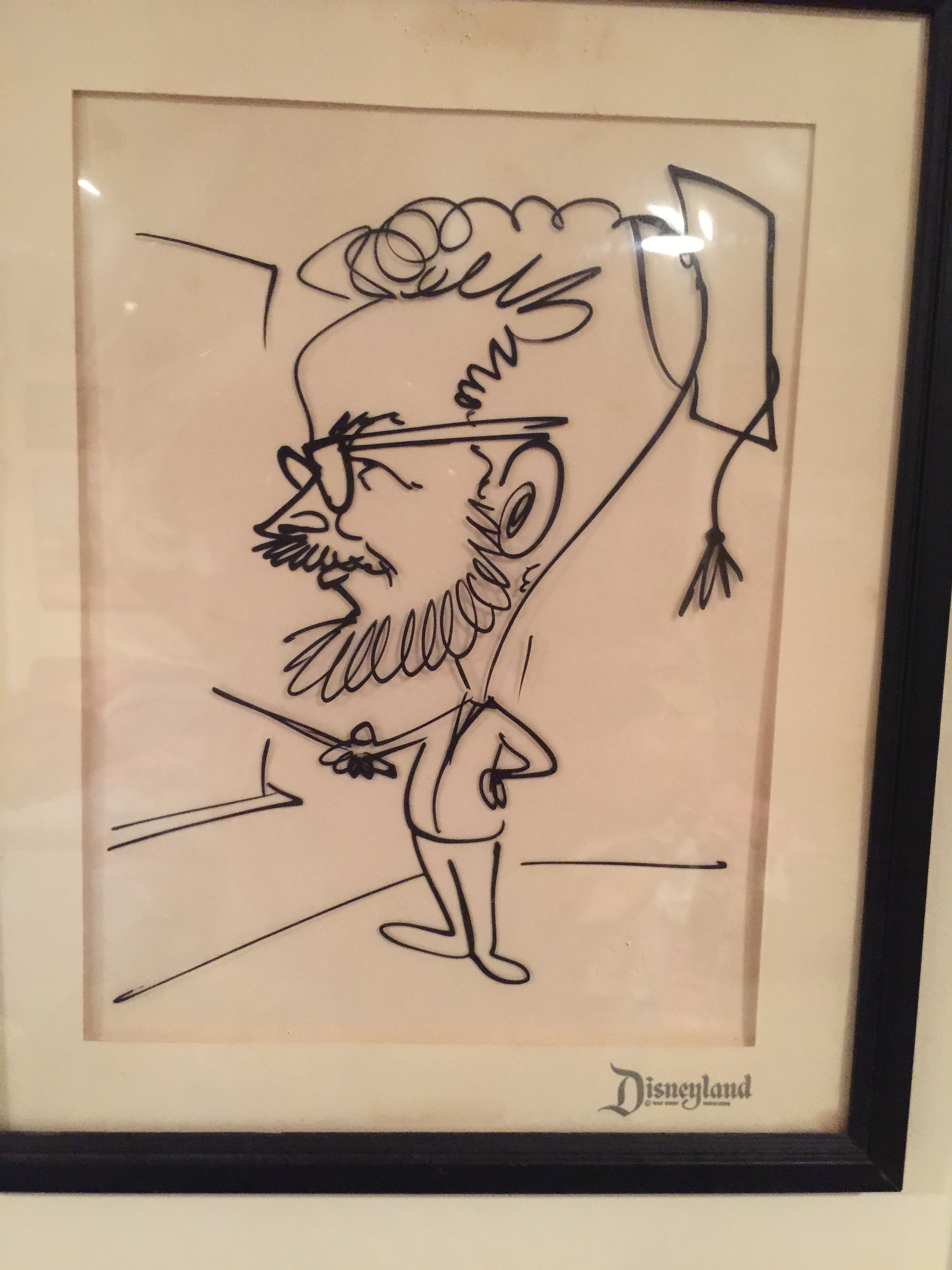
“When in Seminary in 1966, my spouse of one year and I drove to Disneyland. For maybe $5 each, a sidewalk artist drew us as “Research Scientist” (true), and “College Prof” (merely a dream). Although I finally received a Duke Ph.D., I had been a Presbyterian Pastor by then for 10 years, and that’s what I did for 30 more–with some college teaching on the side. Nevertheless, many years of learning & teaching.” – Steve

Nadja Shoemaker (research scientist)

Nadja Shoemaker (research scientist)

Steve Shoemaker caricature   (the professor)

Steve Shoemaker caricature (the professor)

The Punishment and Rescue of the Talkative

You’re reading a blog post. Blogging is talking. Sometimes it’s downright t-a-l-k-a-t-i-v-e. Chatty. Pointless. Silence is to be preferred to word pollution.

Two photographs in The Wood of Our Lady, Dennis Aubrey’s Via Lucis post, give reason to talk about talkativeness. Open the link and scroll down near the bottom to see two capitals: 1) two figures with their heads in their hands, weeping, and 2) what Dennis calls “The Punishment of the Talkative”.

The weeping figures of 12th century Église Notre-Dame-de-la-Nativité strike a chord of familiarity.  How many times a day does the news cause us to put our head in our hands in despair? But “the punishment of the talkative” capital evokes no such sympathy. It strikes us moderns as barbaric, the art of a Christian first-cousin of ISIL with grotesque figures excising the tongue of the talkative. Yet it served to remind the worshipers in the 12th century, as it still does in its startling way, that talkativeness is no virtue. Words are sacred. Dennis Aubrey puts it this way:

Perhaps the most famous capital represents the punishment of the talkative, presumably by excising the tongue with tongs. I don’t know if this condemns lying, calumny, or verbal abuse, or if it is a more generalized censure of chattiness or language in general. While this punishment somehow seems fitting for the slanderers who fill our public lives, I would prefer these thoughts of Voltaire, … les anges m’ont tué par leur silence. Le silence est le just chatiment des bavard. Je meurs, je suis mort. “The angels have killed me with their silence. Silence is the just punishment for the talkative. I’m dying. I’m dead.”

It was poet Kahlil Gibran, author of The Prophet, whose first published book (1918) was titled The Madman, who used words to say, “I have learned silence from the talkative, tolerative from the intolerant, and kindness from the unkind; yet strange, I am ungrateful to those teachers.”

Thank you, Dennis Aubrey and P.J. McKey for bringing the teachers to light.

– Gordon C. Stewart, Chaska, MN, April 20, 2015.

Our Lady of the Crusades Redux


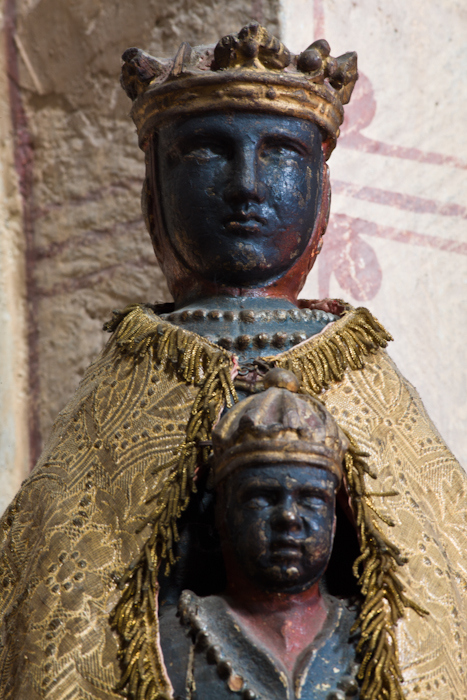
Crusader Madonna and Child courtesy of Via Lucis Photography (Dennis Aubrey and P.J. McKey)

Crusader Madonna and Child courtesy of Via Lucis Photography (Dennis Aubrey and P.J. McKey)How differently people of different times view life is masterfully illustrated by Dennis Aubrey’s post . .Dennis Aubrey’s post .

Dennis Aubrey’s post The Throne of Wisdom demonstrates how peoples’ views of life are shaped by their times in history.

During the Crusades, Mary and the Jesus of the Gospels become the authorization for killing Muslims. The executed Jesus of Nazareth becomes the Knight Templar, angrily taking up the sword against the unbelievers. Mary, the iconic “Mother of God” of Catholic and Orthodox Christian veneration, is turned into the Mother of Christian Jihad.

Pictured below is an altogether different Madonna  (12th Century from Notre Dame de Vauclair, Église de Molompize, Molompize [Cantal] Photo by Dennis Aubrey) who seems to be looking with horror at what is happening.

Notre Dame de Vauclair, Église de Molompize, Molompize (Cantal) Photo by Dennis Aubrey

Notre Dame de Vauclair, Église de Molompize, Molompize (Cantal) Photo by Dennis Aubrey

There is a great struggle today over which Madonna to enthrone.  Our Lady of the Crusades is back. For example, click HERE for Sen. Tom Cotton, author of the letter to Iran signed by 47 U.S. Senators, interviewed by CBS host Bob Schieffer on Face the Nation.

Thanks to Dennis and P.J. for prompting this post. When we look carefully at where we come from, we sometimes see the darkness today in the clearer light.


Visual Poetry

Image

Steve flies kites all night when the weather is just right. Last night the kite was poetry in motion over the Illinois prairie. Photo by Steve Shoemaker, Urbana, IL, March 16, 2015.

Visual poetry

Visual poetry