A Poem for Easter Morning

EASTER MORNING

(double acrostic)


Either Jesus really did rise or

All his followers made up the worst

Series of lies in history…  Poor

Thomas certainly was right to doubt

Even after hearing tales: what four

Reached the tomb (or five?)  Who saw him first?


Matthew says two women, Mark says three;

Or was it just one, as said by John?

Reports of what eye-witnesses can see

Never can be trusted.  Luke said one

In the road joined two who could not see–

Not until he broke the bread…  No one

Got the story straight! Conspiracy?


Even grade school kids could do as well.

And Luke throws in Peter saw him too–

Somewhere unreported…  Who could tell

That this jumble of accounts could do

Enough to give faith and hope to all.

Resurrection?  Who could think it true?


Maybe just the simple:  those whose eyes

Open to the light through grief, through tears…

Reminded of love, of truth, of grace…

Needing to be fed, hands out for bread…

Inspired by the scriptures, in whose head

Grow visions:  life can come from the dead.


-Steve Shoemaker, 2012

The Sin of “American Exceptionalism”

Last night I watched Mitt Romney at a campaign rally in my home town, Broomall, Pennsylvania. What I saw sent chills down my spine. Demagoguery was on display. The people from my home town applauded the scolding of American President for apologizing. No apology for the tragedy of an American soldier(s) walking into the homes of families in Afghanistan to kill. No apology for … well…for ANYTHING. America is the greatest country in the history of the world. We should make no apology, said Mr. Romney.

In light of that speech, I am reposting this piece first published in February. It’s Holy Saturday for me. The one who lay dead on this day was killed, without apology, by The Myth of Roman Exceptionalism. The Roman Empire is long gone. But the myth never goes away. Only the name of the nation changes. Here’s the piece:

Jacket of “My People Is the Enemy”

“The stairway smelled of piss….This [a tenement apartment in East Harlem] was to be my home.  I wondered, for a moment, why. Then I remembered that this is the sort of place in which most people live, in most of the world,  for most of the time. This or something worse. Then I was home.”  – William Stringfellow, My People Is the Enemy: An Autobiographical Polemic.

I’ve been holding my breath, wrestling with whether to speak aloud what I hear and see.

I’m a disciple of Jesus, a Christian, in the debt to the bold witness of the late William Stringfellow, lay theologian. I’m also a religious pluralist. I believe with Chief White Calf of the Blackfeet that there is not just one way, there are many sides to the mountain and many paths on which the Divine Mystery is experienced.

I have learned over the years to respect the multiplicity of ways different sides of the mountain experience the living God. I work hard to understand my Hindu, Buddhist, Muslim, and Jewish neighbors. I often experience these discussions as encounters with God whose vastness, like the ocean, is so much greater than any of the tea cups in which we hold a few drops of the sea.

I also know that some forms of religion are just plain nuts. The religion of Jim Jones whose followers drank the purple Kool Aid in shared suicide in the jungle of Guyana is only the most ludicrous example of why we need to join comedian Lewis Black’s raging objection to political distortions of the truth: “You can’t just make s—t up!” Religion represents the best and the worst of the human psyche (the Greek word for ‘soul’).

Joseph Campbell, among others, long ago opened the aperture on my theological camera. He helped me to see that what we are all dealing with, on all sides of the mountain, is myth, the human spirit’s uniquely creative meaning-making activity that expresses both the grandeur and the terror of finite experience. Myth is not the opposite of truth; it is the story that points us beyond ourselves to the transcendent and the eternal.

My way of looking at the world is shaped by a vast variety of voices. Among them are Fyodor Dostoevsky, Friedrich Nietzsche, Franz Kafka, Jean-Paul Sartre, Albert Camus and Dietrich Bonhoeffer, whose experiences of the horror of the absence of God caused them to poke their fingers in the eyes of prevailing religious traditions whose tidy moral worlds turn God into a cosmic sadist.

Any religion worth its salt in the 21st century has to pass through the existential protests of these thinkers and of the shrieks and cries that still echo across the world from Auschwitz and Buchenwald that poke holes in every theory of a morally ordered universe. The Garden of Eden was lost a long time ago and, in the wake of the closing of the gates to it, any religion has to take account of the human history that looks much more like the trail of tears paved by Cain’s slaying of Abel than like two innocent people in Paradise before the fall.

Yet there is a deep longing for something more tangible, more trustworthy than myth. Something one can touch, see, feel, smell – a story that is not a story but fact. The longing is strongest when we experience great uncertainty and insecurity.

With this perspective, I have been looking again at the fastest growing religion in America, Mormonism, and the Church of Jesus Christ of the Latter Day Saints (LDS).

My first experience with the Mormons came quite by accident thirty years ago. I was riding a bus in New York City on my way uptown to visit African-American theologian James Cone at Union Theological Seminary in Harlem when I noticed the sign “Mormon Visitation Center.”  Already stressed by an unfamiliar transit system and feeling quite alone, I decided to get off the bus and take the tour.

Unlike the streets outside that were filled with trash and lit by flashing neon signs, the Visitation Center was spick-and-span. Everything was in perfect order, complete with a hologram of a Mormon family in a tranquil woods sitting in a circle, listening to the white upper-middle-class family’s father sitting on a stump higher than the other members of the family, reading from the Book of Mormon to an enthralled wife and two perfect, obedient, happy children. The hologram elicited two responses. One was amazement. I had never seen or even heard of a hologram. The other was a sense of outrage at the perpetration of a promise that was, in short, nothing but a hologram, the illusionary projection of someone’s idea of Eden that would strike a chord with visitors who long for the lost woods of the Garden of Eden. It offered a world of perfection: orderly, tidy, white, rural – nothing like the urban world on the street outside – the antidote to the realities and complexities of life in New York City.

When I left the Mormon Visitation Center it never crossed my mind that the Mormon vision or mythology would become the fastest growing mythology in America in the 21st Century. I was relieved to get back on the bus on my way to Harlem.

I ask myself now why this is so. I look again at Mormon beliefs and practices to try to understand.

In Mormon teaching, the Garden of Eden was a historical place, and it was not in the Mesopotamian Valley by the Euphrates River, as in the original biblical myth of Genesis. It was in North America…in Missouri.

“According to Joseph Smith [Mormonism’s founder] the Garden of Eden was located in Jackson County, Missouri and following his expulsion from the Garden, Adam traveled northward to a place near modern-day Gallatin, Missouri. Mormon Apostle Orson Pratt stated that the name Adam-ondi-Ahman “is in the original language spoken by Adam, as revealed to the Prophet Joseph” (Journal of Discourses 18:343) – Bill McKeever, Mormon Research Ministry.

It is to this very spot of physical geography that Jesus will return at the Second Coming. None of this is in the realm of myth. It’s fact. You can go there to touch it and  walk on it, knowing that Adam was there long before you and that, after you have walked there, it will prove to be the epicenter of the universe, the very spot where Christ will return.

Why is the Mormon myth gaining such traction in America? And why would I break the code of silence, the well-advised reticence to those of us who share White Calf’s belief that the Divine Mystery is known differently on different sides of the mountain?

Some things are too important to leave unaddressed. The Mormon mythology is quintessentially American.

The myth that America is the center of transcendent goodness and power, the world’s epicenter, the original Garden of Eden and the place of Christ’s return, the people of “Manifest Destiny”, the one exception to the rising and falling of empires and nations, is losing its hold on us at home and abroad. We are losing our sense of innocence. Yet there lurks the nostalgia for the secure home provided by the illegitimate marriage of Jesus’ gospel of the Kingdom of God with America, “the City set upon a hill” of Jesus’ Sermon on the Mount and of John Winthrop’s sermon to English settlers on their voyage to the new world.

As Nietzsche knew, such gods don’t die easily, even when they’re already dead. When the town crier takes his lantern into the darkened town square at midnight crying “God is dead! God is dead!” in Nietzsche’s Thus Spake Zarathustra, the rest of the town regarded him as a madman. But it would be only a matter of time before the news would reach their ears.  It was the god of Western civilization that Nietzsche’s madman pronounced dead.

When something dear to us dies, especially when it is the prevailing religious myth of a nation about its own holiness and invulnerability, we become like starving people who continue to look in the same old bare cupboard for bread.

What better place to go than the reassurance that America is still the center – the ancestral home of a real man named Adam, who came complete with his own (now lost language, the special place to which Jesus (who visited the lost tribe of Israel in the Americas between his resurrection and bodily ascension into heaven) will return? When the Christian story the story is concretized to a finite, mortal place, it power as myth – pointing us beyond ourselves to the transcendent and the eternal – is not only lost but turned on its head.

There are many sides of the mountain, and it behooves all of us to approach people of different religious traditions with open ears and open minds. But approaching another’s religious beliefs respectfully does not require that we pretend not to see what we see or that we conclude that all religions are really the same or that one opinion is as good as another in the free market of religious truth claims. “You can’t just make stuff up!”

Let me say without hesitation that what I see in Mormonism is but the most exaggerated illustration of the idolization of the nation that includes so much of the American churches of whatever stripe where the nation is enshrined as God and where patriotism is the unspoken highest virtue with the cross wrapped in a flag.

The American wars of foreign intervention in Vietnam, Iraq, and Afghanistan could not have happened without this widespread faith in American goodness and exceptionalism. It is the cardinal sin that afflicts us across all denominational and religious lines. Whenever the Jesus executed by the Roman Empire becomes the Imperial King of a new empire, those who continue to hear the shrieks and cries of the world that suffers – and who continue to smell the piss on the stairway in the place we call “home”- are obliged to break the silence, violate the code, and get back on the bus to Harlem.

Mitt Romney: Never Aplogize…EVER

This afternoon I was surprised to learn that Mitt Romney campaigned yesterday in my home town, Broomall, Pennsylvania. Click HERE for the video and my quick “comment” posted on Unedited Politics. I now live in Minnesota.

“Good” Friday?

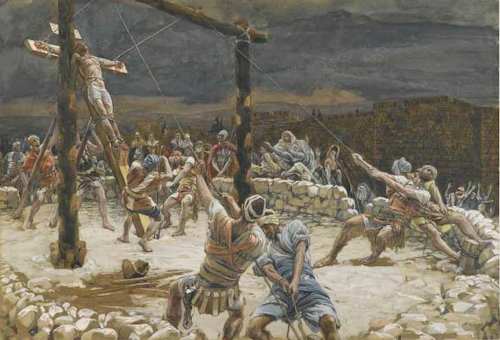
It’s Good Friday. Why would anyone call it “GOOD”? Today the Roman Empire executed Jesus. Beat him, stripped him, mocked him, jeered at him, hoisted him intot he air on cross, threw dice for the purple royal robe in which they had clothed him, pierced his side with a soldier’s spear, heard him cry from the cross, “Eloi, Eloi, lema sabachtani!” “My God, my God, why have you forsaken me!” Why would anyone in their right mind call this horror “GOOD”?

The raising of the cross - James Tissot

Sebastian Moore, O.B, speaks to this in The Crucified Jesus Is No Stranger (Seabury Press, 1977).

The meaning of the Christ-event is that in it the wrestle of man with his God-intended self is dramatized and led through the phases of rejection, hatred, crucifixion, destruction, surrender, new life. Oscar Wilde said, “each man kills the thing he loves.” Those who stop short of evil in themselves will never know what love is about. They will never receive the crucified. – p. 37

The human race thinks it can go on with all its Narcissistic human normalities, of war, of politics, of religion, and that somehow the vast other side of the picture will look after itself. So in opting for “himself as conscious”, man is opting for an ultimate solitude.

And ultimate solitude is death. It is to be cut off from the tree of life, and to wither. – pp. 69-70

For your further reflection, this poem received today from Steve Shoemaker.

Good Friday?

What makes this Friday Good is not what Rome

did to Jesus: torture, false witnesses,

and finally capital punishment.

In all regimes these standard practices

preserve the powerful, but then foment

disgust, infamy,  abroad– shame at home.

The dying one, the empty tomb was good

only if we are justified by trust,

mysteriously by God’s grace made whole.

The goodness cannot stay with us, it must

be passed on to the world–this is our role.

The Good is recalled in the feast:  soul food.

In a few moments I will host the Good Friday meditation – readings from the Gospels, long silences, the movements of Garbriel Faure’s Requiem…silence…reading… until it all soaks in.

I can’t get to Easter by by-passing the cross. Click  to hear the music.

Sojourners Today

This morning Sojourners chose to publish last Sunday’s sermon (posted yesterday on “Views from the Edge”) on it blog, “God’s Politics:  a Blog with Jim Wallis and Friends”. Click THE STONES ARE SINGING for the Sojourners post to read and hear it, “like” it (If you do :-)), post a comment,or send it to a friend by email.

Once again, special thanks to Dennis Aubrey and Via Lucis (click the link for today’s Good Friday photos) for permission to use his magnificent photographs and written description of his time in the Basilica of Mary Magdalene in Vezelay, France.

Reading Dennis’ words from the pulpit near the end of the sermon, I had to stop. It was as though years of trying to understand had come together into a single moment. When  the Gospel writer has Jesus respond to his critics with “I tell you, if these keep silent, the very stones will cry out,” he is quoting from the Scriptures of his Jewish faith – Ode against the Chaldeans in the Book of Habakkuk “The stone shall cry out from the wall, and the beam out of the framework shall answer it. Woe to him that builds a town with blood, and establishes a city by iniquity.” (Hab. 2:11-12)


The stones are singing

Sometimes things just seem to come together all of a sudden. This was one of those moments.

This sermon created itself when four texts converged. “But one of the soldiers pierced his side with a spear, and at once there came out blood and water” (Gospel of John 19:34).  “She has done a beautiful thing to me. … Truly, I say to you, wherever this gospel is preached in the whole world, what she has done will be told in memory of her” (Gospel of Matthew 26:10, 13). “I tell you, if these were silent, the very stones would cry out” (Gospel of Luke 19:40). And, last but by no means least, the piece that pulled them all together: “Elle Chante, Pere” (Dennis Aubrey, Via Lucis Photography), used with permission of Dennis Aubrey. Yesterday, Good Friday, Via Lucis re-posted the sermon. CLICK HERE for Denniis’s comments and those of others on Via Lucis.

Click the title to hear and see

 “THE STONES ARE SINGING

Albert Camus once said that your life is “the slow trek to recover the two or three simple images in whose presence [your] heart first moved.”

Sebastian Moore recovered one of those images after he had wandered into church at vespers on the Feast of the Sacred Heart.

In his book, The Inner Loneliness, he describes that moment of awakening. It came one evening after lots of pasta, a lot of spaghetti, and a lot of wine. “As I entered the church, I heard the familiar words [in Latin] ‘One of the soldiers opened his side with a spear, and immediately there came forth blood and water.’ And I had what can only describe as a sense of fullness of truth. Somehow, everything that was to be said about life and its renewing was in those words. Somehow my life, my destiny, was in those words.”

The image that moved his heart became one to which he returns daily, as do I. For the piercing of the side of the helpless man hanging on the cross happened not just then and there at Golgotha; it happens here and there and everywhere that torture own souls and the souls of others because we, or they, have failed to measure up to what we expected.  Strangely, it is in the piercing that brings blood that we are cleansed by the living water that pours from his side.

Do you see your life in the words and in the image of the spearing of his side, in the blood, but also the water that heals, restores and renews, flowing from his pierced side?

A second image came to me this week on a photography blog of religious architecture by Dennis Aubrey.

“There are sights impossible to forget,” writes a blogger I’ve been following, a photographer. His name is Dennis Aubrey. He takes magnificent photographs of great church architecture and accompanies his images with equally spell-binding words describing his experience sitting in those sacred spaces.

Dennis Aubrey tells the story of walking into a basilica. It’s the Basilica of the Magdalene – dedicated to Mary Magdalene, who is thought to be the woman in the Gospel stories who poured out the expensive ointment on Jesus and then wiped his feet with her hair. The scene for the photograph and the writing that describes his experience is the Basilica of Mary Magdalene in Vézelay, France.

”There are sights impossible to forget,” he writes, “the first glimpse of your child, or the look on the face of a your beloved at a moment of perfect happiness. My first sight of Vézelay[i] was such a moment of perfection for me, a small medieval town clustered on a steep hill with a single narrow road winding its way to the top of the rise where stands the Basilica of Mary Magdalene.

“To appreciate Vézelay is to watch sunlight move like a living thing across walls of stone, then suddenly create a vision of indescribable, aching beauty. It is to watch shadows deepen around a priest sitting solitary in a side chapel waiting patiently for a penitent to come for confession. It is to hear the songs of nuns echo off the vaulted ceiling and ring like bells in the human soul. David sang in the Psalms, ‘You, O Lord, will be my light; by you, my God, the dark will be made bright for me,’ and in Vézelay this is palpable.

“So many days PJ and I have brought camera equipment into the church and have seen and captured images that make me wonder if it is even us taking the pictures. It is enough to sit and watch and wait, and suddenly the shot appears, as if summoned by the Magdalene herself. It has never failed to occur, and I don’t imagine that it ever will. In September 2008, at the end of two full days of shooting in the church, I sat on the stone wall leading down to the crypt where Mary’s relics have been kept for so long, venerated by so many. The originals were destroyed in the paroxysm of the French Revolution, but new ones have been placed in this crypt and are visited to this day. I was quiet and trying to remain inconspicuous because the priest was in the side chapel of Saint Teresa of Ávila hearing confession. Every once in a while, a young man or an elderly woman would come and sit next to him on a small wooden stool. With heads huddled together they would murmur quiet words of repentance and forgiveness. At the end, a sign of blessing and then footsteps echoed on the flagstones. It seemed to me, sitting near, the church was silent and reverent, fulfilling its very purpose even if it was only a single person seeking the expiation of sins.

“In this silence, a new thought entered my consciousness, something never expressed before. With this thought came a tumult of emotions, a release of waves of images and thoughts and feelings. I suddenly understood the need for God; even if I did not acknowledge that need for myself, I knew with certainty that it existed. It was a terrifying moment, unsettling and disturbing. I struggled to lock this transient understanding firmly in my mind so as not to forget, so that it did not turn into a mere anecdote. After some time a sound entered my consciousness, emanating from the pillars, the walls, arches, from the blocks
of granite themselves. I don’t know how long I sat there, rapt, listening, as the flow coursed through me in a flood that grew in intensity. And all the while, this faint sound of music.

“Eventually, I became aware of being watched, of not being alone in my thoughts. I turned to see a strong young priest standing next to me, with a small and knowing smile.

“’Elle chante, Pere,’ I said, ‘elle chante aujourd ’hui‘(‘She sings, Father, she sings today.’) His smile broadened, he nodded, and he went off down the aisle, leaving me with my thoughts. And on this day, Magdalene was singing, her very stones ringing with song.”

On this day – on the way to his death –  when they told him to silence his disciples, Jesus replied, “I tell you, if these were silent, the very stones will sing out” – and they still do!


[i} After Note: A bit of history from Dennis Aubrey: “On Easter Sunday 1146, on the great open hillside to the north of the basilica, Saint Bernard of Clairvaux preached the Second Crusade to an enormous multitude gathered to hear him — King Louis VII, princes and peasants, clergy and laity. A few years later, two kings, Phillipe Augustus of France and Richard the Lion-hearted of England, assembled their forces here to begin the Third Crusade.

“Vézelay was also the site of a violent century-long social and political struggle among several parties — the monks and abbots of the abbey of Vézelay, the great abbots of Cluny, the Count of Nevers, and the merchants of Vézelay. The disputes over control of the fees and the rights of the various parties escalated to such heights that in 1106 the Abbot Artaud of Vézelay was murdered by townspeople. Three popes and two French kings tried to mediate a settlement, but the forces of history were in opposition, not just the rights of the nobility, the Church, or an emerging mercantile class.

“Eventually the power of the abbey waned, the legitimacy of the relics of Mary Magdalene was disputed by monks in Provence, and a pope eventually denied their authenticity. The pilgrims stopped visiting and the economy suffered. With the Renaissance, things human replaced things divine, and Vézelay sank into oblivion, a silent monument to the glories of the Romanesque revival in France.”

MLK Assassination: A Memory

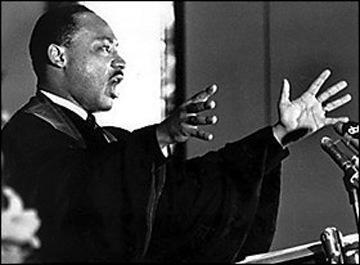
The Rev. Dr. Martin Luther King, Jr.

Forty-four years ago today the Rev. Dr. Martin Luther King, Jr. was assassinated in Memphis, Tennessee. Read this morning’s Washington Post story.I was with about 200 teenagers from “the projects” in Decatur, Illinois when the news broke. First Presbyterian Church and the Office of Economic Opportunity had partnered to create a youth program at the church. Charles Johnson, a former Blackstone Ranger from Chicago, and I (the 29-year-old Assistant Pastor) jointly administered the program.

We were in the church basement when the voice rang out from the steps, “Dr. King’s been shot! Dr. King’s been shot!” The room was filled with shock and anger. Some of the kids preferred Malcolm X to Dr. King, but on that night it didn’t matter. The room was united, overwhelmed by tragedy, another violent act of racial hatred.

Dr. King’s assassination came two months after the release of the report of the President’s National Advisory Commission on Civil Disorders (the “Kerner Commission”) that had concluded:

Our nation Is moving toward two societies, one black, one white—separate and unequal.”

The conclusion of the Kerner Report about police violence had been demonstrated on the church parking lot two weeks before Dr. King’s assassination. On that night Decatur police officers, without warning, had stormed into the crowd of black kids in the church parking lot at the end of the evening program. They came waving billy clubs and spraying mace. I was there. I saw it. Forty store windows in downtown Decatur were broken out that night. A number of the kids were arrested.

While the Decatur Chief of Police and I squared off with our different accounts of the events on the front page of The Decatur Herald, the board of First Presbyterian Church, which included a prominent sitting Judge, stood united and firm. We would not close the program, as the Chief was demanding.

First Presbyterian Church, Decatur, IL

When the voice announced that Dr. King had been shot, the adult leaders of the program had reason to fear the worst. Quickly we rounded up tape recorders. We made an announcement inviting the kids into smaller circles, spread out throughout the church building, that would give each and all of them time to talk.  We announced that, in light of what had happened two weeks before, we wanted their voices to be heard by the Chief, the Mayor, and the members of the Decatur City Council. We were all outraged; the feelings needed to be spoken and shared.There was no violence in Decatur that night. There was no riot.

The tapes were edited and played for the city officials.

The program continued without further interruption.

The Spirit of Martin Luther King, Jr. prevailed. And it still does.

Doubting Thomas

Thomas “the doubter” – Thomas “the Twin” – is my favorite Apostle. He is I. I am he.

Why do I love Thomas?  He’s slow to believe. There are many doubts, too much conflicting evidence that begs the questions. The questions come easily. The answers come harder and are few. “Unless I see the nail prints in his hands and place my own hand where the soldier’s sword had pierced his side,” said Thomas to the too credulous others in the Upper Room, “I will not believe.”

This Holy Thursday “I believe. Lord, help my unbelief.”

Poem “THOMAS THE TWIN” – Steve Shoemaker, Urbana, IL, April 4, 2012

To be a twin is to prove every day

How seeing is not believing.  And so,

Of course, I doubted when my friends would say

Many had seen the Lord.  I said, “If so,

A finger in his nail-pierced hand or where

Sword cut his side will prove he lives for sure.”

Then Jesus came into the room and said

He would let me touch him!  My doubt then was

Overcome by his presence.  And he said

Many would be blessed who believed he was

Alive without the benefit of sight…

Seeing may not lead us into the light.

Tonight, Holy Thursday, at 7:00 p.m. Shepherd of the Hill we will gather around the Lord’s Table. Ruth Janousek has drawn us at the Table.

God's Table at Shepherd of the Hill

God's Table at Shepherd of the Hill

Following the simplest Service of Holy Communion, the church will be darkened, lit only by candles held by individual worshiper representing the light of faith. As the Gospel narratives are read aloud … with long silences between them…the candles will be blown out, one by one, as the worshipers recognize ourselves in the story of the betrayal, denial, and flight of the Jesus’ closest friends and followers. It’s an ancient service called Tenebrae, the service of light and shadow.  By the end of the readings, the room will be dark. The only light will be from the Christ candle – the light of God’s faithful mercy and grace that cannot be extinguished.

Next up: IRAN?

Gordon C. Stewart, April 3, 2012

So…Iran is next. First Afghanistan. Then Iraq. Now Iran… where does it stop?

I feel helpless, like a parent watching a hopped up teenager taking the car. I know I’m not alone.

This afternoon an email invites me to add my name to a statement and show up at the State Capitol in Saint Paul on April 24.  Here’s the email:

In 2008, over 50 Minnesota politicians and religious leaders signed a statement opposing U.S. military action against Iran.  We held a press conference on the steps of the Capitol in St. Paul that generated articles around the world because of the presence of a  delegation of Middle Eastern journalists.

Unfortunately, four years later we are again faced with even more threats of attacks against Iran.

While politicians are pushing for military action, several prominent military leaders are encouraging caution.  The Chairman of the Joint Chief of Staff, General Martin Dempsey has said that, “It’s not prudent at this point to decide to attack Iran.  A strike at this time would be destabilizing and wouldn’t achieve long-term objectives.”  Secretary of Defense Leon Panetta has stated that Iran is NOT developing a nuclear weapon.  (Meet the Press, 1/08/12)

If Iran is attacked, Dempsey has said the results would destabilize not only that country, but the entire region.  Other analysts have written of the possibility of war on Iran escalating to a third world war.  However, Ron Burgess, the director of the Defense Intelligence Agency, told Congress that “the agency assesses Iran is unlikely to initiate or provoke a conflict.”

Yet the media continues to give more coverage to the politicians and pundits who are claiming that Iran is a grave threat to world peace and must be stopped.  The U.S. is just beginning to withdraw from the devastating wars in Iraq and Afghanistan – conflicts that destabilized those countries and cost hundreds of thousands of lives and trillions of dollars.

Minnesotans have spent nearly $5 billion to fund the Iraq and Afghan wars in 2011 alone, bringing total Minnesota taxpayer spending for these wars to more than $37 billion.  At a time of cutbacks for education, healthcare, jobs, and housing, we cannot afford another costly military adventure.

Please add your name to the list of Minnesota leaders who advocate diplomacy over military attacks as the way to deal with Iran.  We will hold a press conference at noon on Tuesday, April 24, as part of our campaign to work for a peaceful resolution.

Sponsored by:   Middle East Committee (WAMM), Middle East Peace Now ,  Minnesota Peace Project, Twin Cities Peace Campaign, Women Against Military Madness

I signed the statement. I’ll be there again on April 24. It’s Holy Week. My faith was born on a cross, the Roman state’s instrument of torture and execution during a military occupation. I’m a disciple of the crucified Jesus. How can I do anything else?


The House We Live In

Gordon C. Stewart, April 3, 2012

The economy is broken. While most of us have been holding our breath, some of us have been out buying the most expensive jewelry at Tiffany’s. Investor’s Business Daily reported that Tiffany’s profits rose by 56 percent during the 2nd Quarter of 2011.

‘Economics’ is about the house we all live in. We get the word from the Greek word oikos (household).   Economics (Oikonomia) is how we arrange things in the one household. They don’t teach that in MBA programs.

This is not an economy. It’s something else. It’s an anti-economy, the antithesis of one household in which all residents are housed, fed, secure, and peaceful.

Profit vs. loss is not a way to manage a household. It divides the members of the household into winners and losers, owners and renters, charitable givers and those who receive, or do not receive, the winners’ charity.

What we call the American economy is spiritually and morally bankrupt. It’s not just broken financially.  Warren Buffett’s proposal to increase taxes on those who can afford to shop at Tiffany’s only scratches the surface of the household problem.  One could argue that the system – free market capitalism – is working the way it’s set up to work. Or one could argue that it isn’t.

It all depends on what floor of the house one lives in.

Two percent of the rooms are in the penthouse. They’re very large, decorated by the best interior designers and decorators. The furnishings are custom-made.  Those who live in the penthouse have a private elevator to leave the for lunch at the country club or the yacht club.  Over lunch they discuss how to maximize their profits with more blue chip stocks or bonds and whether to leave the penthouse for a week, a month, a season in exotic places. They discuss their charitable giving, encouraging each other to give to their favorite causes. Sometimes, in the best of clubs and social circles, they argue vociferously, just like the rest of us, about the economy in the Greek sense, the oikos. They are not all of one mind.  Some belong to the  Buffett Fraternity, others to the Trump Circle, even if they wish “the Donald”  would be more subtle.

The other 98 percent of the rooms in the house are rentals of various sizes. Some very large, some modest, and some small.  Only a few of the tenants have long-term leases or the protections of rent control.  The most vulnerable of us live downstairs on the smallest rooms on the lower levels. A growing number of us have been forced into the cellar.

And the rest?  We watch “the Donald” to catch a glimpse of life in the penthouse. We watch our neighbors and family members move to smaller rooms or to the basement, fearing that we, too, will end up in the cellar, but hoping that someday we’ll win the lottery and move upstairs to the penthouse.

Meanwhile, the folks who own Tiffany’s are laughing all the way to the bank, confident that the 98% are too preoccupied to get what’s happening…right there under our noses in the one house where we live.

Economics 101: “The Earth is the Lord’s and the fullness thereof, the world and all who live in it” (Psalm 24:1). How, then, shall we re-arrange the one house? How will we Occupy it?