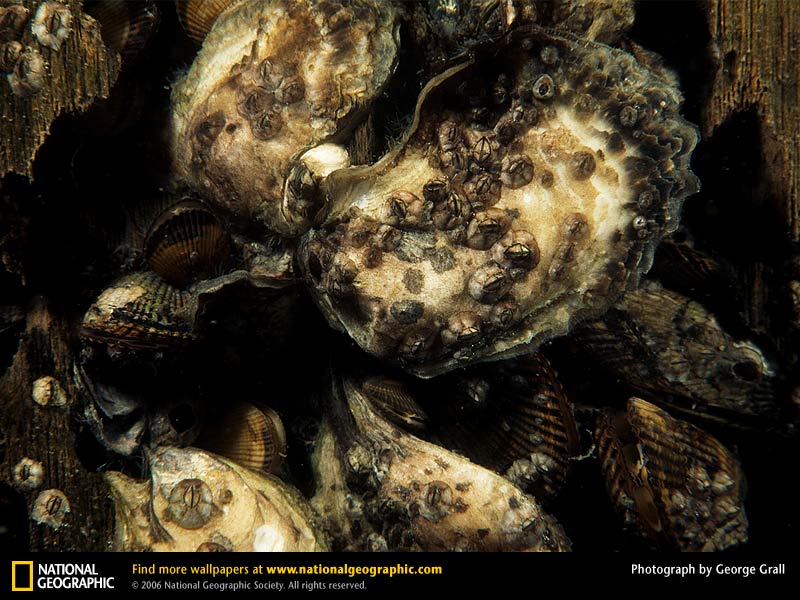
The World in an Oyster – an Earth Day reflection

Oysters

A COMMENTARY FOR EARTH DAY – Rev. Gordon C. Stewart | Friday, June 4, 2010 – published by MinnPost.comThe “spill” in the Gulf of Mexico raises the most basic questions about how we humans think of ourselves.

We’re at a turning point. The crisis we can’t seem to kill in the Gulf of Mexico puts before us the results of a more foundational crisis than the black goo that is choking the life out of the Gulf. The uncontrolled “blow-out” raises basic questions about how we think of ourselves and the order of nature.

Fifteen years ago I was with a group of pastors who spent four days with the Chesapeake Bay Foundation, whose mission is to protect and clean up the Chesapeake Bay. Our time there began with a day on the bay on a Skipjack, one of the last remaining motorless sailing vessels that used to harvest oysters by the tens and hundreds of bushels from oyster beds. The director of the Chesapeake Bay Foundation and an old waterman named Earl, who had worked the bay for 54 years, took us to school.

Back then the oyster population had shrunk to a fraction of 1 percent of what it used to be. Fifteen years before our visit the oyster population would filter all the water in the bay in three days’ time. A single oyster pumps five gallons of water through its filtration system every day.

The oysters were close to extinction; the bay’s natural filtering system was in danger. “It’s humans who’ve done this,” said the old waterman. “They’ll come back; I have to believe they’ll come back.”

Others were less hopeful. The Maryland Department of Natural Resources discussed the damage to the wetlands and the estuaries, the seedbeds of life. It had sounded the alarm for public action to protect the birthplaces of all the seafood we eat, the places on which the whole chain of life depends.

Deepwater Horizon fire

This week we heard from the Gulf of Mexico that the attempted “top kill” has failed and that the “spill” is spreading in every direction — not only on the surface, but below the surface — a glob the size of the state of Texas. I think of Earl and his Skipjack as I see the poisoned oysters in the hands of Louisiana oystermen whose livelihood depends on clean Gulf waters. “It’s humans who have done this.”

But it’s not every human who has done this violence to the Gulf. It was not the indigenous people of North America, nor was it the Moken people (“the sea gypsies”) who, because they see themselves as part of nature, anticipated the 2004 Asian tsunami while the rest of the world was caught by surprise. It was a specific form of humanity known as Western culture that sees humankind as the conqueror of nature.

Our language is not the language of cooperation with nature. “And God said, ‘… fill the earth and subdue; and have dominion over the fish of the sea and the birds of the air and over every creeping thing that creeps upon the earth’ ” — (Genesis 1:28), a conquering view based in the idea of species superiority expressed in the phrase “top kill” for the attempt to plug the hole that is killing the oysters and fish of the sea.

Insofar as interpreters of the Book of Genesis have shaped this Western hubris, my Judeo-Christian tradition bears responsibility for this crisis. The idea of human exceptionalism springs from the Bible itself.

But no sooner do I sink into confession and despair than I remember a prayer that Earl called to my attention on the Skipjack 15 years ago, the prayer of St. Basil from the third century that offers a more hopeful understanding of ourselves, a view like Moken people’s that knows that the whole world’s in an oyster:

“The Earth is the Lord’s and the fullness thereof. O God, enlarge within us the sense of kinship with all living things, our brothers and sisters the animals to whom You have given the Earth as their home in common with us. We remember with shame that in the past we have exercised the high dominion of man with ruthless cruelty, so that the voice of the Earth, which should have gone up to You in song, has been a groan of travail. May we realize that they live not for us alone, but for themselves and for You, and that they have the sweetness of life.”

 

News: 24/7

Author C.S. Lewis as a child before his mother's death.

Author C.S. Lewis as a child before his mother's death

“NEWS: 24/7” 

a poem by

Steve

Shoemaker

April 20, 2012

The writer, C.S. Lewis, said he never read the newspapers or owned a TV.  “If any-

thing important happens, someone will always say,”

he claimed. His house was filled with books. The life he led

began each day with prayer, with pen and a notebook,

food, teaching, more writing, then meeting friends for beer

and talk and laughter. 50 books of his appear

in 65 years on this earth. “Just take a look,”

he said, “I’m the last dinosaur you’ll ever see!”

His day of death was not reported on TV:

November 22, 1963.

JFK (R) with big brother Joe Kennedy

JFK with big brother Joe Kennedy

C.S. Lewis’s books have been translated into more than 30 languages and have sold millions of copies. The Chronicles of Narnia are the most popular. having been popularized on stage, TV, radio and film. His book A Grief Observed, an exceptionally honest reflection following the death of the love of his life, Joy Davidman, meant a great deal to me in dealing with my own raw grief. The film Shadowlands was based on A Grief Observed. Lewis was no stranger to the grief that shocked the world in Dallas November 22, 1963, the day he died without the notice he deserved.

 “…God’s demand for perfection need not discourage you in the least in your present attempts to be good, or even in your present failures. Each time you fall He will pick you up again. And He knows perfectly well that your own efforts are never going to bring you anywhere near perfection.”

– C.S. Lewis, Mere Christianity

Purple Martin Mansions

Purple Martin

Purple Martin

The early morning is cool and sunny. The walking trail has been shaded by huge oaks, elms, and ash trees, the path shimmering with light and shadow. I come out of the shadows and suddenly it is there: Purple Martin Place, 76 Purple Martin houses on poles reaching for the sky, each one labeled with a number. “ In my father’s house are many mansions” and a host of chirping Purple Martins flying out across the large open field.I remember the Benedictine morning mass at St. John’s Abbey where I had retreated on the hard walk to the end of my 33-year-old step-daughter Katherine’s terminal cancer. RIP.

From their Purple Martin Mansions

The Purple Martins swoon and swoop

O’er the green grass field shimmering

In early morning light cooled by the breeze


A Purple Martin chorus chants its antiphons

En masse above the green grass field,

A purple Benedictine chorus sings praise

To the morning on their way to breakfast.

–          June 1, 2011

Two Views from the Edge commenters found themselves singing the hymn “Morning Has Broken” after reading the poem. Click  to hear and watch a magnificent instrumental and photographic rendering of the hymn. Here’s the first stanza:

Morning hasd broken

Like the first morning,

Blackbird has spoken

Like the first bird.

Praise for the singing!

Praise for the morning!

Praise for them singing,

Fresh from the Word

– Gaelic melody; lyrics by Eleanor Farjeon, 1931

Escaping the Inner Prison

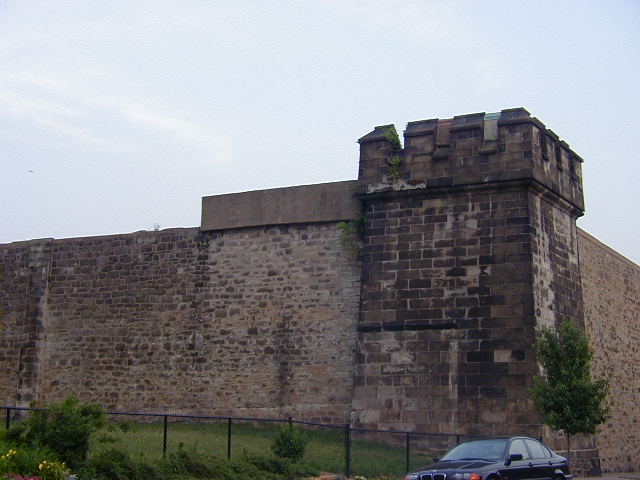
Corinthian Avenue Penitentiary, Philadelphia, PA

I once worked outside this prison as a street worker in North Philadelphia. Young gang members and I played “stickball” on the lawn outside the prison wall. I thought then that the prisoners were inside, and that the gang members were headed for the inside. The rest of us were free…on the outside. Now I see it differently.

We’re all in prison. Yet we’re free. We’re in the prison of deregulated corporate capitalism.We’re back in the Roman Empire, where Paul and Silas were thrown in prison because they dared to interfere with the free market. They freed a young slave-girl who had been put on the street corner as a fortune-teller. She lived on Main Street; all the money from her fortune-telling went to her slave owners on Wall Street.

By rescuing the slave-girl, Paul and Silas were challenging the morality of the prevailing economic system. So the folks from Wall Street seized them, dragged them “into the market place” before those in power and the judges — who were in the hip pocket of those who owned the marketplace and the market — beat them and threw them in prison for advocating “customs and practices” that were unlawful, according to law of the Roman empire. It’s all there in the New Testament Book of Acts. It was unlawful to be moral, unlawful to mess with the economy of a free market.

After beating them to a pulp, the judicial system ordered the jailer to lock them up in the most secure part of the prison — “the inner prison.” It’s always “the inner prison” — the one in our own hearts and heads — whose walls are the thickest. The people who challenge prison security are put in the “inner prison” — solitary confinement.
As Paul and Silas sang and prayed “at midnight” from their inner prisons and all the others were listening, there was a kind of earthquake that shook the foundations of the prison. All the prison doors swung open and everybody’s chains fell off! Everybody’s! And when the jailer woke up to what was happening and drew his sword to commit suicide, Paul and Silas declared that he, too, had been set free from the prison he had guarded.
In September-October 2008 an earthquake rocked the foundations of deregulated corporate capitalism. The earthquake, of their own making, shook the prison walls owned by the big investment brokerage houses and the big banks and AIG, and the inner cell doors had begun to swing open in the hearts and minds of the American people.
But instead of leaving the prison, we stayed in the “inner prison.” We rebuilt the prison, gave the keys back to Wall Street, and chose three square meals a day, a roof over our heads, some chump change for candy and cigarettes, numbed ourselves TV entertainment, and gave the slave-girl back to her owners so we could all dream about a different future. We rebuilt the Wall Street Prison.
What to do? For me, this is a matter of faith. I’m still an inmate of the Wall Street Prison, but my “inner prison” is free. I’m going to keep singing out loud at midnight about human freedom from the prison economy of a deregulated corporate free market that is anything but free. I’m going to walk out of that inner prison by taking my chump change out of the big banks that give $1,000,000 bonuses to the very people who foreclosed on the family of that slave-girl, and I’m transferring all it to the local credit union which belongs to the people. Then I’m going to invite everyone else to do the same.
I’m going to join Paul and Silas and song-writer Timothy Frantzich until everybody’s chains fall off and all the prison doors swing open.
Questions for comment and discussion:
  1. What is “the inner prison”?
  2. How does “the inner prison” work?
  3. Do you agree, in part or in whole, with the commentary?
  4. Where do you agree and disagree?

I’d love to hear from you. Others would, too. Thanks for coming by.

The First Supper

Steve Shoemaker, 4/18/12

Front gate, Ganghwa Anglican Church

With traitors, cowards, doubters he sat down,

he took the bread, gave thanks, passed it around…

With Adam, Eve, and Sarah, Abraham,

with David and Bathsheba:  sinners all.

With you and me, with the whole human family,

he shared the holy cup of salvation.

The water, flour and heat (bread):

his body broken.  Then his blood was shared:

the fruit of the vine, pressed down, runs over

the land–ocean, flood, eternal river…


Give thanks for grace, for love, for mystery.

(Jesus):  This do in remembrance of me.

Barabbas

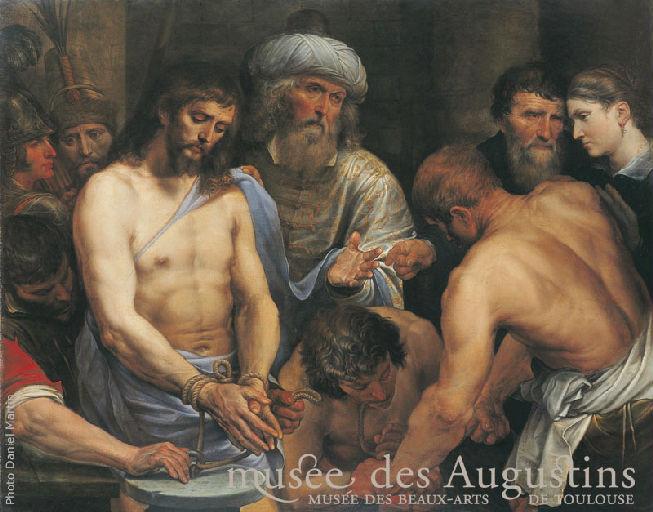
Release of Barabbas - artwork by Wenceslas Coehergher

Another acrostic poem by Steve Shoemaker, April 16, 2012, a reflection from the standpoint of Jesus Barabbas, the man released by Pilate. He is variously described as “among the rebels,” “a notorious prisoner, ” and a bandit/terrorist. Jesus of Nazareth is crucified. Jesus Barabbas is set free.

BARABBAS

Because my father was a Rabbi, when

Assassinations became part of our

Rebellion against Rome, my friends were then

Amazed that I would kill.  But victory

Belongs to us:  power yields only to power.

Being arrested, jailed, soon a martyr,

All will help the cause! Peaceful ways never

Save a soul.  Blood alone will set us free…

The desire for the society that is beyond up-and-down, oppressing-oppressed, haves-and-have-nots takes many forms.  Steve’s “Barabbas” is the son of a peaceful rabbi, a man of peace. Unlike his rabbi father, Barabbas knows that “Peaceful ways never save a soul. Blood alone will set us free.”

What do you think?

Ist Barabbas right that “Power only yields to power!”

Is violence – the taking of blood – necessary “to the cause”?

There are two Jesus figures in the story. One takes life; the other gives it.

How do you understand Steve’s last line?

Stone (Dennis Aubrey)

Stone (Dennis Aubrey) re-posted from Via Lucis: Photography of Religious Architecture (also on Views from the Edge blogroll).

Pontius Pilate

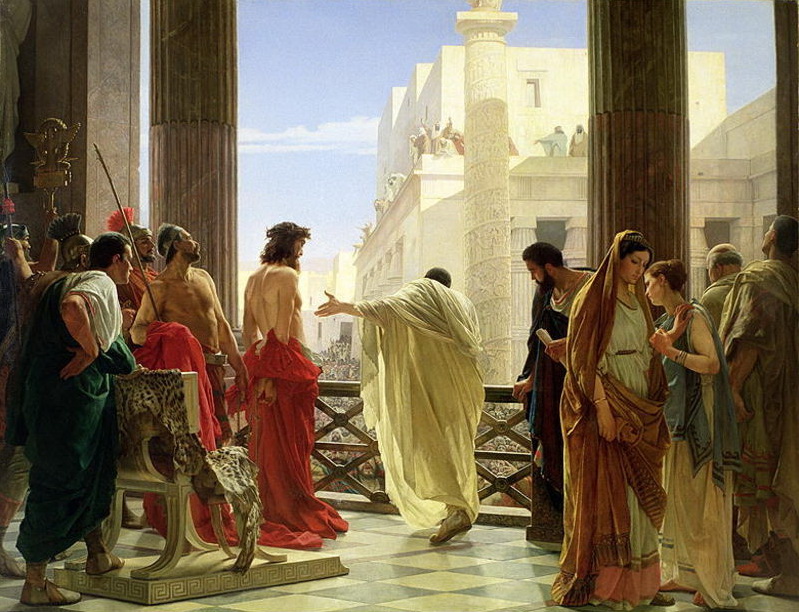
Pontius Pilate with his Prisoner - Antonio Ciseri

Ecce homo - "Here is the man"

“PONTIUS PILATE” – (acrostic) – Steve Shoemaker – April 14, 2012

Position is the most important thing,

Of course…   You say your reign is not in this

Nasty world, but here you are suffering…

Total power is mine.  If this grim choice

I make (and ignore my wife’s dream), nothing

Untoward will come back to haunt me!  I wash

Sand and dirt from my hands as I wash you…


Prefects are not required to be perfect.

If I send tax money to Rome, a few

Lies told against me soon will die.

A sect or uprising I stamp out now will do

The most to make my name remembered. Fact:

Even if I call you “King,” you die a Jew….

If you like Steve’s poem, you might also be interested in “You don’t get to have a non-Jewish Jesus” (CLICK HERE), posted earlier on Views from the Edge on Christian anti-Semitism.

Art work Ciseri, Antonio, 1821-1891. Ecce Homo – “Here is the Man”, from Art in the Christian Tradition, a project of the Vanderbilt Divinity Library, Nashville, TN.  http://diglib.library.vanderbilt.edu/act-imagelink.pl?RC=55115 [retrieved April 14, 2012].

DENIAL

Peter's denial

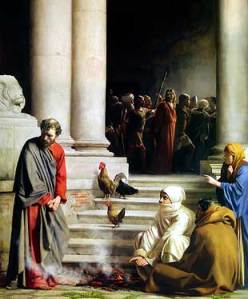
Peter's Denial by Carl Heinrich Bloch

Any faith worth its salt recognizes our capacity for denial, betrayal, and flight, as well as our capacity for truth, love, and courage. Steve Shoemaker’s poem about the Apostle Peter, “the Rock” who crumbled, takes us into the heart of the matter. It;s a reflection on Peter denying that he knew Jesus (represented by Carl Bloch’s painting where he looks away from the woman who claims he knows him) and the post-resurrection appearance where the resurrected Christ offers forgiveness.

“DENIAL” – Steve Shoemaker, 2012


The future Bishop began badly.  He

was “rude, crude and lewd,” as they say.

His fist would shake, would hit,

his mouth could often be a sneer, or leer…

but Jesus chose him first.


The fisherman was big and brash, yes,

bold as well at times.  But after the arrest

a servant girl confronted him and

told those listening that Peter was with Christ.

He swore and then denied it, then again

and still again–she would not stop.


The cry then came of rooster telling of the dawn,

and he wept because he had told a lie.

But Peter felt forgiveness full and deep

when Jesus three times told him,

“Feed my sheep.”

Peter “the Rock” was no rock. Nor are we. He was sinking sand. So are we.

Like “the future Bishop,” we slip badly and yet we are raised up. Betrayal, denial, flight are part of every human story. But grace… even more….so much more, abounds! And to the likes of Peter and of us, there comes to our three-fold denial the Voice of forgiveness with a gentle but bold command: “Re-gain your courage. Live in love!”

In the Strife of Truth with Falsehood

Get ready for the verbal assaults.The PAC ads. The disinformation and misinformation media campaigns funded by big money with big interests that know how powerful words are.

Words are POWERFUL! Sometimes those of us who stand in pulpits doubt that our words matter. But reading this paragraph in Timothy Egan’s NYT,Deconstructing a Demagogue,”reminds me of just how powerful words are:

Back in 1994, while plotting his takeover of the House, Gingrich circulated a memo on how to use words as a weapon. It was called “Language: A Key Mechanism of Control.” Republicans were advised to use certain words in describing opponents — sick, pathetic, lie, decay, failure, destroy. That was the year, of course, when Gingrich showed there was no floor to his descent into a dignity-free zone, equating Democratic Party values with the drowning of two young children by their mother, Susan Smith, in South Carolina.

Today, if you listen carefully to any Gingrich takedown, you’ll usually hear words from the control memo.

And that’s just the beginning of the story of how language is used and abused for purposes of social manipulation. Gingrich knew that language is “A Key Mechanism of Control.”  Those who are well-schooled in theology and politics know that language is the primary mechanism of mind control: truth becomes falsehood and falsehood becomes truth; beauty becomes ugliness and ugliness becomes beauty; goodness becomes evil and evil becomes goodness, twisted by the language of innuendo and word association.

The cynicism that pervades the American electorate is due, in part, to this demagogic use of language. Words are precious things. Holy things. Sacred things. When they get twisted, they become vulgar and profane, one might even say ‘demonic’ in the sense in which Paul Tillich defined ‘demonic’: the twisting of the good. “The claim of something finite to infinity or to divine greatness is the characteristic of the demonic” (Paul Tillich, “Life and It’s Ambiguities,” Systematic Theology, Vol. 1, p. 102).

Paul Tillich, “The Courage to Be”

Paul Tillich was one of the first university professors fired during the Third Reich in 1933. At the invitation of Reinhold Niebuhr, he came to America where he taught at Union Theological Seminary in the City of New York, Harvard Divinity School, and the University of Chicago. Tillich and his academic colleagues in theology, philosophy, and ethics (Willem Zuurdeeg, Martin Niemoller, Karl Barth, Dietrich Bonhoeffer, and Elie Wiesel) left us a rich legacy of linguistic analysis of the language of demagogic use of language.They speak with authority because they each paid a price for their opposition to it.

There are those who say that Hitler won his war after all. His ingenious use of language and rhetoric is the substance of Language: a Key Mechanism of Control. Newt Gingrich is not Adolf Hitler. And we are all well-advised to be very careful with contemporary references to him, the Third Reich, or the Holocaust. Yet the language that once led a nation regarded as “the most sophisticated culture” to swallow the toxin of twisted truth is with us still. The demonic poison how rules the day in America, peddled as cure and candy by candidates bought and sold by the private corporate powers whose PAC ads control the airwaves.

Words are sacred. And those who abuse them enter into the darkness of the demonic twistings that led James Russell Lowell to write the hymn lyrics I sang as a child:

Once to every man and nation Comes the moment to decide, In the strife of truth with falsehood…. Though the cause of evil prosper, Yet t’is truth alone is strong; Though her portion be the scaffold, And upon the throne be wrong;, Yet that scaffold sways the future, And, behind the dim

unknown, Standeth God within the shadows, Keeping watch above His own. – James Russell Lowell, 1945, “Once to Every Man and Nation”

The PAC ads are coming. Plug your ears…or…better yet, listen carefully, listen critically. Then speak out “in the strife of truth with falsehood.”